Politics
Marriage advocate to speak out for LGBT workers
Wolfson among speakers for Freedom to Work’s premier ‘Situation Room’
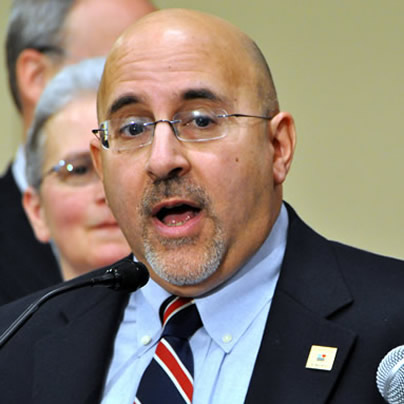
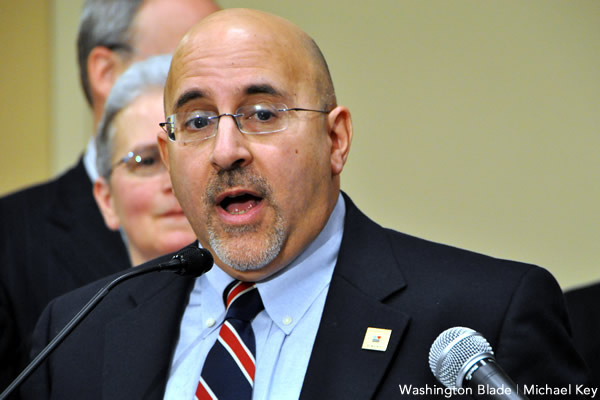
Freedom to Marry President Evan Wolfson is set to speak at Freedom to Work’s “Situation Room” (Washington Blade file photo by Michael Key)
A longtime LGBT advocate at the forefront of the movement to advance marriage equality may take a slightly different tune on Thursday when he’s set to speak out on ways to advance LGBT workplace non-discrimination protections.
Evan Wolfson, president of Freedom to Marry, is scheduled to be among the speakers at Freedom to Work’s premier “Situation Room” in New York City at New York Law School — the first in a series of public forums to strategize on the way forward for the Employment Non-Discrimination Act.
Wolfson told the Washington Blade he envisions that his participation will facilitate a discussion on the ways successes from the marriage equality movement can be applied to ENDA.
“It’s going to really be more of a conversation about what are some of the lessons that we applied from history and from other movements in the shaping our strategy and campaign to bring the freedom to marry to the United States, and how can we apply some of those in the work to end employment discrimination,” Wolfson said.
The cross-pollination of the marriage equality strategy to other movements isn’t new for Wolfson, who said he’s been asked by other campaigns — ranging from the environment to voting rights efforts — to talk about the ways in which marriage equality achievements can be applied to these initiatives.
Although he’s credited with being a founder of the marriage equality movement, Wolfson is no stranger to advocating on behalf of other LGBT causes. In 2000, he argued before the U.S. Supreme Court that a New Jersey law prohibiting the Boy Scouts of America from banning gay scouts was constitutional. The court ultimately ruled the other way.
Other LGBT causes in which Wolfson said he’s been involved are employment cases, work to abolish state sodomy laws as well as protections for people with HIV/AIDS.
“In all my years working in our movement, I’ve never really been a fan of pitting one so-called issue against the other,” Wolfson said. “To my mind, marriage has never been just about marriage. Marriage has been a powerful vocabulary of helping people understand who we are as LGBT people and to tap into their values of fairness and respect and help them move.”
After talking on this initial panel, Wolfson said he’ll speak out to aid LGBT workplace non-discrimination efforts “where it can be appropriate and helpful,” but added he has no immediate plans to do so.
“Obviously, my primary mission right now is continue leading the campaign to win the freedom to marry, and I want to finish the job, and we are not done,” Wolfson said.
Freedom to Work President Tico Almeida first announced the “Situation Room” in July as a way for groups working on federal workplace non-discrimination protections to lay out their contributions to the effort.
Wolfson is set to speak on a second panel as part of the “Situation Room” alongside Almeida in a session titled, “Lessons from Freedom to Marry for the Campaign to Win the Freedom to Work,” according to a statement from Freedom to Work.
Another panel earlier in the day is set to consist of Brad Sears, executive director of the Williams Institute at the University of California, Los Angeles, as well as two LGBT advocates representing both major political parties: Gregory Angelo, executive director of the National Log Cabin Republicans; and Melissa Sklarz, president of Stonewall Democrats of New York City.
In a statement, Almeida billed the “Situation Room” as a bipartisan event said it would help lead to victory for ENDA on the Senate floor, where a vote is expected to take place later this year.
“We’re honored to host a bipartisan group of leading experts and advocates for this first of a kind ENDA event,” Almeida said. “I’m confident we’re going to win a big Senate victory this year, and then ride that momentum into a robust campaign in the House of Representatives.”
The program, which is scheduled to begin Thursday at 2 pm, is set to be webcast live at the LGBT blog Towleroad.com. Moderating the first panel will be Towelroad legal editor and New York Law School professor Ari Ezra Waldman of New York Law School.
Almeida declined to comment on who’s set to moderate the second panel with Wolfson, but added additional speakers will be named later in the week.
A second ENDA “Situation Room” is planned later for Miami, which Almeida said will include Spanish-language content for Latino voters. Depending the timing of the ENDA Senate vote, similar events may place in Phoenix, Las Vegas and Philadelphia.
“Given where the undecided senators reside in states like Arizona, Nevada, and Florida, we believe Latino voters are a critical part of any winning ENDA coalition,” Almeida concluded.



Politics
Buttigieg indicates he may run for president in 2028
Former Transportation Secretary was in Biden-Harris administration’s Cabinet

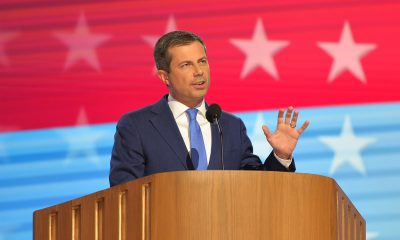
Former Transportation Secretary Pete Buttigieg told a podcaster he is considering throwing his hat in the ring for president once again.
“I don’t know,” Buttigieg told Steven Bartlett, the British host of The Diary of a CEO, the most popular top business and tech podcast on Spotify, which aired Monday. “I think I’m more inclined than not, but there’s so much we don’t know.”
“There’s so much I don’t even know about what’s going to happen this year, let alone … what we need to know later,” he added.
Buttigieg is no stranger to running for the Oval Office.
In 2019, the former South Bend, Ind., mayor was a serious contender in the Democratic primary for the 2020 presidential election but ultimately ended his campaign and endorsed Joe Biden.
In May, an Emerson College Polling survey found Buttigieg at the top of the list of potential presidential contenders, leading California Gov. Gavin Newsom, New York Congresswoman Alexandria Ocasio-Cortez, former Vice President Kamala Harris, and others.
In addition to discussing his future in federal politics, Buttigieg also discussed President Donald Trump’s handling of the Iran war — which reached its 5-month mark two weeks ago — the changing landscape of U.S. jobs due to the rise of artificial intelligence, and the growing national debt, all issues he could face if he ultimately returns to the White House.
Following his 2020 presidential campaign, Buttigieg gained prominence within the Democratic Party, eventually leading to his confirmation as Transportation Secretary. In February 2021, he became the first openly gay Cabinet member to be confirmed by the U.S. Senate.
In addition to his experience as an elected official, the 44-year-old served as a Navy intelligence officer in the reserves from 2009-2017, including a seven-month deployment to Afghanistan in 2014. Buttigieg came out as gay in 2015 and later married his husband, Chasten Glezman, in 2018. The couple now has two children: twins.
Buttigieg also has an extensive educational background.
He graduated from Harvard University with a bachelor’s degree in history and literature and later became a Rhodes Scholar, attending the University of Oxford, where he earned a bachelor’s degree in philosophy, politics, and economics.
This is not the first time Buttigieg has made headlines this year.
In June, he went public about being falsely accused of posing a threat to his children’s safety. An anonymous police report claimed he was a danger to his 4-year-old twins and was not allowed to be with them until after police interviews were conducted.
The police report was later determined to be false. The Washington Blade reached out to the Michigan State Police to ask what course of action, if any, would be taken against the woman who filed the false report, but the agency did not answer the question.
The Blade reached out to Buttigieg’s team for comment on his potential 2028 presidential bid, but did not hear back before publication.
Congress
House blocks effort to codify transgender servicemember ban into law
Lawmakers approved two anti-trans NDAA amendments

The U.S. House of Representatives on Tuesday rejected an amendment to the National Defense Authorization Act that would have codified a ban transgender servicemembers in the military.
The bipartisan vote was 212-217.
The NDAA is for the 2027 fiscal year and sets policies for the Defense Department programs and activities and the national security programs of the Department of Energy.
U.S. Rep. Lauren Boebert (R-Colo.) proposed the amendment on July 21. It stated that all personnel are required to serve in accordance with their biological sex, citing military readiness and discipline.
Human Rights Campaign Senior Director of Government Affairs Jennifer Pike Bailey stated that she is grateful for the bipartisan vote that rejected President Donald Trump and Defense Secretary Pete Hegseth’s “dangerous and discriminatory policy that has kicked brave transgender servicemembers out of the military and weakened our national security.”
“Everyone who meets the same rigorous standards should be able to serve their country. We should honor that patriotism, particularly in this moment where we are witnessing brave servicemembers making the ultimate sacrifice for our country, instead of ending their careers and politicizing their existence. We’re grateful that a permanent extension of this ban failed, and we will keep fighting to reverse this senseless policy,” Bailey said.
Mark Takano, chair of the Congressional Equality Caucus, stated that he and his members put in countless hours of work to kill the amendment.
“When Americans know they or their families are going to be targeted by or not supported by the military, that leads them to avoid signing up to serve or staying in the service — making it harder to keep the ranks of the armed services full and our nation safe. My colleagues in the Equality Caucus and I will continue working to prevent these attacks on our servicemembers and their families from becoming law,” Takano said.
According to the Congressional Equality Caucus, two other bills could potentially be passed that would also target the transgender community, both of which were proposed by U.S. Rep. Nancy Mace (R-S.C.).
The first was a bill that would have prohibited gender-related medical care under TRICARE and to prevent TRICARE from covering certain gender-related medical procedures and treatments, which was approved in a vote of 219-208.
The second was a bill that would have prohibited male participation in female sports at DoDEA schools. DoDEA schools are Department of Defense Dependents Schools, which is a network of primary and secondary schools.
The amendment was approved in a vote of 221-203.
Congress
Lindsey Graham has passed away. Do LGBTQ people have a right to celebrate his death?
SC senator opposed marriage equality, despite speculation over sexual orientation
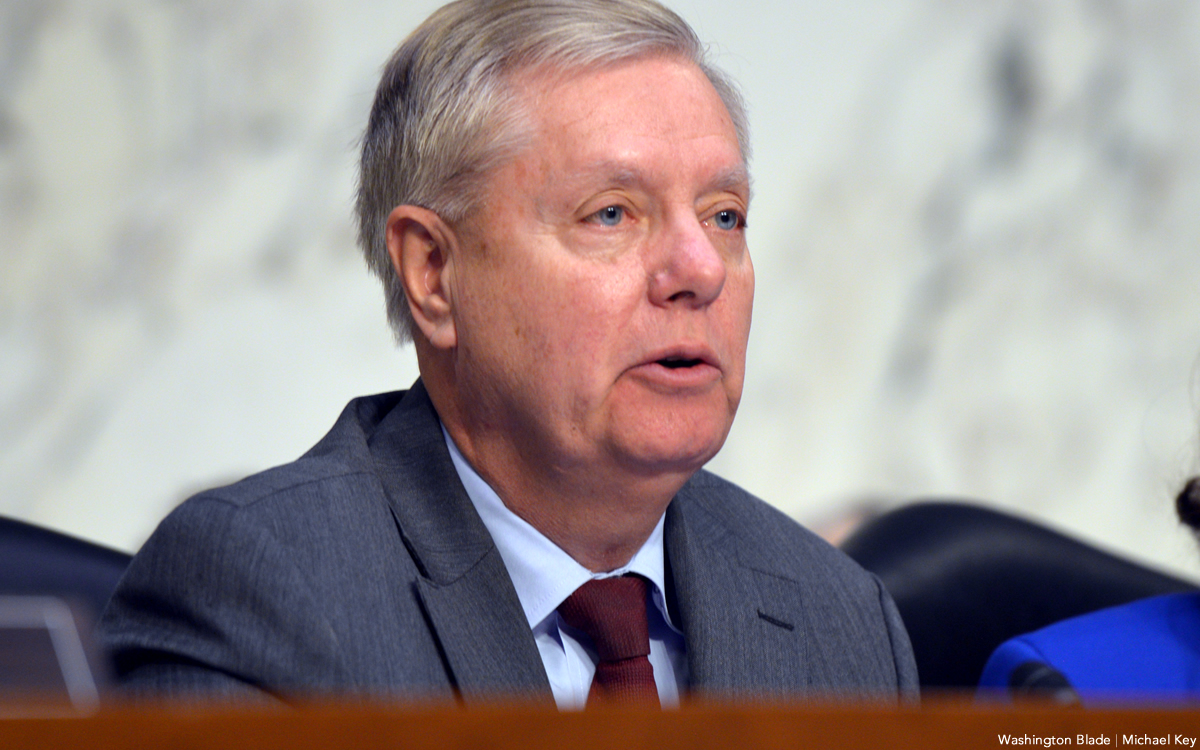
Uncloseted Media published this article on July 16.
By SPENCER MACNAUGHTON | On Sunday, the office of Lindsey Graham reported that the Republican senator and Trump ally from South Carolina died “from a brief and sudden illness.” The office said that the preliminary cause of death was a rupture of his aorta due to a hardening of his arteries.
Since then, many folks in the LGBTQ community, including a large number of Uncloseted followers, have — for better or worse — celebrated the senator’s death. When we posted the news on our Instagram page on Sunday, our followers commented:
- “Maybe he rest in hell”—this one got 194 likes.
- “She made sure to wait until Pride was over.”
- “And just like that the world is a better place.”
These responses are fueled by allegations that the senator lived as a closeted gay man while supporting policies that would roll back LGBTQ rights. In 2006, he voted in support of a constitutional amendment that would have restricted marriage to only being between one man and one woman. After gay marriage became legal across the U.S. in 2015, he said “I am a proud defender of traditional marriage.” And in 2022, he told CNN he would oppose the Respect for Marriage Act and later reiterated that states should decide the issue of marriage.
Outside the Washington rumor mill, there wasn’t much evidence that Graham could be gay until 2020, when adult video performer Sean Harding wrote on Twitter that “There is a homophobic republican senator who is no better than Trump who keeps passing legislation that is damaging to the lgbt and minority communities. Every sex worker I know has been hired by this man. Wondering if enough of us spoke out if that could get him out of office?”
Harding followed up with another post, writing “If you’d be willing to stand with me against LG please let me know,” and, “So far I have two individuals who would be willing to go public and support my claims. Anyone else?”
A few days later, another anonymous sex worker came forward and made similar allegations.
But after that, there was silence, with some believing these sex workers were slapped with non-disclosure agreements (NDAs). And while at least one lawyer took to Twitter saying that he’d “be more than happy to read the NDAs and look for loopholes. For free!” nobody else came forward.
That is until earlier this week, when author Jesse James Rose posted to her Instagram that Graham had paid her for sex work prior to her gender transition. Rose wrote that “Most of you know him as the homophobic senator from South Carolina but to me he will always be the man who paid a twinky pre-transition college student a fat stack of cash to do unspeakable things to him in a hotel room while he wore red lingerie.”
This dynamic has created a complicated question for LGBTQ people: Is it appropriate to posthumously celebrate the death of a man who railed against our community and used his position of power to make our lives less equitable and less safe? Is it even more fair to criticize him if he was living a secret queer life?
Or should we go high and give his track record on LGBTQ issues a positive spin now that he’s no longer with us?
In a time where social media feels like a breeding ground for angertainment, I’ll admit that the immediacy of the response to his death at first felt intense.
At the same time, I knew I didn’t want to send thoughts or prayers to a man who tried to rip my rights away.
If the alleged NDAs that Graham handed his sex workers were legitimate, they likely evaporated after his death. So now really may be the first time people can speak their truth and offer an accurate window into the absurd hypocrisy between Graham’s public and private life.
For that, I think it’s fair game to speak candidly about the story he may have worked hard to muzzle while he was here.

Perez Hilton’s live breakdown reveals social media mental health crisis

Mr. Henry’s to host 60th anniversary party

Calendar: August 7-13

Greg Araki still wants your sex

Insured on paper, excluded in practice

Reggie White relishing first season as artistic director of Woolly Mammoth

Madonna headlines World Pride Music Festival in Amsterdam

PHOTOS: Petal Release Party

My evening with Madonna