a&e features
Aretha’s triple whammy
Queen of Soul’s on a roll with great local concert, her best new album in years (and a book she wishes had never seen the light of day)
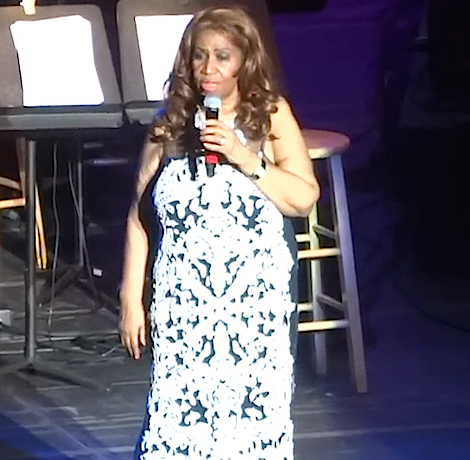
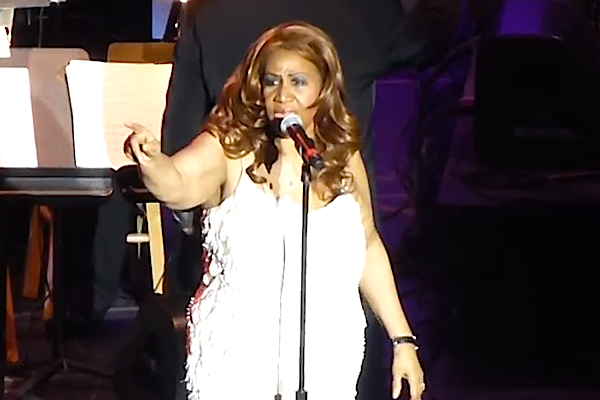
Aretha on stage in Baltimore on Nov. 13. (Screen capture from a YouTube video by Jim Brunzell)
It wouldn’t be an Aretha Franklin concert without at least one head-scratching oddity. For the legendary diva’s latest concert in our region — last Thursday’s show at the Lyric in Baltimore — she came up (sure ’nuff!) with a real winner: for no apparent reason, she sang the encore “The Way We Were” off stage.
For the first minute or so, I suspected it might be a recording and that she was simply too lazy to sing her encore live. If you’ve followed the Queen for any length of time, this notion is hardly outside the realm of possibility. Many others suspected the same as the approximately 98 percent-capacity crowd started pouring out of the theater in droves. But just as many were calling it a night, Franklin — still off stage — inserted a few geographically specific ad libs to the song. It was just another “WTF” moment in a legendary six-decade career (seven if you count her teenage gospel debut) that has been, especially in the last 15-odd years, as noted for its eccentricities and oddities as its music.
These quirks are not as random as they may seem at first glance. With Franklin, who’s actually a lot more predictable than is widely acknowledged, her musical genius — and it truly is genius — is pretty much proportionate inversely with her indulgences, eccentricities and career- and relationship-sabotaging whims. A lifetime in show business has her well informed on just how much she can get away with and how much she has to deliver to keep the world eating out of her hand.
She did return, for a few fleeting moments, to wave good night while her orchestra — in another baffling choice — closed the show with a rousing instrumental rendition of the old warhorse “There’s No Business Like Show Business.”
It’s actually a great time to be an Aretha fan. Late last month she released her best album since 1998 (there’ve only been a few) with the all-covers set “Aretha Franklin Sings the Great Diva Classics.” Galaxies better than the interminably delayed 2011 train wreck known as “Aretha: A Woman Falling Out of Love,” Franklin — a singer known for her way with covers throughout her career — tackles stalwarts like “I Will Survive,” “I’m Every Woman,” “Midnight Train to Georgia” and, most notably, Adele’s “Rolling in the Deep,” which she tore up in a live performance on “Late Show with David Letterman,” a performance that went viral in September.
But if last week’s Baltimore concert — more on that in a bit — and the new album are the first two pieces of a modern Aretha trifecta, the third is a controversial pork chop for the ages that will be discussed and debated for decades — no exaggeration — to come: David Ritz’s towering biography “Respect: the Life of Aretha Franklin,” which dropped just days after her album in October.
At first glance, it’s easy to prematurely dismiss the book as a character assassination of almost “Mommie Dearest” proportions (not quite, but almost). The backstory is delicious: Ritz, having co-written Franklin’s 1999 memoir “Aretha: From These Roots,” laments in the “Respect” intro that he wasn’t able to crack the famously private Franklin facade. The ’99 book, although still a priceless piece of Franklin history in many ways, is about as honest and forthright as its heavily airbrushed cover photo (Franklin’s wildly fluctuating weight has dogged her for years, yet the cover makes her look more like Iman than herself at the time).
“In my view,” Ritz writes in the new book, “my two years of working on ‘From These Roots’ resulted in my failure to actualize the great potential in Aretha’s narration. I didn’t do what I set out to do. Since the publication of the book some 15 years ago, I have not rested easy. It took me a decade to recommit myself to the Aretha story, knowing that this time around, I would have to fly solo.”
What results is a no-holds-barred dishfest that has had media outlets as far ranging as the Daily Mail and Gawker regurgitating its bitchiest passages (which are legion). From family fights with her sisters Carolyn and Erma (also both singers) to passive-aggressive intransigence and egotism gone mad working with collaborators such as Luther Vandross and producer Oliver Leibert, to endless canceling of engagements at the 11th hour, a habit that cost her dearly in the courtroom and drove former booking agent Ruth Bowen (a priceless source of Aretha legend, quoted here at length) nearly mad, “Respect” drips with unflattering tale after tale, the cumulative effect of which is damning, yes, but also rather sad. If even a tenth of its stories are true, Franklin is still an egomaniacal control freak who’s impossible to deal with.
Modern-day Franklin would seem, at first glance, to be quite a different story. Having quit drinking and smoking many years ago and now having her weight under control after a mystery illness in the fall of 2010 — an episode she masterfully spun into an extended testimony/gospel vamp improvisation complete with de rigueur miraculous recovery that found her trotting Holy Ghost-style (the crowd ate it up) at last week’s show — one would like to think Franklin is at peace. Sadly, Ritz says that’s hardly the case. Although long banished from her inner circle, he makes a strong case now that she’s an imperious monster surrounded by yes people who don’t dare cross her. Beset by irrational fears — from her refusal to fly to her her habit of paying her band members cash which she carries around in a purse that’s never out of her site (an assistant both brought it out before Thursday’s show and retrieved it just as she left the stage so it was never out of her sight) — Ritz paints a portrait of a controlling and impulsive woman incapable of self scrutiny or critique.
Franklin, of course, begs to differ. She told the Wall Street Journal last week the book was “a book of trash” and nothing but “lies, lies and more lies.” News broke this week that she’s considering legal action.
It’s an interesting conundrum because the book is not the crucifixion either Franklin or the more salacious outlets would have you believe. What’s been totally lost in the discussion — hardly a surprise — is the book’s many passages of balancing anecdotes. Even those who share the book’s most unflattering tales — Carolyn, Erma and Bowen chief among them — are also some of Franklin’s most loyal compatriots.
“My sister was always engaged in acts of kindness and charity that went unreported,” Ritz quotes Erma as having said. “She and I would be watching the late news. There’d be a story about a woman who lost her home in a fire and the next thing you knew, Aretha was on the phone to the news station getting the woman’s number. The next day she’d send her a check for thirty thousand dollars.”
Brother and former manager Cecil is quoted as calling Aretha “an open-hearted person” and one who “always wanted to help her family.” One gradually senses that Aretha is, at heart, a good person and altruistic when push comes to shove.
Many moments of sheer and utter joy are recalled such as one where Erma, singing backup for Aretha in the studio, remembers her sister cutting — in a mind-boggling display of brilliance — the hits “Day Dreaming” and “Rock Steady” on the same day.
“That was a marvelous day,” she says. “Aretha absolutely tore up the vocal. We knew it was an instant classic.”
Anytime a highly unflattering celebrity biography comes out — one thinks of everything from J. Randy Taraborrelli’s “Call Her Miss Ross,” Christopher Ciccone’s “Life With My Sister Madonna,” Carol Ann Harris’s “Storms: My Life With Lindsey Buckingham and Fleetwood Mac” and many others — everyone debates the perceived verisimilitude of the books. Although opinions vary wildly — Taraborrelli even amended in a way, his Diana Ross books with a later, more balanced effort (2007’s “Diana Ross: a Biography”) — most would concur where there’s smoke, there’s at least some fire.
Groomed and mollycoddled by a doting father (the legendary Rev. C.L. Franklin) and armed with enough Grammys, RIAA certifications and life achievement awards (Rolling Stone even voted her the best singer of all time — an accolade she’s sure to have pointed out every time she’s introduced), it’s easy to see how someone like Franklin could manage to live in her own little world, largely immune to anything she wishes to ignore. (A curious side note: Ritz quotes Carolyn as saying how happy she was to hear of the Stonewall riots in 1969; Aretha, who has supported gay causes in more recent years, initially “found the topic distasteful,” Ritz says.)
The best argument against Ritz’s book, which has gotten strong reviews in USA Today and the New York Times, is that the vast majority of the people he quotes, such as Aretha’s siblings and the voluminously quoted Bowen, are dead.
“He offers no proof that he interviewed them,” says Roger Friedman, writing for showbiz411.com. “Ritz wrote a whole book about Ray Charles. But none of the Ray Charles info in ‘Respect’ was in the Ray book. Suddenly a dead Ray Charles has a whole lot of new quotes about Aretha Franklin.”
It’s a good point, but hardly a damning one. Having co-written a whole book with Charles, (1978’s “Brother Ray”), it’s wholly conceivable that the two spent many hours together and that Ritz could have substantial outtakes Charles either didn’t want in his own book or one party or the other didn’t think were pertinent.
Also curiously absent are the slightest comments or input from any of Franklin’s four sons, two of whom (again, oddly) are pictured with her in the booklet for her new album. It’s debatable the degree to which Franklin herself actually raised these boys, two of whom were born when she was a teen. A passing reference from sister-in-law Earline notes that at one point in the early ‘70s, “Clarence and Eddie were back in Detroit being cared for by Big Mama (Franklin’s grandmother),” and “Teddy was being raised by his father’s folks.” While Teddy played guitar for his mom for years, at times hawking his own recordings outside her shows, the Franklin children are largely a mystery. While Diana Ross counters much of her negative press with united-front photos of her with all five smiling grown children in tow every time she gets an award, I don’t know that a single photo of Franklin with all four of her boys has ever surfaced publicly (Tina Turner’s grown sons are equally as low-key and almost never seen).
This absence of comment is telling. A historian as thorough as Ritz surely tried to get their input. There are a few other flaws with “Respect.” Although perhaps unavoidable considering Ritz knows Franklin personally and witnessed some of the incidents first hand, the shifts into first person are jarring. And there are curious omissions. For all the talk of Aretha’s heavily religious (albeit liberal) formative years, we leave without the slightest sense of whether she has been much of a church goer in her adult years or, if celebrity and travel prevent it, where she gets her spiritual needs met now. Bishop Carlton Pearson was her guest at her 2012 Washington concert at DAR Constitution Hall and her faith background is essential to her persona. And although her appearance on a 1994 episode of “Saturday Night Live” might be seen as a minor matter overall, it gives an interesting insight into the legend. Perhaps compensating for a not-quite-ready-for-prime-time guest host Nancy Kerrigan (fresh off the ’94 Olympics) Franklin, in addition to being that week’s musical guest, also hilariously spoofs her persona in a mock BET interview sketch. If nothing else, it shows Franklin does not always take herself as seriously as Ritz and his flock of mostly dead mudslingers would have you believe. And she hardly sings her hit “Angel” at every concert as Ritz posits: in fact the only time she’s sung it at any of her D.C. concerts in the last decade was at her summer 2011 show at Wolf Trap.
Aretha’s cousin and long-time back-up singer Brenda Corbett, very much alive yet not in her usual spot at last week’s concert, is, however, quoted and is as forthcoming and candid as Carolyn and Erma (both, along with brother Cecil, sadly gone) were.
“I’ve been singing background with my cousin for some 42 years,” Ritz quotes her as saying. “And I still don’t know — record from record or concert from concert — where she’s going to hire me or fire me. Months will go by when she cuts off all communication with me. She’s furious with me and I never know why. Then she’ll call and we’re back together like nothing ever happened.”
It’s a pattern Ritz says happens over and over with family and longtime associates. And like abuse patterns — when many people over decades have eerily similar stories — the tales gain traction.
Ritz’s book ultimately succeeds because it holistically presents a balanced psychological portrait of the great legend. It’s an unexpectedly satisfying unofficial companion to Anthony Heilbut’s brilliant 2012 book “The Fan Who Knew Too Much: Aretha Franklin, the Rise of the Soap Opera, Children of the Gospel Church and Other Meditations.” Though only part of it focuses on Franklin, it’s the most contextualizing thing about her that’s ever been written. Ritz also deserves credit for having the balls to publish this while Franklin (72) is still alive. He could easily have taken the Darwin Porter (known for his trashy celeb bios always published within a year of the subject’s passing) approach, but he opted to forge ahead.
So what’s the deal with Aretha? Is it just Norma Desmond-ism — talent-plus-ego run amok?
Perhaps a quote from Carolyn sums it up best: “I think she was basically afraid that she wasn’t enough,” Ritz quotes her as saying. “Crazy as it sounds, she was afraid that she wasn’t good enough as a singer, pretty enough as a woman or devoted enough as a mother. I don’t know what to call it except deep, deep insecurity.
Ritz offers his own summation in the book’s coda. “In her troubled mind,” he writes, “control is the antidote to fear. She hires, fires and rehires a battery of publicists, booking agents and managers because, when all is said and done, she cannot relinquish control. … When these efforts fail, she deflects the blame. Self-scrutiny is not her way. Her methods of denial have been perfected over a lifetime.” He also writes, though, that she’s the “ultimate survivor, a symbol of strength” who “keeps moving forward, no matter what.”
Ritz also gains credibility to an extent because his love and admiration for the woman — of which he’s unabashed — comes shining through. His laments about the things he wishes Aretha would do, the career twists and turns he longs for her to have made, echo those expressed by many a gay man for the divas they love. With Franklin, it’s especially sad because the sheer magnitude of her greatest great moments indicate how much more she could have accomplished if she had personal discipline, the ability for introspection, a management team whose advice she heeded and better artistic instincts. Hers, unfortunately, have just as often let her down (like attempting a ballet routine at a Clive Davis tribute with a straight face) as reinforced or at times even expanded her legend (subbing memorably for an ailing Pavarotti at the ’98 Grammys).
His description of his ultimate dream for her furnishes a lovely, though bittersweet, moment: “I wanted her to realize a concert with only a superb jazz trio behind her as she sings George Gershwin and Cole Porter and the blues ballads of Percy Mayfield,” he writes. “I wanted her to sit at the piano and accompany herself as she revisits her best songs and the songs of Thomas A. Dorsey and James Cleveland and Curtis Mayfield” and to “put her performing and recording career in the hands of producers noted for impeccable taste, musical restraint and unfettered imagination.” They’re all things, sadly, that will likely never happen.
Leaving an Aretha concert, one has many similar thoughts. Her shows vary in quality — like Ritz, I’ve seen her on several occasions, merely going through the motions and serving up adequate, but hardly inspiring, renditions of her classic hits.
But catch her on a good night — and last Thursday was one — and there are magical moments to be had amidst the clutter (did we really need an on-stage presentation from the local Delta Sigma Theta chapter?) and repetition (she’s used Jackie Wilson’s “Your Love Keeps Lifting Me,” a song she’s never recorded, as her opening number for several years now; it’s a fine song she delivers solidly, but the lack of imagination considering her vast catalogue is inane).
Her cut from “Waiting to Exhale,” “Hurts Like Hell,” was a delicious surprise, that gave her a great little musical cushion upon which to unfurl her trademark melismas, “It’s Just Your Love” was a wildly unexpected deep album cut from the “Jump To It” album and the aforementioned testimony vamp had all the energy and passion one would expect from a soul legend and product of the church whose authenticity of faith has never been questioned.
Probably a little shy in terms of overall quality compared to her Nov. 2012 show at DAR (her last in the region), which included scintillating renditions of “Day Dreaming,” “Think” and “Something He Can Feel,” the Baltimore concert was still highly enjoyable. She looked resplendent in two different gowns and was far more spry and mobile than she was at her heaviest about five years ago. Even with the repetition, the woman truly never gives the same show twice. She mixes up her set list oceans more than her contemporaries like Dionne Warwick, Gladys Knight or Diana Ross, whose set list is essentially the same one she’s been using the last five years.
It’s all part of the joy and frustration of being an Aretha Franklin fan. As Ritz has learned the hard way, you either take the Queen on her terms or you don’t take her at all. Each person, fan and minion alike, has to decide for him- or herself if the sweet outweighs the bitter. Last Thursday night, it did.
- Overture (orchestra)
• Introduction of Aretha (8:52 p.m.) - Your Love Keeps Lifting Me Higher and Higher
- It’s Just Your Love
- Don’t Play That Song
- Hurts Like Hell
- Sweet 16
- gospel vamp/testimony
- Chain of Fools (w/ dancers)
- band jam — Another Star/band solos
• recorded track — Aretha returns dancing with Willie Wilkerson
• presentation from Delta Sigma Theta
• recognition of honored guests - Old Landmark
- I Remember (Keyshia Cole)
- Rolling in the Deep
- You Send Me (Aretha at the piano)
- Freeway of Love (with dancers)
- Respect (with dancers)
ENCORE - The Way We Were
- No Business Like Show Business (orchestra)
(show ends at 10:30 p.m.)





a&e features
What ‘Queer Eye for the Straight Guy’ can still teach us
Producer David Collins on lasting impact of hit series
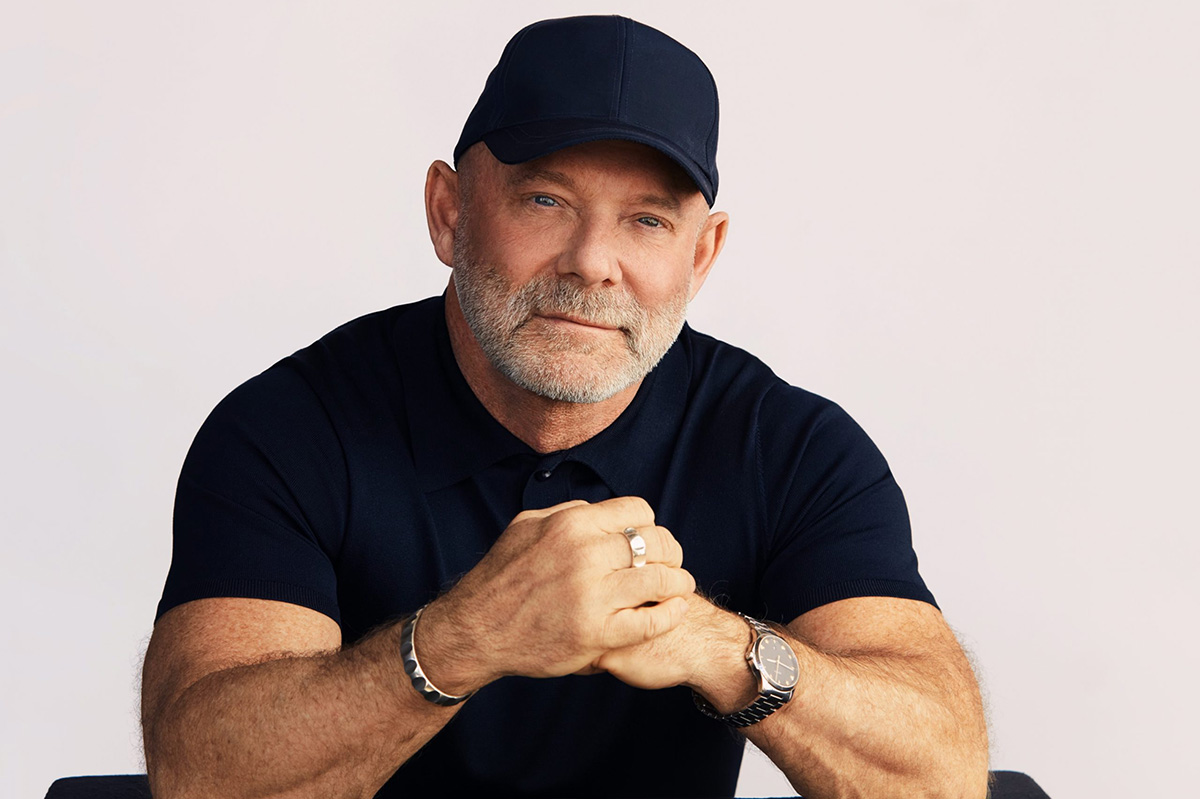
It’s hard to imagine where LGBTQ+ television would be without “Queer Eye for the Straight Guy,” the trailblazing reality series that premiered in 2003.
Each episode of this Emmy-winning show saw a group of gays converge on a struggling man — the titular straight guy — and offer nonstop wit while organizing his endlessly messy life. This program about a group of homosexual helpers took the world by storm, furthering the love of gay television begun by shows like “Will and Grace” but bringing it into the growing medium of reality TV. Of course, it wasn’t perfect; “Queer Eye for the Straight Guy” often cast its experts less as multi-faceted queer folks and more as sources of early 2000s gay jokes. But despite these pitfalls, it’s undeniable that the original program explored the realities of being gay in a way audiences had never seen before. It was a monumental piece of LGBTQ+ representation, and its success is largely owed to the man who fought to get this show made: producer David Collins.
Collins spoke with the Blade from his Los Angeles home, where he’s spent the past few years living with his husband and his two daughters. David spoke fondly of his many years in the industry, detailing how it feels to be such a huge part of LGBTQ+ history. He explained, however, that he didn’t initially set out to alter how queer people were seen on television. “I never went out to make gay television,” said the producer. “I went out to tell great stories.”
“I’m a hillbilly from Ohio, and I thought I was going to be an editor,” David laughed, looking back on his career. “I interned at the Cincinnati Film Office, and I showed up to work my very first day, and the film commissioner was like, ‘Get to the airport right now and pick [someone] up. Don’t talk to them.’ Well, I ended up picking up Jodie Foster.” Collins raved about this car ride that changed his life, with the pair becoming friends and Foster pushing him to become a producer who puts their own media out into the world. Eventually, he did just that, and after learning about the wild new genre that was reality TV, he pitched a series to Bravo: “Queer Eye for the Straight Guy.”
“I was obsessed with Esquire magazine, and they had five categories: fashion, grooming, interior design, culture, food, and wine. So I gave them each a gay, and the Fab Five were born!” Collins said, describing how viewers quickly fell in love with the concept and earned the program four seasons and an Emmy for Outstanding Reality Program. He spoke about how proud he felt creating a show that centered real gay people, not characters in a story, remembering, “To stand in the middle of Times Square and look up and see this massive billboard with the original Queer Eye guys…it wasn’t even a dream come true, because it wasn’t a dream I had even fathomed.”
With his series, people were watching actual gay men and learning the realities of a queer culture that had always been portrayed as a danger to society. Collins tearfully recounted hearing about queer people using the show as a way to connect with their family, saying, “What I’m most proud of that’s come out of Queer Eye [are] the conversations that that series has allowed to have people around their kitchen tables with little boys in Ohio like me who were scared to death that they were going to burn in hell because their pastor was telling them that they were a sinner.”
Now, for all of its trailblazing, the program wasn’t wholly positive; the show’s focus on the central ‘straight guy’ meant it rarely delved into the lives of its Fab Five. Collins regretted that lack of depth but understood that earlier audiences weren’t accustomed to such a nuanced look into queerness — that would have to wait for the reboot.
When “Queer Eye” came out in 2018, audiences were introduced to not only a new Fab Five, but a whole new format (that didn’t rely on a straight person). Now, the series would assist queer folks and allies alike, spotlighting these individuals as well as the queer experts helping them improve their lives. The show has been applauded for its amazing makeovers, but where it truly stands out is its representation, offering a look into individuals across the country and the struggles — along with the immense joys — of being queer in America today.
Fans were disappointed to hear that “Queer Eye” would be ending after its 10th season, but David stressed that they wouldn’t have to be sad for long. “What I will say to you is this: hang tight,” he teased. “There’s yet another version of ‘Queer Eye’ to come, and we’re working on that now.” In the meantime, Collins is continuing his work with new shows like the “House of Stassi,” a series centered on “Vanderpump Rules’”prolific waitress. He’s excited about these new projects, but emphasized that his heart will always belong to “Queer Eye for the Straight Guy” and all that it continues to do for viewers 19 years after its finale.
“It’s not about your new outfit or your new couch or your new whatever. It’s about your humanity,” said Collins, speaking about the core lesson he hopes people take away from the Queer Eye franchise. “It’s about seeing yourself. It’s about dignity. It’s about how confidence breeds success.”
A valuable message that queer folks can benefit from even more now than they did in 2003. And, while it’s unclear just what lies ahead for this franchise, one thing is for sure: “Queer Eye for the Straight Guy” helped people everywhere understand the power that exists within our queerness. It’s a truth that has impacted countless pieces of LGBTQ+ television today, and it’s one that Collins promises to keep alive through whatever hit show he creates next.
a&e features
Jason DePuy on coping with homophobia in ‘Big Brother’ house
First drag queen contestant on CBS show fought to stay positive

One week after Jason DePuy (known as Salina EsTitties on “RuPaul’s Drag Race”) was bullied and eventually evicted from CBS’s “Big Brother” house, the queer drag performer is still emotionally processing his feelings.
During his 24 days in the reality TV competition, DePuy often had a rough time, with fellow cast member Kamuela “Kamu” Kirk making homophobic comments and feeling isolated.
In a conversation with Head of Household Rick Devens, Kirk left viewers upset when he said, “Bro, miss me with the drag stuff. Miss me. I’m still an MMA guy, and I have an image to uphold.”
Former “Big Brother” contestant Frankie Grande called his words ‘homophobic’ and ‘gross.’ Another comment, where Kirk said he wanted to end DePuy’s career, also received strong backlash online.
Now that he is out of the house, DePuy has been shocked and deeply touched by the love from “Big Brother” fans and former contestants. We chatted with DePuy for this Blade exclusive.
“To know that my community was rallying for me outside the house was the most wonderful thing. Seeing how much people were just wanting to shower me with love was incredible. Even my friends, I went to say hi and give them a hug, and they’re like, ‘Uh, uh, come here.’ They had to hold me and let me know America was feeling for me in a way that I had no idea.”
He added: “To see that reality was just overwhelming, and I couldn’t ask for more.”
Known as a messy player in the house, DePuy often had to fight to stay positive and stand up for himself.
“No one was coming to my rescue. In real life, it’s easy to block people, but in the house, I didn’t have that luxury, so I had to find it within myself to learn how to speak up for myself in a way that wasn’t nasty or biting. I didn’t attack anyone personally, which is what I was the most proud of.”
DePuy acknowledged he has had a history of putting his foot in his mouth when it came to certain “Drag Race”moments, being in the public eye, and making a fool of himself. “I’ve learned my lessons; to see how I handled myself in the ‘Big Brother’ house was amazing.”
While DePuy has been sober for 14 and a half years and has a strong spiritual foundation, in the Big Brother house, he often felt like he couldn’t communicate what he was feeling.
“As a queer person, a person of color, a drag queen, I have to be very careful about how I move. I don’t have the luxury or privilege to just act a certain way or say a certain thing. I have to be very careful; I’m representing me. But who I am is a Latino, a person of recovery, a drag queen, a queer person in the community. I know that there’s a lot of pressure that comes with that. I felt it was safer for me to sit there and just breathe than try to do anything crazy.”
He continued: “I couldn’t speak to the personal attack that was happening in the house, because in my mind I was like, ‘no, this is a game, and I have to play it, put that aside.’”
Not only can viewers watch the episodes, but they can also watch the live feeds of what’s happening. Seeing the fans’ social media posts from people who had watched the episodes and the live feeds also contributed to DePuy realizing that his feelings of discomfort were valid.
“To know that I wasn’t delusional in those moments, that others could see what was happening, has been a lot to take in. Fans and friends let me know the comments made went beyond the game…I’m like, ‘Oh, so my instincts were correct.”
One of the most poignant moments on the live feeds occurred when DePuy was crying, alone in his room, and said how he missed his gay community.
“I really missed my friends. I missed my queer community. We’re so colorful. We’re so loud. We’re so vibrant. We speak off the cuff, and we’re very truthful and honest with how we speak, and it’s fun. We have fun lingo.”
DePuy had to censor his expressions in the house. “Because I can say one thing, but it can mean something different to straight people than it does with my queer brothers and sisters. So, there was a sense of code-switching that I had to do. I had to even put aside some of my queerness in a way sometimes to fit in.”
DePuy was thrilled to be the very first drag queen to ever be cast on the show.
“I’m honored to have been chosen. There’s a million drag queens out there, and to know that I was a contender to come in the house and not even be in drag was like a wow for me. I’m over here in Hollywood, running around these streets with a wig and heels just to make a dollar to survive, and I have to rely on drag to do that. And then to be offered this opportunity and be given the privilege to say, ‘hey, you don’t have to put on the wig for you to be valuable here,’ is just insane to me.”
Prior to his shows, DePuy has been hustling for 15 years, flipping burgers and doing drag at night.
“That has been my life these past since I was 17. So it’s been a long journey; the opportunity to do this out of drag is a very big blessing. I’m honored and grateful to be the representation of my community.”
If you missed Jason on “Big Brother: Unlocked,” the episode can be seen on CBS.com. He will be back on the show for the finale.
a&e features
Rainbows in Revolt on a mission to make LGBTQ artists’ voices heard
Rainbows in Revolt on a mission to make LGBTQ artists’ voices heard
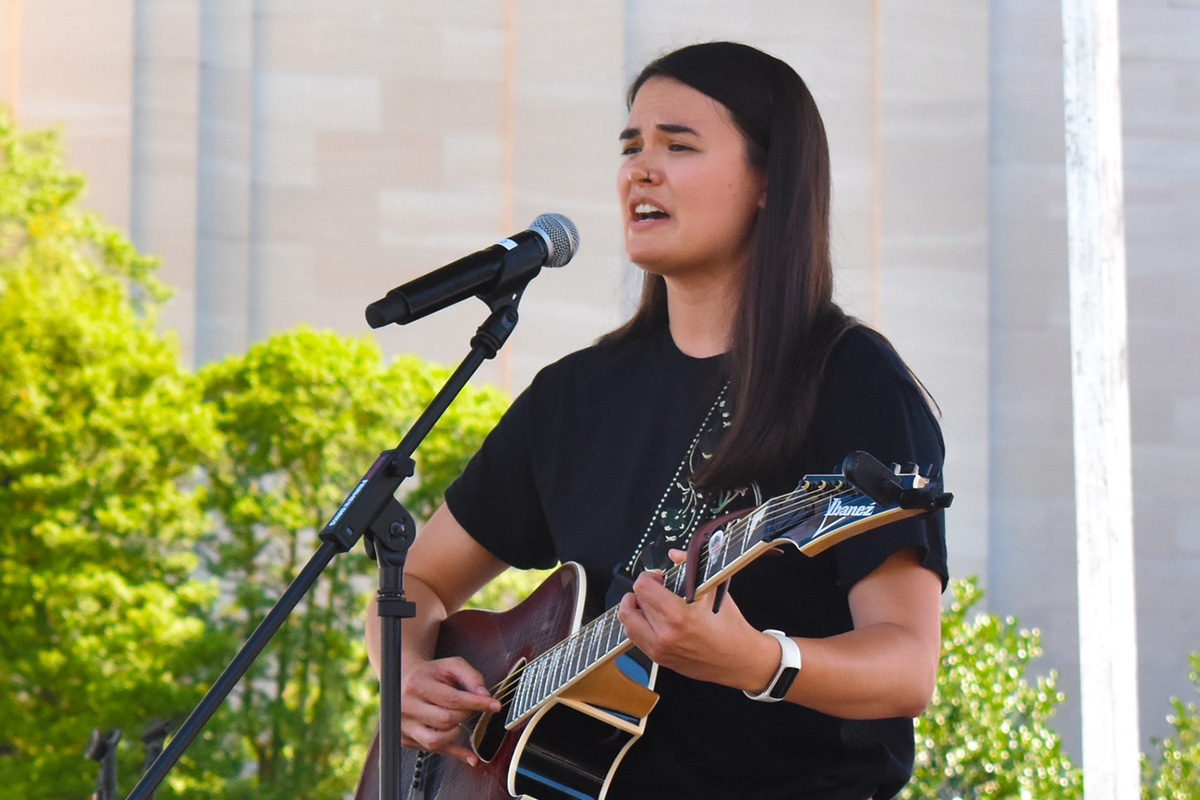
Last month’s Pride celebration in D.C. was so fun. Walking around my first Capital Pride with a $15 lemonade I was loving the madness and the color. Artists and small businesses battling banks you’ve never heard of collecting your personal information so you can spin a wheel to snag free merch. Great music blaring, people actually smiling and enjoying themselves, the “Great” American State Fair could never!
The Monument Stage was on Pennsylvania Avenue, directly in front of the National Gallery of Art and I can’t think of a better venue to see live music. How does someone get on the lineup for Pride? How do we accelerate the visibility of the most talented voices in our community to perform in places like this?
There is certainly not a talent gap, but there is a visibility gap. Chappell Roan went from playing for two people in a parking lot to owning the main stage at Coachella in one year. Whether it is shadowbanning or bias in AI, algorithms have been shown to suppress queer artists. In a digital age, how can queer people break through and show the world how talented they are?
Allison and Matt of Rainbows in Revolt are on a mission to make openly LGBTQ+ artists’ voices heard. Their goal is to find “musicians whose queerness is central to their identity as an artist,” and accelerate them to a place where they can actually reach fans.
The only time queer events seem to be in the spotlight is June, but this should be year round, according to Allison and Matt. Rainbows in Revolt wants to act as a “nucleus” for different sub-communities, finding common ground in the universal language of music.
Matt and Allison founded Rainbows as a way to make cheaper, higher quality merchandise for queer artists. While Rainbows has already pledged 20% of their profits to the LGBTQ+ community, with 10% to Whitman-Walker Health and 10% to LGBTQ+ organizations in need, this is just the beginning of the work that they do.
Rainbows “does the dirty work” that artists normally struggle to do on their own with limited resources. Interviews, artist profiles, social promotion, playlist discovery, radio outreach, and merch-funded support. This work is normally expensive, time consuming, and requires lots of different skills. Musicians don’t want to be editing clips to post online. Standup comedians don’t want to make graphics for their tour dates. They want to write more. They want to focus on their craft.
In addition to helping artists find their audience, Rainbows has built other digital tools to help queer people connect, including an interactive Safe Space Map for most major cities. It is hard to know which places are truly safe and supportive just from a simple Google search. Attitudes and actions change, and there should be a simple way for queer people to find other places that align with them. The Safe Spaces Maps are all up to date, and are tagged and filterable. Instead of relying on forums and word of mouth, Rainbows has created a centralized way to find authentic community quickly.
I had a chance to talk with Allison and Matt at Pride where Lily Erin, one of their signature artists, was performing on the Monument stage. Lily Erin is a folk singer who is familiar and forging her own path. Her bittersweet sound echoes through Acadia, and her garb mirrors the New England athletes I grew up with. Gorp Core meets streetwear. A graphic tee, hiking shorts, and creamsicle Jordans.
Her debut single, “Bus Stop,” tells a sad story about unconditional love, and the conditions that still seem to come with it. Graduating into lockdown, Erin needed a new way to connect with herself and others. Lily made “Bus Stop” without an intention to share it, but doing so was a liberation. People have been responding to her honesty around queer-ness, family, and the “ghosts which haunt us” even in the daytime.
Rainbows in Revolt has helped Lily Erin go from bars and backyards to The Monument Stage at Pride. This is a meteoric rise, and a testament to both Erin’s talent and the work of Rainbows to promote her. “A little encouragement goes a long way with early artists,” and by “planting a seed” Rainbows is already seeing their artist garden grow. Community is power, and Erin is a perfect example of how effective simple modern techniques of promotion can be.
A next step for Rainbows is putting on shows themselves. On Oct. 3, Rainbows in Revolt will host an Evening with Ray Boltz at the National City Christian Church. Boltz grew up in the Catholic Church and for many years was the soundtrack to many services, youth camps, and church groups. He was celebrated by millions until he came out in 2008. Allison remembers her community “never playing his music again.”
Rainbows in Revolt is helping him to return to the church, and proving that identity does not need to be exclusive. We live in a complicated world with complicated lines being drawn. Boltz proves that these lines don’t exist, and will be breaking down barriers to bring together communities. To Allison, “a trans woman standing next to a straight white man in church is a powerful teacher.”
The Safe Space maps bridge all types of spaces, and one of the unlikely ones is, perhaps, churches. Matt said that “BYU has only nine safe spaces around their campus and seven of them are churches.” Not all churches are anti-gay, and many times they are the only place for people to find community.
Rainbows in Revolt is just getting started bridging gaps and building community.

PHOTOS: Miss Gay Old Bay

SUNFESTIVAL takes center stage as Rehoboth Beach closes out summer

Anne Arundel schools now need parent permission to call trans students by preferred names
Shooting outside gay bar in Ariz. leaves three dead

‘People don’t see me. They see a trend’

San Francisco, long a queer safe haven, remains competitive for homebuyers

Trans, nonbinary Americans find refuge in the Netherlands

Calendar: August 28-September 3

‘Teenage Sex and Death’ has never been more entertaining

Actor Tim Curry dies at 80
-

 California4 days ago
San Francisco, long a queer safe haven, remains competitive for homebuyers
-
Netherlands5 days ago
Trans, nonbinary Americans find refuge in the Netherlands
-
Calendar5 days ago
Calendar: August 28-September 3
-
Movies5 days ago
‘Teenage Sex and Death’ has never been more entertaining