News
Clinton emails: ‘We should emphasize LGBT human rights’
Former secretary of state responds to Iraq, creation of LGBT liaison
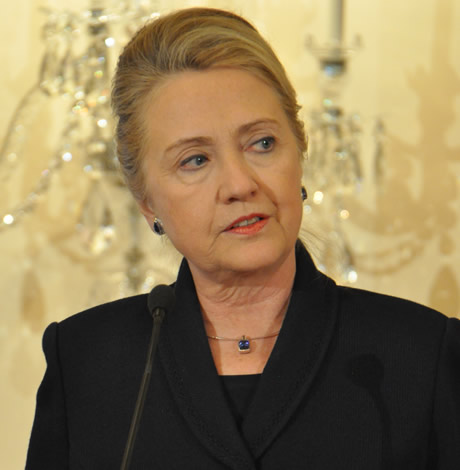
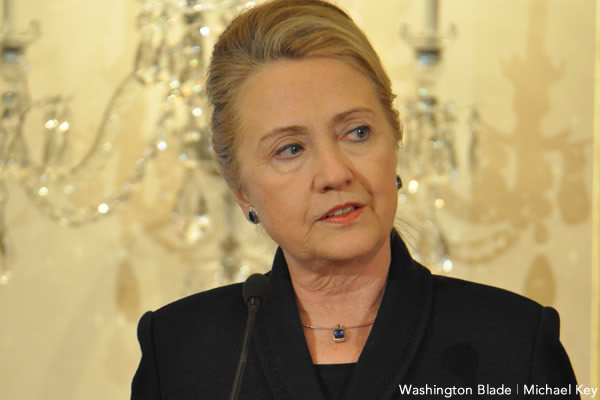
Hillary Clinton called for emphasis of LGBT rights in her State Department emails. Washington Blade photo by Michael Key)
Clinton, who’s now pursing the Democratic nomination for president in 2016, expressed the view in response to a 2009 Voice of America report forwarded to her by adviser Cheryl Mills on the alleged murder and torture of gay Iraqi men, many of whom reportedly said they were more secure under the regime of Saddam Hussein.
Clinton responded 11 minutes after Mills sent her the article.
“So sad and terrible,” Clinton writes. “We should ask Chris Hill to raise this w govt. If we ever get Posner confirmed we should emphasize LGBT human rights.”
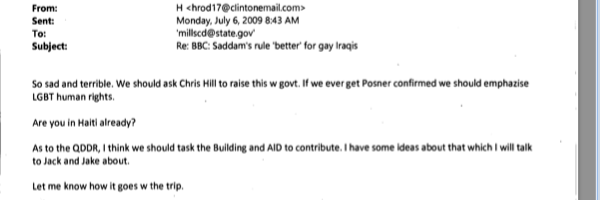
The Chris Hill to which Clinton is referring is likely the U.S. ambassador to Iraq during the first two years of the Obama administration. Posner is likely Michael Posner, who came to serve in the State Department after his confirmation as assistant secretary of state for democracy, human rights and labor.
Clinton’s call for pushing LGBT rights within the State Department is consistent with her stated philosophy that “gay rights are human rights and human rights are gay rights” and her 2011 speech in Geneva in which she highlighted international LGBT rights concerns.
Other emails in the batch unveiled on Tuesday, which span from March to December 2009, demonstrate the hang-wringing on the perceived lack of progress on LGBT issues in the first years of the Obama administration and the potential creation of a State Department official dedicated to LGBT human rights.
The emails reveal that among the individuals forwarding articles to the Clinton State Department on LGBT rights was Richard Socarides, a gay New York-based advocate who advised former President Bill Clinton on gay rights issues.
Socarides told the Washington Blade that as a former White House official he sometimes passed along information and reports he thought would be of interest to the State Department. Sometimes, Socarides said, Clinton’s staff reached out to him with a specific question.
“From what I can tell, these emails are all part of that back-and-forth,” Socarides.
In one email to Mills, Socarides forwards a Gay City News article on anti-LGBT brutality in Iraq and writes, “You guys will have to deal with this at some point if not already.”
In response to the exchange, Socarides expressed satisfaction with how issues related to the rights of LGBT Iraqis were handled, saying it was part of ongoing concern about the country and “raised by our government at many levels and on repeated occasions.”
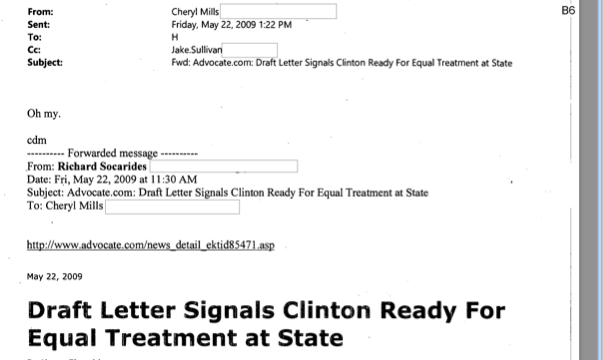
In another email dated May, 22, 2009, Mills forwards to Clinton an article in the Advocate on a draft letter signaling the State Department’s intention to extend partner benefits to gay Foreign Service officers.
Clinton’s response isn’t revealed, but Mills commentary on the article is simply “Oh my.”
In another December 2009 email in which he forwards a Voice of America article on evangelical leaders spreading anti-gay sentiment in Africa, Socarides recommends the creation of an international LGBT point person.
“There is a lot of appreciation for everything the Dept has done around this so far and I think you could really build on it by putting someone there in charge of international LGBT human right issues,” Socarides said.
Socarides’ email was in turn forwarded to Clinton by Mills, who endorsed the idea, saying, “I think this is a good idea — what do you think?”
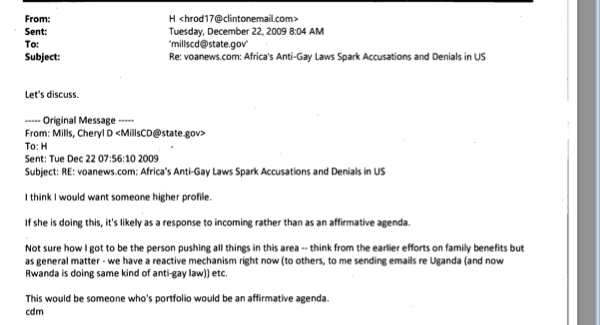
Clinton’s initial response was “Mira patel in sp told me she is already starting to do this. Do you want someone in drl.” The rest of Clinton’s response is redacted by the State Department. Mira Patel served at the State Department as an advisor for Clinton after having served on her Senate staff.
The response from Clinton apparently wasn’t adequate for Mills, who responded she “would want someone higher profile” and Patel is likely preparing a “response to incoming rather as an affirmative agenda.”
“Not sure how I got to be the person pushing all things in this area — think from the earlier reports on family benefits but as a general matter — we have a reaction mechanism right how (to others, to me sending emails re Uganda (and now Uganda is doing same kind of anti-gay law)) etc.,” Mills writes. “This would be someone who’s profile would be an affirmative agenda.”
Clinton has a short response to Mills eight minutes later, “Let’s discuss.” The Clinton emails don’t reveal the resolution of this discussion, which may have been taken offline.
In response to the email exchange, Socardies pointed to the appointment of Daniel Baer as deputy assistant secretary in the Bureau of Democracy, Human Rights & Labor. Part of the portfolio for Baer, who now serves as U.S. ambassador to Organization for Security & Cooperation in Europe, was international LGBT rights issues.
No specific LGBT international affairs official was appointed during Clinton’s tenure, but the State Department named Randy Berry as special envoy for the human rights of LGBTI persons under current Secretary of State John Kerry.
The emails unveiled by the State Department aren’t the last missives expected to be made public. As a result of a Freedom of Information Act request and the direction from Clinton herself, the emails are slated to keep coming on a rolling basis and all 55,000 pages should be public by Jan. 29. Clinton deleted an estimated 32,000 emails on recommendation from her legal team.
Over the course of her tenure at the State Department period, Clinton opposed same-sex marriage. The Blade could find no emails discussing the issue or any potential evolution on her views. Clinton endorsed same-sex marriage after she left the State Department in 2013.





The Comings & Goings column is about sharing the professional successes of our community. We want to recognize those landing new jobs, new clients for their business, joining boards of organizations and other achievements. Please share your successes with us at [email protected].
Congratulations to Richard Garrett on being honored by Delaware Gov. Matt Meyer with the Order of the First State. Garrett is executive director of the Children’s Beach House, in Lewes, Del. Upon accepting the honor he said, “I am deeply honored to be recognized by Governor Meyer with the Order of the First State, but I hope this occasion also shines a light on children who are struggling in some of the same ways I struggled as a child and teenager. Perseverance, connection, patience, and the presence of caring adults made all the difference in my life. For 24 years, my greatest privilege has been helping Children’s Beach House create that same sense of belonging and possibility for children and families across Delaware. They are strong, smart, resilient, and resourceful—and they deserve every opportunity to discover just how much they are capable of becoming.”
He told the Blade, “In many ways, my own childhood helps explain why this work has been so deeply personal to me. I grew up in a family that struggled financially, and I had a speech impediment so severe that, as a young child, I often could not be understood without one of my siblings acting as an interpreter. Thankfully, I had strong parents and a mother who was an educator. She spent countless hours helping me practice consonant blends and trying to master the “R” and “S” sounds. Just as importantly, she understood that being around other children my own age would teach me things that no adult could. What made a difference in my life were competent, caring adults who built relationships with me and gave me the sense of safety and belonging I needed. People like Sister Kathleen Swan, OSF; Father Gerald M. Dunne, OSFS, Dr. Susan Cassidy and her husband, John Bronson, to name a few! In many respects, my story mirrors the work we do every day at Children’s Beach House. The children and families we serve are strong, smart, resilient, and resourceful. Sometimes what they need most is for someone to recognize those strengths, stand beside them, and give them the relationships and opportunities they need to flourish.”
Over the years Garrett has grown the Children’s Beach House’s annual budget from approximately $650,000 in 2003 to $4.5 million while strengthening impact, visibility, and organizational infrastructure. He raised $2.5 million in Delaware foundation capital grants, and established a $7 million endowment for the Margaret H. Rollins Center, a $1 million capital endowment, and increased the general operating endowment to $6 million.
In addition to all that Garrett is the founder and owner of Midway Motion and Fitness. He is also looking forward to the groundbreaking of Midway Pickleball in 2027. He is treasurer of the Community Foundation Board of Kiwanis Club of Coastal Delaware. He began his career as executive director of the Delaware County Children’s CAMP, Media, Pa.; and was director of Student Affairs for the Williamson Free School of Mechanical Trades, Media, Pa.
Garrett earned his bachelor’s degree in psychology from Neumann University, Aston, Pa.; and did his graduate studies in vocational education, Temple University.
Turkey
‘Governments that attack LGBTQ+ rights learn from each other’
Turkish authorities on Sept. 12 launched anti-LGBTQ ‘My Family Is Safe’ campaign
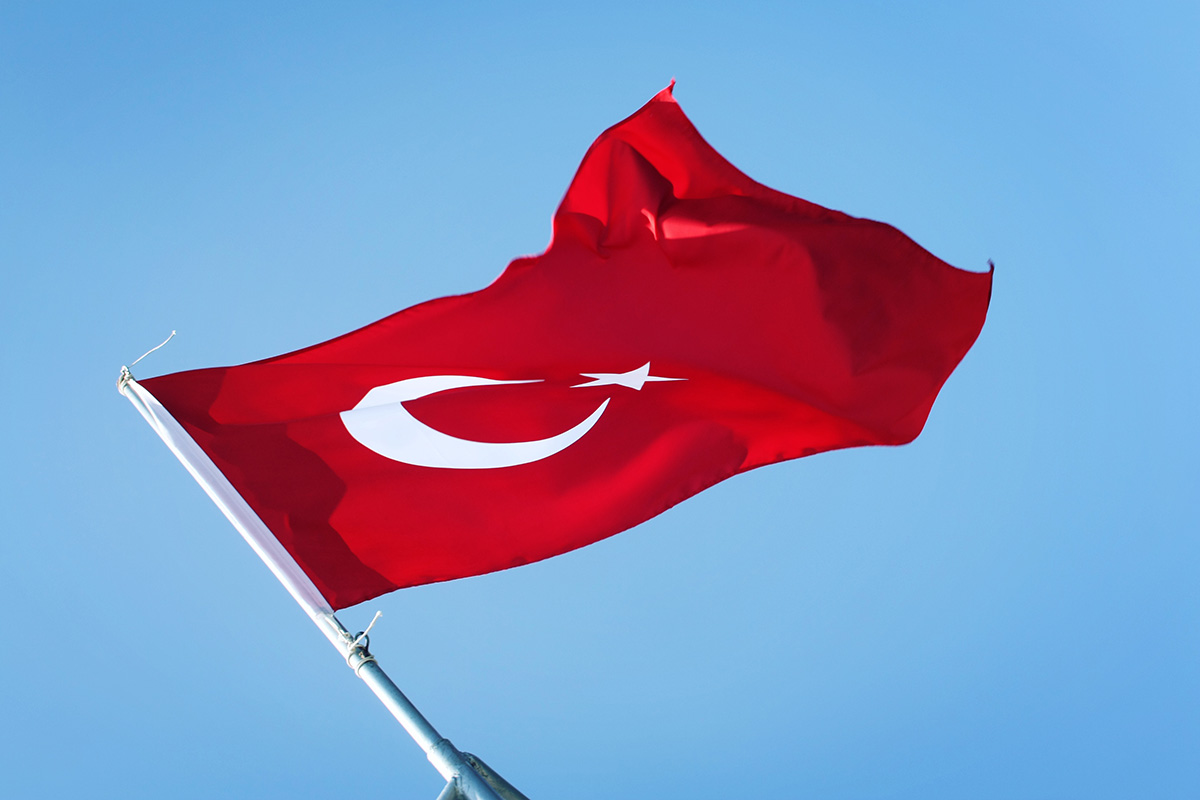
Sept. 12 is a solemn day for the people of Turkey. It is the anniversary of the 1980 coup d’état — when members of the National Security Council, along with the armed forces, dissolved the Turkish parliament, arrested hundreds of thousands of people, and entered a three-year period of martial law.
On Sept 12, the 46th anniversary of the 1980 coup, the country faced another wave of arrests; this time they targeted the LGBTQ community. The government launched the national “My Family Is Safe” campaign, which triggered mass raids and arrests of LGBTQ organization leaders, advocates, academics, and sexual health treatment centers for people with HIV. (These include EU-funded organizations launched by the Turkish government in 2005.) Since the nation has seen a decline in birthrate and a swelling economic crisis, this has allowed authoritarian President Recep Tayyip Erdoğan and conservatives in Turkey to use the LGBTQ community as the ideal scapegoat.
“This is the cruelest part. It was Erdoğan’s own party that made it easier to found NGOs in 2005 as an EU accession process, and that is how many LGBTI+ groups came to be officially registered.” Ali Yildiz, a linguistics graduate student at the University of Cologne in Germany, told the Washington Blade. “Everything was legal, transparent and official. Now those same registrations are being used as arrest lists. The state is basically punishing those who trusted it. It sounds very much like the Nazis. They also used member lists of associations to persecute them later.”
Yildiz has witnessed the oppression of the Turkish government firsthand: in 2024, he moved to Germany. As one of the board members of a grassroots NGO that focuses on sexual health, Yildiz was at risk of arrest and prosecution.
As part of the “My Family Is Safe” operation on Sept. 12, police raided Yildiz’s family’s former home to find him.
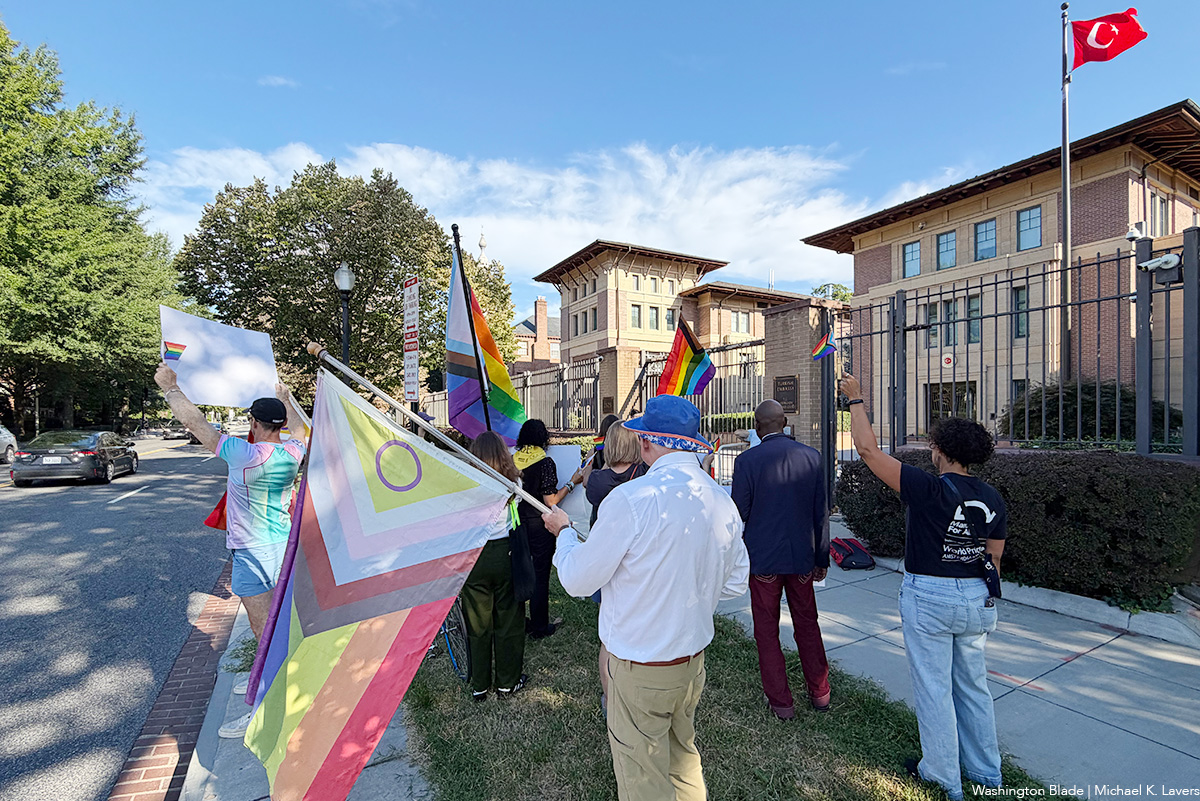
In the aftermath of these raids in Turkey’s major cities, protestors have gathered at Turkish embassies across Europe and the U.S.
A critical discourse has also emerged as a response to the crackdown across international queer media: how should the West cover oppressive regimes abroad?
“From what I see, the Western reading of Turkey’s crackdown on LGBTI+ people usually goes: it’s a conservative, Muslim country, so this is what you’d expect. I believe that framing is incomplete, and it lets the people responsible off the hook. The Erdoğan regime is also heavily relying on this contextualization,” said Yildiz. “The government is not simply reacting to existing conservatism but is actively shaping it. Look at how operations are presented: raids on LGBTI+ organizations and activists come packaged with claims about drugs, obscenity, sex work, or organized crime on other groups in the news. The evil strategy is to link LGBTI+ people with criminality in the public mind.”
The LGBTQ community is not the only group that has been under the weight of oppression. Political opponents and descendants whom Erdoğan deems criminals are also charged with treason.
Istanbul Mayor Ekrem İmamoğlu, who is the leading candidate for the upcoming 2028 presidential elections for the opposition center-left Republican People’s Party, was arrested on terrorism charges in 2024. On the same day, he was nominated as the CHP’s presidential candidate.
For a while, X served as a platform to express discontent with the government, but that changed recently when Elon Musk blocked nearly 500 accounts in Turkey. The Turkish government also banned Grok after the AI system responded to a user’s question about Erdoğan, which government leaders found offensive.
The visibility of these pages has decreased. With a VPN, citizens can still access the pages because they were banned only in Turkey, not internationally.
Discontent with the government is increasing, but so is government oppression.
Not only have LGBTQ pages been shut down, but many journalists and academics have also had their pages banned.
The Blade spoke to an anonymous academic living in Ankara, the Turkish capital, who said Erdoğan, U.S. President Donald Trump, and other authoritarian leaders are constantly learning from each other.
“These anti LGBTQ+ policies are being created in the name of preserving traditional family values and are not only a threat to Türkiye,” they said. “It is also a global issue that threatens people everywhere. It should be perceived as an international problem. That is why we LGBTQ+ people need to act in solidarity internationally.”
Because of the compounding human rights crisis happening simultaneously around the globe, visibility has been advocates in Turkey’s main challenge.
Since 2022 there have been a series of crackdowns against opposition parties, academics, labor unions, student organizations, journalist and advocates. Another anonymous academic in Istanbul told the Blade that after the 2022 crackdown, “people were intimidated, and most people did not feel encouraged to organize.”
In the weeks following this recent crackdown, discontent with the Erdoğan government has increased along with inflation and unemployment, not helped by the war in Iran.
“Our leaders do not say anything about the financial crisis,” said the Istanbul academic.
High inflation, high unemployment rates, many factories, and businesses have left Türkiye and transferred their businesses to other countries. And because of the timing of these recent crackdowns, during this financial crisis, many people haven’t been paying attention.
Though for many queer and transgender Turks, post-Sept. 12 life has been radically different.
“I stopped doing drag in order to protect myself, and many queer performance artist friends of mine have also given up this part of their lives,” said one source who asked the Blade to remain anonymous.
“Everybody is not scared, but they simply bring their fear with them to the march and march courageously, because they believe they are on the right side of history,” they added. “However, I think it is important that people in Turkey are not represented only through their experiences of victimization. There should also be spaces where artists, activists, journalists, and other queer people can express themselves in their own words.”
The justification for this crackdown has been preserving “traditional family and conservative values.” The Turkish government has persecuted these offenses with raids, trials, and arrests that have gone beyond just the LGBTQ community. It targeted last year musicians, performers, and artists whom they deemed obscene or offensive.
In September 2025, the K-pop-inspired girl band Manifest was investigated for three months. Footage from their shows was banned from the internet, and the remainder of their tour was canceled. All seven members of the group faced 3 1/2 months prison sentences before the charges were ultimately dropped.
“I believe there is no pride for only some of us. Governments that attack LGBTQ+ rights learn from each other.” Yildiz tells the Blade, “Erdoğan borrows from Putin’s playbook, and parts of the Western right eagerly adopt the same rhetoric. This is a call for our community to see how important international solidarity is. People show up every single year for the Pride March, even though they know the police are going to attack. What I see in our community is pure courage.”
2026 Midterm Elections
Annie Andrews denounces trans athletes after Trump targets her
President used anti-trans slur to describe SC Senate candidate

Days after President Donald Trump called Annie Andrews, the cisgender Democratic nominee for South Carolina’s U.S. Senate seat, an anti-transgender slur on social media, Andrews came out against transgender girls and women participating in sports.
Trump called Andrews a “trannie” on Truth Social while attempting to garner support for her opponent, U.S. Sen. Darline Graham (R-S.C.), the incumbent seeking reelection in South Carolina.
After the president’s use of the slur was widely reported, the incident provided an opportunity for Andrews to explain her position on the ongoing trans debate that has shaped political discourse in the 2020s, despite trans people making up only 1 percent of the U.S. population, according to the Williams Institute.
She used the opportunity to denounce trans rights and pointed out that, as a physician, she had never performed gender-affirming surgery on minors.
“I want you to hear me loud and clear: I don’t support biological men playing women’s sports, and I don’t support and haven’t ever performed gender surgery for minors,” Andrews said in a political ad.
Despite these recent developments, Andrews has previously voiced support for trans South Carolinians. In 2022, she posted on her X account, criticizing the Save Women’s Sports Act, which was signed into law by Republican Gov. Henry McMaster and restricts trans girls from participating on girls’ sports teams.
“This is shameful legislation that does nothing to protect or support women or children in SC. In fact, it is actively harmful. I will always support trans youth,” Andrews wrote in after the legislation passed.
The Washington Blade reached out to Andrew’s campaign about the comments, and asked if she supports trans rights but did not receive a response.

Comings & Goings

‘Hidden in Plain Sight:’ The story of Odessa Madre

‘Governments that attack LGBTQ+ rights learn from each other’

Horror genre has evolved into space to explore queer identity

Annie Andrews denounces trans athletes after Trump targets her

ICC unseals arrest warrants for Taliban officials accused of persecuting LGBTQ people, women

Physician: addiction doesn’t always look the way you think it does

Calendar: October 9-15

Solidarity beyond the parade: the actual cost of Pride

Essential queer horror classics for Halloween
-

 Afghanistan4 days ago
ICC unseals arrest warrants for Taliban officials accused of persecuting LGBTQ people, women
-
District of Columbia4 days ago
Physician: addiction doesn’t always look the way you think it does
-
Calendar4 days ago
Calendar: October 9-15
-
Opinions3 days ago
Solidarity beyond the parade: the actual cost of Pride