Local
Former activists on trial in Wone case
Unsolved murder has elements of gay mystery novel

Three once politically active gay men whose polygamist relationship and proclivity for S&M sex has been exposed by prosecutors following a D.C. murder investigation are scheduled to go on trial May 10 in a case that mimics a mystery novel.
Gay rights attorney Joseph Price, dairy industry official Victor Zaborsky and former Virginia gay rights group staffer turned massage therapist Dylan Ward have been charged with evidence tampering, obstruction of justice and conspiracy in connection with the August 2006 murder of Asian American attorney Robert Wone.
Wone, 32, was found stabbed to death in a second floor guest room in the Dupont Circle area townhouse where the three gay men lived at the time. Authorities have yet to charge anyone with the murder itself, but police and prosecutors have said they believe Price, Zaborsky and Ward most likely know the identity of the killer.
The men have pleaded not guilty, saying an unidentified intruder who entered their house through a rear door killed Wone while the three slept.
Wone was a longtime friend of Price since the two were students at the College of William & Mary in Virginia. He was spending the night at the gay men’s house on Swann Street, N.W. after working late at his nearby office, according to his wife, Kathy Wone, and other family members who say he was straight.
The trial is set to begin after more than a year of haggling between defense and government attorneys over the admissibility of a mountain of evidence gathered by D.C. police and prosecutors. A team of nearly one dozen defense lawyers is set to face off against a smaller team of prosecutors headed by Assistant U.S. Attorney Glenn Kirschner, who is considered one of the city’s most effective prosecutors.
“Given the sophistication of the defendants’ cover-up of the murder of Robert Wone, the evidence obtained to date does not yet establish beyond a reasonable doubt who actually killed Robert Wone,” Kirschner wrote in a government motion filed in February.
“Although the government investigation into the murder continues,” he wrote, “there is ample evidence demonstrating the killer is someone known to the defendants, and not, as the defendants told the police, an unknown, unseen phantom intruder.”
Much of the government’s evidence against the three defendants surfaced in October 2008, when prosecutors released a 13-page affidavit in support of an arrest warrant for Ward, who was the first of the three men to be charged in the case.
The affidavit describes in detail some of the findings of crime scene investigators and an autopsy conducted on Wone. It says that someone in the house cleaned the crime scene by wiping away spattered blood. The affidavit also says chemical and fiber tests showed someone used a towel to wipe some of Wone’s blood onto a knife taken from the defendants’ kitchen. The men told police they found the bloody knife on a nightstand in the room where Wone was sleeping, saying it was the weapon an intruder used to stab Wone three times in the chest and abdomen.
Prosecutors, however, said later that a knife missing from a cutlery set found in Ward’s bedroom appeared to be the actual murder weapon based on the shape and depth of the stab wounds. Prosecutors obtained a duplicate of the missing knife from the manufacturer for the purpose of comparing it to the wounds on Wone’s body, court papers show.
Prosecutors initially said they would argue at trial that Wone had been immobilized by a paralytic drug, sexual assaulted and possibly tortured with needle punctures found in various places on his body before being stabbed. They pointed to autopsy findings showing surgical-like stab wounds on the body, with no signs that Wone moved or flinched when he was attacked. The lack of any signs of defensive wounds or slightly jagged stab wounds — which are found in virtually all stabbings — indicated the victim was immobilized, Kirchner has argued.
Kirschner has since said the government has been unable to definitively show through chemical tests that Wone was immobilized with a drug, but he indicated he might introduce evidence found in Ward’s bedroom of a large collection of S&M sex devices, including body restraints, face masks, and an object used to administer an electric shock to different parts of the body.
Defense attorneys, led by seasoned trial lawyers Bernard Grimm, Thomas Connolly and Robert Spagnoletti, the gay former D.C. attorney general and a former U.S. prosecutor, have waged a fierce pre-trial fight to disqualify key pieces of government evidence. Superior Court Judge Lynn Leibovitz was expected to rule on evidence related matters as a final pre-trial hearing set for Wednesday, after Blade deadline.
While details of the murder scene and the private, sexual proclivities of the defendants have emerged over the past two years, gay activists have watched cautiously as fellow activist Price prepares for trial.
Price, an attorney in private practice, had served as general counsel to Equality Virginia, a statewide LGBT rights group based in Richmond. Ward, who worked as a staff member of the group, left the organizations a few months before the Wone murder. Price withdrew from the group shortly after the Wone murder drew extensive media coverage.
“You have gay activists on trial that had a polygamist gay family,” said David Greer, a D.C. gay man and one of four editors of whomurderedrobertwone.com. “Having a conjugal relationship with more than one partner is not pushing the white-picket-fence image that gay organizations like to promote.
“To have them on trial in an unseemly situation that has surfaced here is difficult for the gay community. But it also shows that our community has matured” by not automatically rallying behind activists charged with a crime, Greer said. “It shows that our community supports justice.”


District of Columbia
Blade contributor, husband exchange vows in D.C.
Yariel Valdés and Kevin Vega held ceremony at Jefferson Memorial on March 23

Washington Blade contributor Yariel Valdés and his husband, Kevin Vega, exchanged vows at the Jefferson Memorial on March 23.
The couple married in Fort Lauderdale, Fla., on Nov. 24, 2025. The Jefferson Memorial ceremony — which Blade International News Editor Michael K. Lavers and Samy Nemir Olivares officiated — coincided with the third anniversary of Yariel and Kevin’s first date.
Yariel in 2019 asked for asylum in the U.S. because of the persecution he suffered as a journalist in his native Cuba. He spent nearly a year in U.S. Immigration and Customs Enforcement custody before his release on March 4, 2020.
Yariel wrote a series of articles about his time in ICE custody that the Blade published. The series was nominated for a GLAAD Media Award in 2022.
Yariel and Kevin live in South Florida.
District of Columbia
‘Out for McDuffie’ event held at D.C. gay bar
Mayoral candidate cites record of longtime support for LGBTQ rights
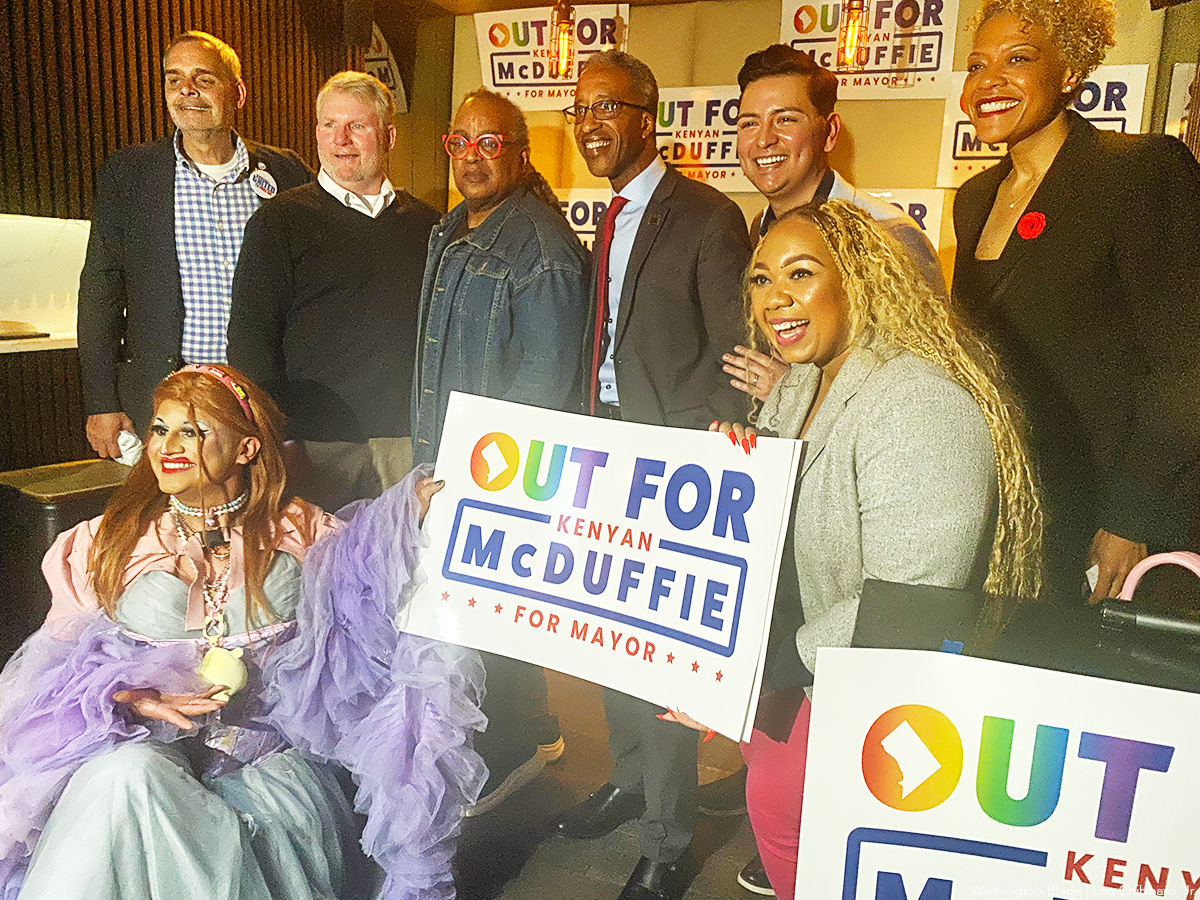
More than 100 people filled the upstairs room of the D.C. gay bar Number 9 on Thursday night, March 26, to listen to D.C. mayoral candidate Kenyan McDuffie at an event promoted as an “Out for McDuffie” meet and greet session.
Several local LGBTQ activists who attended the event said they support McDuffie, a former D.C. Council member, in his run for mayor while others said they had not yet decided whom to vote for in the June 16 D.C. Democratic primary election.
As of March 27, eight other Democrats were competing against McDuffy in the June 16 primary, including D.C. Council member Janeese Lewis George (D-Ward 4), considered McDuffie’s lead opponent. Lewis George also has a record of strong support on LGBTQ issues.
Most political observers consider McDuffie and Lewis George the two lead candidates in the race, with the others having far less name recognition.
The two lead organizers of the Out for McDuffie event were LGBTQ rights advocates Courtney Snowden, a former D.C. deputy mayor in the administration of Mayor Muriel Bowser, and Cesar Toledo, a local LGBTQ youth housing services advocate.
“I’m a candidate for mayor of Washington, D.C. and I’m running for mayor because I love this city,” McDuffie told the gathering after being introduced by Snowden. “And now more than ever we need leadership to take us to the future,” he said, adding that he and his administration would “stand up and fight” against President Donald Trump’s efforts to intervene in local D.C. affairs.
“Our strength is in the 700,000 beautifully diverse residents of Washington, D.C.” he told the gathering. “And as Courtney said, I didn’t just show up and run for mayor and then start saying that I’m going to be an ally for the queer community, for the LGBTQ+ community,” he said, “I’ve lived my entire professional life fighting for justice and fighting for fairness.”
Following his speech, McDuffie told the Washington Blade, “We’re going to fight to protect our LGBTQ+ community every single day. That’s what I’ve spent my career doing, making sure we have a beautifully diverse and inclusive city.”
He remained at Number 9, located at 1435 P St., N.W., for nearly an hour after he spoke, chatting with attendees.
District of Columbia
‘No Kings’ protests set for D.C.
Anti-Trump demonstrations to take place across country on Saturday

As President Donald Trump and his administration escalate rhetoric targeting transgender youth and student athletes, push efforts to restrict voting access for millions of Americans, and pursue foreign policy decisions that critics say bypass congressional authority, organizers across the country are once again mobilizing in protest.
For many LGBTQ advocates, the moment feels especially urgent.
In recent months, activists have pointed to a surge in anti-trans legislation, attacks on gender-affirming care, and efforts to roll back nondiscrimination protections as direct threats to the safety and visibility of queer and trans communities. Organizers say the demonstrations are not just about policy, but about defending the right of LGBTQ people — particularly trans youth and people of color — to live openly and safely.
Thousands of “No Kings” protests are planned nationwide, with multiple demonstrations set to take place in D.C.
One of the primary events, “No Kings Washington,” will be held in Anacostia, an overwhelmingly Black area of D.C. that is often at the center of conversations around racial justice, policing, and access to resources in the nation’s capital.
The protest in Anacostia is focused on what organizers describe as the “power behind the throne,” specifically Stephen Miller, the White House Deputy Chief of Staff for Policy and Homeland Security Advisor. Miller has been closely associated with the administration’s “zero tolerance” immigration policy, including the family separation practice that resulted in thousands of children being separated from their parents at the Southern border.
Activists have also linked immigration enforcement policies to broader concerns about LGBTQ migrants, including queer asylum seekers who often face heightened risks of violence and discrimination both in their home countries and within detention systems.
Anacostia protest details:
Participants are asked to gather starting at 1:30 p.m. on the southeast side of the Frederick Douglass Bridge. The closest Metro station is Anacostia on the Green Line, about an 8-minute walk from the starting point. Organizers strongly encourage attendees to use public transportation, as street parking is limited.
The march will proceed past Fort McNair and conclude near the Waterfront Metro station.
D.C. icon and LGBTQ activist Rayceen Pendarvis is set to speak at the protest around 2 p.m.
Kalorama protest details:
A separate protest will take place earlier in the day in Kalorama, a neighborhood long associated with political power and home to presidents, cabinet officials, and foreign ambassadors. Demonstrators are expected to gather at 10 a.m., with a march running until approximately noon near the intersection of Connecticut Avenue and Kalorama Road.
Arlington/National Mall protest details:
Another group is expected to assemble at Memorial Circle near Arlington National Cemetery at 10 a.m. before crossing the Memorial Bridge into D.C., passing the Lincoln Memorial and continuing on to the Washington Monument. Organizers say the march is intended to defend “American democracy, the rule of law, and a healthy planet.”
Unlike last June — when organizers discouraged large-scale demonstrations in D.C. due Trump’s military/birthday parade — activists are now explicitly calling on people to show up in the nation’s capital and surrounding areas.
The protests also coincide with Transgender Day of Visibility weekend, which includes additional gatherings and celebrations on the National Mall. At the same time, peak bloom for the National Cherry Blossom Festival is expected to draw large crowds to the city. With multiple major events happening simultaneously, officials and organizers anticipate significant congestion, increased traffic, and crowded public transit throughout the weekend.
Organizers are urging participants to plan ahead and come prepared.
“Bring your signs, noisemakers, music, and creative ideas, and gather in joyful, nonviolent protest,” they said. “Children are very welcome.”
For more information, visit nokings.org.

Thousands attend ‘No Kings’ protests in D.C.

Blade contributor, husband exchange vows in D.C.

Ghanaian president welcomed to Philadelphia amid backlash over anti-LGBTQ bill

PHOTOS: ‘No Kings’ rally and march

‘Out for McDuffie’ event held at D.C. gay bar

Pa. House passes bill to codify marriage equality in state law

Introducing the Torchbearers Awards honoring queer, trans women and nonbinary people

A surtax would end this war quickly

New IOC policy bans trans women from Olympics

‘No Kings’ protests set for D.C.
-

 Pennsylvania4 days ago
Pa. House passes bill to codify marriage equality in state law
-
a&e features4 days ago
Introducing the Torchbearers Awards honoring queer, trans women and nonbinary people
-
Opinions4 days ago
A surtax would end this war quickly
-
Sports4 days ago
New IOC policy bans trans women from Olympics