Bars & Parties
Still searching for a home
D.C.’s gay community center, facing eviction, suffers from lack of city funding
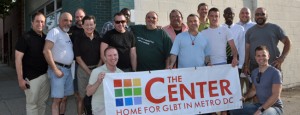
The current home of the D.C. Center is just across from the Black Cat on 14th Street, N.W. in Washington. The Center has to be out of its present location by June 19 and has nowhere to go. (Washington Blade photo by Michael Key)
Homelessness is a problem in every large city but in Washington it’s threatening an unlikely candidate: The D.C. Center, the District’s only LGBT community center, is getting dangerously close to a June 19 eviction notice and has nowhere to go.
“I don’t know where we’re going,” said David Mariner, the Center’s executive director, who’s gay. “And realistically it’s quite possible that the next place we move to is not our final destination.”
Progress is being made. Gay D.C. Councilmember Jim Graham, who helped the Center find its current facility across from the Black Cat on 14th Street, which the Center knew was a temporary arrangement when it moved there in January, has been in touch with Mariner and Center board member Pat Hawkins this week about potential new sites and says he’s committed to helping them find a place. The Center operates many LGBT-specific programs such as tobacco prevention, an HIV working group, an anti-violence group, career development and more. Other LGBT groups, including the Washington Blade, use the space for meetings and events.
“As recently as today I’ve got them referred to see a property in Columbia Heights,” Graham said Tuesday. “I haven’t heard back from them yet so it makes me think maybe they have another option. But anyway, I’m definitely involved. I don’t have earmarks anymore. If I had an earmark, they would definitely get it.”
Graham’s referring to no-bid contracts in the non-profit sector that were eliminated in 2009.
“I go way back with these guys,” Graham said. “We definitely hope to get them settled.”
Hawkins said the Center is facing two issues — the emergency, immediate need for space, but also a longer-term home. Center leaders hoped to be at their current location, owned by JBG Properties, longer than six months but a massive rebuilding of the site — retail and condos that will stretch to Swann Street — is getting started sooner than the Center had hoped.
“Obviously we don’t want to move someplace and then be in the same position again in six months,” Hawkins, a lesbian, said. “We need to go someplace where the space won’t be developed fast and we’re getting good cooperation. I think they all see this as very important and the will is there.”
But the Center’s current dilemma is indicative, Mariner said, of deeper issues. He points to data from CenterLink, an umbrella organization of U.S. LGBT community centers, that show the D.C. Center — currently with a 6,000-square-foot space that’s significantly larger than the office suite it occupied at 1111 14th St. just off Thomas Circle for five years — is much smaller than that of the average U.S. LGBT center, which has 9,706 square feet.
He also points to government financial aid most centers receive. On average, according to CenterLink numbers, centers across the country receive 32 percent of their annual operating budgets from state and local government. D.C. provides none.
The D.C. Center, which was incorporated in 2002 (the average U.S. center is 20 years old), has an annual operating budget of $130,000. It gets about $25,000 from federal grant money and makes up the rest through individual donors, fundraisers, corporate giving and selling ads in its newsletter. The Center received $200,000 in D.C. grant money for its crystal meth program in 2008 and 2009 ($100,000 each year) but hasn’t received anything from the District since August 2009.
“We’re on track for federal and on track for individual donors,” Mariner said. “We’re not all that different in all those other categories. It’s just the local government support. That’s where we’re getting zero.”
Early versions of the 2010 D.C. budget had the Center slated to receive $150,000 for the crystal meth program and $1 million for a permanent home, but neither made it into the final budget. The 2011 budget, which Council gave preliminary approval to last week, similarly has no Center allocations.
Mike Sessa, president of the Center board and a co-founder, says grant funding has been an ongoing struggle.
“Any center wants to be funded by the government in which it’s housed,” Sessa, who’s gay, said. “So it’s a challenge because this city government is so fucked up. You wouldn’t believe the back and forth we went through with the Department of Health for a half-a-million grant. Sometimes it’s like pulling teeth. We went back and forth for months and months and then it got pulled. The fact that this city can’t get its act together affects everyone, so we’re moving on.”
Mariner said it’s remarkable that the Center managed to make up the rest of its budget after losing the crystal meth D.C. grant money this year. A development committee worked on innovative ways of diversifying revenue streams and was largely successful.
“It really was quite remarkable,” Mariner said. “That’s the good news.”
But he said compared to how other large U.S. cities fund their LGBT community centers — eye-poppingly large and splashy centers in Los Angeles, Chicago and New York are often pointed to as models to emulate — D.C. is woefully behind.
Third time’s a charm?
The D.C. Center is the District’s third attempt at an LGBT community center. The Gay and Lesbian Activists Alliance (GLAA; then known as GAA) started one in 1972 but it ran out of funds and was closed by mid-1973. The Washington Area Gay Community Council had another called simply the Gay Community Center that ran from 1978 to 1989 but it too eventually closed, plagued by financial difficulties.
“We got some small little grants but we mostly paid the rent by renting space, by a small membership and doing a lot of fundraising,” said James Crutchfield, who’s gay and was president from 1982-88. “We also had great swimming parities that made a lot of money for us. Swimsuits were optional.”
An issue that has always plagued the concept of a D.C. LGBT center, whomever might be running it, is whether there was or is a need for such a thing. For years Whitman-Walker Clinic fulfilled many of the health-related needs provided by many gay community centers in other cities.
“After we lost so much leadership when the [AIDS] epidemic first hit, the Clinic began taking on a lot of those functions,” said Hawkins, a former Whitman-Walker psychologist. “The gay and lesbian hotline, gay men’s peer counseling groups, a lot of functions evolved because [former Whitman-Walker director] Jim Graham had the vision for those things. But now that the Clinic has moved back into more of a medical focus, those secondary services are not as primary as they once were, so now some of those things are moving to the Center. Like the yoga for bears. You’d never see something like that at a federally qualified health center. The community has evolved. Everybody’s not dying like they were for so long, so there’s room for broader, long-range development.”
Sessa said he couldn’t believe there wasn’t a gay community center when he moved here in 1999.
“There was just a community feel that was missing,” he said. “Yes, there are a million groups to join. If you want to play rugby, you go play gay rugby or if you want to sing or bowl or dance or whatever. But you just go and do that one thing. I didn’t want any of those things or to have a sense of community that was that specific. I just found it very difficult to engage with the gay community. Whitman-Walker had kind of served as a de facto center, but that was when we were building our communities around HIV. I’m not saying that’s a bad thing. It happened out of necessity, but our community does not equal HIV.”
Mariner points to the $43 that California spends per lesbian, gay and bisexual person based on Census and Williams Institute estimations and the more than $17 New York spends and says D.C. is egregiously behind.
“Imagine what I could do with $43 per person,” he said. “We are marginally better than Ohio, three times better than South Carolina, but for the cities that are really international hubs and pride themselves on diversity of all their residents, of those cities, we’re in the lower echelon. Even Minnesota has roughly twice what we have.”
But is it fair to compare D.C. to cities like Los Angeles, Chicago and New York, which have significantly larger populations and LGBT community centers that are decades older than D.C.’s? Mariner said when you consider the size of the D.C. metro area, which, of course, includes parts of Maryland and Virginia, D.C. is right up there in terms of the size of its LGB population.
He’s right — according to Williams Institute figures, D.C. is number six with an estimated 191,959 LGB residents in its metro area, just behind New York, Los Angeles, Chicago, San Francisco and Boston (transgender residents haven’t been counted).
But taking into consideration other factors, an informal Blade study found that those aren’t the most comparable cities overall. The Blade looked at a number of factors and came up with a list of cities that have more in common with D.C. and compared their centers. In terms of numbers of LGB residents for the city alone, Washington comes in only at number 19, just between San Antonio and Sacramento, according to Williams Institute and Census estimates. The percentage of LGB residents of its total population places it much higher — at number nine for the country, just between Denver and Orlando.
In terms of the general population, D.C. is only the 27th largest U.S. city, between Nashville and Las Vegas. General populations for metro areas place it much higher — there it’s number eight, between Houston and Atlanta.
So how does D.C.’s Center compare to the cities with which it has the most in common? Terry Stone, executive director of CenterLink, said D.C. is doing quite well.
“It’s really unfair to compare to L.A., Chicago and New York,” Stone, who’s gay, said. “L.A., for instance, has been around almost 40 years. Chicago’s (Center on Halsted) is almost 30 years and even though it’s certainly one of the grandest, it took them several years of working in small spaces to make that a reality. And they’ve only been in that space two or three years.”
The cities most comparable to Washington — San Antonio, Sacramento, Denver, Orlando, Boston, Dallas, Nashville, Las Vegas, Houston and Atlanta — vary wildly in terms of their LGBT Centers (Boston and Dallas are above and below D.C. on the ranking of GLB residents in terms of their respective metro areas, according to Census estimates).
San Antonio, Boston and Atlanta don’t have centers. They previously did but they’ve all been closed for years. Some of the gay needs in those cities are met by other organizations, such as Boston’s Fenway Health and the Boston Alliance of Gay, Lesbian, Bisexual & Transgender Youth (BAGLY).
Has Boston suffered by not having a Center? BAGLY’s executive director Grace Sterling Stowell said no.
“I tend to think the community responds to its needs and if there’s a need it’s created,” Stowell, who’s transgender, said. “If there’s not, it goes away. There are different models for different cities, towns and states.”
Stone said Sacramento’s Lambda Gay & Lesbian Community Center is “very active” and has an operating budget in the $250,000 range. Nashville’s OutCentral is “very small” and volunteer run. The Houston GLBT Community Center leases its building, has some paid staff and operates with a budget less than $500,000. Orlando’s Gay, Lesbian, Bisexual & Transgender Center of Central Florida is “very active with paid staff,” Stone said. It owns its own building and has a budget under $500,000.
Dallas’s Resource Center Dallas is huge with a $4.6 million budget, but it serves a dual role as both an LGBT center and HIV clinic. Rafael McDonnell, the center’s communications director, said it gets 65 percent of its budget from government funding but only a small portion of that goes to the LGBT side of the operation.
“We had a small amount from the city of Dallas for a Latino outreach program but it was cut,” McDonnell, who’s gay, said.
He said Dallas’s mayor and city council members have traditionally been highly supportive of the center’s efforts. D.C. Mayor Adrian Fenty’s office did not respond to a request seeking comment for this story.
“We’ve had really great relationships with our last three mayors, going back into the ’90s,” McDonnell said. “I think different cities build community in different ways. What works in Dallas might not work in Atlanta, might not work in Phoenix.”
Las Vegas’s 17-year-old Gay & Lesbian Community Center of Southern Nevada has a $419,000 annual budget, leases its 6,000 square foot building and gets no city help, though it does get 30 percent in local grants and contracts. Denver’s 34-year-old Gay, Lesbian, Bisexual & Transgender Center of Colorado gets 13 percent of its $2.5 million budget from grants. It owns its 15,000 square foot building and got a $250,000 grant from the city of Denver toward its building.
Looking ahead
Supporters of the D.C. Center who hope local activists will make the Center a priority now that same-sex marriage is legal in D.C. might be in for a rude awakening. While activists such as GLAA’s Rick Rosendall express support for the Center amid a host of legislative goals, BAGLY’s Grace Sterling Stowell said things didn’t play out that way in Boston after Massachusetts became the first state to legalize same-sex marriage in 2004. She hoped activists there would turn their attention to BAGLY but they didn’t.
“The community has kind of turned its attention to other issues,” she said. “Helping marriage expand to other parts of New England and focusing on supporting legislators who supported it in their reelection campaigns. A freestanding community center is a hard thing to sustain unless the whole community sees it as a priority and that’s a challenge. Our community has not seen it as a priority.”
Could Chicago’s Center on Halsted, which leases space to a Whole Foods, be a business model for D.C. or other cities? Not likely, Stone said.
“That a very unique situation and just one of those things that worked out,” Stone said. “It’s a business model that everyone should at least look at but I think it would take a very unusual set of circumstances to make that a reality. It’s the only one that exists that I know of in the country but it takes a lot of work on both the corporate and the non-profit side.”
GLAA’s Rosendall said the D.C. Center has come into its own and is worthy of support.
“There was a period about 10 years ago where it kind of felt like the Center was a solution in search of a problem,” he said. “But now I think they’re filling needs that aren’t otherwise being filled and it’s working very well. Aside from the thorny question of government funding, they certainly deserve our support.”
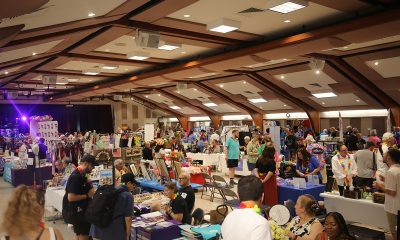



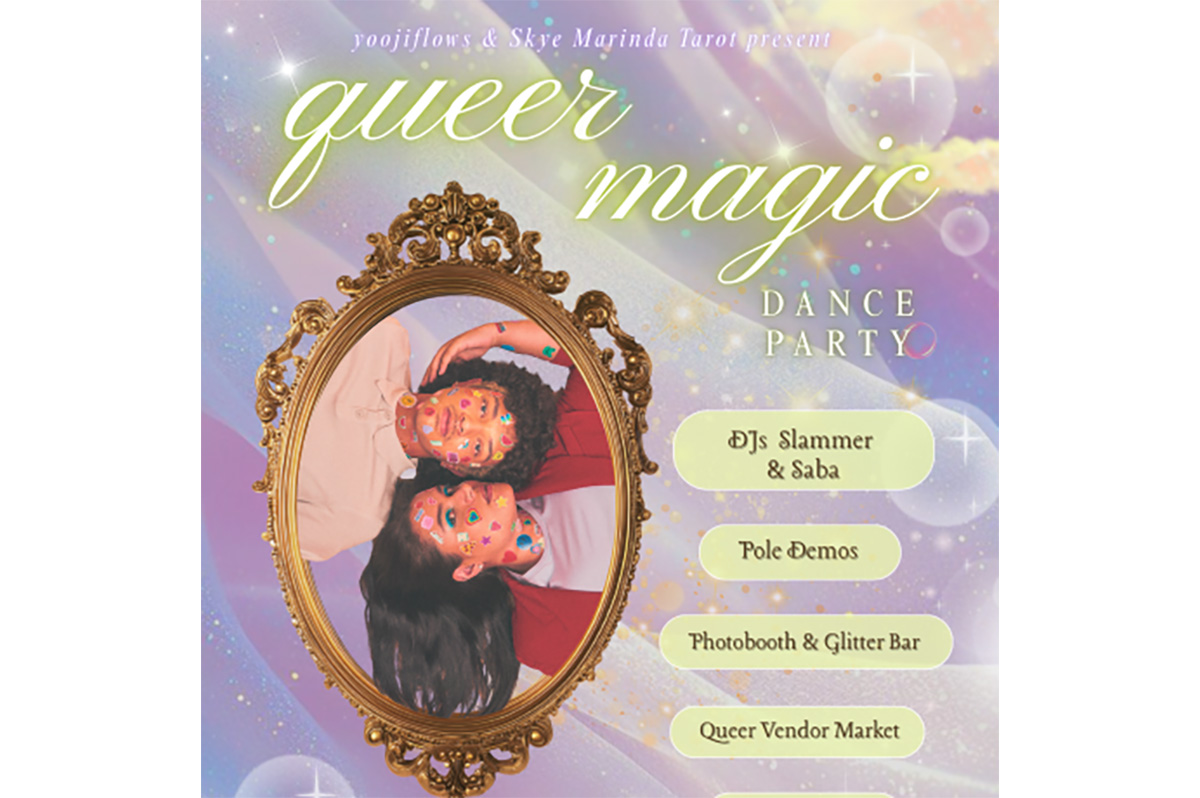
Celebrate the start of Pride month at the Queer Magic Dance Party at the Black Cat on Saturday, June 6. Doors open at 9 p.m.
There will be pole performances and demonstrations, a free photo booth with glitter bar, a queer vendor market, tarot readings by Skye Marinda Tarot, a drag performance by Sapphica, and dancing to a blend of smooth R&B, Afrobeats, hip-hop and pop by Slammer & Saba. Tickets are $20 at the door or $15 (plus fees) in advance, purchased here.
Bars & Parties
Here’s where to watch ‘RuPaul’s Drag Race’ with fellow fans
Entertainers TrevHER and Grey host event with live performance
Spark Social Events will host “Ru Paul’s Drag Race S18 Watch Party Hosted by Local Drag Queens” on Friday, Jan. 23 at 8 p.m.
Drag entertainers TrevHER and Grey will provide commentary and make live predictions on who’s staying and who’s going home. Stick around after the show for a live drag performance. The watch party will take place on a heated outdoor patio and cozy indoor space.
This event is free and more details are available on Eventbrite.
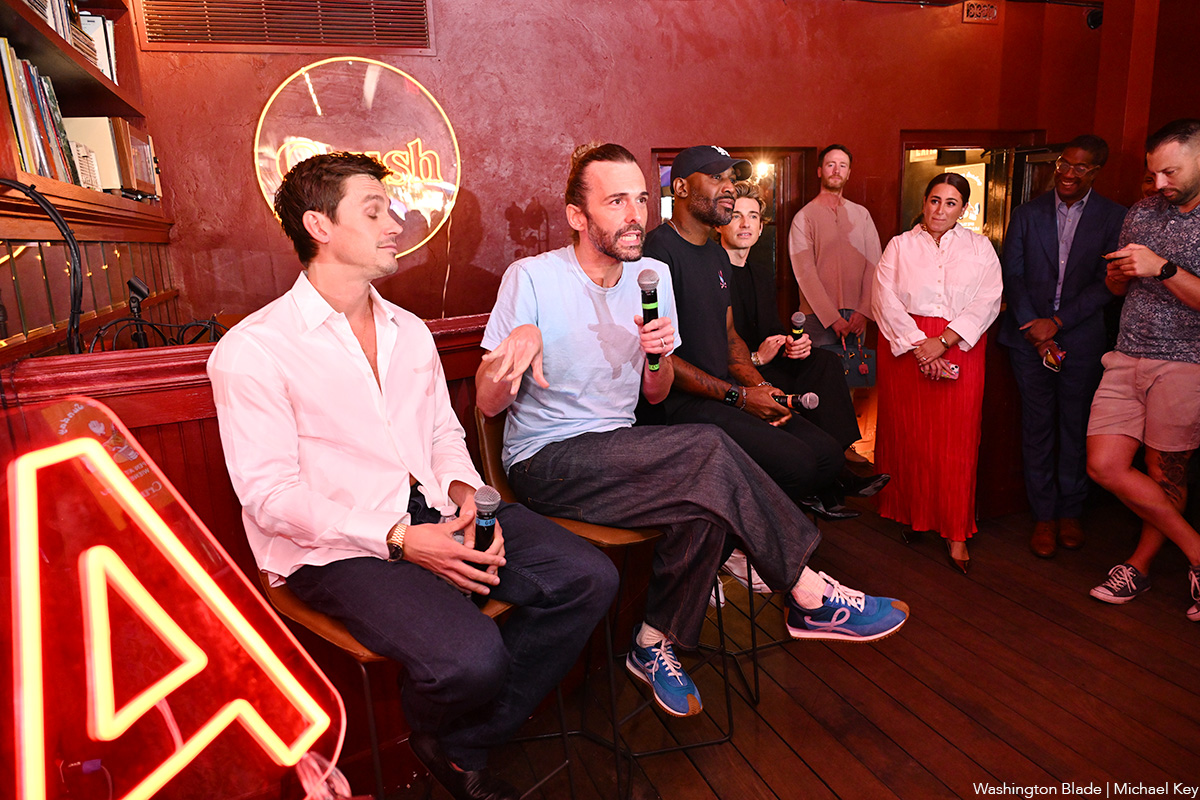
The DC Center is hosting a watch party for an episode of the 10th and final season of “Queer Eye,” which was filmed in D.C. The screening will be held on Friday, Jan. 23 from 5:30-7:30 p.m. at the Center.
The screening will last 45-55 minutes, with community time both before and after the episode. Drinks and snacks will be provided and organizers promise a “surprise or two.” For information on tickets, visit the DC Center’s website.
Supreme Court ruled Boy Scouts could exclude James Dale. Now he says that same rule protects LGBTQ scouts from Trump

Will Michigan save the GOP?

Treat our political opponents as neighbors not enemies

Flanagan beats Craig in Minn. Senate primary after winning key LGBTQ endorsements

Gay ANC commissioner sues D.C. over police ‘failure’ to pay reward money

PHOTOS: World Pride March

Tens of thousands take part in World Pride March

Don’t miss summer productions at Clear Space in Rehoboth Beach

Todd Blanche’s record on LGBTQ issues comes under scrutiny as he takes over DOJ

HISTORIC: Susan Stewart elected Rehoboth’s first out mayor
-

 Photos4 days ago
PHOTOS: World Pride March
-
Netherlands5 days ago
Tens of thousands take part in World Pride March
-
Theater3 days ago
Don’t miss summer productions at Clear Space in Rehoboth Beach
-
Federal Government2 days ago
Todd Blanche’s record on LGBTQ issues comes under scrutiny as he takes over DOJ