Bars & Parties
A passion for fashion
Gay ‘Project Runway’ alum to show collection at new Va. event
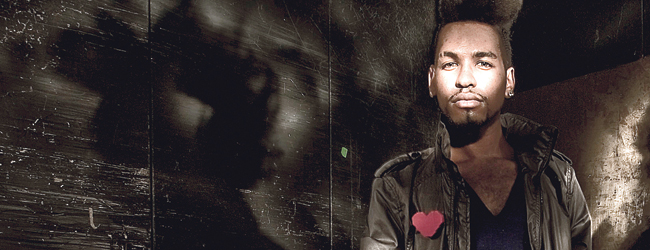
Ra’mon Lawrence Coleman collection
Oct. 23, 8 p.m.
Waterfront Park
1A Prince St.
Alexandria, VA 22314
$10-$50
Tickets are here.

Chicago native Ra'mon sidestepped a budding medical career to follow his interest in design. (Photos courtesy of Ra'mon)
Fashionistas, get ready for the runway. And don’t be thinking now about autumn/winter, but spring/summer, for fashion is always forward looking.
The second annual NOVA Fashion Week is Oct. 21 to 24 in Old Town Alexandria and designers from near and far will flock here along with buyers and the media. The entire D.C. region is beginning to make its fashion imprint felt, from Chevy Chase’s “Rodeo Drive” of luxury retailers to similar offerings of Sak’s Fifth Avenue and Neiman Marcus at Tysons Corner.
So the buzz is on and organizers hope this event will help establish the region as the next big place for fashion, buyers, customers and investors in new talent.
Thus it should be no surprise that new this year among designers showing their spring/summer 2011 collections at NOVA Fashion Week is 32-year-old Ra’mon Lawrence Coleman, a bright star among young designers with a flair for the bold and edgy but also fine hand detailing and impeccable construction. Coleman, who’s gay, describes himself as “a perpetual student.” He’s a whirlwind of energy who began his journey growing up in one of Chicago’s predominantly black neighborhoods on the South Side in a single-parent home with his mother, a teacher.
“I certainly wasn’t interested in fashion,” he says, but he acknowledges he had “a weird artistic side” and was “inclined toward musical theatre and art.”
From a pre-teen love of science and math, however, stemmed a decision to plan for pre-med studies and a career in neurological surgery, an ambition partly sparked from his mother who he says “liked the idea of saying ‘my son, the doctor.'”
A precocious high school graduate at age 15, Ra’mon (friends call him “Ray”) entered the University of Iowa on an all-expenses scholarship to major in biology, firmly ensconced on a pre-med path.
But Ra’mon says during his senior year “my next stop was med school … I had to do some critical thinking and self-analysis, and I couldn’t say ‘yes’ to the next step.” Could he really be passionate about medicine? The answer was no.
Though he earned his bachelor’s in biology, his love for theater and the arts had cast a spell over him and his laboratory focus on anatomy simply shifted from the physiological to the aesthetic. Instead of the healing arts he would choose a focus on assessing how “fabric can drape the body” in interpretations of human form and texture.
From Iowa City he moved on to the School of the Art Institute of Chicago.
“At first, I wasn’t sure of what I wanted to do,” he says. “Maybe something theatrical but then I learned they didn’t have a costume design program at SAIC.”
But they did have a program in fashion design. He created costumes for a performance piece and discovered he had an easy flair for tailoring. He entered the school’s fashion design program and went on to earn two degrees in both fine arts and performing arts.
Ra’mon’s next step was to head uptown for a design assistant job at the Price Walton Couture Lab, a design studio known to cater to the fashion forward.
“It was an eye-opening experience for me,” he says, because Price Walton was “very client-oriented, for people who want your name (as a designer) but they also want what they want.”
He could see first hand the whims of customers seeking “very specific and high-end designs,” such as for custom-ordered evening wear for Chicago socialites and politicians.
Ra’mon’s assignments were to organize trims and hand-embellish custom-made handbags but also menial tasks like cleaning the studio. He would spend hours analyzing the pattern scraps he swept up from the workspace floors and would then match each scrap to its finished counterpart.
Following his early apprenticeship there, he bounced around the four world “fashion capitals” — London, Paris, Milan, and then a stint as an intern in New York City at Gary Graham, a New York design house. Under Graham, he created jeans and a bustier that Britney Spears wore on an album cover.
But his first real step onto the fashion stage came in Washington in 2002 when the Black Fashion Museum named him apparel designer of the year, based on what he now calls his “first real novice show,” one he did in Chicago that was part of his junior year thesis at SAIC, a collection he called “Nefertiti’s Lament.” An homage to the beauteous wife of the Egyptian Pharaoh Akhenaton, Ra’mon says today that “my collection was based on my idea of what I would offer Nefertiti as a woman.”
“She was an empowered figure of her time,” he says, and in tribute to her feminine power Ra’mon created a look in silks and chiffons that made a real mark.
“It was my first exploration of architectural silhouettes,” he says, and even included one garment where “the sleeve is also the hem … it’s one of those things where you just have to see it to believe it.”
In 2004, Ra’mon came to Minneapolis to be an associate designer for Target’s Massimo label, which he has described as “a very long training course,” staying there for five years learning what he calls “fashion for the mass market.”
While at Target, during a Twin Cities fashion week in April 2008, he also launched a line of his own creations in his “Eluded Love” solo show featuring 52 looks with muted mauves and creams, sculptural shapes and with a remarkable range from ornate beading on an evening shift dress to hand finishing on a sheer T-shirt, and even safari-esque menswear.
But in September 2008, he left Target to compete on reality TV and take his chances on season six of “Project Runway” with the sudden-death eliminations and often absurdist design challenges under the judging of supermodel Heidi Klum with Tim Gunn as mentor to the aspiring designers. The glittering first prize was $100,000 to start a line of clothing and an all-expenses-paid trip for two to Paris. The shows aired on the Lifetime cable network beginning a year later in the fall of 2009.
Ra’mon started off strong in the competition, looking like a favorite to make it to the finals, scoring a “high” in one competition, to design a dress for a red-carpet event on a $200 budget, and ended the third episode with a “win” from a competition to create fashionable surfer-inspired beachwear.
He held his own through two more rounds, but his luck ran out in the sixth face-off when the judges declared that he flubbed the assignment to create a movie character inspired by the science-fiction genre.
“I took a risk,” Ra-mon says, “and it was the least impressive design that I have ever done, but I respect the decision.” At the time, however, he was “utterly shocked, because I had won other challenges.”
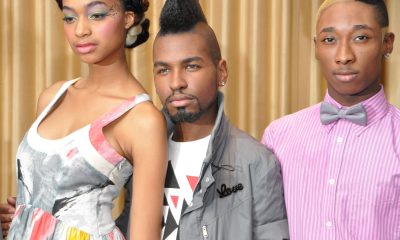
More recently, he has moved on to tackle design assignments for the Mudd label for Kohl’s, the giant mid-priced department store chain, and has also showed a spring 2010 collection during New York’s fashion week. But now comes the next hurdle — his spring/summer 2011 collection for both men and women’s wear for NOVA Fashion Week. He has named his collection “Give Them Grace,” based, he says, around Grace Jones, the actress and performer he calls “an iconic, androgynous figure.”
His colors will be “a little bit more bold,” he says, “not muted at all but bright and vibrant,” and with a “punchy” pizzazz that he calls “pop-y” and “a hybrid of everything — from a futuristic spin forecasting a look for the year 2033, to a more ethnic look, but more abstract.”
He’ll also showcase a menswear collection (another was last year in New York), showing what he calls “a sense of androgyny without being at all feminine.”
“I like to be edgy,” he says. “That might even be uncomfortable for people to look at, but I am what I like to think of as a thinking designer.”
He sees “fashion everywhere — in pop culture, in music, in movies,” no longer the remote and closed-off preserve of a Vogue magazine clientele much less the haute couture (French for “high dressmaking”) of Paris ateliers with all custom-fitted, hand-sewn, one-of-a-kind and prohibitively expensive designs.
“I feel very fortunate right now,” says Ra’mon, who remains based with his design studio in Minneapolis. “I design for someone very opinionated, someone who is not shy in a crowd and who wants to make a statement but in a very affordable way.
Whether they can spend $50 or $5,000 the trends are the same. They want the same things, but within their budget, and as a designer you need to understand that just because someone has less money does not mean they want to have less quality. I have done mass market and high end, but my label is right in the middle.”
His current price tags range from $75 for a knit top to as high as $3,000 for custom-designed eveningwear. His label was in two stores in Minneapolis but he has discontinued that arrangement and is hoping now to find a retail base in New York City, Los Angeles and Chicago — and maybe also the D.C. area, using NOVA Fashion Week as a springboard.
Fashion Week is at 1A Prince Street in Old Town Alexandria, across from National Harbor. The event’s proceeds go to three charities: the Lupus Foundation of America, Susan G. Komen for the Cure and Baby Haven. Tickets to see the new Ra’mon Lawrence Coleman collection, to be shown Oct. 23 at 8 p.m., range from $50 for the front row to $10 for the back row and are on sale here.



Bars & Parties
Lesbian Bar Project co-founder: purity politics could destroy our remaining spaces
Last Ditch’s decision to lift its mask requirement for one night a week has sparked intra-queer controversy
Uncloseted Media published this story on Sept. 29
By ERICA ROSE and THE LESBIAN BAR PROJECT | As a professional lesbian and Massachusetts native, I’ve recently been asked by a lot of folks what I think about the saga unfolding at Last Ditch. The now-viral story, first reported by the Boston Globe, centers on a Western Massachusetts lesbian bar that lifted its mask requirement for one night a week to help drum up business.
The decision ignited an intra-queer controversy that has been feasted on by media outlets across the political spectrum — from the New York Post to LGBTQ Nation — and is even reportedly being eyed for a Hollywood adaptation. Apparently nothing is more entertaining than a bunch of lesbians and queers fighting with each other over KN-95s.
What has been lost in all of the chatter and media coverage is the very real possibility that Last Ditch, which just opened in April 2025, will have to close its doors. The venue’s one remaining founder, Jackie Matellian, revealed in a community Zoom meeting that she’s working four jobs, is now solely responsible for the bar’s $50,000 business loan and is struggling to keep up with the bills. So as we laugh about the controversy’s similarity to a “Portlandia” skit and how one of the bar’s founders left to enroll in clown school, we forget that yet another lesbian bar is facing an existential crisis — and this time the call is coming from inside the house.
In 2020, my friend Elina Street and I created The Lesbian Bar Project, an Emmy-, Webby- and GLAAD Media Award-winning docuseries and initiative that tells the stories of lesbian queer bars around the world. We were moved to act because at the time there were only an estimated 16 lesbian bars in the United States, and the pandemic threatened to bring that number down even further.
There are now more sapphic bars than there were just before the pandemic — about 36 of them in total — but this is down from approximately 200 in 1980. Maybe that doesn’t mean much to you, but for the millions of sapphics living in the U.S., this number is calamitous.
As the world laughs at lesbians and sapphics, I want to take a second and tell you what I feel when I walk into one of these bars, which are all unique and irreplaceable in their own way: I feel seen.
Sometimes I think Cubbyhole in New York City’s West Village neighborhood knew I was gay before I did. When I walked in there for the first time, before I was even out, I was transfixed by the colorful array of tchotchkes hanging from the ceiling and how the women standing next to me were completely unafraid to express their desire for one another. I knew the minute I was ready to come out, I had a home. I also felt the joy of a new couple falling in love at Seattle’s Wildrose, the quiet confidence of a short king lining up her shot at the pool table at Ginger’s in Brooklyn and the kick of cayenne pepper in Julie Mabry’s crawfish at Houston’s Pearl Bar.
Lesbian bars don’t just serve lesbians; they serve queer folks across the spectrum, including bisexual, pansexual and trans people. As Elina and I traveled across the U.S. and Europe and to parts of Latin America to document the bar owners, staff and patrons that make up the ecosystems of these spaces, we also became uniquely acquainted with the factors that threaten their existence: gentrification, wage gaps, sexism, environmental disasters, gun violence, rising insurance premiums and political administrations working to annihilate queer people and their families.
Lesbian bar owners, like all leaders and entrepreneurs, are imperfect. There have been significant issues over the years at lesbian bars: employee harassment, racism, lack of accessibility, sexual assault and transphobia. All bar owners should be held accountable and should listen to their communities to evolve into safer and more equitable spaces. I also acknowledge my privilege: I am able-bodied, white, cis and from a family system that loves me for who I am. Not everyone has that.
Queer people, especially trans and bisexual people, are suffering from disproportionately high levels of depression, and our mental health system isn’t equipped to support them. Immunocompromised people and long COVID are real, and many of my friends are suffering to this day. The people with the least safety net are often the ones for whom a bar closing costs the most. And yet, as we’re seeing with Last Ditch, the queer community often lashes out at each other. It’s also the mainstream media taking the internal conflict and making a mockery out of it, distracting from the real possibility that this bar could close due to financial pressures. A bar that many people loved and needed is facing extinction. Perhaps it’s safer to dissent with one another than with the larger forces trying to eradicate us, but in doing so, we risk destroying the few spaces we have left.
Due to the constraints of purity politics — some in good faith, some not so much — lesbian bar owners, almost all of whom are queer women themselves, are forced to be everything for everyone, similarly to how women are forced to be everything for everyone. By asking these bars to uphold impossible standards — standards very few other third spaces are asked to consider — we all end up losing.
I want to move as a community toward dialogue, compassionate dissent and collaboration to make our spaces better with the goal of keeping them OPEN and thriving, rather than destroying them from the inside with expectations that are arguably unattainable.
While I have your attention — for this fleeting second of the news cycle — may I urge us to spearhead a way to keep these small businesses afloat without attacking our own community along the way? Bar owners are left with an impasse: They want to be community-centered, but they also have to make money to keep their doors open. Sometimes they might make business decisions that don’t work for everyone — and that’s partly because different patrons have different priorities and want different things — but these owners deserve the opportunity for productive dialogue. We have to work with them and with each other to keep our spaces open, to keep them growing.
Lesbian bars raised me into the queer woman I am today. One thing I think about as I reflect on the six years of work we’ve done to document these spaces is that shared, unspoken language I have with a stranger the moment we both walk into one of these bars: the nod, the ease, the not having to explain ourselves. I don’t want to lose that, and neither should you.
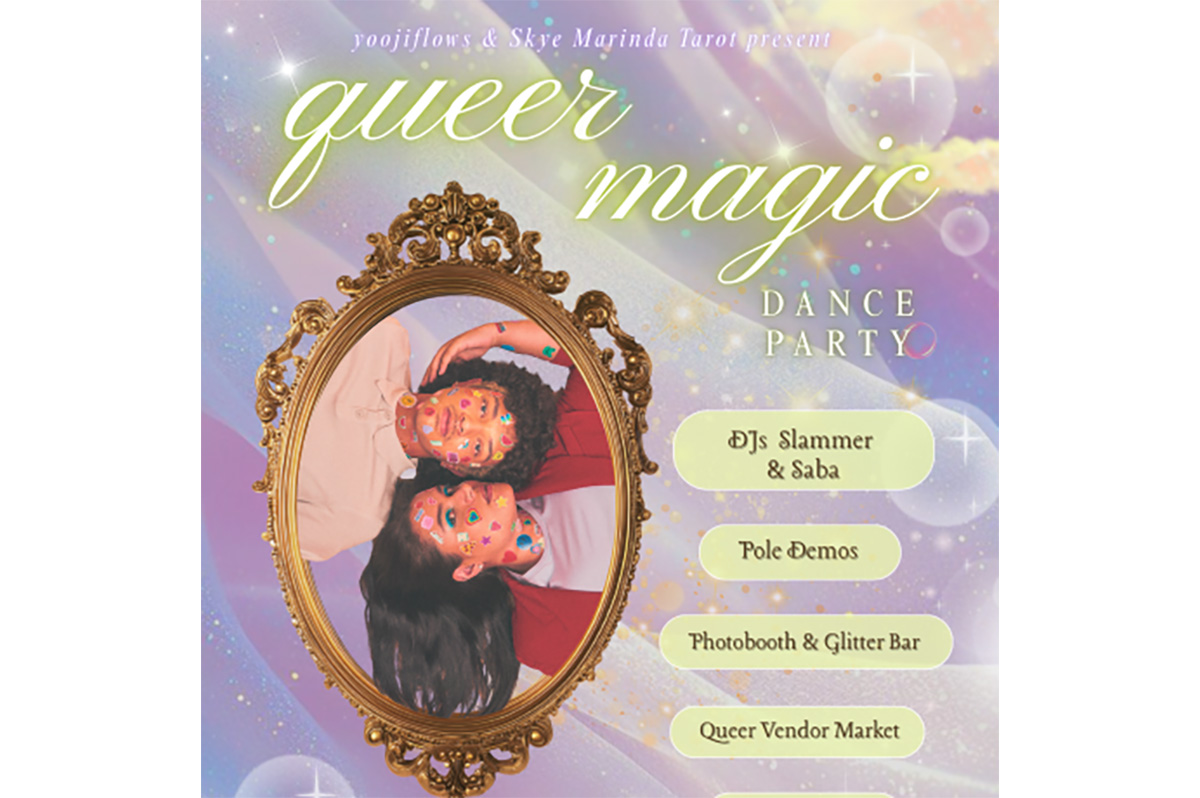
Celebrate the start of Pride month at the Queer Magic Dance Party at the Black Cat on Saturday, June 6. Doors open at 9 p.m.
There will be pole performances and demonstrations, a free photo booth with glitter bar, a queer vendor market, tarot readings by Skye Marinda Tarot, a drag performance by Sapphica, and dancing to a blend of smooth R&B, Afrobeats, hip-hop and pop by Slammer & Saba. Tickets are $20 at the door or $15 (plus fees) in advance, purchased here.
Bars & Parties
Here’s where to watch ‘RuPaul’s Drag Race’ with fellow fans
Entertainers TrevHER and Grey host event with live performance

Spark Social Events will host “Ru Paul’s Drag Race S18 Watch Party Hosted by Local Drag Queens” on Friday, Jan. 23 at 8 p.m.
Drag entertainers TrevHER and Grey will provide commentary and make live predictions on who’s staying and who’s going home. Stick around after the show for a live drag performance. The watch party will take place on a heated outdoor patio and cozy indoor space.
This event is free and more details are available on Eventbrite.

Eliot Glazer’s new book an engaging collection of essays

Equality Chamber hosts Pride in Business Expo and Profits & Pours

Learn more about Virginia’s queer history

Annapolis Pride arrives this weekend

Calendar: October 2-8

529 openly LGBTQ candidates running in Brazilian election

Meet the LGBTQ candidates running for U.S. House, Senate

Ana Brnabić becomes world’s first openly lesbian head of state

Vote now! Best Of LGBTQ DC readers’ choice awards

Gay Va. couple hopeful voters will enshrine marriage equality in state constitution
-

 Brazil5 days ago
529 openly LGBTQ candidates running in Brazilian election
-
2026 Midterm Elections4 days ago
Meet the LGBTQ candidates running for U.S. House, Senate
-
Serbia4 days ago
Ana Brnabić becomes world’s first openly lesbian head of state
-
Arts & Entertainment4 days ago
Vote now! Best Of LGBTQ DC readers’ choice awards