National
Murphy introduces new ‘Don’t Ask’ legislation
House could vote on legislation on Wednesday
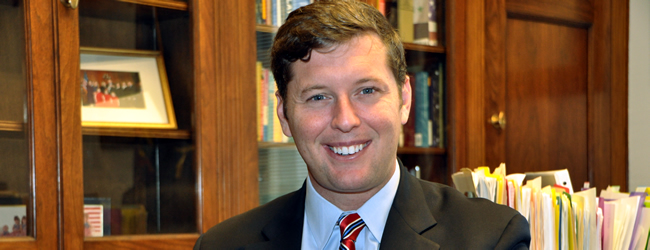
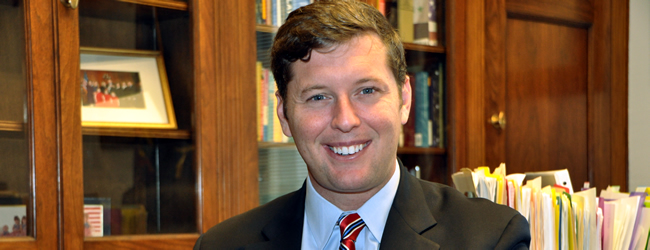
Rep. Patrick Murphy on Tuesday introduced new "Don't Ask" repeal legislation (Blade photo by Michael Key).
Rep. Patrick Murphy (D-Pa.) today introduced new “Don’t Ask, Don’t Tell” repeal legislation in the U.S. House that, according to one repeal advocate, could see a vote as soon as Wednesday.
Aubrey Sarvis, executive director of the Servicemembers Legal Defense Network, said the introduction of the bill is part of a plan concocted by U.S. House Speaker Nancy Pelosi (D-Calif.) and House Majority Leader Steny Hoyer (D-Md.) to pass repeal before time expires in the lame duck session of Congress.
In a statement, Sarvis said House leadership intends to have a vote on repeal in the House on Wednesday and to send the legislation to the Senate as a “privileged” bill.
Having the vote first in the House and sending the bill to the Senate as “privileged” legislation would allow the Senate would be able to take up the measure without having a cloture vote on the motion to proceed. Still, the Senate would need 60 votes to proceed to final passage of the legislation.
“This ‘privileged’ House bill will need to pass the full House and then move to the Senate,” Sarvis said. “While we avoid a cloture vote to proceed and save time on the Senate floor, we’ll still need 60 votes to complete the bill and send it directly to the President’s desk. Repeal supporters need to contact their House member to vote for repeal tomorrow.”
Drew Hammill, a Pelosi spokesperson, confirmed that the vote would take place on Wednesday, although he said he couldn’t offer a time for when the vote would take place.
In a statement, Murphy said the time to repeal “Don’t Ask, Don’t Tell” has come and he’s “insulted” by those who say the U.S. military can’t handle open service when foreign nations such as Isreal and the United Kingdom “allow their troops to serve openly with no detriment to unit cohesion.”
“I’m proud to stand with the secretary of defense, the chairman of the Joint Chiefs of Staff, and the majority of servicemembers and the American public who all support repeal of this discriminatory policy that harms our national security and military readiness,” Murphy said.
In the Senate, Sen. Joseph Lieberman (I-Conn.) introduced companion repeal legislation last week after the chamber failed to reach the 60-vote threshold to move forward with major defense budget legislation containing “Don’t Ask, Don’t Tell” language.
Like the legislation introduced by Lieberman, Murphy’s bill is identical to the “Don’t Ask, Don’t Tell” provision that’s currently in the fiscal year 2011 defense authorization bill.
Language in the both the House and Senate bill state that repeal wouldn’t take effect until the president, the defense secretary and the chair of the Joint Chiefs of Staff certify that the U.S. military is ready to implement open service.
Alex Nicholson, executive director of Servicemembers United, praised Murphy for introducing the legislation in the House.
“The swift introduction of an identical repeal bill in the House shows that continued efforts to repeal ‘Don’t Ask, Don’t Tell’ this year are still very much alive and the process is moving forward,” Nicholson said. “We are especially grateful to Speaker Pelosi, Leader Hoyer, and Congressman Murphy for their commitment to drive on despite temporary setbacks in the Senate.”






Florida
DeSantis signs emergency bill that restores Fla. ADAP funding
Temporary funds to last through June 30
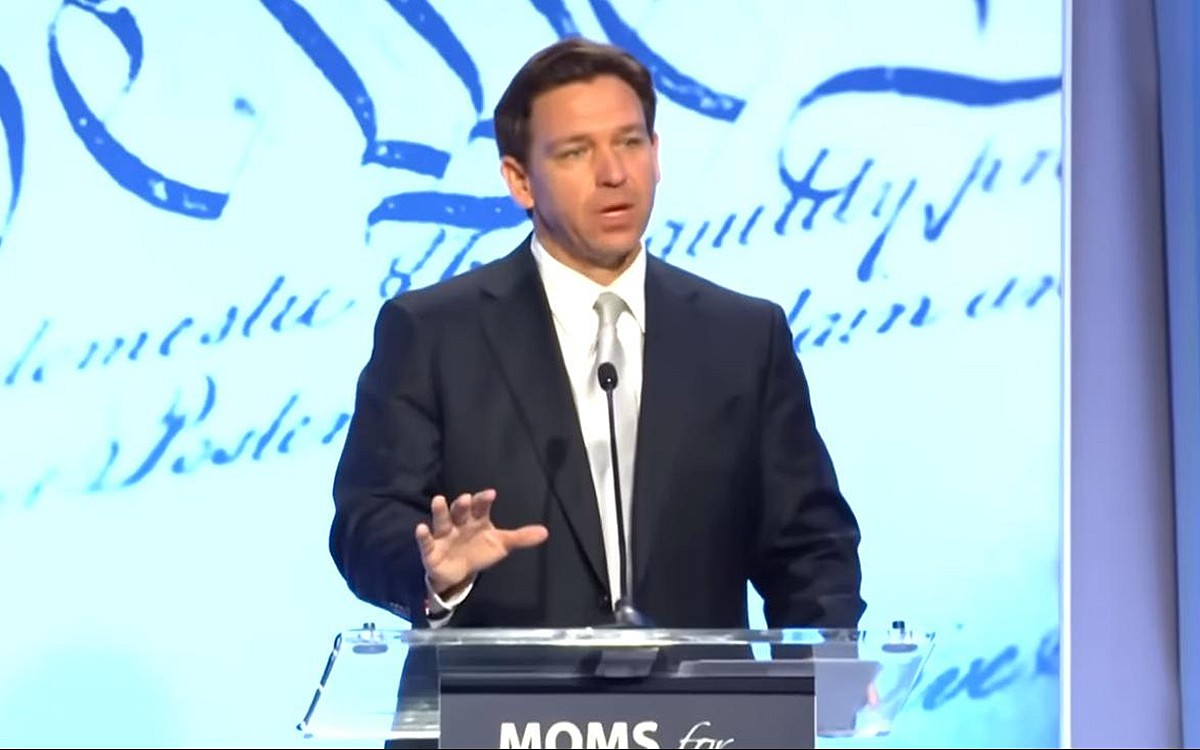
After the Florida Department of Health made huge cuts to the AIDS Drug Assistance Program in January, Republican Gov. Ron DeSantis has signed emergency legislation restoring HIV access to more than 12,000 Floridians.
Two months ago, as the Washington Blade reported, the Sunshine State cut the vast majority of those in ADAP by shifting the income levels required for eligibility — without following standard procedure when changing government policy outside of legislative or executive action.
The bill, signed by DeSantis on Tuesday, passed both chambers of the Florida Legislature unanimously and appropriates $30.9 million in emergency bridge funding through June 30, 2026. It restores Florida’s ADAP income eligibility to 400 percent of the Federal Poverty Level — the level it was prior to the January cuts. The legislation also requires the FDOH to submit detailed monthly financial reports to legislative leadership beginning April 1.
Under the old policy, eligibility would have been limited to those making no more than 130 percent of the federal poverty level, or $20,345 per year.
“For 10 weeks, 12,000 Floridians living with HIV did not know if they could fill their next prescription. Today, they can,” Esteban Wood, director of advocacy and legislative affairs at AIDS Healthcare Foundation, said in a statement.
The detailed reports now required to be sent to legislative leadership must include all federal revenues and expenditures, including manufacturer rebates; enrollment figures by county and insurance status; prescription utilization by drug class; and any projected funding shortfalls. This is the first time the Legislature has required this level of financial transparency from the program.
DeSantis signed the legislation one day after a Leon County Circuit Court judge denied AIDS Healthcare Foundation’s request for an injunction to block the significant changes the DeSantis administration is making to the program, which it claims faces a $120 million shortfall for calendar year 2026.
AIDS Healthcare Foundation, a national organization focused on protecting and expanding HIV healthcare access and prevention methods, filed a lawsuit over the change in eligibility, arguing the Florida Department of Health did not follow the laid out path for formally changing policy and was acting outside established procedures.
Typically, altering eligibility for a statewide program requires either legislative action or adherence to a multistep rule-making process, including: publishing a Notice of Proposed Rule; providing a statement of estimated regulatory costs; allowing public comment; holding hearings if requested; responding to challenges; and formally adopting the rule. According to AIDS Healthcare Foundation, none of these steps occurred.
The long-term structure of ADAP will be determined by the 2026–2027 fiscal year state budget, something that lawmakers have until June 30 to finish.
Federal Government
Markwayne Mullin confirmed as next DHS secretary
Okla. senator to succeed Kristi Noem
The U.S. Senate confirmed Markwayne Mullin as the next secretary of Homeland Security on Monday, as the agency continues to grapple with what lawmakers have described as a “never-ending” funding standoff, with Democrats attempting to withhold funding from one of the nation’s largest and most costly agencies.
Mullin — a Republican senator from Oklahoma, former mixed martial arts fighter, and plumbing business owner — was confirmed in a 54–45 vote. Two Democrats — U.S. Sens. John Fetterman (D-Pa.) and Martin Heinrich (D-N.M.) — sided with Republicans in supporting his confirmation.
The new agency head is expected to follow the policy direction set by President Donald Trump, emphasizing stricter immigration enforcement. This includes proposals to support immigration agents at polling sites and to cut funding to so-called “sanctuary cities.”
Mullin replaces Kristi Noem, who was fired earlier this month following a widely scrutinized 2-day congressional hearing on Capitol Hill.
During the hearing, Noem faced intense questioning over her response to several crises, including the fatal shooting of two American citizens in Minneapolis by U.S. Immigration and Customs Enforcement agents, a $220 million border security advertising campaign that featured her on horseback near Mount Rushmore amid one of the largest federal workforce reductions in U.S. history, and the federal response to major natural disasters such as the July 2025 Texas floods and Hurricane Helene in 2024.
Noem had previously drawn criticism for a series of policy decisions in South Dakota that broadly focused on restricting the rights of LGBTQ individuals. In 2023, she signed House Bill 1080, banning gender-affirming medical care for transgender minors. She also signed legislation and executive orders restricting trans athletes’ participation in women’s sports, as well as the state’s “Religious Freedom Restoration Act,” which critics argued enabled discrimination against LGBTQ individuals. Additionally, the state canceled contracts related to LGBTQ support services — including suicide prevention and health care navigation programs‚ and later agreed to a $300,000 settlement with trans advocacy group, The Transformation Project.
Despite her removal from DHS, Noem will remain in the Trump-Vance administration as a special envoy for the “Shield of the Americas,” an initiative aimed at promoting U.S. influence in the Western Hemisphere, including efforts to counter cartel networks, reduce Chinese influence, and manage migration.
The new head of DHS has served in Congress since 2013, in both houses of the federal legislature. While in the Senate and a member of the Health, Education, Labor, and Pensions (HELP) Committee, Mullin has been a vocal critic of policies aimed at expanding LGBTQ inclusion. He led a group of lawmakers in urging the Administration for Community Living to reverse a rule requiring states to prioritize Older Americans Act services based on sexual orientation and gender identity, arguing the policy could have unintended consequences.
Mullin also makes history as the first Native American — and a citizen of the Cherokee Nation — to lead the Department of Homeland Security. He was also among the 147 Republicans who voted to overturn the 2020 presidential election results despite no evidence of widespread fraud, and was present in the U.S. House of Representatives chamber on Jan. 6.
Federal Government
Protesters say SAVE Act targets voters, transgender youth
Bill described as ‘Jim Crow 2.0’
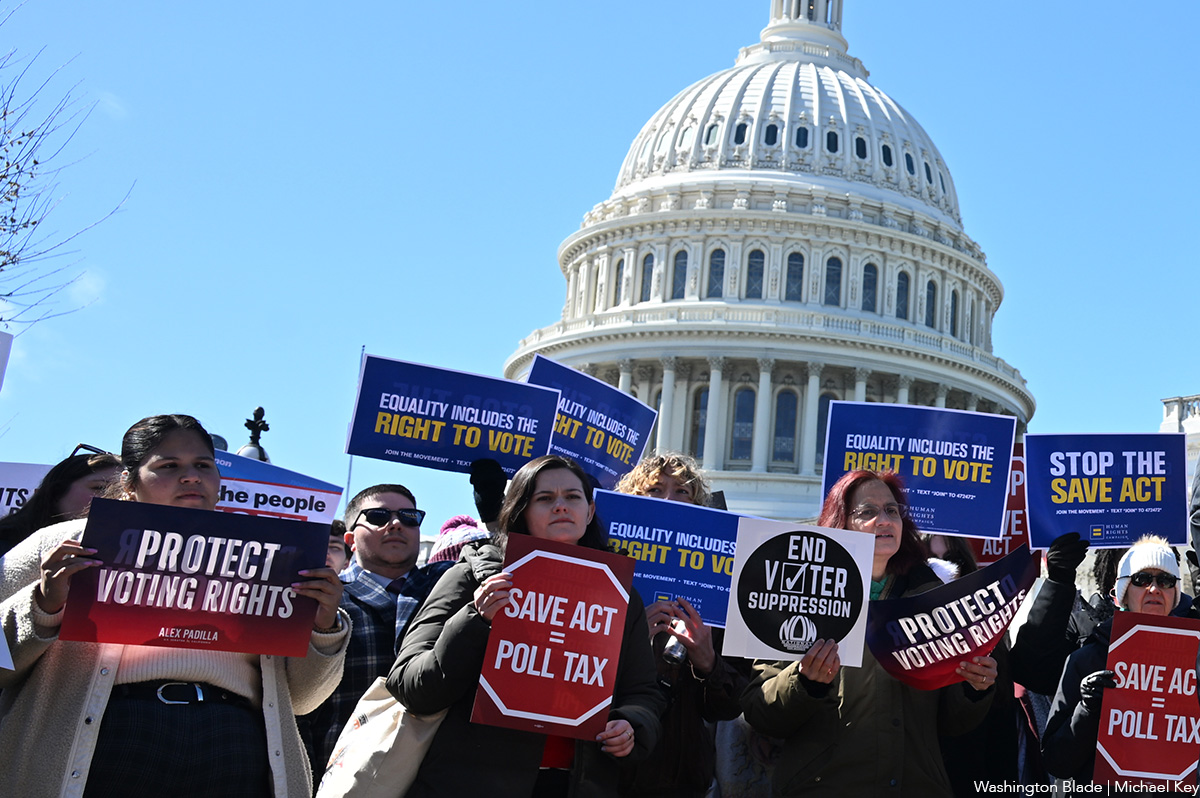
Members of Congress, advocates, and people from across the country gathered outside the U.S. Capitol on Tuesday to protest proposed federal legislation that voting rights activists have deemed “Jim Crow 2.0.”
The Safeguard American Voter Eligibility (SAVE) Act would amend the National Voter Registration Act of 1993 to require in-person proof of citizenship for anyone seeking to vote in U.S. elections.
President Donald Trump has also pushed for the proposed legislation to include a section that would ban gender-affirming medical care for transgender minors, even with parental consent, and prohibit trans people from participating in school or professional sports consistent with their gender identity rather than their sex assigned at birth.
In addition to changing voter registration requirements, the bill would limit acceptable forms of identification to documents such as a birth certificate or passport — records that the Brennan Center for Justice estimates more than 21 million Americans do not have — effectively restricting access to the ballot. It would also ban online voter registration, DMV voter registration efforts, and mail-in voter registration.
A 2021 investigation by the Associated Press found that fewer than 475 people voted illegally or improperly, a tiny fraction of the estimated 160 million Americans who voted in the 2020 election.
Senate Minority Leader Chuck Schumer (D-N.Y.) spoke at the event.
“It will kick millions of American citizens off the rolls. And they don’t even require you to be told,” the highest-ranking Democrat in the Senate told protesters and reporters outside the Capitol. “If this law passes — and it won’t — you’re gonna show up in November … and they’ll say… sorry, you’re no longer on the voting rolls.”
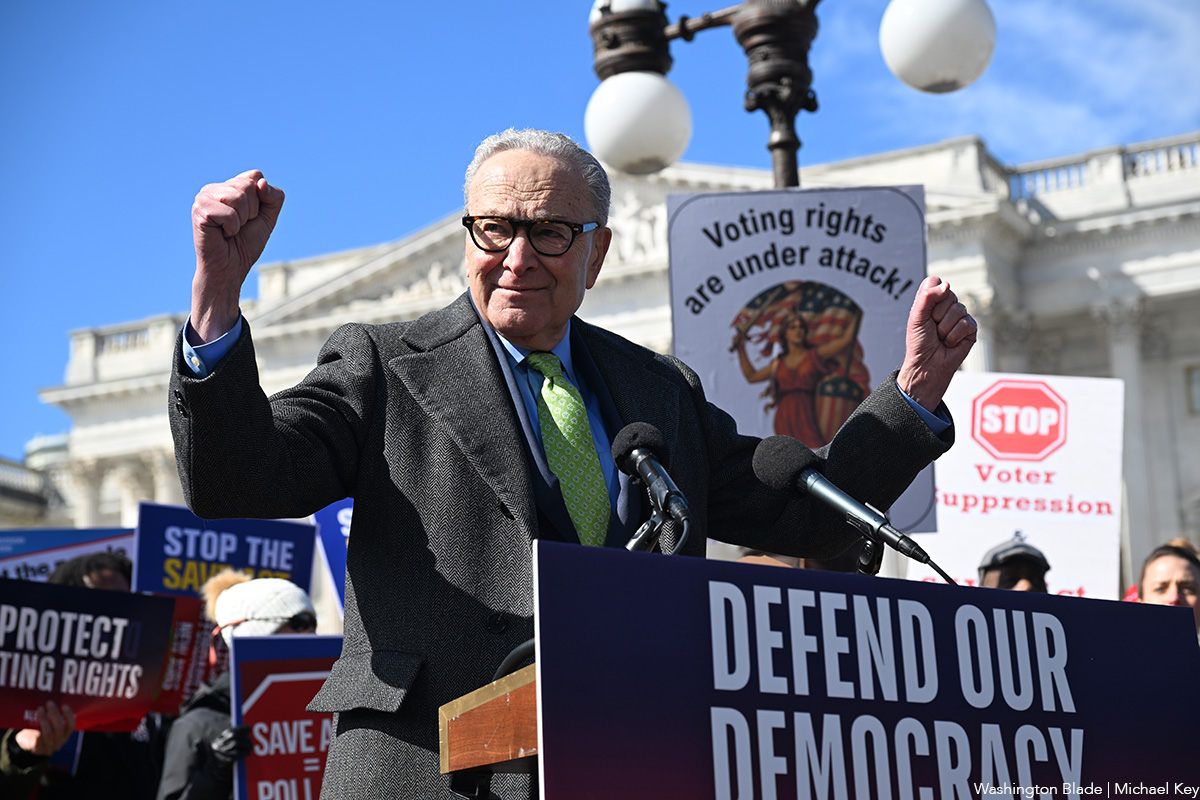
He, like many other speakers, emphasized the bill in the context of American history, pointing to what he described as its racist roots and its impact on Black and brown Americans.
“I have called this act, over and over again, Jim Crow 2.0 … because they know it’s the truth.”
U.S. Sen. Alex Padilla (D-Calif.) was one of the lawmakers leading opposition to the legislation and spoke at the rally.
“It’s not just voting rights that are on the line — our democracy is on the line,” the California lawmaker said. “It’s not a voter I.D. bill. It’s a bait and switch bill.”
He added historical context, noting the significance of voting rights legislation passed more than 60 years ago. In 1965, Alabama civil rights activists marched to protest barriers to voter registration. Alabama state troopers violently attacked peaceful demonstrators at the Edmund Pettus Bridge in Selma, using tear gas, clubs, and whips against more than 500 — mostly Black — protesters.
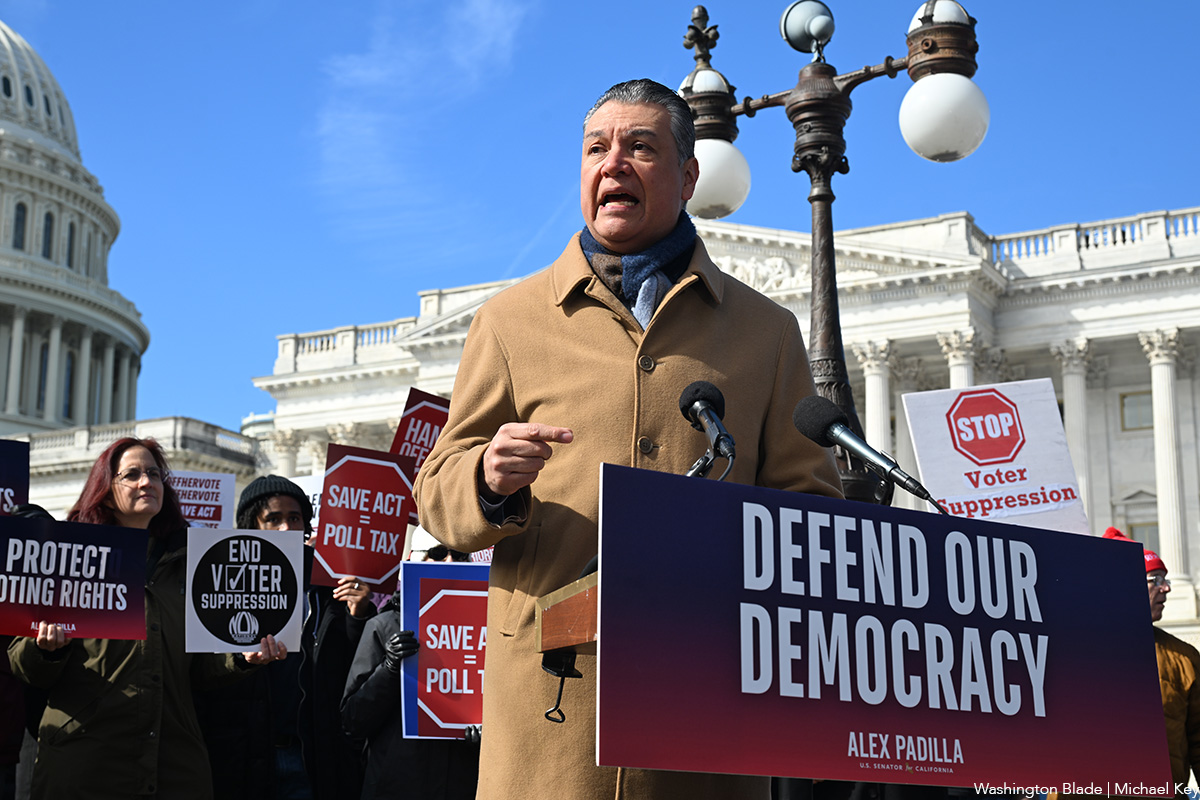
“61 years ago — not to the day — but this week, President Lyndon Johnson came to the Capitol and addressed a joint session of Congress in the wake of Bloody Sunday and pushed Congress to pass the Voting Rights Act,” Padilla said. “61 years later, Donald Trump and this Republican majority wants to take us backwards. We’re not gonna let that happen.”
U.S. Sen. Ben Ray Luján (D-N.M.) also spoke, emphasizing that he views the effort as a Republican-led and Trump-backed attempt to restrict voting access, particularly among Black, brown, and predominantly Democratic communities.
“President Trump told Republicans when they were meeting behind closed doors that ‘The SAVE Act will guarantee Republicans win the midterms and ensure they do not lose an election for 50 years,’” Luján said. “The first time I think Donald Trump’s been honest … This voter suppression bill is only that. Taking away vote by mail? I hope my Republican colleagues from states that voted for Donald Trump or where vote by mail is popular have the courage and the backbone to stand up and say no to this nonsense, because their constituents are going to push back.”
U.S. Sen. Lisa Blunt Rochester (D-Del.) also spoke.
“Our Republican colleagues have already cut Medicaid, Medicare, people don’t know how they’re gonna be able to afford energy,” she said, providing context for the broader political moment. “We’re in the middle of a war that they can’t even get straight while we’re in it and don’t have a way to get out of it. And we are now faced with defending our democracy?”
She then showed the crowd something that she said has been with her throughout her political journey in Washington.
“I brought with me something that I carried on the day that I was sworn into the House of Representatives when I was elected in 2016, and I carried it with me on the day that I was sworn in as United States senator. And I also carried it with me when I was trapped up in the gallery on Jan. 6 and all I could think to do was pray … This document allowed my great great great grandfather, who had been enslaved in Georgia, to have the right to vote. We took this and turned it into a scarf. It is the returns of qualified voters and reconstruction code from 1867. This is my proof of what we’ve been through. This is also our inspiration.”
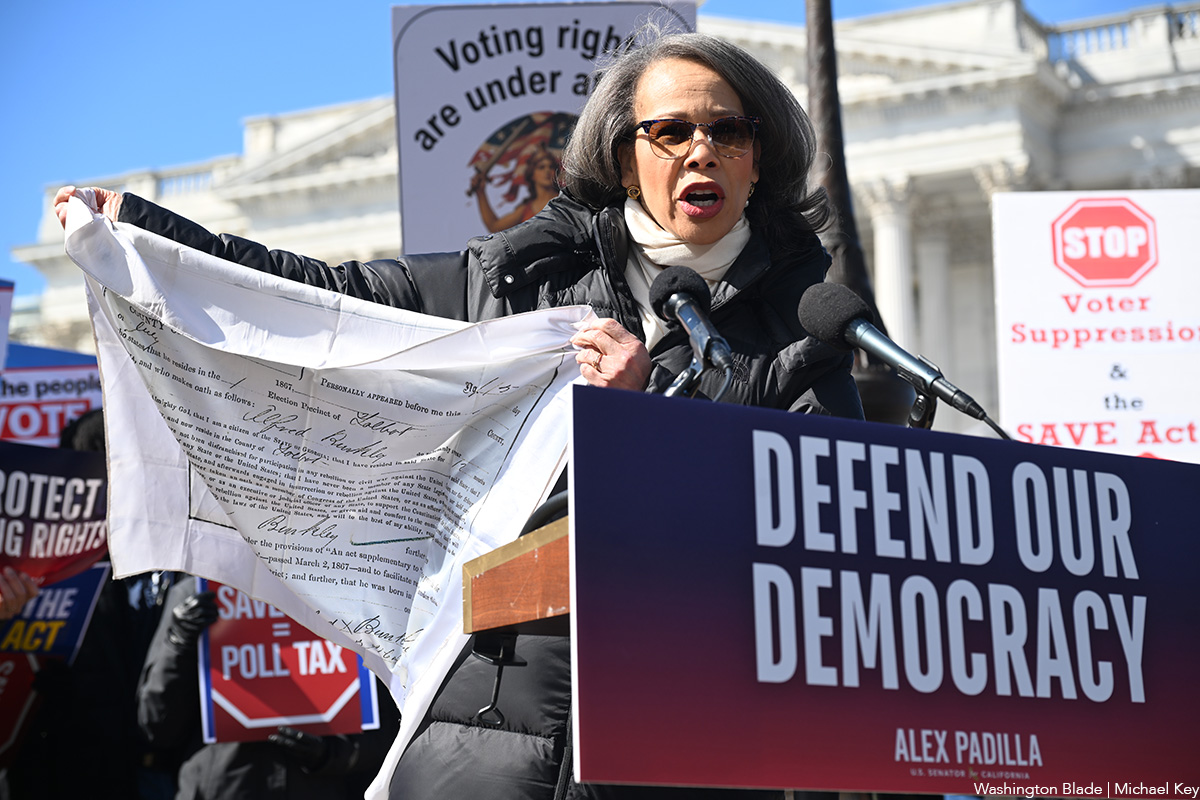
“I got to travel between the Edmund Pettus Bridge two times. And even as I thought about this moment, I recognized that while we wish we weren’t in it, while we don’t know why we’re in it, I do know we were made for it … So I came today to tell you that, um, just like the leader said, that he calls it Jim Crow 2.0. I call it Jim Crow 2.NO.”
Kelley Robinson, president of the Human Rights Campaign, the largest LGBTQ advocacy organization in the U.S., also spoke, highlighting the impact of the bill’s proposed provisions affecting trans people.
“This bill is not about saving America. This bill is about stealing an election. This bill is about suppressing voters,” Robinson said. “This bill not only tries to disenfranchise voters that deserve their right to vote, it also tries to criminalize trans kids and their families … It tries to criminalize doctors providing medically necessary care for our trans youth.”
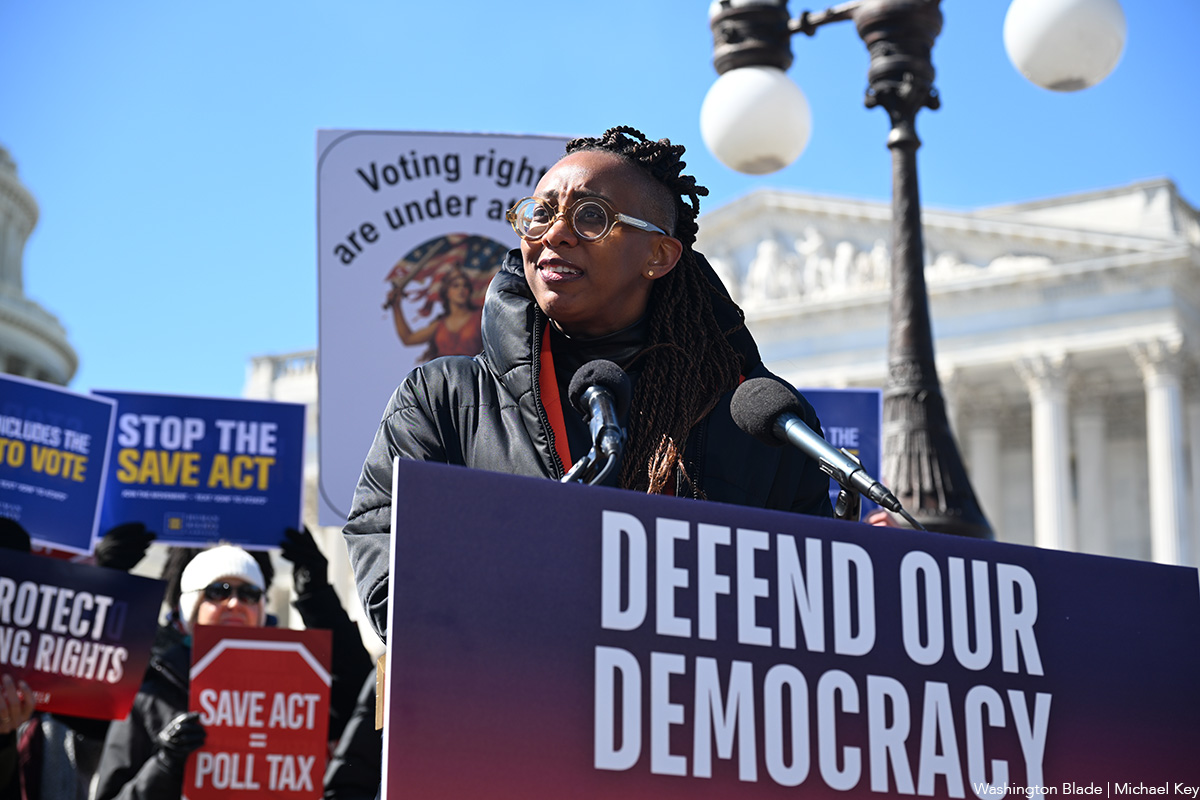
The SAVE Act passed the U.S. House of Representatives on Feb. 11 but has not yet been considered in the U.S. Senate.

DeSantis signs emergency bill that restores Fla. ADAP funding

Menaka Guruswamy celebrated as India’s first openly LGBTQ MP

Trans-led HIV clinic in Portsmouth struggles amid funding cuts

D.C. goes gaga for Gaga

Gay priest credited with boosting church support for LGBTQ Catholics

‘How We Survived’ panel set for March 25

Calendar: March 21-26

PHOTOS: Capital Stonewall Democrats 50th anniversary

‘Inherit the Wind’ isn’t about science vs. religion, but the right to think