Opinions
Learning from adversarial activism of the past
Why LGBT advocates are better off now that the ‘love affair’ is over
With the Netroots Nation 2011 convention having taken place in Minneapolis last month, media coverage was filled with stories about how liberal and progressive activists have been disappointed with the Obama administration. LGBT activists have been at the center of many of these stories, as they have had much to criticize the president for – his slow action on repeal of “Don’t Ask, Don’t Tell” and his vague and shifting stance on same-sex marriage.
These issues have forced a debate within the progressive base as to the degree to which he should be supported in his upcoming bid for reelection. In some circles, there is talk about the need to stand with the president so as to not cost him political capital. This is based on the idea that any attempt to challenge the president will weaken his image and may cost him a second term, leading to a Republican win and a more conservative regime that would be an active opponent of gay rights.
But while these fears are understandable, activists need to remember how much historical precedent there is for using the pressure of the grassroots to remind politicians that they are expected to do the right thing.
LGBT activists should look back to the Mississippi Freedom Democratic Party (MFDP) as an example of how a grassroots organization can play an adversarial role in the reelection of a president with productive results. In 1964, voting rights activists in Mississippi were facing a local Democratic Party that was determined to bar African Americans from voting. Activists formed the MFDP to protest the seating of delegates who had been elected through a system of legal and physical intimidation that had shut black voters out of the system, and they took their protest to the Democratic National Convention that year.
The MFDP captured the attention of the media and the impassioned address of sharecropper-turned-activist Fannie Lou Hamer to the Convention’s Credentials Committee was seen as such a threat to Johnson’s campaign that his staff called for an emergency press conference in an attempt to divert news cameras away. The activists knew that the alternative to a President Johnson was a President Goldwater, but this did not stop them from increasing their pressure. Their goal was not to destroy the Democratic Party, but to make it stronger.
Ultimately, the MFDP delegates were denied official recognition by the national party, but the attention given to the issue and the pressure placed on Johnson from the voting rights activists altered the course of his presidency. President Johnson did not sign the Voting Rights Act of 1965 out of charity. He did it out of pressure from an activist base that knew to be adversarial toward the former Senate Majority Leader from the State of Texas, a base that was never in love with him. He was a better president for it.
Perhaps due to the fact candidate Obama was such a brilliant and charismatic speaker, progressive activists came to believe that they were electing one of their own. Being African American, and having worked as a community organizer, he does indeed have a background previously unseen in the politics of the American presidency. But Barack Obama is the president of the United States and, like any politician, it is wrong to assume that he will make all of the right moves without the pressure of his constituents, particularly when such actions run against the status quo.
So indeed, the “love affair” between the president and the ‘netroots’ is over, and has been for some time. Knowing where things stand between LGBT activists and the president is a good thing, because it means that now we can look back at the work of our predecessors in the Civil Rights Movement and take the struggle right up to the conventions if need be.
Sean Cotter is a New York-based author who studied LGBT history and literature. Reach him at [email protected].




Opinions
D.C. is the place for the Democratic Socialists of America
Our endorsed candidates hold their affiliation as a badge of honor
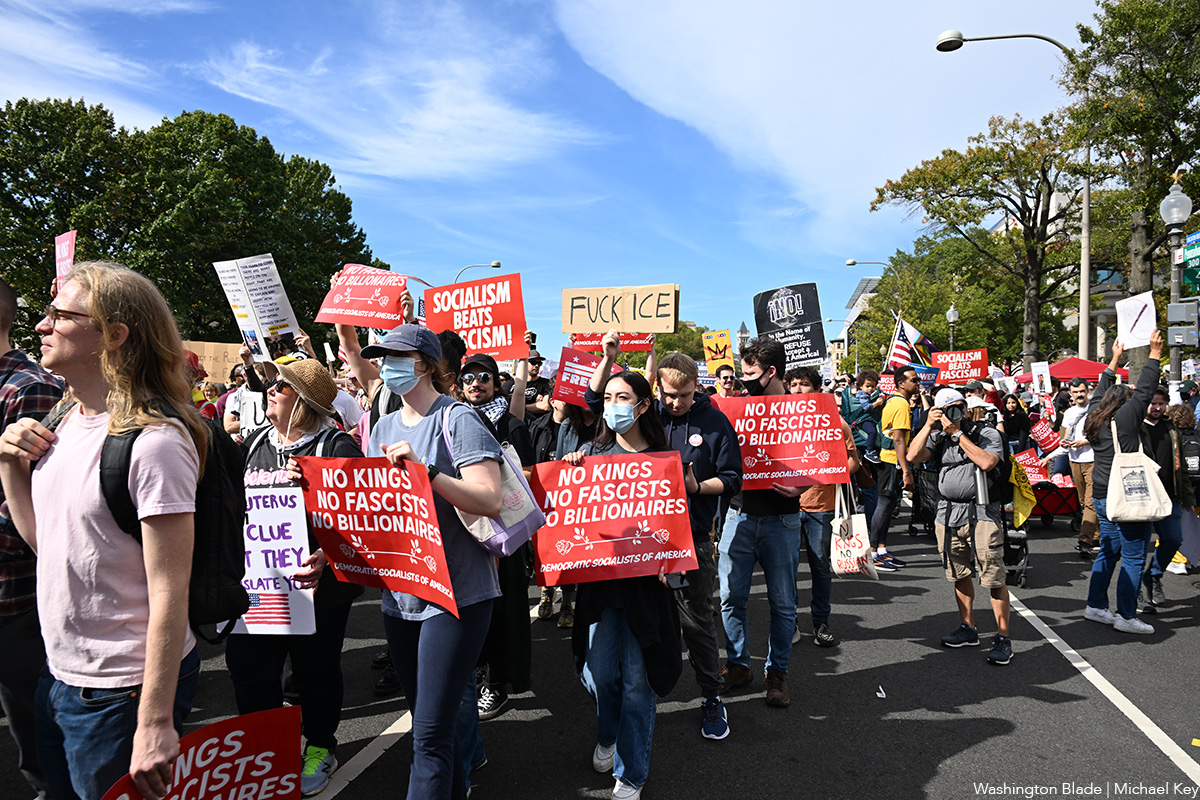
D.C. is the place for the Democratic Socialists of America (DSA). We believe in a District where everyone can live a happy and dignified life. That means housing, healthcare, transit, education, and safety are treated as guarantees rather than privileges reserved for the wealthy and well-connected.
Our endorsed candidates do not hide what they believe. They engage in the democratic process openly, explain their politics clearly, and ask their fellow members to spend long nights and weekends doing the hard work of campaigning. And as the last six years of local elections have shown, including three successful D.C. Council campaigns and the overwhelming passage of Initiative 82, D.C. voters are often a great deal more interested in the endorsement of Metro DC DSA than in the handwringing of the Washington Post editorial board.
That is what makes Peter Rosenstein’s April 2 op-ed in the Blade so revealing. His piece was not just wrong. It was smug, unserious, and politically disconnected from the actual lives of queer people in this city. Worse, he used the platform of our local LGBTQ outlet to disregard Palestinian humanity while scolding democratic socialists for refusing to join him in that moral failure. Put plainly, Rosenstein has been publishing crank op-eds for years, and this one was no exception.
My name is Hayden Gise. I am a transgender, lesbian, Jewish, Democratic Socialist, and I am a union organizer. I do not speak on behalf of the national DSA organization, the local chapter, or any campaign. But I will not sit quietly while Rosenstein wraps himself in the mantle of queer Jewishness to sell the lie that anti-Zionism is antisemitism.
He packages that lie in the same kind of pinkwashing rhetoric used by Benjamin Netanyahu, who mocked solidarity with Palestinians by saying, “Some of these protesters hold up signs proclaiming ‘Gays for Gaza.’ They might as well hold up signs saying ‘Chickens for KFC.’” Rosenstein’s liberal Zionism is not thoughtful, brave, or nuanced. It is just a more polished way of telling Palestinians their lives matter less and telling queer people we should be grateful for the empire so long as it flies a rainbow flag. Which, by the way, is showing itself to be a losing strategy.
The ongoing genocide in Gaza is not some tragic deviation from the history of an otherwise peaceful Israel. The Nakba was the mass expulsion and displacement of Palestinians during Israel’s establishment in 1947–49, when hundreds of thousands were driven from their homes. My Jewish values tell me that is wrong. Rosenstein’s politics treat anti-Zionist Jews like me as illegible. No serious person should treat that accusation as an argument.
But the deeper problem with Rosenstein’s piece is that he has no real understanding of why Democratic Socialism resonates here. For queer people in D.C., Democratic Socialism is not an abstract theory. It is rent that does not consume half your paycheck, a union on your job, childcare you can actually afford, public transit that works, and a city where working-class Black and brown queer people are not displaced so developers and donors can cash in. Queer politics is not only about recognition. It is also about whether ordinary people can afford to survive.
That is why D.C. is fertile ground for Democratic Socialism. In the race for mayor, one of the leading candidates is Kenyan McDuffie, whose campaign already looks like a focus-grouped merger of Andrew Cuomo’s slogan and Donald Trump’s graphic design instincts, backed by big business interests and the super PAC money that follows them. The other has the endorsement of the major labor unions in the District. Who has a cohesive vision to make D.C. more affordable and childcare universal. Who puts people over profit and human rights over political expediency. Our next mayor, and our first Democratic Socialist Mayor: Janeese Lewis George.
D.C. is exactly the kind of city where Democratic Socialism should grow: working-class, queer, tenant-heavy, union-minded, and tired of being told that dignity is too expensive. Which side are you on? I know what side the queer people of the District of Columbia will be on.
Hayden Gise is a union organizer in Washington, D.C.

For half a century, the arc of LGBTQ progress in America has bent—slowly, imperfectly—toward justice. We fought for visibility, for legal protections, for the right to marry, serve openly, and live with dignity. Each generation built on the courage of the last.
And yet today, that progress is in peril. Across the country, lawmakers are rolling back protections, demonizing LGBTQ people for political gain, and trying to erase us from public life.
Opponents of our equality are working to erase us from the Constitution, and indeed, public life. In moments like this, based on my personal involvement working with one of the most effective leaders for LGBTQ rights I find myself asking a simple question: What would Jeffrey do?
Jeffrey Montgomery—the focus of a new documentary “America You Kill Me” and a long time Michigan activist and founder of the Triangle Foundation—was never content with quiet advocacy or compromise. He was a rabble-rouser, a strategist, and a relentless thorn in the side of powerful bigots. When politicians tried to marginalize LGBTQ people, Jeffrey didn’t politely ask for scraps. He forced the issue.
Jeffrey Montgomery started with his own determined voice and turned it into a movement. His story is living proof that personal courage can spark national conversations about justice and inclusion.
At a moment when the LGBTQ movement again faces hostility and regression, Jeffrey’s playbook offers lessons we would be wise to remember.
First, Jeffrey understood the importance of punching above our weight. In the early days of LGBTQ organizing, our movement was small, underfunded, and politically marginalized. But Jeffrey refused to let opponents see us that way. Through visibility, media savvy, and relentless organizing, he made LGBTQ advocates appear larger, stronger, and more unified than our numbers alone might suggest.
That perception mattered. Political opponents think twice before attacking a movement that looks organized, energized, and capable of mobilizing public pressure. Jeffrey knew that power is partly about reality—but also about what your opponent believes your power to be.
Second, Jeffrey never compromised on the value of our lives. Movements make compromises all the time. Politics often requires it. But Jeffrey understood that some things are not negotiable. The basic humanity of LGBTQ people is one of them. You can’t put our basic rights on the ballot. You don’t tell people to wait their turn. There are no turns. It’s now. It’s always now.
Too often, our opponents frame equality as something to be bargained over—as if the dignity and safety of queer people were a policy preference rather than a fundamental right. Jeffrey rejected that premise entirely.
You can negotiate strategy. You can negotiate timelines. But you cannot negotiate the worth of human lives.
And finally, Jeffrey understood the power of coalition. Today, one of the most effective tactics used against marginalized communities is division. If LGBTQ people can be fractured—by identity, ideology, generation, or strategy—our collective strength weakens.
Jeffrey instinctively resisted that trap. He worked with civil rights groups, labor leaders, faith communities, civic leaders and allies across movements. He understood that the fight for LGBTQ equality was never isolated from the broader fight for justice.
When opponents try to divide us, the answer is not retreat into smaller camps. The answer is to build broader ones.
If Jeffrey Montgomery were here today, he would not be discouraged by the backlash we are seeing. He would recognize it for what it is: the predictable response of those who feel their power slipping away.
And he would remind us that progress has never been linear. It has always required courage, persistence, and a willingness to challenge power directly.
So, when the moment feels uncertain, when the political winds shift against us, and when our opponents try to make us feel small, the question remains a useful one: What would Jeffrey do?
If history is any guide, the answer would be simple. He would make some noise. And making noise, today, means refusing to let fear, fatigue, or false unity quiet us when our lives are on the line.
Sean Kosofsky was director of policy at the Triangle Foundation.
Opinions
D.C. not the place for antisemitic Democratic Socialists of America
Candidates like Janeese Lewis George should reject its endorsement

D.C. is not the place for the antisemitic Democratic Socialists of America (DSA), who advocate for the end of the State of Israel from the ‘river to the sea.’ The candidates they endorse agree to their platform, which includes not talking to any Zionist organizations. Being a Zionist simply means supporting the existence of the State of Israel. It does not mean supporting the war criminal who heads the government, or what he is doing, including murdering innocent Palestinians, or bombing civilians in Iran and Lebanon. As Ron Halber, CEO of the Jewish Community Relations Council of Greater Washington, wrote in a column in DC Jewish Week, the views of the DSA are totally unacceptable.
The Council is non-political, but I am not. I can say one candidate for mayor, Janeese Lewis George, has asked for, and received, the endorsement of the DSA, and by doing so agrees to its antisemitic platform. After her endorsement became public, George tried to ‘privately apologize’ saying she didn’t see the questionnaire submitted by her campaign, rather it was submitted by a staffer. Now George says she is both not antisemitic, and supports Palestinians. Well, that sounds good. But she, and anyone else who accepts the DSA endorsement, has to answer a series of questions: 1. Are you for a two-state solution and the continued existence of the State of Israel, contrary to the position of the DSA? 2. Do you support BDS? 3. What is your definition of a Zionist? 4. What is your acceptable definition of antisemitism? 5. Will you meet with Zionist groups in DC?
Then, we must recognize if one candidate, like George, can go after and accept an endorsement from an antisemitic organization, it gives tacit permission for others to do the same with organizations that might be Islamophobic, racist, homophobic, sexist, or anti-immigrant. All unacceptable. I urge D.C. voters to reject any candidate, for any office, who has the endorsement of the DSA. That is not what we want the leaders of our government to represent.
Thankfully, there are many choices in this year’s Democratic primary elections for every office. There is a race for mayor, congressional delegate, attorney general, Council chair, two D.C. Council at-large seats, additional Council seats, Democratic State Committee seats and ANCs. D.C. political leadership will look very different after this election.
I urge voters to whittle down their choices by first rejecting anyone endorsed by the DSA. The DSA’s platform, aside from being antisemitic, also includes suggestions to ‘Defund the Police.’ That is a slogan some of the candidates running adopted a few years ago, thinking the people wanted it. They quickly found the people of D.C. didn’t want fewer police, they wanted their police better trained, with better community oversight. They wanted to be sure the police were here to protect them, not to harass them. People should know the DSA at one point even withdrew its endorsement from Rep. Alexandra Ocasio-Cortez (D-N.Y.) as she wasn’t strident enough in her opposition to Israel and actually met with a Zionist organization. There are many Zionists like me — a gay, Jewish man — who support the existence of the State of Israel, yet want to see Netanyahu, a war criminal, a murderer, tried for his crimes and in jail, and his government replaced. Zionists who support Palestinians and want them to have their own free state.
As you decide who gets your vote, one way to find out about a candidate is looking at their website. I would suggest you reject any candidate who doesn’t have a strong issues section. The least you can expect of a candidate is to tell you in detail what they intend to do if you elect them. That includes our delegate to Congress, even if they won’t have a vote. If Democrats take back the House of Representatives, we can expect our delegate to once again get a vote in committee, and that can be very important.
In the next couple of weeks, I will make some endorsements and share them with you in the Blade, for anyone who might be interested. They will detail why I endorse a particular candidate. I will not suggest second, third, fourth, or fifth choices. That is for you to decide. No matter who you give your first vote to, even with ranked choice voting, you can still vote for only one person. If you decide to list more choices, make sure the views of your second, and other choices, coincide with those of your first choice.
So here is to an honest election season, one in which we end up with candidates winning who really care about our city, who have proven track records, and who will make us proud. Your job is to VOTE, and I hope everyone will.
Peter Rosenstein is a longtime LGBTQ rights and Democratic Party activist.

Police mental health struggles gain growing attention

Man faces first S.C. ‘hate intimidation’ charge

Trump budget would codify expanded global gag rule

D.C. is the place for the Democratic Socialists of America

Key lifestyle changes can help patients cope with diabetes

VIDEO: Gay journalist detained for booing Trumps at ‘Chicago’ opening night

Trans-driven ‘Serpent’s Skin’ delivers campy sapphic horror

D.C. not the place for antisemitic Democratic Socialists of America

Pam Bondi ousted as attorney general

Award-winning D.C. chef reaching new culinary heights
-

 The White House4 days ago
VIDEO: Gay journalist detained for booing Trumps at ‘Chicago’ opening night
-
Movies5 days ago
Trans-driven ‘Serpent’s Skin’ delivers campy sapphic horror
-
Opinions5 days ago
D.C. not the place for antisemitic Democratic Socialists of America
-
The White House4 days ago
Pam Bondi ousted as attorney general