Local
O’Malley backs 2012 push for marriage equality
Bill becomes part of guv’s legislative package
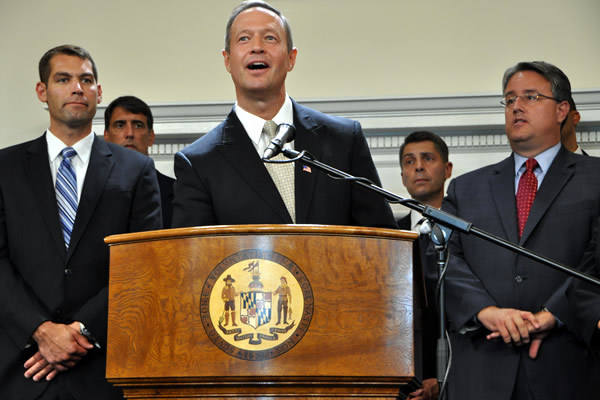
Gov. Martin O'Malley (Washington Blade photo by Michael Key)
ANNAPOLIS, Md. — Flanked by lawmakers and members of a broad coalition of Maryland LGBT leaders, Gov. Martin O’Malley today announced that a law legalizing same-sex marriage would be part of his 2012 legislative package.
After a disappointing 2011 session for marriage equality advocates in Maryland, ending with the death of a Senate-passed marriage bill in the lower house, the governor came out in favor of a bill that he said would address “religious freedom and protect marital equality rights equally under the law.”
O’Malley’s press conference today signals that he may take a more active role in leading on marriage equality legislation. He was criticized earlier this year for not taking a more visible role in support of the 2011 bill.
“I’m supportive of this bill in the upcoming session, and so supportive that I’ve decided to make it one of the handful of bills that will be an administrative priority.”
When asked by a reporter if his own views on marriage equality had changed, the governor said, “I have always believed in the dignity of every individual. I believe in our own responsibility to advance the greater good. And I also understand that there is a unity of the spirit and matter, and that what we do in our own lifetimes does matter.”
He continued, “As a free and and diverse people of many faiths, we choose to be governed under the law … governed by certain principles and beliefs. Among them, equal protection of the law for every individual and the free exercise of religion free of interference from government. Other states have found a way to protect both of these fundamental beliefs. Therefore in the 2012 legislative session I will sponsor legislation that protects religious freedom and protects marital equality rights equally under the law.”
“I was raised to understand that there are certain things that churches and religions dispense, and that the government should not interfere with defining those,” the governor said when asked about his own evolution on marriage, after previously favoring civil unions rather than full marriage equality. “That’s what we seek to protect, both of those freedoms, that is equality under the law in terms of rights conferred.”
While taking questions, O’Malley emphasized that while he supported civil unions in the past, he’s always believed in equal protection under the law.
“The difficulty that we face as a diverse people was how to enforce a consensus that will protect rights equally under the law,” he said, “the development of that consensus, the ability to come together around marital equality is something that I think is one of the faster moving issues of opinion that we’ve seen in our country for some time.”
He also brought up the victory for marriage equality in New York, and noted that process will influence strategy in Maryland as well.
“Each state learns from the other states,” the governor said. “I would like to think that in New York, they learned from our experience, and we will learn from their experience.”
He continued, “New York showed you could protect religious freedom and you can protect protect rights equally and that’s what we’re going to do with this bill.”
When asked about the influence the momentum from New York had on his decision to hold today’s press conference, O’Malley said the bill’s prospects are stronger because the coalition pushing the bill is much better developed.
“I think the broad nature of this coalition is something I’m very much encouraged by and by the success in New York. It is a fundamental truth that with every accomplishment, further accomplishments appear possible. When New York was able to bring people together—and do it by the way, in a bi-partisan way—and were able to bring into their coalition… a number of religious leaders.” He said, “We still have a lot to do, and this coalition is important, and this is the way to get it done, and certainly New York’s success in accomplishing the marital equality bill in New York was something encouraging to everyone, including myself.”
There had been some speculation within the Maryland LGBT community that a second chance for a 2011 success may surface in the state’s October special session for redistricting, but the governor was quick to dismiss that strategy.
“I think most of us are focused on the upcoming regular session, and I think that time will be well used to broaden this coaltion,” O’Malley said.
When asked what he thought about the possibility of opponents of marriage equality bringing a referendum to the ballot undoing any new law, O’Malley said, “It’s their right under the laws,” but added that he is focused on getting the law passed by a broad coalition of leaders from throughout the civil rights and religious communities so that such efforts would not gain traction.
“I’m very optimistic that if all of us work hard and all of us stay focused on the important principles at stake here, which are freedom of religion and also equal protection under the law,” he continued, “that we can pull together the necessary votes for passage.”
“We know that we have work to do, because it did not work the last time, and that’s why we’re here today. To commit ourselves to that work.”
During the press conference, several lawmakers took the podium to emphasize the size and scope of the new coalition to pass a bill legalizing same-sex marriage in the Free State.
“Many during the past session said this was not a civil rights issue,” said Sen. Robert J. Garagiola, (D-Montgomery Co). “I don’t see how you can’t look at it as a civil rights issue. You just look at our history—American history, Maryland history—we had laws on the books that discriminated between different races, and right now we have laws on the books that discriminate between two loving people. To me it’s the same exact thing.”
“We had a little bit of courage from one Republican in the Maryland Senate, Allan Kittleman,” the senator continued. “To me this is an issue where Democrats and Republicans should come together.”
“The governor is saying this is what’s right,” said Del. Benjamin Barnes (D-Anne Arundel & Prince George’s County). “We’re a nation founded on equality, and when you deny certain individuals their rights under marriage, you deny them certain fundamental equal rights. This governor is saying this is not just, and we’re going to have equality in the state of Maryland.”
Ezekiel Jackson of the Servicemembers Employee International Union local 1199 of Maryland and the District of Columbia was also on hand to announce the union’s involvement with the coalition taking the lead on passing marriage in 2012. Jackson claims SEIU’s membership on the coalition makes sense because families should not have to leave the state of Maryland in order to get married and take advantage of the benefits marriage affords.
“Anytime we look at a situation where residents are spending money outside of Maryland, we rush to find ways to keep that money in Maryland,” Jackson said. “Why can’t we do the same thing with families?”
Many members of the Maryland LGBT Caucus were on hand to praise the governor as well, including Sen. Richard S. Madaleno Jr. (D-Montgomery County), and Del. Maggie McIntosh.
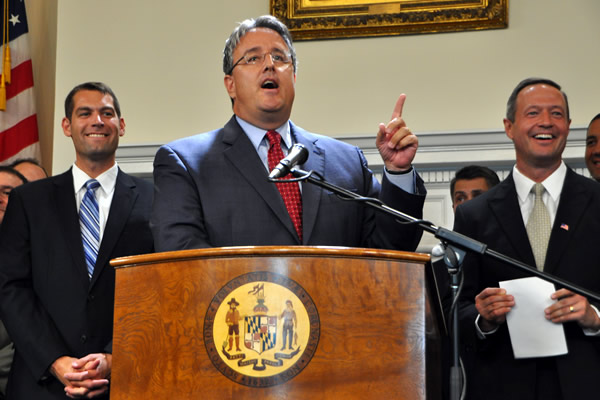
Sen. Richard S. Madaleno Jr. (D-Montgomery County) (Washington Blade photo by Michael Key)
The only openly gay member of the Senate, Madaleno enthusiastically took the microphone to praise O’Malley for pledging to lead in passing marriage equality in Maryland.
“This is probably going to be the second most exciting moment that I have had in this room,” Sen. Madaleno said. “And it will only be surpassed by the moment within the next nine months that we will stand here, with [the governor], pen in hand, to sign into law the marriage equality bill.”
“Maryland, in history, is the seventh state in the union to have embraced the Constitution,” Madaleno pointed out. “And in the next nine months, we will be the seventh state in this country to embrace marriage equality.”
Del. McIntosh, Maryland’s first openly gay lawmaker, and former majority leader, has known O’Malley throughout his political career, beginning with his time on the Baltimore City Council. “All of us in the legislature who are openly gay members would like to thank you for your leadership, Gov. O’Malley,” she said at the press conference. “Your sponsorship and your willingness to continue toward marriage equality in Maryland means so much to so many families in Maryland. So we’re going to win!”
When asked how the LGBT Caucus is mapping out its strategy with the governor and who has taken the lead, McIntosh told the Blade that, while the members of the LGBT Caucus have yet to meet with the governor over this bill, officially, she and Madaleno have been working with the governor’s chief legislative officer, Joe Bryce.
“Obviously Sen. Mandeleno and I have had conversations with the governor, and many of our colleagues have had conversations with the governor urging him to take the lead,” McIntosh said. “We will work with Joe Bryce going forward, probably looking at the New York law, looking at ours—ours was only two or three votes short—so is there something we can tweak. We have to all be on the same wavelength about that. But we will introduce a bill, and I think we will absolutely work with his office hand-in-hand to get the legislation passed.”
“We were working closely with members of the LGBT Caucus and other supporters of marriage equality last session earlier this year,” Marty Rouse, national field director for the Human Rights Campaign, told the Blade. “And now we work very closely with the GLBT delegates, and working with Progressive Maryland and others. If there’s a difference between earlier this year and today, it’s a much broader and deeper coalition. And now with the support of the governor, clearly we have a much better chance of getting this passed next session.”
Marylanders for Marriage Equality, a new group, announced last week a major coalition to begin a statewide effort to press for passage of a marriage equality bill in 2012. The coalition includes Progressive Maryland, 1199 Service Employees International Union, Communications Workers of America, American Federation of State, County Municipal Employees (AFSCME), American Civil Liberties Union of Maryland, Equality Maryland, the Human Rights Campaign, Pride in Faith, Maryland Black Family Alliance and Catholics for Equality.



District of Columbia
David Archuleta, Monroe Alise named D.C. Pride parade marshals
Honorees ‘live authentically’ and ‘power of sharing your story’

The Capital Pride Alliance has announced that David Archuleta and Monroe Alise will be the grand marshals for the Pride parade on June 20.
Ryan Bos, the Capital Pride Alliance’s president, said the two were chosen for the way that they exemplify the theme “Exist. Resist. Have the Audacity!”
Archuleta is the “American Idol” season 7 runner-up and a strong supporter of the LGBTQ community.
He grew up religious and has been clear about his struggle to reconcile his faith, identity, and self-expression. In 2021, he publicly came out and has since been a major voice for LGBTQ visibility and acceptance. This year, Archuleta published the memoir “Devout,” which details his lived experience as a closeted Mormon teenager.
Alise is a transgender advocate and a D.C. native.
She has appeared in the shows “P-Valley” and “The Chi.” She also grew a major online following through her social media series “I’m CLOCKABLE,” where she discusses topics such as dating, culture, and self-discovery from the perspective of a queer person.
“Together, they represent to live authentically and the power of sharing your story to create change,” Bos said in a statement.
As grand marshals, the two will kick off celebrations leading up to the parade and participate in it. Alise will join the Crack of Noon Parade Brunch from 12-3 p.m. at Viceroy Washington, alongside honorees such as D.C. Mayor Muriel Bowser.
The parade will kick off at 3 p.m. at the intersection of 14th and T Streets, N.W., before moving straight down 14th Street and ending at Pennsylvania Avenue at 7 p.m. The parade is free for anyone to watch at designated viewing areas.
More information about celebrations throughout Pride and the parade can be found at www.capitalpride.org.
District of Columbia
Hundreds of thousands expected to attend D.C. Pride events
Parade to take place on June 20
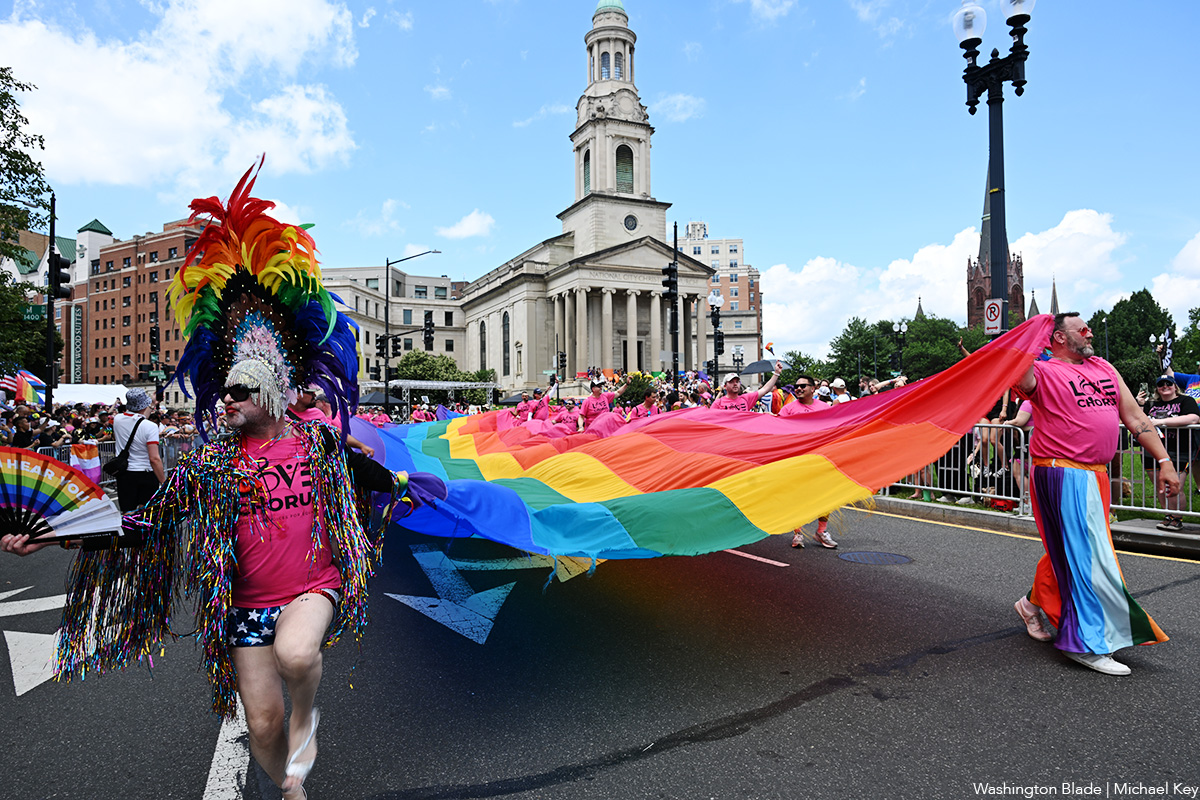
Hundreds of thousands of people are expected to attend Pride events in D.C. this month.
The Capital Pride Alliance is marking its 51st year with a full slate of events, including a parade, festival, concert, parties, and community events across the city. This year’s theme is “EXIST. RESIST. Have the Audacity!”
“Our audacity is our collective strength. Against the forces that try to diminish us, we must remain bold, courageous, visible and heard, in a world that questions our humanity and challenges our rights. Together, let’s have the audacity to live, thrive, be joyful, and proud!” Capital Pride Alliance said in a statement.
Capital Pride’s signature weekend events will center on the June 20 parade and June 21 festival and concert.
The parade and concert will not take place on the second weekend of June, as they have in the past, to avoid conflicts with America’s 250th anniversary celebration.
The parade route is expected to begin at 14th and T Streets, N.W., and end at Pennsylvania Avenue and 9th Street, N.W. Free viewing areas will be available, though reservations are required for seating at designated locations across the route.
Leading up to the parade, a family event will be hosted from 11 a.m. to 3 p.m. at Stead Park in Dupont Circle. Activities will include crafts, glitter tattoos, hair tinsel, photo ops, and an inflatable obstacle course. The event is free, but a prior reservation is required.
Crack of Noon Parade Brunch, a 21+ event featuring an all-you-can-eat buffet, will also take place earlier on June 20 at the Viceroy Washington at 1430 Rhode Island Ave., N.W.
The 17th Street Block Party, presented by Absolut, will also take place from noon to 10 p.m. on 17th Street in Dupont Circle. It will feature local food, an adult beverage garden, and other events.
On June 21, the Capital Pride Festival will run from noon to 10 p.m. on Pennsylvania Avenue The festival includes the Capital Pride Concert at Capitol Stage. The lineup of artists for the festival concert includes Maren Morris, queer rapper Leikeli47, Lisa Lisa, “Heated Rivalry” DJ Harrison, Tracy Young, and Myki Meeks.
“In a moment when LGBTQ+ people are being challenged across the country, the Capital Pride Concert is a space where our community is fully seen and heard,” said Capital Pride Alliance President Ryan Bos in a news release regarding the concert lineup.
Tickets to the concert are free, with exclusive pit and VIP experiences available for purchase.
The night will end with a “Capitol” Sunset Dance Party from 8-10 p.m., directly following the concert. It is available to all ages.
Other stages for concerts include the Monument and Dupont Dance Stage, with the artist lineup yet to be announced.
Three main parties will be available leading up to and during the parade: Riot!: The Official Pride Opening Party on June 19, featuring Bob the Drag Queen with a DJ set and headliner Myki Meeks. ELIX-Her on June 20 is a women-centered event at Decades and is 21+. On the same night, KINETIC: Toyland will feature headliner Alaska, “RuPaul’s Drag Race All Stars 2” winner.
Before the parade and festival weekend, community events, and celebrations will take place throughout the city.
The Washington Blade will host Pride on the Pier on June 13 from 4-9 p.m. at The Wharf. The free event will feature Pride365 Radio, a drag show with Venetian, DJ Chord, and dancing.
Capital Pride will have Night of Expression on June 10 at 7 p.m. at Busboys and Poets (14th and V streets). The event will feature an open mic and other performances.
Capital Pride Honors
Beyond its public celebrations, the Capital Pride Alliance will also recognize community leaders through its annual Capital Pride Honors program. This year’s honorees were selected based on how their work reflected the 2026 theme of Pride.
The winners were awarded at the Audacity Brunch: In Full Fuchsia, which is part of a fundraiser with Pride365, on Sunday.
Honorees included D.C. Del. Eleanor Holmes Norton, who received the Paving the Way Award; D.C. Mayor Muriel Bowser, who received the Key to Capital Pride Award; and the Heroes Award recipients Benjamin Coy, Charity Blackwell, Darryl Hamilton, Thea Kano, Kendall Martinez-Wright, and Lee Levingston Perine.
Dylan Drobish and Tyler Hack received the SaVanna Wanzer Visibility Award, while Patrick Magee and Judy Schloss were honored with the Bill Miles Award for Outstanding Volunteer Service.
Darrell Wood and Tyler Cargill received the Breaking Barriers: Community Impact Award, and Dai Nguyen received the Bernie Delia Award.
Maryland
‘Girlfriends’ wanted for murder in Silver Spring, Md.
Montgomery County police say two charged with killing mother of one of them
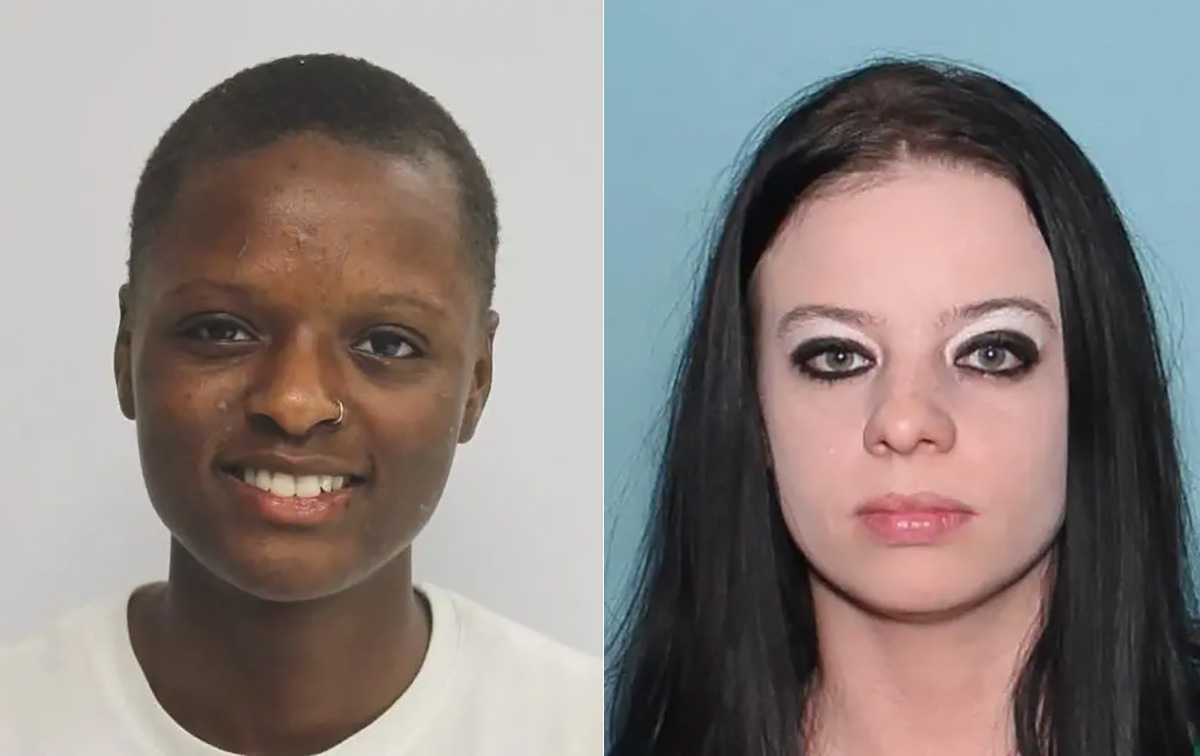
The Montgomery County, Md., Department of Police announced on June 4 that it is seeking the public’s help in locating two women, who they identify as a couple, who are charged with first-degree murder for allegedly killing the mother of one of them.
In a statement police identified the two women as Vanessa Tjongarero-Henderson of Clarksburg, Md., and her girlfriend Samantha Raebel of Phoenix, Ariz. The statement says the two are charged with the murder of Hilde Henderson, 67, the mother of Vanessa.
According to the statement, officers with the department’s 3rd District found Hilde Henderson deceased on Tuesday, May 26, 2026, at her home at the Charter House apartments in the 1300 block of Fenwick Lane in Silver Spring after being called to check on the resident’s welfare.
“Henderson was transported to the Office of the Chief Medical Examiner, where an autopsy was conducted,” the statement says. “The cause of death was ruled a homicide.”
It adds, “Through the course of the investigation, detectives identified Henderson’s daughter, Vanessa Tjongarero-Henderson and Vanessa’s girlfriend, Raeble, as the suspects.” It says detectives obtained an arrest warrant against the two women, charging both with first-degree murder.
“Anyone with information regarding the location of these suspects or this crime is asked to call 911 or to visit the Crime Solvers of Montgomery County, Md. website at crimesolversmcmd.org,” the statement says, or to call the tip line at 1-866-411-8477.
“Tips with information leading to an arrest may be eligible for a reward from $250 up to $10,000,” it says, adding that tips may remain anonymous.
A spokesperson for Montgomery County police didn’t immediately respond to a request from the Washington Blade for information not disclosed in the police statement, including the physical-medical cause of death for Hilde Henderson and whether detectives have determined a motive for the murder.

PHOTOS: Fairfax City Pride

EXCLUSIVE: Pelosi reflects on four decades of LGBTQ advocacy

D.C. prepares to party as Pride celebrations kick off Saturday

David Archuleta, Monroe Alise named D.C. Pride parade marshals