Health
D.C. prepares to host Int’l AIDS Conference
Event expected to draw more than 30,000 to city from July 22-27
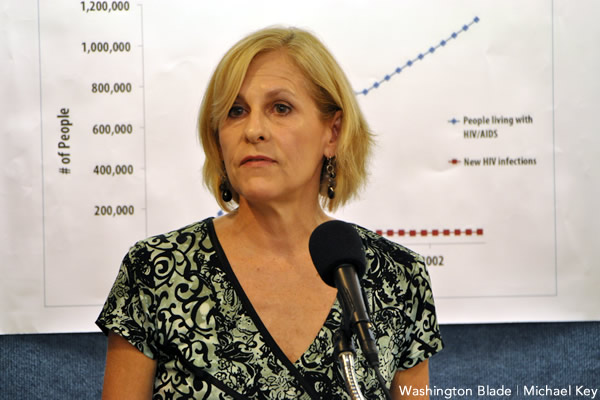
Julie Scofield, executive director of the National Alliance of State and Territorial AIDS Directors (Blade photo by Michael Key)
The International AIDS Conference is expected to draw more than 30,000 people from around the world to D.C. July 22-27.
Former President Bill Clinton, former first lady Laura Bush, Bill Gates of the Bill and Melinda Gates Foundation, Health and Human Services Secretary Kathleen Sebelius, U.S. Global AIDS Coordinator Eric Goosby, “The View” co-host Whoopi Goldberg and singer Elton John are among those who are scheduled to speak at the Walter E. Washington Convention Center. The White House has yet to confirm whether President Obama will attend; California Rep. Barbara Lee and Michel Sidibé, executive director of UNAIDS, are among those who are scheduled to speak at the opening session on July 22. The Gay Men’s Chorus of Washington is also slated to perform.
“We are gathering at a defining moment in the AIDS epidemic where the science tells us we can turn the tide on HIV,” said Dr. Elly Katabira, president of the International AIDS Society who serves as the conference’s international chair, and Dr. Diane Havlir of the University of California-San Francisco, who is the U.S. co-chair of AIDS 2012, in a statement that officially welcomed delegates to the nation’s capital. “Scientific advances are also propelling towards the efforts to find a cure and vaccine for HIV. AIDS 2012 will unite science, community and leadership from around the globe to develop strategies and mobilize support for translating new evidence into meaningful action that reflects HIV’s complex web of social, human rights and political issues.”
The conference — the theme of which is “Turning the Tide Together” — will feature a number of workshops and other events that will specifically discuss the epidemic’s impact among men who have sex with men and other LGBT communities. These will include networking spaces in the Global Village that will allow LGBT people and MSM to share strategies to more effectively respond to HIV and advocate on behalf of those living with the virus. “The Lancet” will also present a symposium on the epidemic’s impact among MSM on July 24.
Debbie McMillan of Transgender Health Empowerment will be among the panelists on a July 26 plenary that will examine the virus’ effects on at-risk populations. A symposium on the same day will discuss the future of HIV prevention and related health and human rights issues among gay, transgender and MSM communities.
The Blade is also an official media sponsor of the conference and will host a photo exhibit chronicling AIDS in Washington in the Global Village, which is open to the public.
A call to action
The International AIDS Society and the University of California-San Francisco on Tuesday unveiled a nine-point plan designed to further combat the global epidemic.
The “Washington, D.C., Declaration” specifically calls for an end to stigma, discrimination and human rights abuses against people with the virus and those who remain at-risk for HIV. It backs what it describes as evidence-based prevention, treatment and care that respects the human rights of “those at greatest risk and in greatest need.” The declaration further stresses the need for accelerated research on new HIV prevention initiatives, treatments and a vaccine.
UNAIDS noted in its 2010 report that an estimated 33.3 million people around the world live with HIV. The agency further reported that the number of new infections has fallen 19 percent since 1999. UNAIDS also found that 5.2 million of the estimated 15 million people with the virus in developing countries who need antiretroviral treatment receive it.
“In a scenario unthinkable just a few years ago, we now have the knowledge to begin to end AIDS in our lifetimes,” said Katabira, professor of medicine at Uganda’s Makerere University. “Yet, at this moment of extraordinary scientific progress and potential, the global response to AIDS faces crippling financial challenges that threaten past success and future progress. Through this declaration, we stand together to call on world leaders across all sectors to provide increased resources, visionary leadership and a full-fledged commitment to seize the opportunity before us.”
This year marks the first time since 1990 that the International AIDS Conference has taken place in the United States—President Obama in 2009 completed the process that lifted the ban on people with HIV from entering the country. City officials and HIV/AIDS service providers alike plan to use the biennial gathering to highlight local efforts to combat the epidemic.
D.C. Officials, HIV/AIDS groups seek presence at conference
The Department of Health’s HIV/AIDS, Hepatitis, Sexually Transmitted Disease and Tuberculosis Administration will present 15 scientific abstracts on the epidemic during the conference. The D.C. Center for AIDS Research, the body that coordinates HIV/AIDS-specific research in Washington, will highlight city-based research in a Global Village session. Mayor Vincent Gray is among those who will speak at a Memorial AIDS Quilt ceremony on July 22.
“It’s appropriate that AIDS 2012 is taking place in the District, its first return to the U.S. in 22 years, as the District has in so many ways been the face of our nation’s epidemic,” said D.C. Council member David Catania (I-At Large.) “From years of an inadequate and failed response to now, an increasingly effective and aggressive one, the District embodies the varied and diverse experience our nation has endured with the deadly disease. AIDS2012 will be a fantastic opportunity for the District to showcase its innovative prevention and treatment programs for the best and brightest in the field. The District stands as an example of what can occur when data-driven, evidence-based policies are put in place.”
Whitman-Walker Health will hold a forum on the state of the epidemic at the Lisner Auditorium, where the city’s first AIDS forum took place in 1983, on July 24. Metro Teen AIDS and Us Helping Us have also scheduled a series of events to coincide with the conference. Organizers have also organized tours of Helping Individual Prostitutes Survive, Food and Friends, La Clinica del Pueblo and other D.C. HIV/AIDS service organizations for delegates.
“We are pleased and honored to have the International AIDS Conference come to D.C.,” Dr. Ray Martins, chief medical officer at Whitman-Walker, told the Blade. “The conference gives the world a chance to learn more about the state of HIV/AIDS in the District of Columbia, but also the breadth of the response to the epidemic locally. It will allow us to highlight the tremendous efforts made by outreach workers and volunteers as well as health care providers and our elected officials.”
A number of gatherings, panels and other events will also take place throughout the city in the days leading up to the conference. These include the Gay Men’s Health Summit at George Washington University and the Global Forum on MSM and HIV on July 21, a panel on stigma in transgender and other HIV-vulnerable communities at the Human Rights Campaign on July 21 and Youth Force’s annual conference at Gallaudet University in Northeast Washington from July 17-19 and the International Network of Religious Leaders Living with or Personally Affected by HIV/AIDS’ conference at Howard University from July 17-19.
“It’s really an incredible event, so I’m glad it’s coming back here,” Ron Simmons, president of Us Helping Us, told the Blade. “With the eyes of the world focused on you, this is the time to take advantage of it.”
Calls to bolster response to domestic epidemic
HIV/AIDS activists also plan to use the conference to urge lawmakers in this country and around the world to reaffirm their commitment to ending the epidemic.
Policy makers also plan to urge Congress to adequately fund policies they say effectively combat the domestic epidemic.
“When people think of AIDS today, most probably don’t realize that AIDS is still really in a crisis mode in our country,” said Carl Schmid, deputy executive director at the AIDS Institute, during a press conference at the National Press Club in D.C. on Tuesday. He noted that 20 percent of the 1.2 million Americans with HIV today do not know their status. Schmid also pointed to roughly 50,000 new diagnoses each year. “Many, including our youth, have become complacent. With nearly 40 percent of new infections occurring in those under age 29 and with more HIV in our country than ever before, it is imperative that we raise our country’s consciousness.”
President Obama in 2010 unveiled a National HIV/AIDS Strategy that seeks to reduce rates of HIV and HIV-related health disparities and increase access to care for people with the virus.
Julie Scofield, executive director of the National Alliance of State and Territorial AIDS Directors, applauded the Obama administration for what she described during the National Press Club press conference as its ongoing commitment to fight the domestic epidemic. She stressed, however, that federal funding has not kept pace with the needs of those with HIV.
“It has always been important to acknowledge from the very beginning of this fight that the goals of the strategy cannot be achieved without significant increases in funding for critical domestic HIV/AIDS discretionary programs,” said Scofield.





Health
Trans-led HIV clinic in Portsmouth struggles amid funding cuts
As states across the U.S. cut funding for HIV care this small clinic in Va, is still fighting

Two years ago, Nyonna Byers, a transgender woman from Portsmouth, Va., founded Ending Transmission of Sexual Infections (ETSI) Health Clinic to support a community she saw struggling with rising HIV rates. Now, as costs continue to climb and funding for HIV healthcare initiatives is being cut across the United States, Byers says her transgender identity has made it harder to secure the financial support her clinic needs to survive.
Portsmouth, with just under 100,000 people, is right across the Elizabeth River from Norfolk.
“We’re an HIV-led organization here in Portsmouth, providing services throughout the Hampton Roads area,” Byers told the Blade. “As a trans-led organization—with me as the founder and executive director—I’ve received a lot of rejection when it comes to funding. That’s one of the main reasons why we’re struggling to keep the clinic open. Without funding, we can’t provide HIV treatment or care, and then we’re just a theoretical organization—we can’t be impactful in the community we serve.”
She said the data clearly shows a need for increased investment in HIV care in Portsmouth, but the response from leadership has not matched the urgency of the crisis.
“Portsmouth is one of the smallest cities with one of the highest HIV rates, and there are very few HIV-led organizations or clinics here. The need is urgent, but the response doesn’t match it. We’re doing the work on the ground, but we’re not getting the support to sustain it. That disconnect is what’s hurting people the most.”
That need, Byers explained, continues to grow as ETSI struggles to meet the financial demands of the life-saving work it provides.
Portsmouth has one of the highest HIV prevalence rates in Virginia, with roughly 736.9 cases per 100,000 people—a rate that exceeds both state and national averages.
“Leaders like the mayor and city council don’t focus on public health or social health. They focus more on development—building the city up physically—rather than investing in the health of the people. I’ve applied for funding multiple times and been denied. Every time I’ve asked for resources, I’ve been turned away.”
When asked why, Byers said the answer felt clear to her.
“I honestly believe I was denied funding because I’m trans. I told the mayor I was going to go public with it, because it’s not fair. We’re on the ground doing the work to end HIV, and we’re still not getting the support we need. That’s not just frustrating—it’s harmful.”
While she said local support has been lacking, Byers noted that the state has stepped in—though the funding still falls short of what is needed to sustain the clinic long term.
ETSI Health Clinic was included as a recipient of funding in the Virginia 2027–2028 Senate budget, receiving $50,000 per year from the Virginia General Fund. Byers specifically credited State Sen. Lillie Louise Lucas with helping secure that funding, which she said did not come from city leadership.
Byers shared that she has given up a lot to keep ETSI afloat, but the costs just keep coming.
“I’ve worked a lot of contracts—jobs paying $30 to $40 an hour—and poured that money into my clinic. But the downside is that I’m struggling personally. I’ve lost cars, I’ve lost a house—I’ve lost a lot to keep this clinic going. This work has cost me almost everything.”
She added that the impact of federal policy shifts is also being felt locally. As the Trump-Vance administration continues to roll back what it has described as unnecessary “DEI” spending, Byers said those decisions are affecting clinics like hers.
There was a time when the clinic was able to receive funding from Sentara Cares, the philanthropic program of Sentara Health, a not-for-profit healthcare system based in Virginia and North Carolina, but now they can’t.
“We had funding from Sentara Cares for three years, and it helped keep us going. Then when DEI initiatives started getting rolled back, that funding stopped. I was told directly that because of federal policy changes, they couldn’t fund the clinic. I broke down during that meeting, because it felt like they were really saying they couldn’t support us because of who we are.”
That lack of funding is compounded by broader gaps in healthcare access in the region. Portsmouth—the ninth most populous city in Virginia—does not have a hospital.
“There’s very limited access to care in Portsmouth. We don’t even have a hospital—people have to be transported to Norfolk. We’ve had high rates of syphilis, and the health department is only open a few days a week. A lot of people don’t trust it, and that leaves entire communities without care.”
Byers made it clear that this is more than a passion project for her—it is her life’s calling, and she would do nearly anything to keep it going.
“To be honest, I would go back to sex work before I let my clinic close. This is something I built from the ground up. I built this clinic with money I earned myself. I’m not going to let it disappear without a fight.”
She also pointed to gaps in education and outreach, which she says exacerbate HIV rates despite the availability of preventive measures.
“There’s almost no marketing or education about PrEP in the Hampton Roads area. If you go to places like D.C. or Atlanta, you see billboards and campaigns—but here, you don’t see anything. If people don’t see it, they don’t know about it. That lack of awareness is putting people at risk.”
It is also a deeply personal fight, she explained.
“I’ve lost friends to HIV. People say you can’t die from HIV anymore, but you can if you’re not in care. I’ve seen it firsthand, and that’s what motivates me to keep going. HIV doesn’t have to be a death sentence—but without support, it can become one.”
The Blade reached out to Portsmouth’s mayor, city council, and city manager for comment but received no response.
To donate to ETSI, visit their donation page at ESTIhcvas.org/donate
Health
Housewives head to Capitol Hill to promote PrEP coverage
Bravo’s Real Housewives stars to lobby lawmakers for expanded PrEP access.

Stars from Bravo’s hit franchise “The Real Housewives” are heading to Capitol Hill next week to advocate for expanded access to HIV prevention and treatment.
On March 18, several well-known cast members — including NeNe Leakes, Phaedra Parks, Candiace Dillard Bassett, Erika Jayne, Luann de Lesseps, Melissa Gorga, and Marysol Patton — will travel to D.C. to participate in an advocacy event aimed at increasing awareness and coverage for pre-exposure prophylaxis, commonly known as PrEP.
The event, dubbed “Housewives on the Hill,” is being organized by MISTR, the nation’s largest telehealth platform focused on sexual health. The group’s founder and CEO, Tristan Schukraft, will join the reality television stars as they meet with lawmakers and legislative staff to discuss the importance of maintaining and expanding access to HIV prevention tools.
PrEP is a medication regimen that can, if taken properly, reduce the risk of contracting HIV through sex by up to 99 percent according to public health officials. Advocates say wider access to the medication — including through insurance coverage and telehealth services — is critical to reducing new HIV infections across the United States.
During their day on Capitol Hill, the Housewives are expected to meet with members of Congress and participate in conversations about federal policies affecting HIV prevention and treatment. Organizers say the reality stars will also share personal reflections about the continued impact of HIV on communities across the country and the importance of keeping prevention resources accessible.
The “Housewives on the Hill” event aims to use the cultural influence of the Bravo stars to spotlight HIV prevention efforts and encourage lawmakers to protect and expand access to lifesaving medication and treatment options. Organizers say the goal is simple: ensure that more Americans can access the tools they need to prevent HIV and maintain their sexual health.
Health
Too afraid to leave home: ICE’s toll on Latino HIV care
Heightened immigration enforcement in Minneapolis is disrupting treatment

Uncloseted Media published this article on March 3.
This story was produced in collaboration with Rewire News Group, a nonprofit publication reporting on reproductive and sexual health, rights and justice.
This story was produced with the support of MISTR, a telehealth platform offering free online access to PrEP, DoxyPEP, STI testing, Hepatitis C testing and treatment and long-term HIV care across the U.S. MISTR did not have any editorial input into the content of this story.
By SAM DONNDELINGER and CAMERON OAKES | For two weeks, Albé Sanchez didn’t leave their house in South Minneapolis.
“[I was] forced into survival mode,” Sanchez told Uncloseted Media and Rewire News Group (RNG). “I felt like there was an invisible wall [to the outside world] that I couldn’t cross unless I really wanted to put myself in a place where there was a chance that I might not be able to come back.”
Queer and Mexican American, Sanchez was afraid of being targeted by the Immigration and Customs Enforcement presence in their neighborhood, even though they are a U.S. citizen.
“Every day is a risk,” they say, adding that even if they have paperwork, if they fit the profile, they are a target, making it scary to go even to work or the grocery store.
Sanchez, a 30-year-old sexual health care educator, has been taking oral PrEP, the daily preventive medication for HIV, for over a decade. But the mounting stress of ICE raids has made it harder to keep up with dosing.
“A missed dose here and there pushed me to make the appointment [for something more sustainable],” they say.
Sanchez says they felt like somebody would have their back at their local clinic. It was only a 10-minute drive from where they worked, they knew its staff from previous visits and community outreach, and they could count on finding Spanish-speaking staff and providers of Latino heritage. But not everybody has had that same experience accessing care.
Since ICE’s Operation Metro Surge began in early December, an increasing number of Latino patients in Minnesota are delaying or canceling what can be lifesaving care for the prevention and treatment of HIV.
These findings are particularly alarming for Latino communities, who, as of 2023, are 72 percent more likely than the general U.S. population to be diagnosed with HIV. And while overall infections have decreased, cases among Latinos increased by 24 percent between 2010 and 2022.
“I’m very concerned that there is going to be a sharp uptick in transmission,” says Alex Palacios, a community health specialist in the Minneapolis area.
In a January 2026 declaration as part of a lawsuit seeking to end Operation Metro Surge in the days following Renee Nicole Good’s killing, the commissioner of the Minnesota Department of Health said HIV testing among Latino populations has “dropped dramatically” and that “although grantee staff continue to go into the community to promote and provide testing, people are not showing up.”
Local clinics are reporting the same thing. The Aliveness Project, a community wellness center in Minneapolis specializing in HIV care, told Uncloseted Media and RNG they have seen more than a 50 percent decrease in new clients. The clinic serves a large number of Latino and undocumented clients, and while it usually sees 750 people walk through their door each week, according to providers, it reported seeing 100 fewer people each week since December.
Red Door, Minnesota’s largest STI and HIV clinic, has had a “modest uptick” in no-shows and missed appointments since December.
What happens when treatment stops
Today, there are multiple medications available that work to prevent HIV and dozens that treat it once a person tests positive. Many people who consistently take their medication have such low levels of the virus that they can’t transmit it through sex. But becoming undetectable requires patients to stay on their medication; otherwise, the virus replicates and mutates, weakening the immune system and increasing the risk of life-threatening infections.
“If patients aren’t on their medicines consistently, HIV can learn about the medication and become resistant to them. When this happens, the medicine will not work for the patient, and the new resistant virus could potentially be passed on to others,” says George Froehle, a physician assistant and provider at Aliveness Project. “Medication adherence is one of the most important aspects of HIV care.”
To maintain care and prevent dangerous, untreatable strains from spreading in Minnesota, providers at Aliveness Project have begun delivering medication to patients when possible, offering telehealth when they can, and pausing routine lab work to limit in-person appointments.
“The most important thing we can do from a public health perspective is to keep people undetectable so they don’t transmit HIV,” Froehle says, adding that providers in other cities targeted by ICE will need to make plans for missed injection visits, pivot to telehealth and prepare their teams for the “trauma that can occur.”
Sanchez understands the risks of inconsistent treatment, which is why they opted for the injectable preventative medication.
“I have a lot of risk [to HIV in my community],” Sanchez says. “With so much uncertainty about the future and whether HIV care will remain stable, I realized I couldn’t let this opportunity pass.”
But injectable HIV treatments are commonly dosed at two weeks to six months apart, and the medication must be administered in a clinic — a setting many patients are avoiding, according to providers.
“They have a two-week window” to get their shots, according to Froehle, who added that because patients are afraid to come in person, they have had to transition people off of their injectable HIV treatments. This has caused patients to return to oral HIV treatments without the testing they would normally receive had ICE not been in Minneapolis. “[Oral treatments] weren’t super successful [for these patients] to begin with and that’s why they were on injectables.”
Oral HIV medications, too, must be taken consistently to work. In response, providers have urged patients to have their pills with them at all times in case they get deported or detained.
The caution is not unfounded. Federal immigration facilities have a history of denying adequate medical care to people living with HIV, despite internal standards that require them to comply. Since 2025, at least two men living with HIV have been denied access to their medication in a Brooklyn jail, according to lawsuits obtained by THE CITY. One man said he was only given his medication after his lips broke open and he developed an open pustule on his leg. And in January 2025, another man died of HIV complications while in ICE custody in Arizona.
Beyond being detained without proper medication, patients are at risk of being deported to countries with limited access to HIV care, like Honduras and Venezuela, experts say.
“A lot of men [from Venezuela] told me they left because it wasn’t safe to be gay there and because they struggled to access HIV care,” says Froehle. “It’s a little heartbreaking to see new folks not only face the threat of deportation, but to places where they didn’t feel safe medically or identity-wise.”
“Some of these patients will die in their home country,” says Anna Person, the chair of the HIV Medicine Association. “It’s a death sentence.”
A ‘cascading disaster’
While ICE’s presence is threatening the infrastructure of HIV care that Minneapolis has built over decades, experts say there has always been a blind spot in HIV care for the city’s Latino community.
Vincent Guilamo-Ramos, executive director of the Institute for Policy Solutions at the Johns Hopkins University of Nursing, describes HIV in Latino communities as a “cascading disaster,” the result of years of compounding inequities.
“There’s been an invisible crisis among Latinos that hasn’t gotten traction,” he says. “The numbers have consistently gone up in terms of new infections, while nationally they’ve gone down. … That should be a big alarm.”
Numbers are rising because structural barriers and stigma are preventing Latinos from receiving care. A 2022 report from the Centers for Disease Control and Prevention found that between 2018 and 2020, nearly 1 in 4 Hispanic people living with HIV reported experiencing discrimination in health care settings. Lack of representation among providers, language barriers and deep-rooted medical mistrust further complicate access to care, according to Guilamo-Ramos.
Beyond the medical system, stigma within Latino communities can be equally damaging. According to Human Rights Campaign data, more than 78 percent of Latino LGBTQ youth reported experiencing homophobia or transphobia within the Latino community in 2024.
Sanchez agrees that stigma and bias are already massive barriers to care, citing the strict gender norms and Catholic beliefs many Latino communities hold. They say ICE’s presence is threatening already delicate access to HIV care.
“This has caused so much damage to people,” Sanchez says. “Not being able to access your health care appointments is such a stab in the side. … Being able to navigate any of these things in normal circumstances already has so much difficulty to it.”
Palacios, who is Afro-Latine and living with HIV, says the heightened ICE presence is worsening barriers that have long undermined the Latino community’s access to HIV care.
“The horizon has always been stark and dim,” they say. “And this just feels like one more thing to address and to fight back against.”
Sliding backwards
Navigating HIV care is becoming more difficult across the board, as the federal government has decimated HIV funding, compromising decades of progress made in the fight against the virus since Donald Trump retook office just over a year ago.
In February 2026, three months into Operation Metro Surge, the Trump-Vance administration proposed slashing $600 million in HIV-related grants, targeting four blue states, including $42 million for Minnesota programs. A federal judge has temporarily blocked the cuts.
“This would completely decimate and gut all of our HIV prevention,” says Dylan Boyer, director of development at Aliveness Project. “That’s the reality that we live in.”
“We have all the tools, and yet we are staring down this rollback of infrastructure and research dollars, prevention efforts, treatment efforts, that are going to put us squarely back in the 1980s,” says Person, a national HIV expert who grew up in Minnesota. “[There] seems to be no other rationale for that besides cruelty, to be quite frank, since there’s no scientific reason for it.”
Repair and representation
Jenny Harding, director of advancement at a Minneapolis-area supportive housing program for people living with HIV, says that while ICE’s presence is lessening in the Twin Cities, the “damage is done.”
Person says that this mending will take time, especially between the medical community and patients, since HIV providers can have a “very fragile” relationship with their clients.
“It takes, sometimes, years to build that level of trust. And I do worry that folks are just going to say, ‘I don’t feel safe here anymore. The system does not have my best interest at heart, and I’m not coming back,’” she says. “This is not something that you can flip a switch and everything will go back to normal.”
“We need to hold our federal government accountable, particularly HHS, [and] we need to ensure that HIV funding remains intact,” Guilamo-Ramos says, adding that in order to lower rates of HIV in the Latino community, there should be more specialized efforts: such as bilingual and culturally aligned health care providers, community-based outreach programs co-located where risk is highest, trust-building initiatives to address medical mistrust, mobile clinics, and targeted programs to re-engage patients who have fallen out of care.
Aliveness Project’s patient numbers have increased in the last few weeks as the ICE operation has waned, but the clinic staff is keeping “a watchful eye” and is having “difficulty reaching folks who are understandably scared.”
“Our biggest focus right now is reconnecting with people through our outreach so no one has a lapse in their HIV medications or prevention care,” Boyer, of Aliveness Project, says.
For Sanchez, seeing providers who speak Spanish and are of Latin heritage at Aliveness Project built enough trust for them to reach out and make an appointment despite the risks. Sanchez feels optimistic about their new injectable prevention strategy with the support of their clinic.
“There’s many places where you can receive care here in the Twin Cities where you might not see your skin tone. … There’s still a lot of health care professionals that unfortunately carry bias. … Aliveness is the opposite of that,” they say. “Seeing that representation and knowing someone has that cultural context of how to meet you in moments of sensitivity, it’s crucial.”

DeSantis signs emergency bill that restores Fla. ADAP funding

Menaka Guruswamy celebrated as India’s first openly LGBTQ MP

Trans-led HIV clinic in Portsmouth struggles amid funding cuts

D.C. goes gaga for Gaga

Gay priest credited with boosting church support for LGBTQ Catholics

‘How We Survived’ panel set for March 25

Calendar: March 21-26

PHOTOS: Capital Stonewall Democrats 50th anniversary

‘Inherit the Wind’ isn’t about science vs. religion, but the right to think