National
DNC 2012: Gay speakers, issues take center stage on final night
Prime speaking slots for Frank, Baldwin, Zach Wahls
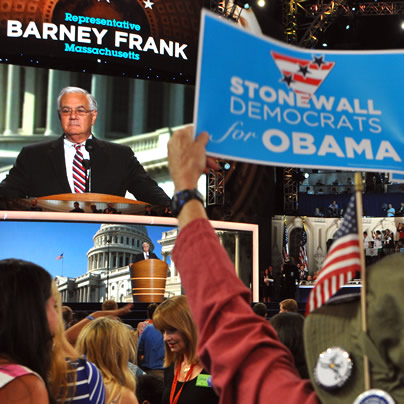
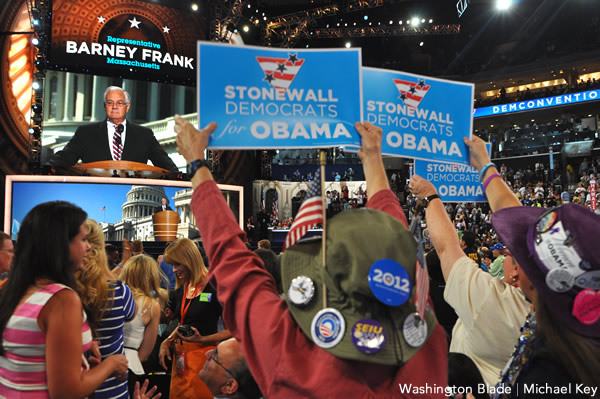
Rep. Barney Frank (D-Mass.) at the Democratic National Convention (Blade photo by Michael Key)
CHARLOTTE, N.C. — Gay issues and speakers took center stage on the final night of the 2012 Democratic National Convention, capping the three-day gathering that was more LGBT-inclusive than any previous iteration of the quadrennial affair.
One of the speeches that came earlier in the evening was from Zach Wahls, an Iowa youth with lesbian parents who gained notoriety for speaking out against a proposed ban on marriage equality in his state. He’s also an Eagle Scout who’s been pushing the Boy Scouts to end its gay ban.
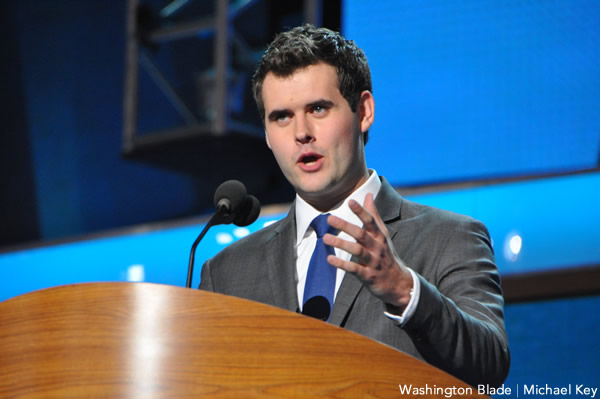
Zach Wahls (Blade photo by Michael Key)
Wahls, who’s straight, said support for the right of gay couples like his parents to marry is a reason he’s supporting the re-election of President Obama, who came out in favor of marriage equality in May.
“President Obama understands that. He supports my moms’ marriage,” Wahls said. “President Obama put his political future on the line to do what was right. Without his leadership, we wouldn’t be here. President Obama is fighting for our families, all of our families. He has our backs. We have his.”
Notably, Wahls cushioned his support for marriage equality by saying the belief that nuptials should be limited to one man, one woman shouldn’t be considered “a radical view,” saying, “For many people, it’s a matter of faith. We respect that.”
But that didn’t stop Wahls from criticizing Romney for opposing same-sex marriage and his support for a Federal Marriage Amendment.
“Gov. Romney says he’s against same-sex marriage because every child deserves a mother and a father,” Wahls said. “I think every child deserves a family as loving and committed as mine. Because the sense of family comes from the commitment we make to each other to work through the hard times so we can enjoy the good ones. It comes from the love that binds us; that’s what makes a family. Mr. Romney, my family is just as real as yours.”
Wahls took to the podium immediately after a video was played showing the Democratic Party’s commitment to marriage equality, including a video with previously recorded remarks of Obama saying the relationships of gay and men women should be respected.
But that video wasn’t the only time support for marriage equality was celebrated on Thursday night. Democratic National Convention Chair and Los Angeles Mayor Antonio Villaraigosa, touted the first-ever inclusion of a marriage equality plank in the Democratic Party platform.
“For the first time, a major party platform recognizes marriage equality as a basic human right!” Villaraigosa said. “This is a reflection of who we are as a party and who we can be as a nation, because as Democrats, as Americans, whenever we’ve opened up our party and our country, whenever we’ve opened up doors for more of our people, whenever we’ve deepened our democracy and renewed our commitment to equal justice under the law, we’ve grown stronger as a nation.”
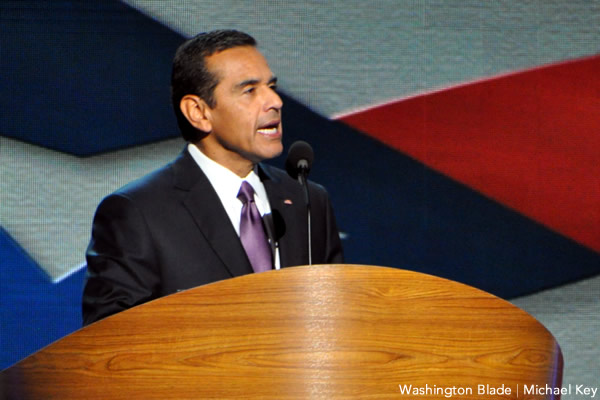
Los Angeles Mayor Antonio Villaraigosa (Blade photo by Michael Key)
Villaraigosa was among those who had called for a marriage equality plank prior to its inclusion in the party platform. His invocation of the marriage equality plank in the platform elicited thunderous applause from the audience.
Another video that played at the convention cited Obama’s repeal of “Don’t Ask, Don’t Tell,” playing footage of the signing ceremony for repeal legislation in December 2010 in which Obama said, “For we are not a nation that says ‘Don’t Ask, Don’t Tell,’ we are a nation that says out of many, we are one.”
Following the video, Iraq war veteran and retired Army Capt. Jason Crow, who’s straight, came to the stage to commend Obama for ending the military’s gay ban and expanding veterans’ benefits.
“It was wrong that men and women I served with could be told they weren’t good enough just because of their sexual orientation,” Crow said. “Soldiers who I trusted with my life, and fought alongside with, could be discharged because of who they loved. President Obama did the right thing by ending ‘Don’t Ask, Don’t Tell.'”
Support for President Obama also came from Alejandra Salinas, a 23-year-old law student at Boston College and member of the LGBT and Latino community.
The outgoing president of the College Democrats of America, Salinas praised Obama for both his support for the LGBT community and the Latino community.
“This president, on so many issues — immigration, LGBT rights, women’s health — has proven that he cares about all of us, and that he’ll keep on expanding opportunity,” Salinas said. “As a young, LGBT Latina, it seems to me that Mitt Romney only cares about an elite few.”
Perhaps the two most high-profile openly gay public officials — Reps. Barney Frank (D-Mass.) and Tammy Baldwin (D-Wis.) — took to the stage earlier in the evening. Both are set to leave the U.S. House at the end of this year, although Baldwin may return to Congress as U.S. senator if she’s successful in her campaign for a seat to represent Wisconsin in that chamber.
Frank, the longest-serving openly gay member of Congress, assailed Republican presidential nominee Mitt Romney both for his positions on LGBT rights and claims regarding his success as governor of Massachusetts, calling the candidate “Myth Romney” for the allegedly false assertions he’s made.
Frank took a jab at Romney over his changing positions on gay rights over the course of this year, saying he once sought to surpass the late Sen. Ted Kennedy, but now looks to anti-gay former U.S. Rick Santorum on the issue. Frank was referring to a 1994 letter from Romney in which he pledged to Log Cabin Republicans to be a leader on gay rights and to support the Employment Non-Discrimination Act — a position he no longer holds.
But a significant portion of Frank’s speech was devoted to criticizing Romney for wanting to repeal financial reform, which Frank took the lead in passing as chair of a House banking committee.
“As governor of Massachusetts, the real Mitt Romney’s record on job creation was terrible,” Frank said. “During his term, net job growth was less than one percent, about one-fifth the national average, 47th in the country. The myth of Romney is that he never raised our taxes. In fact, the real Mitt Romney called his tax hikes “fees.” And in his first year alone, he raised fees more than any other governor in office. Some of those fees? Mitt created a $10 fee for a “certificate of blindness.” He increased the cremation inspection fee from $50 to $75. Maybe he didn’t call them taxes, but they felt like taxes.”
The line about gay rights was apparently an ad-lib because it wasn’t included as part of his prepared remarks.
Asked whether the line was an ab-lib and if Frank was winging it while speaking, Harry Gural, a Frank spokesperson said, “He doesn’t ‘wing it’ — his comments are always very well thought through. He never simply reads speeches, even his most lengthy and complex ones. That’s what makes him such a compelling speaker.”
Earlier in the day, Frank faced criticism for saying during the Democratic National Committee’s LGBT caucus meeting that the Log Cabin Republicans were an “Uncle Tom” organization. In a statement, R. Clarke Cooper, executive director of Log Cabin, responded with his own attack, saying, “It’s a badge of honor to be attacked by a partisan hack like Barney Frank.”
Baldwin’s speech marked the first time an openly gay U.S. Senate candidate spoke before a major party’s national convention.
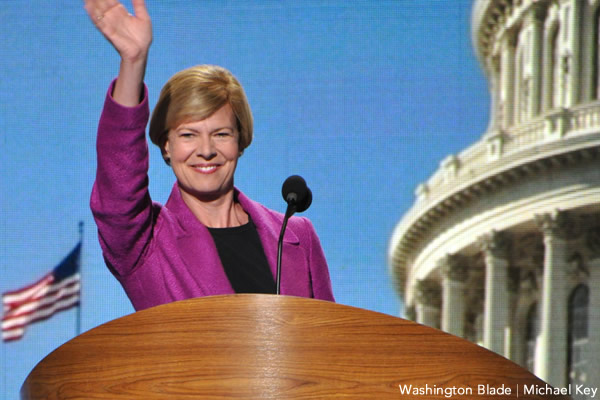
Rep. Tammy Baldwin (D-Wisc.) (Blade photo by Michael Key)
“But the Wisconsin I know, knows that having two sets of rules makes no kind of sense,” Baldwin said. “We believe in hard work. For decades, we’ve worked to make things: paper, engines, tools, ships—and, yes, cheese, brats, and beer. Give our workers a fair shot, and we’ll compete against anyone.”
Baldwin identified Obama’s repeal of “Don’t Ask, Don’t Tell” as evidence of his work in making “historic progress toward equality” for the country and made an oblique reference to Romney’s support for a U.S. constitutional amendment banning same-sex marriage.
“He repealed ‘Don’t Ask, Don’t Tell,’ so that no American ever again has to lie about who they are in order to serve the country we love,” Baldwin said. “Republicans want to write discrimination into our Constitution. But the Wisconsin I know believes that with each passing year and each generation, our country must become more equal, not less.”





Pennsylvania
Pa. House passes bill to codify marriage equality in state law
Governor supports gay state Rep. Malcolm Kenyatta’s measure

The Pennsylvania House of Representatives on Wednesday passed a bill that would codify marriage equality in state law.
House Bill 1800 passed by a 127-72 vote margin. Twenty-six Republicans voted for the measure.
The Republican-controlled Pennsylvania Senate will now consider the bill that state Rep. Malcolm Kenyatta (D-Philadelphia), who is the first openly gay person of color elected to the state’s General Assembly, introduced. Democratic Gov. Josh Shapiro supports the measure.
“Here in Pennsylvania, we believe in your freedom to marry who you love,” said Shapiro on Wednesday. “Today, the House has stepped up to protect that right.”
BREAKING: The Pennsylvania House just passed @RepKenyatta's bill to codify marriage equality into law in PA — and they did it with broad bipartisan support.
— Governor Josh Shapiro (@GovernorShapiro) March 25, 2026
Here in Pennsylvania, we believe in your freedom to marry who you love. Today, the House has stepped up to protect that…
Florida
DeSantis signs emergency bill that restores Fla. ADAP funding
Temporary funds to last through June 30
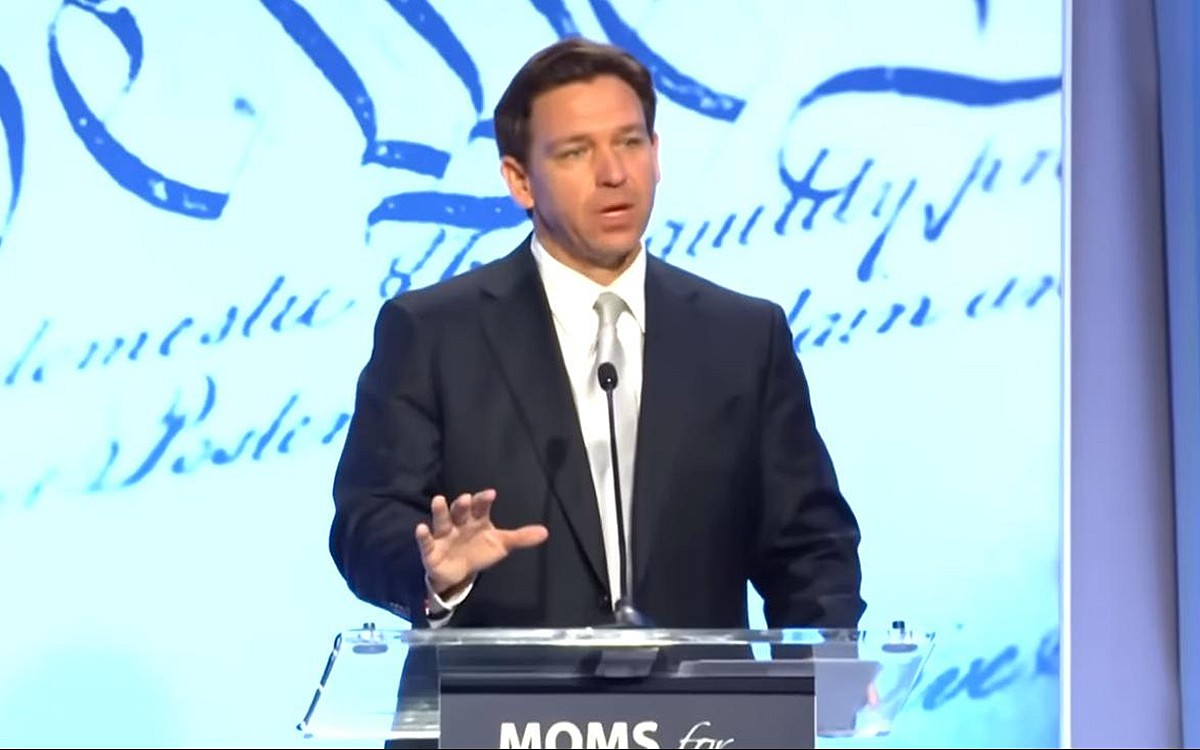
After the Florida Department of Health made huge cuts to the AIDS Drug Assistance Program in January, Republican Gov. Ron DeSantis has signed emergency legislation restoring HIV access to more than 12,000 Floridians.
Two months ago, as the Washington Blade reported, the Sunshine State cut the vast majority of those in ADAP by shifting the income levels required for eligibility — without following standard procedure when changing government policy outside of legislative or executive action.
The bill, signed by DeSantis on Tuesday, passed both chambers of the Florida Legislature unanimously and appropriates $30.9 million in emergency bridge funding through June 30, 2026. It restores Florida’s ADAP income eligibility to 400 percent of the Federal Poverty Level — the level it was prior to the January cuts. The legislation also requires the FDOH to submit detailed monthly financial reports to legislative leadership beginning April 1.
Under the old policy, eligibility would have been limited to those making no more than 130 percent of the federal poverty level, or $20,345 per year.
“For 10 weeks, 12,000 Floridians living with HIV did not know if they could fill their next prescription. Today, they can,” Esteban Wood, director of advocacy and legislative affairs at AIDS Healthcare Foundation, said in a statement.
The detailed reports now required to be sent to legislative leadership must include all federal revenues and expenditures, including manufacturer rebates; enrollment figures by county and insurance status; prescription utilization by drug class; and any projected funding shortfalls. This is the first time the Legislature has required this level of financial transparency from the program.
DeSantis signed the legislation one day after a Leon County Circuit Court judge denied AIDS Healthcare Foundation’s request for an injunction to block the significant changes the DeSantis administration is making to the program, which it claims faces a $120 million shortfall for calendar year 2026.
AIDS Healthcare Foundation, a national organization focused on protecting and expanding HIV healthcare access and prevention methods, filed a lawsuit over the change in eligibility, arguing the Florida Department of Health did not follow the laid out path for formally changing policy and was acting outside established procedures.
Typically, altering eligibility for a statewide program requires either legislative action or adherence to a multistep rule-making process, including: publishing a Notice of Proposed Rule; providing a statement of estimated regulatory costs; allowing public comment; holding hearings if requested; responding to challenges; and formally adopting the rule. According to AIDS Healthcare Foundation, none of these steps occurred.
The long-term structure of ADAP will be determined by the 2026–2027 fiscal year state budget, something that lawmakers have until June 30 to finish.
Federal Government
Markwayne Mullin confirmed as next DHS secretary
Okla. senator to succeed Kristi Noem

The U.S. Senate confirmed Markwayne Mullin as the next secretary of Homeland Security on Monday, as the agency continues to grapple with what lawmakers have described as a “never-ending” funding standoff, with Democrats attempting to withhold funding from one of the nation’s largest and most costly agencies.
Mullin — a Republican senator from Oklahoma, former mixed martial arts fighter, and plumbing business owner — was confirmed in a 54–45 vote. Two Democrats — U.S. Sens. John Fetterman (D-Pa.) and Martin Heinrich (D-N.M.) — sided with Republicans in supporting his confirmation.
The new agency head is expected to follow the policy direction set by President Donald Trump, emphasizing stricter immigration enforcement. This includes proposals to support immigration agents at polling sites and to cut funding to so-called “sanctuary cities.”
Mullin replaces Kristi Noem, who was fired earlier this month following a widely scrutinized 2-day congressional hearing on Capitol Hill.
During the hearing, Noem faced intense questioning over her response to several crises, including the fatal shooting of two American citizens in Minneapolis by U.S. Immigration and Customs Enforcement agents, a $220 million border security advertising campaign that featured her on horseback near Mount Rushmore amid one of the largest federal workforce reductions in U.S. history, and the federal response to major natural disasters such as the July 2025 Texas floods and Hurricane Helene in 2024.
Noem had previously drawn criticism for a series of policy decisions in South Dakota that broadly focused on restricting the rights of LGBTQ individuals. In 2023, she signed House Bill 1080, banning gender-affirming medical care for transgender minors. She also signed legislation and executive orders restricting trans athletes’ participation in women’s sports, as well as the state’s “Religious Freedom Restoration Act,” which critics argued enabled discrimination against LGBTQ individuals. Additionally, the state canceled contracts related to LGBTQ support services — including suicide prevention and health care navigation programs‚ and later agreed to a $300,000 settlement with trans advocacy group, The Transformation Project.
Despite her removal from DHS, Noem will remain in the Trump-Vance administration as a special envoy for the “Shield of the Americas,” an initiative aimed at promoting U.S. influence in the Western Hemisphere, including efforts to counter cartel networks, reduce Chinese influence, and manage migration.
The new head of DHS has served in Congress since 2013, in both houses of the federal legislature. While in the Senate and a member of the Health, Education, Labor, and Pensions (HELP) Committee, Mullin has been a vocal critic of policies aimed at expanding LGBTQ inclusion. He led a group of lawmakers in urging the Administration for Community Living to reverse a rule requiring states to prioritize Older Americans Act services based on sexual orientation and gender identity, arguing the policy could have unintended consequences.
Mullin also makes history as the first Native American — and a citizen of the Cherokee Nation — to lead the Department of Homeland Security. He was also among the 147 Republicans who voted to overturn the 2020 presidential election results despite no evidence of widespread fraud, and was present in the U.S. House of Representatives chamber on Jan. 6.

‘No Kings’ protests set for D.C.

Border to border: modern slavery and human trafficking in refugee movements across East Africa

New IOC policy bans trans women from Olympics

Introducing the Torchbearers Awards honoring queer, trans women and nonbinary people

Pa. House passes bill to codify marriage equality in state law

PHOTOS: Capital Stonewall Democrats 50th anniversary

Small is beautiful: subcompact SUVs

‘Inherit the Wind’ isn’t about science vs. religion, but the right to think

Polish court rules country must recognize same-sex marriages from EU states

Capital Stonewall Democrats 50th anniversary gala draws sold out crowd
-

 Photos4 days ago
PHOTOS: Capital Stonewall Democrats 50th anniversary
-
Autos5 days ago
Small is beautiful: subcompact SUVs
-
Theater5 days ago
‘Inherit the Wind’ isn’t about science vs. religion, but the right to think
-
Poland4 days ago
Polish court rules country must recognize same-sex marriages from EU states