Commentary
Blogging my way through the Norwegian Fjords and the Arctic
Celebrating Pride Norwegian style
Blog # 1 – Celebrity APEX cruise, Norwegian Fjords, and the Arctic
My travel agents, and friends, Dustin, and Scott, from My Lux Cruise, arranged for busses to pick us up from our London hotel, and head to Southampton, to board the Celebrity APEX. It rained on the two-hour trip from London, but stopped just as we got closer to Southampton, which seemed like a good omen. When I first sighted the ship, it was a little like coming home, as I traveled on the APEX before. The crew was welcoming as we got off the bus and check-in was easy. Within thirty minutes I was onboard and headed to my stateroom to drop off my hand baggage, and set up my computer. The only snag, as usual, was with corporate Celebrity, some of the things they promise aren’t there, and you have to make calls onboard to get them. One was the hypoallergenic bedding; I am allergic to feathers; the other was my WIFI was set so I couldn’t use both my phone and computer at the same time. The crew on board acted quickly to remedy both issues. I met my stateroom attendant Mylene, who is great, and she dealt with the bedding. As to WIFI, it works great thus far, and while I hate to credit Elon Musk for anything, Celebrity does have a contract with Starlink.
I walked around the ship until it was time to head to the sailaway party in the Iconic suite, hosted by Scott and Dustin. It was a great party, and the best part was seeing friends who I hadn’t seen in years. Ewan and Barry, who I first met on a cruise on the Celebrity Silhouette, about ten years ago, were there, actually on their honeymoon. We told each other we hadn’t changed in the ensuing years. As long as there is no mirror around for me to look into, I like to believe that. It was fun to reconnect with so many old and new friends who I would be spending the next twelve days with.
I then headed back to my stateroom, my luggage had arrived, and I could unpack. I am in the Retreat, the fancy part of ship, and have what is called a sky suite. That is a misnomer as it is basically just a little bigger stateroom, but very nice. I am on deck 10. My next stop was the LGBTQIA+ happy hour, which is how it is now listed in the daily program, at 6:00pm every evening in the EDEN bar. It was fun, and I met some more new friends. From there on to dinner with Rob and Carlos, my traveling companions, and others. We went to Normandie restaurant, one of four main dining rooms. Rob, acting like he always does, as a travel agent, had planned the daily schedule for this trip. He does a spreadsheet and emails it to all who are traveling with him, allowing the rest of us to not think at all, lol. While in the Retreat, I get the feeling I won’t be eating in the Retreat restaurant, Laminae, very often. Rather in one of the four main dining rooms, or the specialty restaurants, where we will eat at least five of our dinners.
The biggest surprise of the day occurred after dinner when walking around the ship. I saw the Captain sitting with some of the crew opposite Café al Bacio. As I walked over to introduce myself, saw he was chatting with a couple, so just stood nearby and waited. He looked up, and then shocked me by saying to them, oh there is the gentleman who interviewed me, and got me all that free publicity. I couldn’t believe he remembered me from when I did that interview during a transatlantic cruise in 2022. That was before the Celebrity PR department became too difficult and incompetent to deal with. We had a nice chat and told him literally thousands have seen and enjoyed reading about him. Then it was off to bed and a good night’s sleep to prepare for Brugge, Belgium, our first stop, the next morning.
Day 2 dawned beautiful. I had last been to Brugge in the 1970s and it was very much the same in so many good ways. We left the ship for an hour drive into town at about 8:45 and returned at 2:00pm. We had a great guide and walked for a few hours around the city where he regaled us with fun stories. We then had an hour on our own and I managed to get a wonderful Belgian waffle with strawberries, and Rob and Carlos each had Belgian fries and a beer. Then a stop to buy some Belgian chocolate. and back to the ship. I toured the gym, but didn’t work out, figured I would start the next morning when we were scheduled for a sea day. Then a totally relaxed afternoon and the 6:00pm LGBTQIA+ happy hour at EDEN. Then to the Tucson dining room for dinner. After dinner a few of us went to the theater and found it packed to the rafters. They were all there to hear Tabitha, a singer, who to my pleasant surprise, was really great. Her show was a tribute to iconic female songwriters. She also allowed the Celebrity Orchestra to shine, and they are incredible. Then back to my stateroom round 11pm, feeling really good about my 1st full day on the APEX.
Blog # 2 – Celebrity APEX cruise, Norwegian Fjords, and the Arctic
The second full day on Celebrity APEX dawned clear and sunny, and much warmer than anticipated. It was a day at sea. I had breakfast delivered to the stateroom; coffee, juice, fruit, and what they call a bagel. You eat it in two bites. I began the day, Sunday, finishing up my regular Blade columns, and then at 10am headed to the gym. There has to be some sort of penance for all I am eating. My lifecycle was waiting, and even some weights. Then off to the Retreat lounge for a cappuccino. A gaggle of my fellow cruisers were already there, and we spent the next couple of hours chatting, mostly politics, with friends not from the US who none-the-less shared my view of the felon in the White House. Then it was time for lunch, yes more food, and I met some of the gang in the Oceanview Café, the buffet. Again, a little bit of politics in the discussion, how can one not talk about the Trump/Musk feud. I don’t think the couple sitting next to us was totally happy with our conversation, but other than rolling their eyes a few times, they didn’t say anything. So far, I have seen no MAGA hats on the ship.
It got warm enough in the afternoon for people to head to the pool, not to swim, though a couple actually did, but most to sit in the loungers and enjoy the sun. We had been prepared for rain so this was great. The afternoon went by quicky and it was time for the LGBTQIA+ happy hour in the EDEN lounge. This was going to be every evening at 6:00pm and is listed in the daily program. Then we headed to the theater for the 7:30 show, Crystalize, a production show I had seen on another cruise. It was really good. From there it was off to the EDEN restaurant, which I believe is the best specialty restaurant on the ship. I had dinner with Rob and Carlos, and John and Paul who had recently moved from NY to Palm Springs. John and I talked a little about the New York Mayor’s race as he still has an apartment there and votes in New York. Turns out I am supporting Cuomo and he is not. Dinner didn’t disappoint; it was a grand two-hour feast. What was noticeable from the windows in EDEN was at 10:45 pm it was still light outside.
After a little walk around the ship time to head back to my stateroom. Day three would begin bright, yes very bright, and early, with my alarm going off at 6 am when coffee and a banana was delivered to the room. I was due in the Retreat lounge to meet friends and get off the ship by 7:30 am. We were approaching Flam, our first stop in Norway.
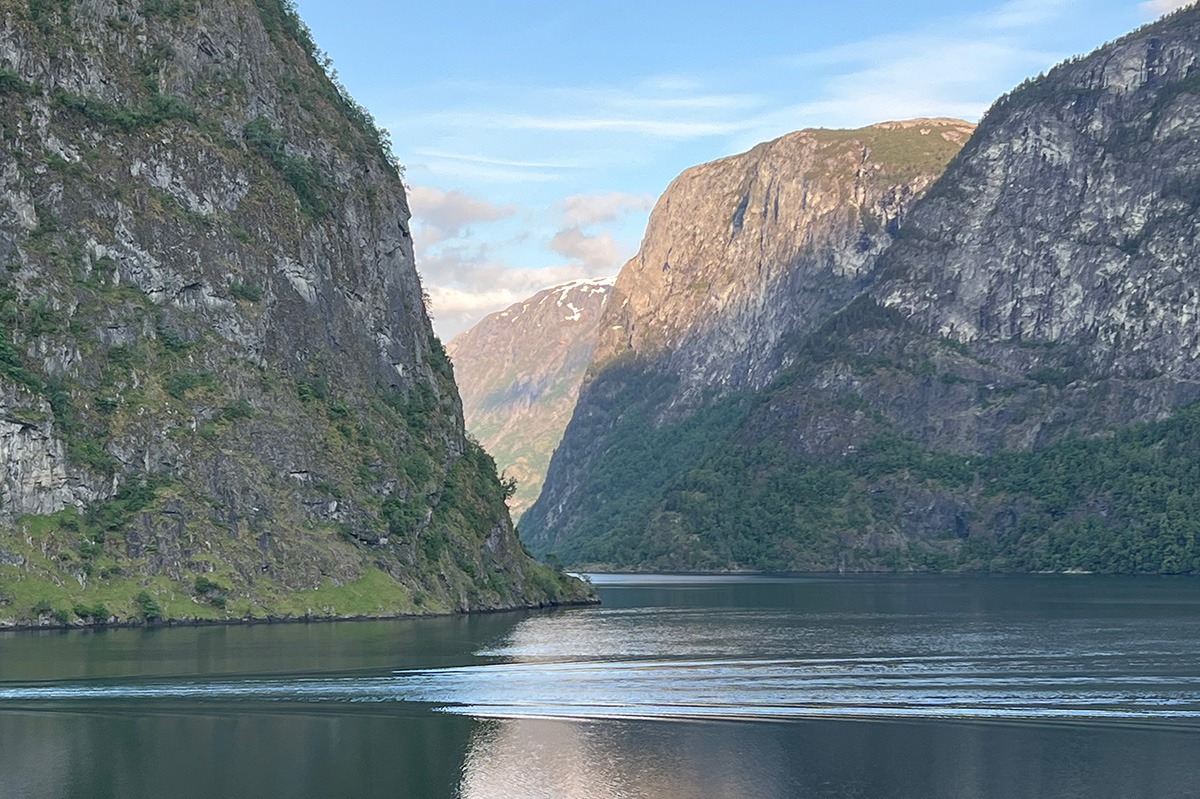
As I opened the blackout curtains in my stateroom, the view of the first Fjord we entered was breathtaking. It is why I was on this cruise and it’s meeting all my expectations for beauty. Instead of the predicted rain it was sunny, and warm enough to open my balcony door and take pictures. We left the ship and headed to the train station, a short walk, for the ride from Flam to Myrdal, about a one-hour trip up the mountain with breathtaking scenery. Countless waterfalls along the way. Again, it surpassed all my expectations and the beautiful weather held out just until we arrived back at the ship, about three hours later, when it began to rain lightly.
Back on the ship I headed to the gym, totally empty, and got ready for another sail away party in Dustin and Scott’s Iconic suite. This time a number of the senior crew were there including the Cruise Director, and Hotel Director. The Hotel Director I had met on a previous cruise and we chatted awhile. The Cruise Director is an interesting and very nice guy. He and his husband live in Las Vegas and he has been doing this with Celebrity for many years. He is a little older than most of the cruise directors I met before. It is a tough job. Then another lazy evening, first happy hour, then, Scott, Mike, Ken, Paul, John, and Paul, Rob, and Carlos, joined me for dinner at Normandie. After dinner we all went our separate ways. I headed to the show in the EDEN lounge. I was looking forward to seeing
Kyrylo and Yaroslav, the Ukrainian aerialists I had interviewed and written about on a previous cruise. I got a chance to say hello to them before the show began, and they are better than ever, and exciting to watch. The entire cast is incredible. Then back to my stateroom for a good night’s sleep. Day four was another sea day. At 2 pm we would be crossing into the Arctic Circle.
BLOG # 3 Celebrity APEX; Norwegian Fjords and the Arctic
Day five was as sea. Woke up to another beautiful day and this just seemed to be too good to be true. All the rain, and cold weather we anticipated, was nowhere in sight. Our luck was holding. This was going to be a totally lazy day on the ship, the kind I love. Breakfast was delivered to the room at 7:30 and then some writing and the gym. It was nearly empty again, which was great, no wait for the lifecycle.
There were a few guys from my traveling group there. From the gym it was over to the Retreat lounge, which is on the same deck, to get my cappuccino so I could really start my day the way I like. My friend Sid, from Carmel, was there, and we go to chat a little. He was going to play Rummikub with Janie and Will. I had my kindle with me and read for a while. There was going to be another party in Scott and Dustin’s Iconic suite as we entered the Arctic circle. The Captain announced he was going to host a pool party to celebrate and he and other senior officers would jump into the pool, and you could have your nose painted blue, in honor of crossing into the Arctic Circle. I did neither, jump into the pool or get the blue nose, but enjoyed watching the Captain come out of the pool in full uniform. A few of the guests actually went into the pool as well and the few that did had on bathing suits, always a few crazies on board, lol. They are the ones who do the polar plunges at home.
Then on my schedule for the day was the LGBTQ happy hour at 6:00pm and dinner reservations at Fine Cut, the steakhouse at 8:30pm. The meal was ok but can’t compare with EDEN as far as I am concerned. The filet mignon at EDEN was much better than the one at the steakhouse. There were a couple of other issues and when the nice lady came to the table asking if everything was ok, I let loose with my complaints. Told her it wasn’t her fault but hoped she would pass them along to the chef. She stopped by later and told me they would refund the money I paid for the dinner as it was one of my specialty restaurant dinners, you pay extra for those. I thought that was nice and thanked her. Tried to get the whole table comped but she wouldn’t go for that. After dinner I headed to the show in the Eden Lounge, a really good violinist. Then it was off to bed.
Day six we arrived in Tromso, often referred to as the Arctic’s capital. It is located above the Arctic Circle. We didn’t have a tour planned, but Celebrity said they would have shuttle busses available to take you into town. Problem was 1,000 passengers, and eight busses. The lines were ridiculous. So, a few of us hopped a taxi and headed to town. We had a nice taxi driver who asked us what port we had been to last and when we told him Flam, he said “oh you could go home now, Tromso is boring compared to Flam.” He wasn’t all wrong, but we enjoyed walking around town, and went to the Polar Museum, and my friends did some shopping. We got a kick out of the names of some places like “The Bastard Bar” and “The Misfit Bar.” There was also a Burger King and a 7 Eleven, just to make us feel at home. We walked around for a couple of hours and then did get a shuttle bus back. We had met David and Kate, and Kate and I headed to the shuttle bus stop where we saw Scott was also waiting. There was a long line but Scott told us as Retreat guests we could jump the line, so we did. Just as we were heading back to the ship it started to drizzle, again, the timing was great.
Then off to another happy hour and there was a show many of wanted to see at The Club that evening. It was Caravan, with the EDEN production cast, which included Kyrylo and Yaroslav, the Ukrainian gymnasts, and aerialists. Scott and Dustin had their butler get us into The Club first, for front row seats. The show was great. The full cast is amazingly talented. Then we had a late dinner in Normandie. Another tough day on board the APEX. Tomorrow we were off to Honningsvag. It would be a later start to the day which was great.
Blog # 4 Celebrity APEX cruise, Norwegian Fjords, and the Arctic
Day 7 dawned sunny, and much warmer than we anticipated. They told us Norway was having a heat wave. We were in Honningsvag, the northernmost city in mainland Europe. There were brightly painted wooden buildings, breathtaking fjords, and loads of waterfalls. The entire town had been rebuilt after World War II. We had twenty-four hours of sun; the sun doesn’t set here in the summer. We had a tour which took us to North Cape, for some incredible views, and interesting exhibits of the history of the area. It included information on how the King of Thailand had come to visit. There was an interesting installation, from a distance you could think it was a mini-Stonehenge, that was based on, and designed, by some children from around the world who visited in 1988. Then back to the ship for another relaxed evening. This time I headed to the theater for the 7:30 show, Tree of Life. A show I had seen before on another cruise, but worth seeing again. The casts of all the shows on board are incredibly talented. The dancers, singers, and aerialists, all make an evening in the theater exciting. What is great about the EDGE class ships main theater is the stage, with its risers and turntable, and the digital screens they have. Then dinner after the show. While I tend to head to bed early, there are many in my group, who keep going until late in the evening. The casino, the Martini Bar, and a host of other venues, go late into the night.
Day 8 was another day at sea. We cruised around the Arctic circle and then headed toward Geiranger, Norway. Once again, Sea days for me are always wonderful lazy days. That is the reason why I enjoy my annual transatlantic cruises. This years will begin in Rome on Halloween. The thirteen days back to Ft. Lauderdale. I had my usual breakfast in the room, then writing, then the gym, then the Retreat lounge for my cappuccino, and half the day is already gone. The evening included the LGBTQ happy hour, a show, and dinner. The only real decision to make is; dinner first and then the show, or the other way around.
Then often a late show in either EDEN or THE Club. On this day it was the Barricade Boys in the main theater, before dinner. They are good but the audio wasn’t, so the orchestra and the singers seemed to be competing. Then it was dinner and a late show in EDEN with my favorite cast of course including Kyrylo and Yaroslav.
Day 9 we arrived in Geiranger. It is an amazing city with a richly deserved designation as a UNESCO world heritage site. Once again blessed with incredible weather, we all took pictures as the Captain stopped the ship as we passed what are called the seven sister waterfalls in the Geiranger Fjord. Beautiful site to see. We learned 97% of the energy used on Geiranger comes from harnessing the power of all the waterfalls around the Island. They told us that by 2032 they hope to ban all fossil fuel using ships. They hope by that time there will be some electric ships, as Geiranger has a permanent population of less than 200, and last year there were nearly one million visitors.
We went on an excursion high up in the mountains with incredible vistas and lots of snow. Then we walked around the town. It was really a perfect visit. Then back to the ship for another evening of food, drink, music, and good company. What more could anyone ask. Life really is good. Some of us talked about just a twinge of guilt knowing the felon in the White House was making life intolerable for many, yet here we were. But we all agreed if we were to stop living our best lives in protest, he would win.
Day 10 and we were in Alesund. It was nearly seventy degrees, and sunny. The town was alight with gay flags. We were told there would be a PRIDE parade and festival starting at 2pm. So, it was off to our morning excursions which for me was to Alnes and some other fishing villages. We stopped at a beautiful historic church and once again the views everywhere we went were fantastic. At one stop we were treated to coffee and some chocolate cake. I struck up a conversation with a young man working there who was a high school senior. His name was Samuel, and he was hoping to go to university in the United States if the felon doesn’t mess up his plans. He wants to be a film director and go to school in California. He does have a good connection through one of his teachers who is friends with the director of Troll, now on Netflix.
When we got back to the center of town it was time for the Pride parade. It was just great to see so many young families and little kids waving gay flags. I met a family from Atlanta who were traveling through Norway and just happened to be here on this day for the parade. They had their kids with them, one a senior in high school, who is gay. They were fun to chat with. Then there were the sailors ready to march, and they had come from the military ship we had seen in the harbor. All-in-all the town was dressed in PRIDE colors, and it was so wonderful to see. That night back on the ship the cruise director had planned a PRIDE party in The Club. It was fun. Another incredible day in Norway, and on the Celebrity APEX.
BLOG # 5 Celebrity APEX; Norwegian Fjords and the Arctic
Day 11 dawned sunny and warm, but very windy. We were in Haugesund, our last stop in Norway. It is a bigger city, located between mountains, islands, and the North Sea. It is a cultural center for Norway. Our excursion was to the lighthouse, the second one we went to see. It was interesting but many of us felt Celebrity didn’t explain the excursion correctly on their website. Rather than a walk, it was more like a hike, on a very hilly gravel path. Again, we were lucky the weather was great, or it would have been a lot more uncomfortable for anyone with bad knees (me) or those walking with a cane as some on the excursion were. It was a far distance to the lighthouse from where the bus dropped us off. Our guide indicated he didn’t think Celebrity wrote about this fairly, and hoped everyone could make the trek. We all did, and saw some goats and beautiful scenery on the way. But when we got to the lighthouse it was disappointing. You couldn’t go inside and they had us in a nice room in one of the other buildings on the site. It had some beautiful artwork which was for sale, and they served us a tasty waffle and coffee, which I guess was to make up for the hike. I would not recommend this excursion to anyone. When we got back to the ship we drove through the town and realized it was Sunday, and nearly every shop was closed. A little disappointing for the last day in Norway. But each day on the cruise had been incredibly exciting so this was only a minor thing. There was a long line when we got back to the ship, but we realized it wasn’t to reboard, but rather everyone who had bought anything during the cruise was reclaiming their VAT tax. Our friends Nancy and Mary got on line. I kidded Nancy she shouldn’t have bought all those diamonds.
The rest of the day on the ship was great. I stopped for lunch at Café al Bacio and then there was a 5:30 party with the senior officers in the Eden Lounge. After that I stayed for the LGBTQ happy hour and arranged to have dinner with David and Kate at the Retreat restaurant, Luminae. It was the first time I would eat there on this cruise. But first we went to see the show in the main theater. They had a few of the people who had individual shows during the cruise, and it was nice. Then off to dinner where we bumped into Sid and Will and they joined us. After eating a quick, very fattening, dessert, I excused myself and went to The Club for a reprise of ‘Caravan’ with the Eden production cast. I was surprised the place wasn’t packed, and this time got a seat up front even without using the amazing Scott’s influence. I enjoyed the show as much the second time. It was the last time I could see Kyrylo and Yaroslav on this cruise. I then headed to the casino for the first time and lost a couple of pennies from my account. Literally only a couple of pennies, and with my friend Jake’s help cashed out the rest. Then it was back to the stateroom for a good night’s sleep. Tomorrow would be our final sea day as we head back to Southampton.
Day 12 showed we were no longer in 20 hours of sun. I woke up during the night and it was actually dark. It dawned sunny, but chillier. The sea was still smooth which was great. My last breakfast was delivered to the room; I will miss this when I get home. Then did some writing and headed to the gym. My last day of sitting on a Lifecyle and looking out at the beautiful sea. My next time on the Lifecyle would be back at the JCC, and I would be looking at a blank wall. Good thing I can read my kindle while peddling away. After the gym I went to the Retreat lounge, something you all would have guessed by now if you had read the previous blogs from any of my cruises. Met Terry and Andy there, and they were about to head to the gym. While at the gym I had bumped into Phil, the dance captain of the Eden production cast, and we agreed to meet at Café al Bacio at 3pm to chat. I may be doing a column on him at some point.
My evening plans included going to the final LGBTQ happy hour at EDEN, where Jill would be taking a group photo. Then heading to see ‘Rockumentary,’ the show at the theater with the full production cast. Then it’s dinner at Fine Cut Steakhouse, (hope it is better than the first time), with Rob and Carlos and Paul and John. I packed before I went to the happy hour. Our suitcases had to be outside our cabins by 10pm.
Day 13 and back in Southampton. I hadn’t slept all that well and the bonus to that was seeing a beautiful sunrise. Celebrity had arranged my transfer back to Heathrow airport for my flight back home and all that went on tine. It was the end of an amazing twelve days at sea, with great friends and absolutely awe-inspiring scenery. The Norwegian Fjords and the Arctic met all my expectations. Now I can look forward to my next transatlantic cruise leaving from Rome the end of October. If you have gotten this far, thanks so much for reading, and being a part of this amazing experience.
Peter Rosenstein is a longtime LGBTQ rights and Democratic Party activist. He writes regularly for the Blade.





Commentary
Washington Blade responds to concerns over White House pool duties
Inaccurate media reports create confusion but we stand with our colleagues
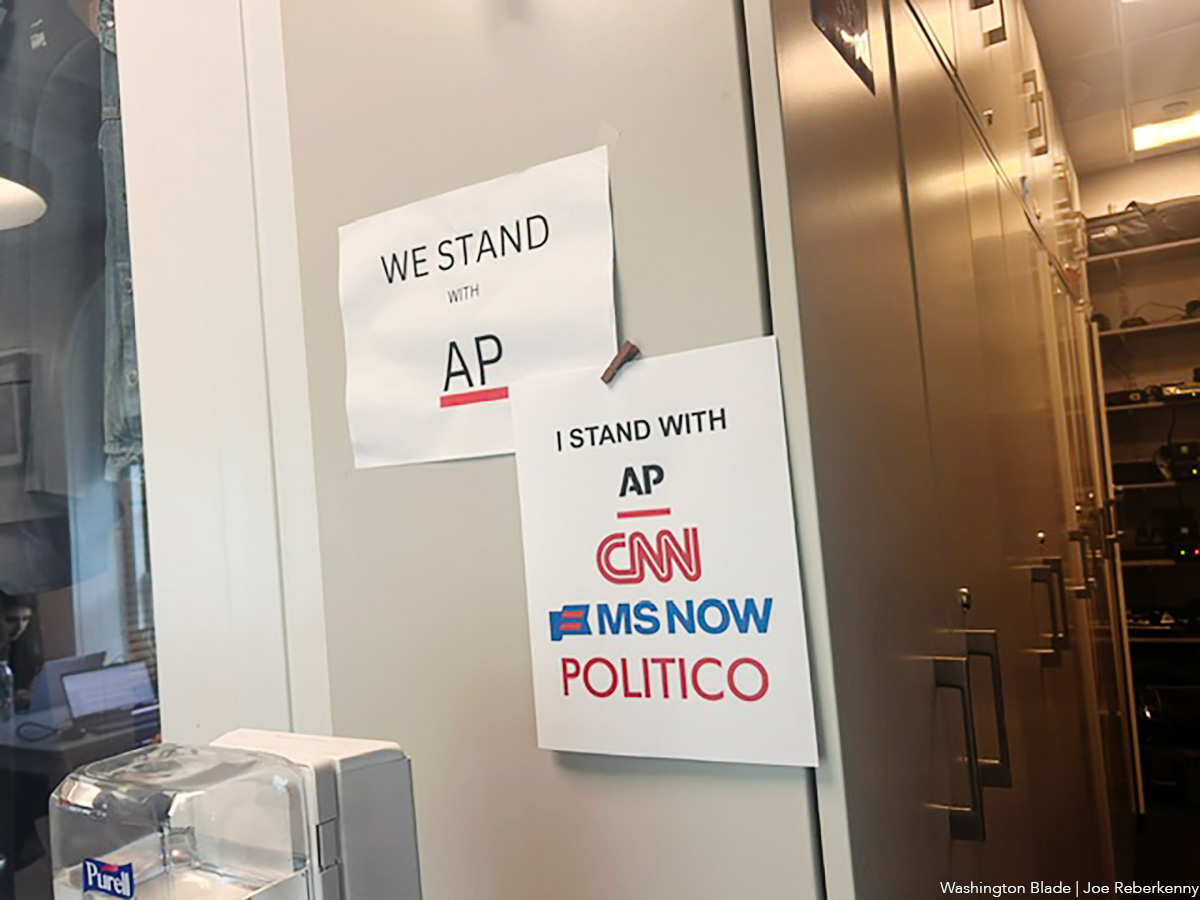
Last week, President Trump announced his unconstitutional ban of CNN, MSNow, and Politico from the White House. Coincidentally, on Monday, it was the Washington Blade’s turn to serve as the print pool reporter on duty covering the president’s actions that day. This important responsibility is shared and rotated among the print members with each serving roughly once per month. The Blade is the only LGBTQ outlet with a seat in the briefing room, a slot in the pool rotation, and membership in the White House Correspondents’ Association, something we fought for decades to secure after enduring years of discrimination, ridicule, and resistance to openly queer journalists working inside the White House. We take our responsibilities there seriously.
There are two pools that cover the president: broadcast and print. The other four members of the broadcast pool — ABC, CBS, NBC, and Fox News — agreed to boycott their pool duties. There has been no boycott among the print pool, which is a separate entity. I called the president of the White House Correspondents’ Association on Monday to confirm that no outlets in the print pool were boycotting.
A boycott by the Blade would set us back and lead to our expulsion from the pool and briefing room and our replacement by a right-wing outlet sympathetic to President Trump’s approach to attacking the media. The LGBTQ community is far better served with the Blade in the room than a far-right blogger taking our seat.
Let’s be clear: the Blade stands for diversity, equity, and inclusion and we stand for the First Amendment and freedom of the press. In solidarity with the broadcast pool, we made two important decisions on Monday — the first day anyone had to think about any of this. First, we refused to take or share any videos or still photos of the president, which would have undermined the broadcast boycott. Second, when Politico’s turn comes up for pool duty in mid-October, the Blade will not fill in and cover for them while they are banned. Politico must be readmitted and allowed to do their job.
After a rough day navigating and reporting on all of this, the Advocate published a reckless and inaccurate story suggesting that the Blade had crossed a picket line. Not true, as there is no print pool boycott. They claimed that I wouldn’t talk to their reporter. Also not true. I called their reporter within 90 minutes of receiving his message and he didn’t take the call or call me back. Their story named me and our White House reporter, immediately exposing us to public criticism and worse. The environment in D.C. is so toxic and even violent these days that subjecting our staff to unfair and false accusations like this invites harassment, doxxing, and worse. To do that without even talking to us is next level irresponsible and the antithesis of journalism.
On Tuesday, I talked to two reporters and an editor at the Advocate but they refused to retract anything in their inaccurate story. If the reporter had returned my call, I could have explained all of this but they are more concerned with clickbait and sensational headlines, a dangerous practice in these troubled times.
Back to the pool. The Blade was in the briefing room in the Reagan era, when Press Secretary Larry Speakes made jokes about AIDS and the reporters in the room laughed out loud. We endured all of that abuse and worse for decades, always standing in the back of the room and never being called on. The Blade’s journalists persevered. When President George W. Bush was re-elected in 2004, the Blade’s White House credentials were revoked amid an earlier press crackdown. Notably, no one boycotted or stood up for us. When Barack Obama won election in 2008, I received an email from his communications director informing me that effective midnight on Jan. 20, 2009, the Blade’s credentials would be restored.
So we have had quite a ride navigating administrations and their changing requirements for gaining access but always playing the long game. As Barney Frank used to say, “If you’re not at the table, then you’re probably on the menu.” The Blade is at the table and we do our best to ensure the LGBTQ community’s issues are addressed by both parties.
Thanks for reading and supporting the Blade’s work. If you have questions about our approach, you can reach me at [email protected].
Kevin Naff is editor of the Washington Blade. Reach him at [email protected].
Commentary
What LGBTQ veterans are building after ‘Don’t Ask, Don’t Tell’
DADT repeal took effect on Sept. 20, 2011. Trans servicemember ban reinstated

Fifteen years ago this month, the repeal of “Don’t Ask, Don’t Tell” took effect. At the time, the importance of the change was obvious: gay, lesbian, and bisexual Americans would no longer have to hide who they were to wear the uniform. What was harder to see was what would follow: a generation of LGBTQ veterans able to carry their service openly into American civic life.
Earlier this month, Alaska state Rep. Andrew Gray, an Army veteran, stood before the Anchorage Assembly and asked the city to recognize Sept. 20 as LGBTQ Veterans Day.
His former command sergeant major, Mike Grunst, followed him to the microphone. A 35-year veteran who had served in combat, Grunst called troops who had served while hiding who they were “the bravest I have ever served with.”
Then Denise Sudbeck stepped forward. A Vietnam-era Navy veteran, she thanked the country for the privilege of serving and asked that the next generation have the same chance.
The Assembly approved the recognition.
Nothing about the scene required a new vocabulary. A veteran made a request of his community. A commander vouched for those who served beside him. Another veteran asked that younger Americans inherit the opportunity she valued. They entered the civic record simply as veterans.
That identity can do more than win recognition.
When federal policy abruptly ended the careers of transgender servicemembers this year, veterans and servicemembers in California began asking a practical question: What happens when those Americans come home?
Republican Assemblyman Jeff Gonzalez, a Marine combat veteran, began one hearing with questions about transgender military service. He listened as veterans explained how the military handles medical care and deployment case by case.
Then the discussion turned to separation.
“I don’t wanna see any veteran homeless,” Gonzalez said. Before the hearing ended, he was asking: “How can I help? How can I understand? How can I be a good advocate?”
The legislation that followed would provide housing, employment and transition assistance to discharged servicemembers. Republican state Sen. Shannon Grove spoke for it. The Senate passed it 32 to 0.
Americans have plainly not settled their disagreements over transgender people. Nor should military service be a prerequisite for rights that belong to every citizen.
But military service creates relationships that are difficult to reduce to the abstractions of the culture war. Before a legislature, “the transgender issue” can become a veteran who deployed, an officer who led troops, or the person who once stood beside you.
The political question changes because the human relationship has already changed.
The pattern is beginning to appear across the country. Kansas is among the states recognizing LGBTQ Veterans Day for the first time this year. New York and Virginia are pursuing broader state-level programs for LGBTQ veterans.
Sept. 20 is deliberate. On that day in 2011, “Don’t Ask, Don’t Tell” ended.
We usually remember repeal for what LGBTQ Americans gained: the ability to serve openly. Fifteen years later, we can also see what the country gained.
A gay veteran can stand before his local government beside the commander who once led him. A transgender servicemember can sit before a legislator who begins with doubts and ends by asking how he can help. A veteran from an older generation can ask her neighbors to give those who follow her the same chance to serve.
This is citizenship in practice.
The enduring legacy of “Don’t Ask, Don’t Tell” repeal is not only that Americans were finally allowed to serve openly. It is also what they can now build after coming home.
Commentary
Anti-science, anti-LGBTQ movements go hand in hand
HHS under RFK Jr. has blocked gender-affirming care for youth

A newborn baby died after contracting measles in Pennsylvania last month, and, as if it wasn’t enough grief for his parents, anti-vax activists are trying to track down and harass his family. Apparently, Gov. Josh Shapiro tangled with Robert F. Kennedy Jr. over his “inaccurate and misleading claims.”
On Aug. 26, RFK Jr., the secretary of the U.S. Department of Health and Human Services, declared that the deaths could be fabricated. We live in peculiar times, when it is government officials, not freaks on the internet, who are spreading conspiracy theories. The new spread of measles in the United States since Donald Trump came to power is one of the most shameful parts of the story of modern American politics, and the tragedy of parents who lost their baby because more and more people refused to vaccinate may seem absolutely unrelated to LGBTQ rights, but actually, there is a pretty solid connection.
Because RFK Jr., the same man who was fighting vaccination, promoted the false idea that vaccines caused autism, and even curated the anti-vaccine organization Children’s Health Defense before going into politics, is also a known opponent of transgender rights. Under his “leadership,” gender-affirming care for trans minors was banned, and there were also created new healthcare guidelines recognizing only two genders.
All around the globe, there is a weird correlation between anti-LGBTQ — particularly anti-trans — ideas and anti-science movements. And it should be clearer to the general public. People who are speaking against LGBTQ rights are not just threatening minorities. They are a danger to everyone.
The Trump-Vance administration is an iconic example of such tendencies.
Trump himself is a known critic of modern scientific studies — for example, believing in the same anti-vax conspiracies that Kennedy promoted, and showing obvious skepticism that global warming exists, despite all the evidence that has been shown by climatologists. And he is also a man who used trans people as boogeymen. Under his command, trans people were kicked out of the military. And even worse, recently he made an extremely chilling statement about the 2026 midterm elections, urging voters to “pretend I’m on the ballot” and vote for Republicans, and while discussing what he says is at stake, he said that if Republicans win, “transgenderism” will “end.” This is an offensive statement at best and genocidal at worst.
And, of course, I think everyone remembers the Department of Government Efficiency (DOGE), which was led by infamous billionaire Elon Musk, who announced to the world that he would destroy the “woke mind virus” that killed his child just because his trans daughter, Vivian Wilson, well, is happy to be a trans person.
DOGE is known not just for cancelling academic research around LGBTQ studies and gender studies. No, this agency abruptly canceled and froze thousands of federal science, research, and health grants, attacking such vital health programs as cancer research, vaccination research, and diabetes research, among others. As you can see, they are not just attacking people who are “affected” by the “mind” virus — they are dangerous to everyone, even if most of the public standing of Musk was around his anti-trans politics and he tried to present himself as a pro-science, pro-progress man by supporting the space industry.
An even more vivid example is the so-called Dark Enlightenment movement.
This extremely reactionary political movement was born in the late 2000s, and originally grew from very democratical classical liberal ideas. Until it became anti-democratic itself. And also often It was created by American software engineer Curtis Yarvin (writing under the pseudonym Mencius Moldbug) and expanded by British philosopher Nick Land. The movement is popular among some Silicon Valley businessmen, and got support from PayPal founder Peter Thiel, and one of their main ideas is that modernity is bad. They are basically obscurantists, who see modern universities as part of “the Cathedral” — a system that, in their opinion, promotes equality and modern science that society doesn’t need. Of course, the movement’s followers are mostly anti-LGBTQ rights, and, as you can see, anti-queerness once again go hand in hand with obscurantism. Unfortunately, the movement got the support of extremely prominent politicians, including U.S. Vice President JD Vance.
In his speech from 2021, Vance proved to be an obscurantist when he claimed that universities are the enemy. He is also a known homophobe and transphobe.
So, why are anti-vaxxers, people who oppose modern scientific studies, and people who hate universities more likely to be queerphobic? Why do the same people who are defending their transphobia by showing that they support common sense actually often show zero such sense when it comes to protecting themselves and their children from measles or decreasing the chances of getting cancer?
We don’t have any statistics or studies that show that all obscurantists are queerphobic, but around the globe, the same dynamic is visible.
In Russian anti-LGBTQ censorship, books about animal biology and zoology have been censored because the censors saw “LGBT propaganda” in them. The famous pro-Putin philosopher Alexander Dugin, who is extremely anti-queer, also speaks up against modernity itself.
In Taliban’s Afghanistan, modern science and LGBTQ rights are attacked at the same time.
Even in the UK, Reform UK is known as the most anti-trans and anti-queer party, and they are facing widespread criticism from scientists and medical experts for promoting climate change denial and anti-vaccine ideas. It doesn’t mean that LGBTQ supporters never believe in conspiracy theories or that progressive politicians always support science.
No, it just means that explicit anti-science and anti-LGBTQ statements often go hand in hand.
I think there are two reasons for this correlation.
First, LGBTQ people are real. You cannot deny that sex is not binary, gender and sex are different, and transition improves the quality of life of actual trans people. Or that same-sex relationships are natural, because even animals have same-sex sexual contacts. To deny it, you need an ideology or a conspiracy theory.
The second reason is that anti-scientific populism and anti-LGBTQ conspiracy theories are popular among the same category of people. It’s a “bundle” of ideas — a trend that conservative voters often adopt together. Studies also show that people who are likely to believe in one conspiracy theory are more likely to believe in another.
But the question is more broad. We don’t speak enough about the harm anti-scientific conspiracy theories and obscurantist politicians around the globe create for mankind in general. Not all people would suffer from a prohibition of hormone therapy, or attacks on same-sex marriage. But anti-global warming ideas, anti-vax advocates, and restrictions on modern research, especially medical research, are potentially dangerous to any human being.
And one of the best things LGBTQ activists could do is just show society that they are being used — that the same people who are stealing LGBTQ rights are also destroying medicine and the environment, and it’s a threat to their own traditional families and future of all kids no less than to queer people.

Trump uses anti-trans slur against Democratic Senate candidate

D.C.’s LGBTQ homeless facilities face possible hit from Trump funding cuts

10 years later, we still can’t shake Barry Jenkins’s ‘Moonlight’

‘Some Like It Hot’ a wild ride at renovated Bernard Family Theatre

Bessent says Trump chose him for his qualifications, not his sexuality

Eliot Glazer’s new book an engaging collection of essays

Equality Chamber hosts Pride in Business Expo and Profits & Pours

Learn more about Virginia’s queer history

Lula, Flávio Bolsonaro to face off in second round of Brazilian presidential election

‘Merrily’ is for Sondheim super fans, the uninitiated, and anyone in between
-

 Books3 days ago
Eliot Glazer’s new book an engaging collection of essays
-
Out & About4 days ago
Equality Chamber hosts Pride in Business Expo and Profits & Pours
-
Out & About4 days ago
Learn more about Virginia’s queer history
-
Brazil3 days ago
Lula, Flávio Bolsonaro to face off in second round of Brazilian presidential election