National
Trump falsely links trans people to terrorism
Intelligence agencies threatening to investigate community members as domestic terrorists
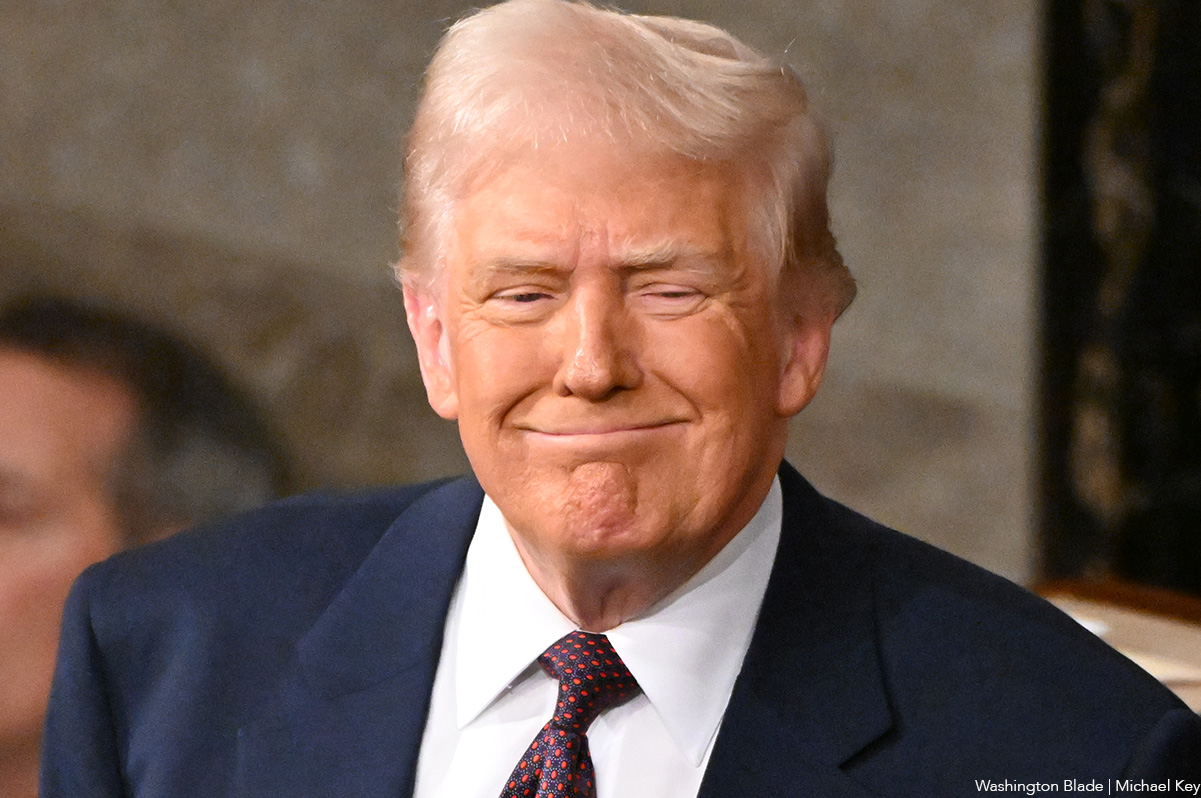
Uncloseted Media published this article on Feb. 14.
By HOPE PISONI | In December, Kathy Brennan was in San Francisco on a video call with her wife and son when she started to feel a burning pain in her chest. While she ignored it at first, it quickly spread to more of her body until it was too much to bear. She called 911 and was brought to the hospital on a stretcher.
“My entire chest was just crushed in pain, I couldn’t even move it was so bad,” Brennan told Uncloseted Media. “I said ‘God, I am not ready to die here. Please don’t let me die.’ I was thinking about Alaina, and we have so much more life together.”
Brennan spent the next few days recovering in the hospital from what doctors determined to be a stress-induced heart attack.
Brennan had spent the past year in a near-constant state of what she called “safety monitoring” her wife, Alaina Kupec.
She obsessively followed the news about the Trump administration’s attacks against the trans community, especially as officials began openly labeling trans people as terrorists. Everywhere she went, she mentally patrolled for how to keep her wife safe.
“Is our home safe? Is my wife safe? Are we safe? What do we have to do? … Can we protect ourselves if people come to our door? What do we have to worry about when we go to the grocery store? Are we gonna get doxxed?” Brennan remembers thinking.
Kupec, a trans naval intelligence veteran, is an outspoken advocate for trans rights and is the founder president of Gender Research Advisory Council + Education (GRACE).
“I think the big worry is that she will be taken away from me and we won’t be able to find her. … Then, just for the sheer sake of cruelty, my beautiful, feminine woman of a wife, they would put her in a men’s prison.”
Brennan’s fear reflects that of many trans Americans and their loved ones. In the aftermath of the assassination of anti-trans conservative activist Charlie Kirk, the Trump administration and its allies began taking actions to target socially progressive people and organizations as terrorists, with a focus on trans people. In September, Trump signed an executive order designating Antifa, a decentralized movement focused on militant opposition to fascism, as the first ever “domestic terrorist organization.” At the same time, the closely allied Heritage Foundation — who penned Project 2025 — began pushing for the creation of a new national security designation called “Transgender Ideology-Inspired Violent Extremism.”
Shortly after, Trump released National Security Presidential Memorandum (NSPM)-7, which directs intelligence agencies to investigate left-wing political organizations for involvement in domestic terrorism, singling out “extremism on migration, race, and gender” and “hostility towards those who hold traditional American views on family, religion, and morality.”
The unfounded trans terrorism panic has swept right-wing spaces, and experts say that it’s putting trans people in danger.
“If people are told, day after day, especially from … people with that veneer of legitimacy, that this entire group of people … is implicitly a dangerous terrorist, that sends that message that these people are able to be targeted for violence,” Jon Lewis, a research fellow at the Program on Extremism at George Washington University, told Uncloseted Media.
The what and the why
While Trump relied on anti-trans messaging since he began campaigning in the 2024 presidential election, his portrayal of trans people as a national security threat emerged in response to an August 2025 mass shooting in Minneapolis, where a trans person killed two children. While the overwhelming majority of mass shooters are cisgender men, right-wing figureheads blamed the shooting on the perpetrator’s transness.
While Kirk’s assassin is cisgender, early reports falsely claimed that he had engraved pro-trans messages onto his bullets, which conservative figures like Megyn Kelly and Laura Loomer used to blame trans people for the killing. “It’s time to designate the transgender movement as a terrorist movement,” Loomer said the following weekend on X. And Vice President JD Vance suggested that he considers trans people to be part of a “terrorist movement.”
The Trump administration picked up on this rhetoric to justify its actions: the Antifa executive order and NSPM-7 both reference Kirk’s assassination as well as either trans people or “extremism on gender.”
As these policies began rolling out, independent journalist Ken Klippenstein reported that the FBI was preparing to designate trans people as “nihilistic violent extremists.” A leaked intelligence brief showed that U.S. Customs and Border Protection had centered the focus of one extremist group on their trans membership, referring to them as a “radical leftist trans militant cult.”
How these actions will be enforced remains to be seen. At least two trans women are currently jailed and awaiting trial over an anti-ICE protest where a local police officer was shot by a cis man, which the Department of Justice claims was connected to an “Antifa Cell.” It is not known whether the government will attempt to use the defendants’ transness to implicate them in terrorism charges.
And leaked documents indicate that the FBI is compiling a list of groups and individuals involved in extremism based on a number of beliefs including “radical gender ideology.” Their ability to compile such lists may be enhanced by a policy change from the Department of Homeland Security last February that allows the government to surveil people based on their sexual orientation or gender identity.
While some have questioned to what extent the administration intends to actually enforce all of these policies, experts say that the fact they’re being discussed poses a serious risk.
“From 9/11 onward, the United States has been leading a ‘global war on terror,’ so to label somebody as a terrorist is a rallying cry for violence and discrimination,” says Arie Kruglanski, a professor of psychology at the University of Maryland. “This term of terrorism calls people to action. … Once you label somebody as a terrorist, then clearly they present a mortal danger to society, and they need to be fought against.”
‘Tremendously damaging’
Lewis says that being exposed to these attacks can be “tremendously damaging.”
“It’s not even that there are [always] explicitly these immediate legal repercussions that some person will face, but it’s that othering, it’s that sense of fear every day,” he says.
That fear has caused Jewels Jones to withdraw from public life. Jones, a trans man from the South, says that the anti-trans vitriol online after Kirk’s death became too much to handle, and he had to leave social media almost entirely.
“I’m 23, I should be on social media, but I can’t because if I even go onto my timeline, something can trigger me,” Jones told Uncloseted Media. “[I miss] the feeling of freedom.”
With community often hard to find, Jones says he and several other trans people he knows have been struggling with substance use.
“Everyone here has their own reasons for turning to things such as drinking and smoking and partying and just finding [a way] to feel numb or ignore what’s going on,” Jones says. “Just being trans and having to see how everybody views you, how you’re perceived, how you’re feeling, all these different emotions that you feel is more than enough of a reason [to] turn to those things.”
PJ, a trans man from a small town in Arizona, who asked to remain anonymous because he is not out, says that after Trump’s inauguration, he’s started to hide his transness. And he’s not alone: Since the 2024 election, 55 percent of trans people have taken steps to be less visible in their communities.
“It is torture,” PJ says. “I do not like having to lower my voice when I speak to prevent sounding androgynous. I do not like having to hide away my wardrobe for ‘being too gay.’ There is no comfort in overcompensation.”
Individuals aren’t the only ones stepping into the shadows. Kupec has been withdrawing herself and her nonprofit from the internet as much as possible. She says GRACE used to host monthly calls, where as many as 100 people would join to hear from experts on issues facing the trans community. But now, they no longer have public meetings, and internal communications have moved to Signal, an encrypted messaging app.
“We have backed off of doing those things because of the fear of how this could be leveraged against us,” Kupec told Uncloseted Media. “It’s had a chilling effect on our ability to exercise our freedom of speech as individuals and as a nonprofit organization.”
Trying to leave
Because of this fear, many trans Americans are trying to leave. A survey by the Movement Advancement Project found that 43 percent of trans Americans had considered moving to a different state since the 2024 election, with 9 percent having already moved. And the Williams Institute found that 45 percent of trans people wanted to move out of the country.
Kupec has watched noteworthy friends disperse across the globe: Rachel See, the former chair for National Center for Transgender Equality, moved to Portugal; and author and advocate Brynn Tannehill moved to Canada.
“That’s part of what [the administration’s] desired outcome is, to get people to self-deport,” Kupec says.
For many, relocating isn’t easy: For 64 percent of trans people who want to move out of state, cost of living was cited as a barrier. PJ has been trying to move for years. But within the U.S., relatively LGBTQ-friendly states like California and Massachusetts have much higher costs of living, making moving there financially challenging.
Moving internationally is no small feat either — every country has its own laws to navigate around immigration.
PJ says he kept running into barriers while trying to leave. The Netherlands initially seemed promising, but he discovered that the path to residency required him to start a business, which he couldn’t afford to do. Other countries fell through because he didn’t have the money to cover application fees. The closest he got to making it out was when a friend on the east coast of Canada offered to let him stay with them for a while. But it fell through when the friend’s septic tank collapsed, ruining the house and forcing PJ back to the U.S.
“It seems like every plan that you make to try to get out of here, it just gets squashed,” he says.
Those barriers have gotten scarier for PJ as the clock may be ticking for him to be able to leave. In November, the Supreme Court allowed the Trump administration to enforce a ban on passports with gender markers that do not align with an individual’s birth certificate, with the State Department’s website suggesting that passports which have already been updated may be invalidated.
Given all of these threats, PJ believes that trans Americans should be able to seek asylum in other countries. Applications for asylum by trans Americans have been rejected in countries including the Netherlands and Canada, and most European countries don’t view the U.S. as dangerous enough to grant refugee status despite many having issued travel advisories for trans residents visiting the country.
“We can’t really claim asylum right now so there’s not really many other options but sink or swim,” PJ says.
There have been some efforts to push for asylum status for trans Americans. Politicians, advocates and lawyers in Canada and Norway have called for their respective governments to accept trans Americans as refugees. And in July, a Canadian judge blocked the deportation of a nonbinary American who overstayed their visa, with one of the factors considered in the decision being “current conditions for LGBTQ, nonbinary, and transgender persons” in the U.S.
Finding hope and respite
In the face of all this, finding a support network can be crucial to survival. While community has been especially hard to find in the South, Jones says that he’s been able to connect with other transmasc people via reddit communities like r/TMPOC (Trans Masculine People of Color) or r/testosteronekickoff.
Kupec and Brennan find solace through their 12-year relationship. Brennan says, “I love her more now … than I did when I first fell mad smack in love with her.”
“Having love where there’s respect and kindness and joy and excitement and it goes both ways, that is really unique, not a lot of people have that,” she says. “But when you do have it, it’s like, ‘I wanna preserve this and protect this with every ounce of my energy and soul because it’s the center of my life,’ and I know that she feels that way too.”
As Brennan recovers from her heart attack, she’s been watching less news and joined a book club to connect with other people. Kupec, a Catholic, has been putting her faith in God to get through.
“I know who I am, I know my maker knows who I am, and I have strong faith that by doing the right thing, at the end of the day, that’s what’s going to win out.”
Additional reporting by Sam Donndelinger.





National
Man charged in Mall of America shooting plot inspired by Pulse massacre: report
Suspect exchanged hundreds of messages, pledged loyalty to ISIS
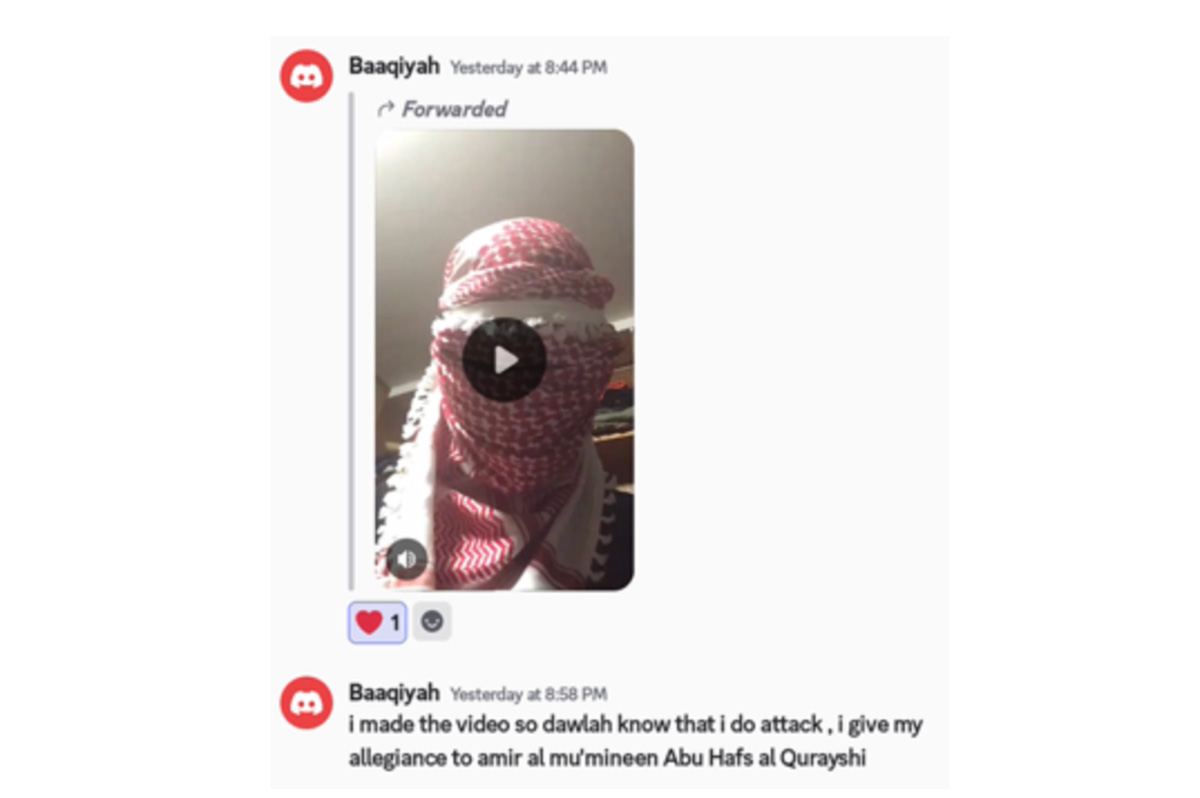
The U.S. Department of Justice charged Sheikhdoon Abdullahi Mohamud, 18, of Richfield, Minn., on Oct. 7 with one count of knowingly receiving a firearm and ammunition in order to commit a federal crime of terrorism. Mohamud allegedly planned to carry out a mass-casualty attack in support of ISIS, inspired in part by the Pulse nightclub massacre that took place on June 12, 2016 when then-29-year-old Omar Mateen murdered 49 people and wounded 58 – one of the deadliest mass shootings in U.S. history, and the deadliest targeting the LGBTQ+ community.
According to a DOJ statement release, Mohamud was arrested on Oct. 6 by the FBI, which had arranged to sell him an AK-47 assault rifle, magazines, and ammunition through an undercover FBI employee. Mohamud was arrested shortly after paying $600 in cash and taking possession of those items; he reaffirmed his intention to shoot people at the Mall of America during the transaction.
“Mohamud allegedly sought to carry out a mass-casualty shooting at the Mall of America, expressing a desire to emulate some of the most horrific ISIS-inspired attacks in the United States, including the atrocities at Pulse Nightclub and 2025 New Year’s Day attack in New Orleans,” said Assistant Attorney General for National Security John A. Eisenberg in the statement by the DOJ. “The National Security Division will continue to work closely with the FBI and Joint Terrorism Task Force to track down and prosecute ISIS-inspired terrorists in the United States.”
According to the complaint, beginning on or about December 2024, Mohamud had exchanged hundreds of messages through multiple social media and messaging apps with a confidential source, and expressed a desire to travel to Somalia to join a designated foreign terrorist organization to fight on their behalf.
The defendant stated many times that if he was unable to travel overseas because of a lack of funds, he planned to carry out a mass-casualty event in Minnesota in support of ISIS.
According to the DOJ, “In July 2026, Mohamud sent messages discussing his intent to carry out a mass-casualty shooting attack at the Mall of America because he claimed it was owned by Jews. He wrote that [he] wanted to kill 30 to 60 people so no one would go there.”
“During the course of his communications, Mohamud stated that he wanted to commit an attack similar to those of the Pulse Nightclub mass-shooting in Orlando, the Bondi Beach mass-shooting in Australia, and the New Year’s Day vehicle-ramming attack in New Orleans.”
This case is being prosecuted by Trial Attorney Ryan White of the National Security Division’s Counterterrorism Section and Assistant U.S. Attorney Benjamin Bejar for the District of Minnesota.
California
Calif. GOP gubernatorial candidate ad ‘disgusting attempt to exploit lesbian intimacy’
Activists, anti-LGBTQ religious leaders criticized Steve Hilton spot

Two women sit on a bed, a Pride flag hanging behind them. One is nervous; the other tells her to be calm and that she’ll do “all the work.” The music swells. The two hold hands and — fill out a ballot voting for Steve Hilton?
This is the new advertisement from the Hilton gubernatorial campaign that is drawing rebuke from both sides of the aisle, but for very different reasons.
Jorge Reyes Salinas, the communications director at Equality California, said the ad was an insult to the queer community.
“This ad is a disgusting attempt to exploit lesbian intimacy for political attention,” he said. The advertisement plays on media tropes that Salinas says “reduce lesbian and bisexual women … to sexual entertainment,” rather than showing them as well-rounded characters. “Any group of the LGBTQ+ community deserves the same dignity and respect as everyone else,” he said.
The ad is truly hyper-sexualized. It ends with one woman telling the other, “Now lick it.” The two pause and stare before she reveals an envelope to send the ballot, and large text pops up saying, “Just try it!”
Salinas characterized the ad as a desperate attempt to get attention from a candidate who is trailing far behind in the polls in heavily Democratic California. The Democratic candidate Xavier Becerra, who is endorsed by Equality California, holds a 25-point lead over Hilton according to recent polling by the UC Berkeley Institute of Governmental Studies.
Conservatives have also criticized the ad.
Influential evangelical Pastor Jack Hibbs thought the ad was distasteful and said, “lesbianism among college girls and some high school girls that right now is an actual pandemic of social ill.” Republican attorney general candidate Michael Gates said it undermines “the sanctity of the relationship between parents and their children.” This criticism is rather confusing because although the ad features two relatively young women, they both appear to be adults, not minors.
“The comments from Pastor Jack Hibbs should be criticized because there is nothing wrong with two women being attracted to each other,” Salinas said. “We’re calling out the ad’s stereotypes, while also rejecting the homophobia in the response to it … by other Republicans.”
The backlash from Hilton’s own party and supporters shows that an advertisement full of queer innuendo was ill-considered, considering the national GOP’s attacks on LGBTQ people in recent years. Hilton himself has been campaigning against transgender girls and women competing in school sports and using locker rooms that correspond with their gender identity. This context might be why Hilton’s political base responded to the ad just as poorly as the liberal voters he was attempting to court.
Hilton says the ad is part of a new series rolling out before Election Day, showing stereotypical California liberal archetypes voting for Hilton. He claims these ads are authentically filmed with real actors, as opposed to being A.I. generated, like many of his previous ads. One other advertisement has been released so far by the campaign showing a man at a spiritual retreat also being swayed to vote for Hilton, although it is notably absent of sexual innuendo.
Caleb Kaufman is a California Local News Fellow placed with the Los Angeles Blade. The California Local News Fellowship is a state-funded initiative to support and strengthen local news reporting. Learn more about it at fellowships.journalism.berkeley.edu/cafellows.
2026 Midterm Elections
Trump uses anti-trans slur against Democratic Senate candidate
President mocked Annie Andrews

President Donald Trump used an anti-trans slur against Democratic South Carolina Senate candidate Annie Andrews on Monday as he sought to rally support for Republicans in the state’s Senate race.
In a post on Truth Social, Trump attacked Andrews three times, referring to her as “trannie” while promoting U.S. Sen. Darline Graham (R-S.C.)’s campaign.
Andrews is running against Graham for a Senate seat in the solidly Republican state.
Earlier this year, Graham was specially appointed to the seat following the death of her brother, Lindsey Graham, who represented South Carolina in the Senate from 2003 to 2026.
Andrews, the Democratic nominee from the state, is a pediatrician that lives in Charleston with her three children. She told NBC News that she will “work with anyone to put South Carolina first.”
“As a mom and a pediatrician, I’m in this race to fight for my patients, my three kids, and South Carolina,” Andrews said, adding that “lowering costs and making life better for families across our state is going to take all of us working together.”
Andrews used the attention from the president’s attack to emphasize what she described as a focus on policy issues rather than the culture wars that have dominated much of the political debate.
“If you care more about your bills than the politics in Washington, this campaign is for you,” she added.
Trump’s remarks have drawn criticism from leaders on both sides of the aisle.
Senate Minority Leader Chuck Schumer (D-N.Y.) condemned Trump’s words Monday night on social media, calling his attacks on Andrews “despicable.”
“Annie Andrews is a mom and pediatrician who’s always put her community first — and she’s exactly who South Carolina needs representing them in the Senate,” Schumer said on X.
Former South Carolina Gov. David Beasley, a Republican, also criticized the president’s attack on Andrews, urging voters to “reject politics based on division and hate.”
“This is abhorrent. Elections don’t have to be about cruelty and lies. South Carolina deserves better,” Beasley wrote Monday night on X.
South Carolina has not elected a Democratic senator in nearly three decades.
Andrews’s campaign website does not mention her positions on LGBTQ issues.
The Washington Blade reached out to Andrews’s campaign for comment on Trump’s attack and her positions on transgender rights but did not hear back by time of publication.

Center Arts Gallery celebration, auction to take place on Oct. 17

Comings & Goings

‘Hidden in Plain Sight:’ The story of Odessa Madre

‘Governments that attack LGBTQ+ rights learn from each other’

Horror genre has evolved into space to explore queer identity

ICC unseals arrest warrants for Taliban officials accused of persecuting LGBTQ people, women

Physician: addiction doesn’t always look the way you think it does

Calendar: October 9-15

Solidarity beyond the parade: the actual cost of Pride

Essential queer horror classics for Halloween
-

 Afghanistan5 days ago
ICC unseals arrest warrants for Taliban officials accused of persecuting LGBTQ people, women
-
District of Columbia5 days ago
Physician: addiction doesn’t always look the way you think it does
-
Calendar5 days ago
Calendar: October 9-15
-
Opinions4 days ago
Solidarity beyond the parade: the actual cost of Pride