National
Activists rally in response to Supreme Court ruling
‘We won’t bow to hatred: we outlive it’
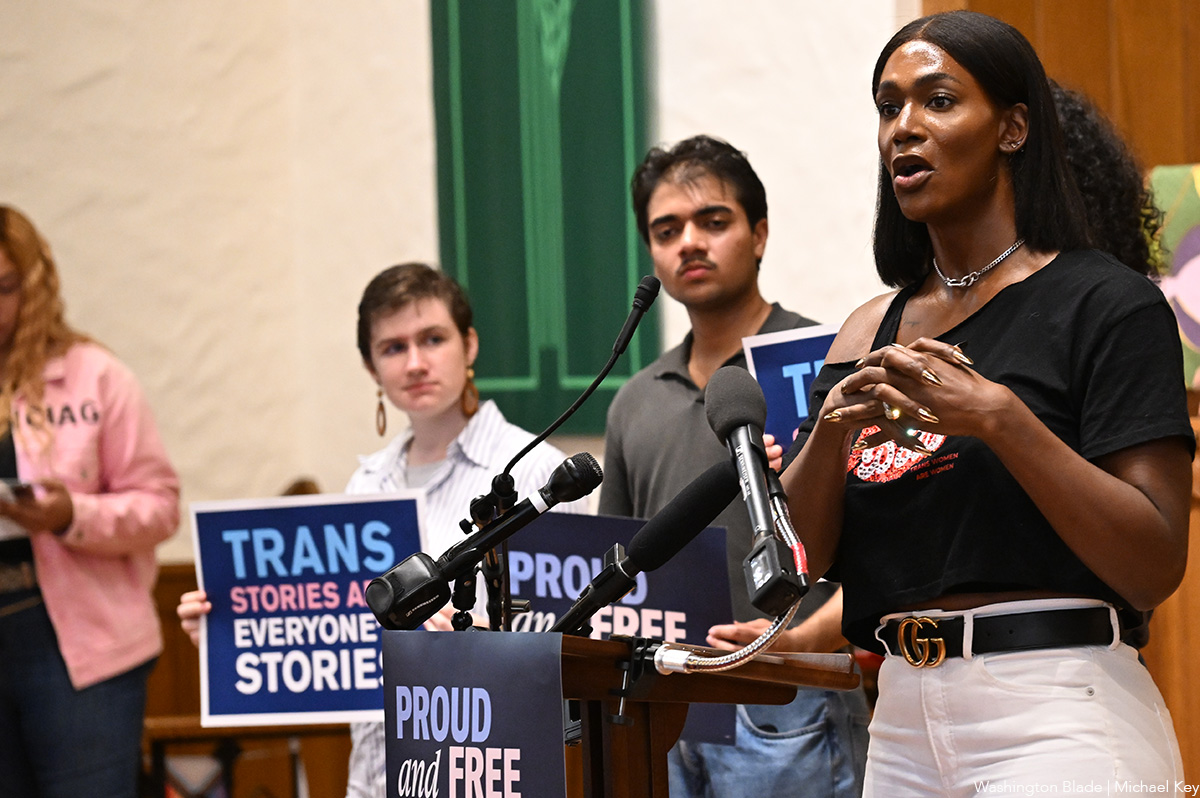
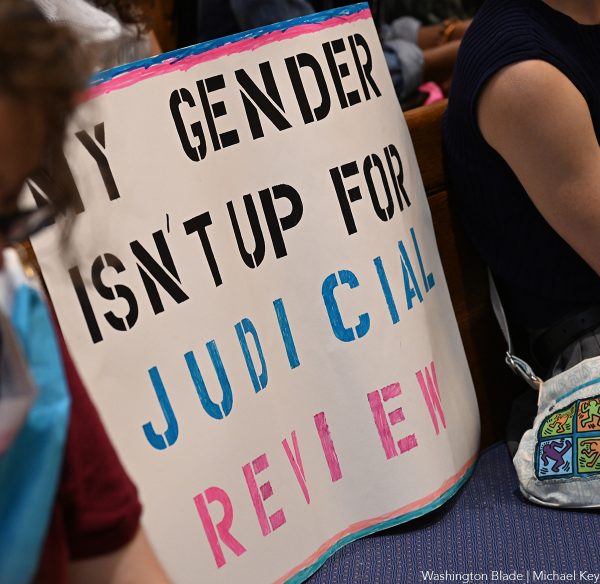
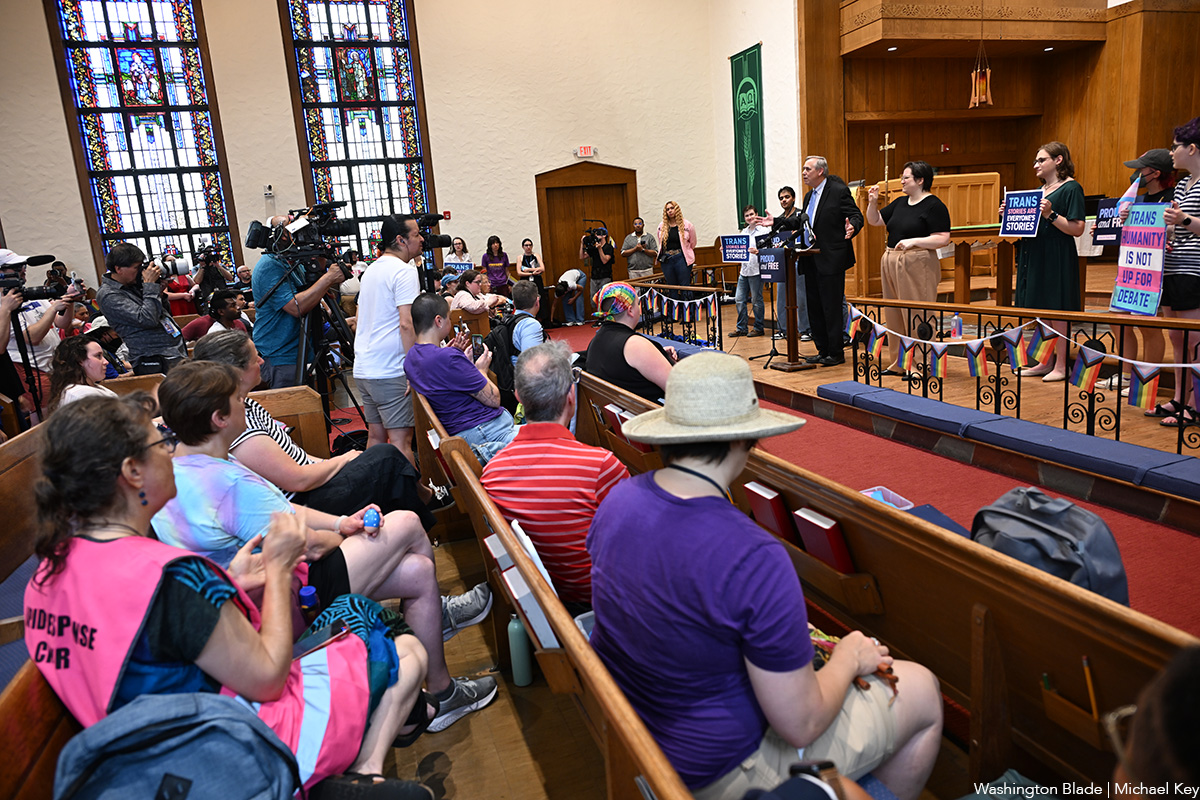
Politicians, LGBTQ activists, and allies gathered at the Lutheran Church of the Reformation in the Capitol Hill neighborhood of Washington, D.C. on Wednesday following the ruling by the United States Supreme Court in the case of U.S. v. Skrmetti. The Supreme Court upheld a Tennessee ban on gender-affirming healthcare for transgender adolescents in a 6-3 decision.
A rally outside the U.S. Supreme Court was called for by the American Civil Liberties Union, Lambda Legal and other organizations following the high court ruling on Wednesday. However, due to a thunderstorm and flood watch, the scores of activists who were to attend the rally were directed to a Lutheran church down the street from the court. Undeterred, activists and community leaders were joined by U.S. Senators Ed Markey (D-Mass.) and Jeff Merkley (D-Ore.) for an indoor rally at the church.
“We know that freedom is not inevitable,” Markey told the crowd. “It is fought for by people who said ‘no’ in the face of health cuts, ‘no’ in the face of discrimination, ‘no’ in the face of invasive laws that ban life-saving and life-affirming healthcare and ‘no’ to this anti-justice, anti-freedom agenda.”
Also speaking at the rally was Deirdre Schifeling, chief political advocacy officer of the National ACLU.
“We believe transgender rights matter,” Schifeling stated. “Transgender kids matter and deserve love, support and the freedom to shape their own futures. I am still processing how the Supreme Court could disagree with such an obvious truth.”
“Today’s ruling shows us that unfortunately these attacks on our freedom will not end here,” Schifeling continued. “The Trump administration and extremist politicians across the country are continuing to target our right — our human right — to control our own bodies.”
“If politicians think that we are going to sit back and be defeated, that we are going to let them strip our rights and freedoms away without a fight, they’ve got another think coming,” Schifeling said. “We will never back down. We will never back down or give up. We will organize, we will mobilize and we will fight to protect trans rights in our communities, in our legislatures, in our elections, and in court rooms across the country.”
“Today, the highest court in this land decided that the bodily autonomy of trans youth, specifically trans youth of Tennessee and states with bans harming youth across the country do not matter,” said trans advocate Hope Giselle-Godsey.
“The opponents of trans equality think that today is a victory, but history will remember it as a moment that sharpened us and not silenced us,” Giselle-Godsey continued.
“So yes, today we grieve for the people in those states where those bans exist, but we grieve in motion,” Giselle-Godsey said. “To the system that thinks that it won today, just like every other time before: you will lose again. Because we won’t bow to hatred: we outlive it. We out-organize it. We out-love it. We are still here and we are not finished yet.”
District of Columbia
Ruby Corado files motion for early release from prison
Former Casa Ruby director pleaded guilty to wire fraud
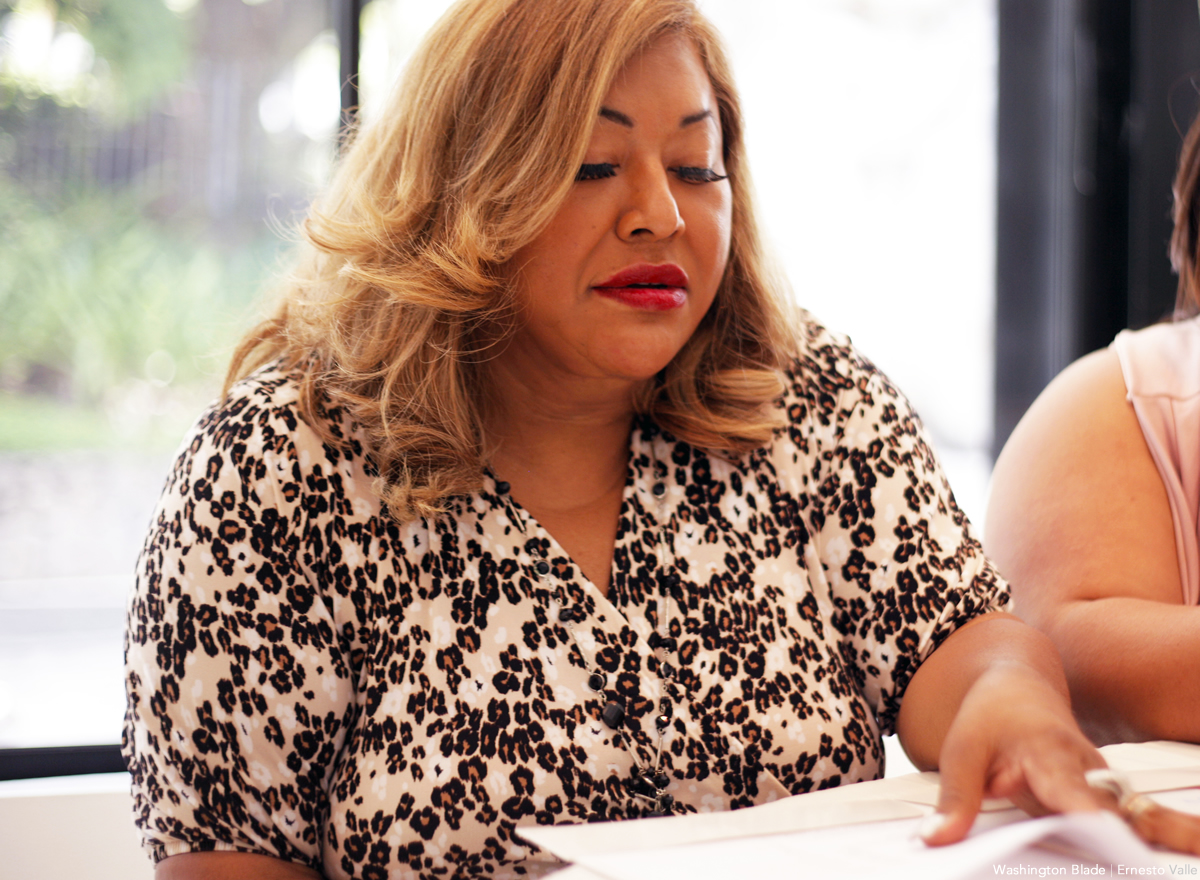
Ruby Corado, the founder and former executive director of the now closed LGBTQ community services organization Casa Ruby, has reported being raped and sexually abused or harassed at least 31 times since being sentenced to federal prison on Jan. 13, 2026, according to a motion seeking early release filed by her attorney.
The motion, filed Nov. 13 in U.S. District Court for D.C. by a federal public defender attorney, asks a federal judge to grant Corado an early release at this time rather than complete her sentence of 33 months of incarceration after pleading guilty to a charge of wire fraud.
The motion says concerns raised by Corado’s attorney at the time of her sentencing hearing in January that, as a transgender woman, she would be subjected to sexual abuse, has happened in a big way.
The motion notes that under the current federal prison policy set by the Trump-Vance administration’s Department of Justice, trans women are assigned to male prisons and male prison housing facilities. It points out that since her initial incarceration in January Corado has spent time in federal prisons in Oklahoma, Louisiana, and Texas.
“Ms. Corado signed a declaration under penalty of perjury detailing her experiences in Bureau of Prisons custody, including the 31 rapes and sexual assaults to which she has been subjected,” the motion states. “She has, for instance, woken up to men masturbating in her face; male officers have stripped her naked in front of 400 other inmates during processing; she has been forced to wear male clothing 32 years after transitioning; other inmates regularly jump into her shower aroused and expecting sex; and her cellmates slap her butt when she is trying to sleep,” her attorney’s court motion states.
The motion, filed by federal public defender attorney Joanna Muson Perales, notes that existing federal law and prison regulations allow for a court to grant a reduced sentence and early release from a prison if “extraordinary and compelling reasons warrant” an early release.
“Altogether with Ms. Corado’s deteriorating mental health, other health conditions, and rehabilitation, these bases are extraordinary and compelling reasons to reduce her sentence to time served,” the motion adds.
Online court records show that U.S. District Court Judge Trevor M. McFadden, who continues to preside over the case, has yet to issue a decision on the motion and has not said how long he may take to deliberate over the motion.
As of Nov. 16, the online court records show that prosecutors from the Office of the U.S. Attorney for D.C. had not yet responded to the motion. Perales couldn’t immediately be reached for comment.
Among other things, the motion includes a 16-page handwritten declaration by Corado describing in detail the instances of rape, sexual harassment, and alleged mistreatment she says she has experienced since being incarcerated in January. It says prison officials for the most part failed to take action against those she accused of sexually assaulting her, claiming, according to Corado, that her allegations were “unsubstantiated” after her attackers denied the allegations.
In January, McFadden sentenced Corado to 33 months of incarceration. He also sentenced her to 24 months of supervised release upon her completion of incarceration.
In addition to the incarceration, McFadden agreed to a request by federal prosecutors to hold Corado responsible for “restitution” and “forfeiture” in the amount of $956,215 that prosecutors said she illegally misappropriated from federal COVID-19 related federal loans obtained by Casa Ruby.
At the time she pleaded guilty to the wire fraud charge Corado admitted to allegations by prosecutors that she illegally transferred at least $180,000 of the COVID relief funds obtained by Casa Ruby to private bank accounts in El Salvador, where she is from. But Corado claimed her intent was to use the funds to start a Casa Ruby facility in El Salvador and not to use the funds for her personal benefit.
California
West Hollywood creates registry for polyamorous relationships
New legal rights for those with multiple partners
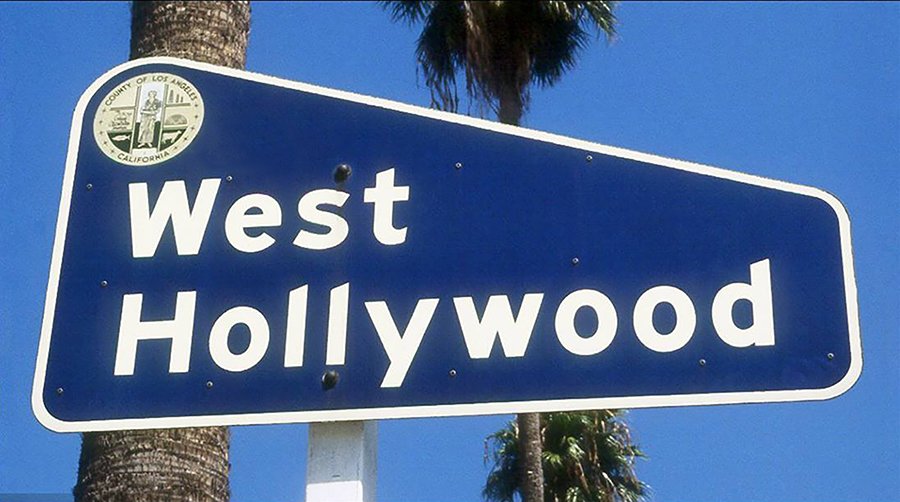
The West Hollywood City Council voted unanimously on Nov. 2 to create a registry for those in “multi-partner domestic relationships.”
The measure gives those in polyamorous relationships the same legal rights afforded to monogamous couples. Those include visitation rights in hospitals and jails in West Hollywood and certain tenant protections.
In 1985, West Hollywood became the first city in the nation to recognize domestic partnerships between same-sex couples. Within a few decades, legal recognition of same-sex couples extended to many cities and states and in 2015 marriage equality was legalized nationally. Now, advocates for polyamory say that WeHo is starting another trend toward recognizing other non-nuclear family structures.
“The new law not only gives polyamorous unions legal recognition, I think it also gives people permission to imagine a future together and to plan their lives openly,” said Christina Fialho, president of Rewrite the BiLine, a non-profit organization that works to expand queer media representation that advocated for the measure. She hopes that as time passes, more cities and states will pass legislation that legally recognizes those outside of traditional monogamous relationships. “This is the first of many more wins to come, and we hope to see more cities adopt similar ordinances,” Fialho said. A few cities in Massachusetts also currently recognize multi-partner relationships.
Fialho said the growing prevalence of non-monogamous relationships will help create demand for more legal recognition. “In the United States, consensual non-monogamy is actually as common as owning a cat,” Fialho said, which amounts to around 5 percent of the population. They are particularly prevalent among LGBTQ people, with around “50 percent of LGBTQ+ people” having been in “consensually non-monogamous relationships,” according to Fialho.
Megan Katz, a West Hollywood resident and librarian is part of that 50 percent. Katz has practiced polyamory for years and is currently in a committed marriage while also dating outside of it. She views the ordinance as a major victory. “It is one more step toward legitimizing nontraditional relationships and specifically polyamorous relationships,” Katz said.
Katz does not plan on immediately using the registry, as one of her relationships “is not established enough,” but she “very much appreciates that the city is taking these steps.”
Katz considers herself lucky that she has not experienced much personal discomfort or discrimination due to her polyamorous relationship. “With my personal, private communities, and even just my personal circles, I really have not had any problems,” she said. But she thinks the ordinance will help curb larger cultural stigmas around polyamory and non-monogamy.
“I am polyamorous and I am very comfortable with that, but it’s not a concept that’s very well known culturally and is sort of vilified or looked down upon,” she said. “There’s nothing wrong with it when you’re engaged in it ethically.”
2026 Midterm Elections
Quinnie Pérez becomes first openly transgender person elected in Fla.
Candidate won seat on Orange County Soil and Water Conservation District
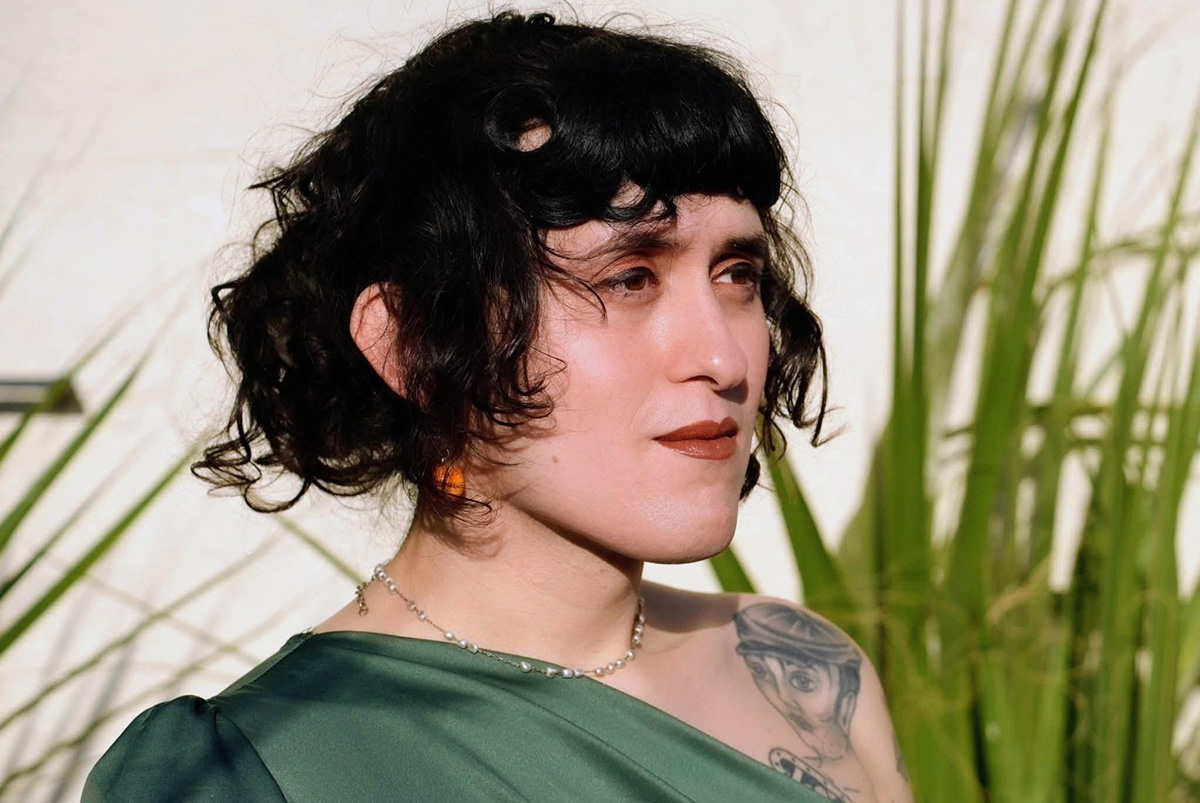
Quinnie Pérez on Nov. 3 made history when she became the first openly transgender woman elected to public office in Florida.
Pérez, 32, won a seat on the Orange County Soil and Water Conservation District. She previously worked for Equality Florida, a statewide LGBTQ rights group, as a paid intern.
Pérez on Tuesday during a virtual post-election briefing that Equality Florida organized noted anti-trans forces in the state ran $200 million worth of transphobic ads during this campaign cycle. Pérez raised around $6,000 for her campaign, but noted “we still defeated that rhetoric.”
“Money doesn’t win, hate doesn’t win,” she said. “We’re just going to keep winning.”
Pérez also said she ran for working people who are struggling in Florida.
“They don’t want to hear any full-blown rhetoric about trans people, LGBTQ+ people,” she said. “People just want to be able to afford their food, be able to afford their housing, and just be able to live another day while managing inflation and other issues around the state and our country.”
The LGBTQ+ Victory Fund also endorsed Pérez.
She will take office in January.

Turkey’s anti-LGBTQ crackdown overshadows UN climate conference

Ruby Corado files motion for early release from prison

Gay VIDA Fitness shooting victim remembered

Gay man named Venezuelan foreign minister

Let the subpoenas fly! Impeach Hegseth, Blanche!

Many ways to move forward after the elections

VIDA Fitness owner ‘devastated’ over fatal shooting

‘Blue Wave’ proves transphobia is not a winning political strategy

Free HIV/STI testing on Nov. 18