U.S. Supreme Court
Supreme Court upholds ban on transgender care for minors
Skrmetti decision among this term’s most highly anticipated rulings
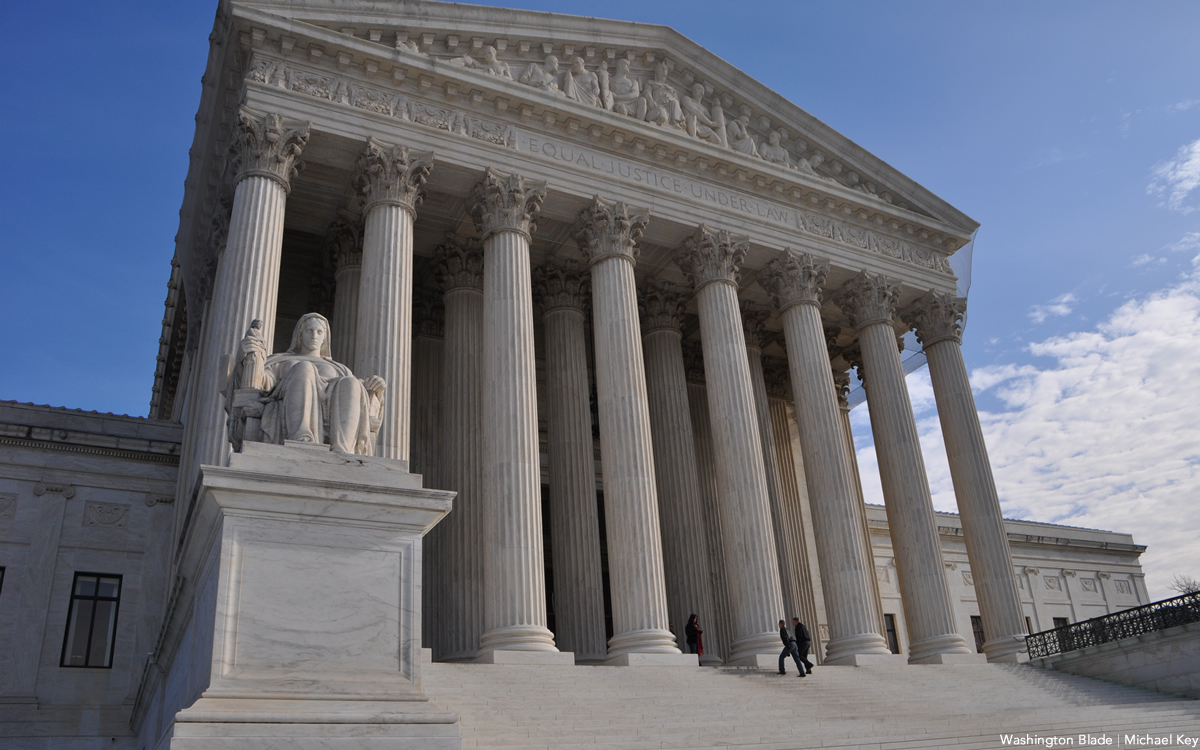
The U.S. Supreme Court on Wednesday upheld a ban on medical interventions for transgender minors in Tennessee, with the three liberal justices dissenting in a ruling that will shield similar laws that block or restrict access to care in more than 20 other states.
Conservative Chief Justice John Roberts, writing for the majority, said questions about the “safety, efficacy, and propriety of medical treatments” should be resolved democratically.
Liberal Justice Sonia Sotomayor argued, in her opinion, that the decision “authorizes, without second thought, untold harm to transgender children and the parents and families who love them,” adding that “Because there is no constitutional justification for that result, I dissent.”
Plaintiffs who challenged Tennessee’s ban were a doctor and three families argued that the policy violated the Equal Protection Clause of the 14th Amendment.
They also emphasized that the care prohibited for minors in the state — puberty delaying medication, hormone therapy, and surgeries — is made available to patients younger than 18 if they are sought for reasons other than gender transitions.
The case, U.S. v. Skrmetti, was among the most anticipated of the court’s June term.
President Donald Trump in February formally reversed course from the Biden-Harris administration’s support for the plaintiffs challenging the Tennessee law, urging the Supreme Court to uphold the ban.
Attorneys, Democratic lawmakers, and medical groups object to the ruling
Representing the plaintiffs in the litigation challenging the ban were the Chase Strangio, co-director of the ACLU’s LGBTQ & HIV Project, Lucas Cameron-Vaughn, senior staff attorney at the ACLU of Tennessee, Karen Loewy, director of constitutional law practice at Lambda Legal, Jennifer Levi, senior director of transgender and queer rights at GLAD Law, Shannon Minter, legal director of the National Center for Lesbian Rights, Sasha Buchert, counsel and director of the Nonbinary and Transgender Rights Project at Lambda Legal, and attorneys with the firm Akin Gump.
“Today’s ruling is a devastating loss for transgender people, our families, and everyone who cares about the Constitution,” said Strangio, who is the first trans lawyer to argue before the Supreme Court. “Though this is a painful setback, it does not mean that transgender people and our allies are left with no options to defend our freedom, our health care, or our lives.”
“The Court left undisturbed Supreme Court and lower court precedent that other examples of discrimination against transgender people are unlawful,” Strangio said. “We are as determined as ever to fight for the dignity and equality of every transgender person and we will continue to do so with defiant strength, a restless resolve, and a lasting commitment to our families, our communities, and the freedom we all deserve.”
“This is a heartbreaking ruling, making it more difficult for transgender youth to escape the danger and trauma of being denied their ability to live and thrive,” said Buchert. “But we will continue to fight fiercely to protect them. Make no mistake, gender-affirming care is often life-saving care, and all major medical associations have determined it to be safe, appropriate, and effective. This is a sad day, and the implications will reverberate for years and across the country, but it does not shake our resolve to continue fighting.”
“The Court today failed to do its job,” said Levi. “When the political system breaks down and legislatures bow to popular hostility, the judiciary must be the Constitution’s backbone. Instead, it chose to look away, abandoning both vulnerable children and the parents who love them. No parent should be forced to watch their child suffer while proven medical care sits beyond their reach because of politics.”
“The Court’s ruling abandons transgender youth and their families to political attacks. It ignored clear discrimination and disregarded its own legal precedent by letting lawmakers target young people for being transgender,” said Minter. “Healthcare decisions belong with families, not politicians. This decision will cause real harm.”
In a press conference on Capitol Hill, Senate Democratic Leader Chuck Schumer (N.Y.) told reporters, “This Supreme Court seems to have forgotten that one of their jobs is to protect individual rights and protect individuals from being discriminated against. It’s an awful decision.”
“On the floor, we had a bill, that the Republicans wanted to take away these rights,” Schumer said. “And we got, I believe, every Democrat voting against it. So it failed because it needed 60 votes. So we’re going to explore every solution.”
U.S. Rep. Pramila Jayapal (D-Wash.) also hosted a press conference, arguing that the court’s decision — and conservative-led efforts to restrict the rights and freedoms of transgender people more broadly — is of a piece with the Republican Party’s broader policy agenda, particularly in Trump’s second term.
In 2019, the congresswoman shared that her daughter, then 22, was trans. When asked on Wednesday whether her staunch opposition to the ruling was both professional and personal, Jayapal said, “I’m not speaking about my personal situation these days” but her family aside, “it’s also personal to me as a member of Congress that represents families who are experiencing the same kinds of issues and the same kind of fear that I hear from people across the country.”
She added, “And so I think what’s important is to recognize that trans people are a tiny percentage of the country and are doing no harm to anyone else. And despite the disinformation, the lies that are being circulated about trans people, I think that we are powerful when we come together, when we realize that these attacks are coordinated and are really about the same thing, which is exerting power over us and taking away our rights in a democracy that should be about allowing everyone to contribute their full selves.”
U.S. Sen. Ed Markey (D-Mass.) said: “Today, hate won. The far-right justices of the Supreme Court endorsed hate and discrimination by delivering a win for Republicans who have relentlessly and cruelly attacked transgender Americans for years. With 25 states already having laws in place that ban gender-affirming care for trans youth, the Supreme Court has cleared the way for families in half of the country to no longer access the medically necessary and life-saving care they need for their children.”
The senator continued, “But here is what no Court nor politician can ever change: trans people will continue to exist. Their health care is lifesaving and essential, and trans rights are human rights. We have a fight ahead of us, but discrimination and hate cannot and must not win.”
U.S. Sen. Jeff Merkley (D-Ore.) said: “Access to medically-necessary care for trans youth saves lives, and the U.S. Supreme Court’s callous decision puts trans youth and their families at risk.
“MAGA extremists across the nation will not stop at banning medically-necessary gender-affirming care for trans youth. The Court’s life-altering decision lays out the playbook for extremist politicians to continue their crusade against trans people and further exclude them from daily life. And this is just the beginning—this decision opens the floodgates for MAGA extremists in state legislatures and Congress to ban medically-necessary care, from gender-affirming care to abortion access.
“This is just wrong—everyone should have access to the care they need, when they need it. No exceptions.
“Let’s get politicians out of the exam room. We will continue to fight these divisive policies in communities nationwide to fully realize the vision of America as a land of freedom and equality for all, and I won’t rest until my Equality Act is signed into law to deliver on this fundamental promise.”
“Today’s decision by the Supreme Court is devastating for young transgender Americans and their families who live in states that decide to put divisive and dehumanizing politics over people,” said U.S. Rep. Mark Takano (D-Wis.), chair of the Congressional Equality Caucus.
“The Court’s ruling upholding Tennessee’s cruel and politically-motivated ban on medically-necessary care for young trans people undermines the ability of transgender patients, their families, and doctors to make medical decisions about accessing evidence-based care without politicians’ interference,” he said.
The congressman added, “The law the Court upheld is an attack on some of the most vulnerable in our community—but we still have other tools to challenge anti-trans laws in courts across the country. As Chair of the Equality Caucus, I am committed to continuing to lead elected officials from across the country in the fight for full equality for transgender people under the law here in Congress.”
“Every parent wants to keep their child healthy. Parents and trans young people have the right to make private health care decisions with their doctors. Today’s ruling allowing Tennessee politicians to interfere in private health care decisions is not only draconian, it’s dangerous and hateful,” said U.S. Rep. Becca Balint (D-Vt.). “I want families who are feeling scared today about the consequences of this decision to know that I’m with you. I’m fighting for you in Congress every single day, and I will not back down.”
Jayapal, Markey, Merkley, Takano, and Balint were among the 164 members of Congress who filed an amicus brief urging the court to preserve access to care.
New York Attorney General Letitia James also released a statement: “At a time when LGBTQ+ communities are under relentless attack, this decision is dangerous and a profound disappointment. Gender-affirming care is essential and lifesaving health care, and denying young people access to it will have devastating consequences.
“Let me be clear: gender-affirming care remains legal and protected in New York, including for young people.
“To the transgender community in Tennessee and across the country: We stand proudly with you. We are strongest together, and we will not let this decision weaken our resolve to build a safer, more just, inclusive, and compassionate nation for all.”
Also issuing a statement was a coalition of seven medical associations that had submitted an amicus brief supporting the plaintiffs — American Academy of Pediatrics, American College of Obstetricians and Gynecologists, American College of Physicians, American Psychiatric Association, Endocrine Society, the National Association of Pediatric Nurse Practitioners, and the American Pediatric Society.
The organizations said:
“As experts dedicated to providing patients with compassionate, evidence-based care every day, we are disappointed in the United States vs. Skrmetti decision, which increases the likelihood that other states will limit or eliminate families’ and patients’ ability to access medical care.
“As doctors, nurse practitioners, and nurses, we believe that every patient is different. Decisions about medical care must be based on individualized assessments by qualified professionals in consultation with the patient and their parents or legal guardians and guided by well-designed medical evidence. This Supreme Court decision strips patients and families of the choice to direct their own health care.
“Every patient should have access to the medical care they need. Health care professionals must be able to rely on their training, education, and expertise to provide appropriate care based on the needs and values of each patient and their family, without bans or interference.”
LGBTQ and civil rights advocacy groups object to the ruling
Allison Scott, president of the Campaign for Southern Equality, said ““I am heartbroken today. No one should be forced to leave their home state to access healthcare – and it is outrageous to see the U.S. Supreme Court uphold these bans and continue to allow the government to interfere with the personal medical decisions of families.”
“The Court’s ruling can’t change what we know in our bones: our identities, our families, and our lives are strong, worthy, and not up for debate by extremists,” she said. “The Trans Youth Emergency Project will be here to help families navigate this painful time.”
“Today, the Supreme Court took the place of parents and doctors and stripped away their ability to make private, lifesaving decisions for their children,” said GLAAD President and CEO Sarah Kate Ellis. “This ruling is a chilling step toward unchecked government overreach, intruding on the most personal aspects of our private lives.”
She added, “All families are now less safe and left vulnerable to politicians and a Court that has abandoned its duty to protect personal liberties. Every family deserves the freedom to make the medical decisions that help their children live, thrive, and be well.”
“This is a devastating and deeply dangerous decision that carries irreversible harm to transgender youth and their families. The majority’s opinion politicizes decades of medical consensus, ignores the Constitution’s mandate of equal protection, and turns its back on youth and their families,” said Skye Perryman, president and CEO of Democracy Forward.
“Our team at Democracy Forward will continue to work every day to support transgender people, including young people, their families, and communities, and we will never give up making the Constitution’s guarantee of equal protection under the law a reality for all people,” she said.
National LGBTQ Task Force President Kierra Johnson said: “Gender affirming care can mean the difference between life and death for our transgender youth. Today, the Supreme Court rejected the science and authorization of gender affirming care, upheld harmful bans, and denied the lived experiences of trans youth.
“The Supreme Court has now rolled back critical protections against discrimination on the basis of sex. This is an especially devastating moment for transgender youth, their parents and their doctors across the country. Tennessee’s ban on essential medical care — and other similar state bans — will continue to wreak havoc on the lives of these families.
“What we know is this: transgender youth denied access to appropriate medical care are in danger of worse physical and mental health outcomes.
“Americans look to the Supreme Court as the highest court of the land, making decisions with long term impact in these critical times; decisions that speak to the value certain communities. Transgender youth are often overlooked, undervalued, and lack the protection that they deserve as both minors and transgender community members. Gender dysphoria impacts more than the physicality of a person and, when left untreated, may result in anxiety and depression. When there is no legal doctrine that speaks to pertinence of gender affirming care, it shows that the law is not on their side, discrediting and disenfranchising a community while obliterating their humanity. ”
Imara Jones, CEO of TransLash Media, said: Today the Supreme Court used the greatest hits of discredited anti-trans, pseudoscientific ideas in order to rule against the equal access of trans kids to healthcare. This is healthcare that is safe, supported by every mainstream medical association, and which is granted with the consent of youth’s parents.
“Moreover, the Court could only issue such a ruling by overlooking the obvious: The denial of equal access to healthcare for trans kids is sex discrimination. Gender-affirming treatments are allowed for some children but not others under the Tennessee law SB1, which explicitly states as one of its goals to encourage minors to ‘appreciate their sex.’
“So what they did here is the equivalent of denying a person’s race, in order to declare that racial discrimination laws don’t apply.
“Now, while the Skirmetti ruling is not as sweeping as it could have been, because it leaves the door open to future cases on sports and bathrooms, it will likely turbocharge attempts to exempt trans people from Constitutional protections. What the court has done is give these efforts the sheen of judicial legitimacy, and a road map for how to do so, by directing them to leave out the explicit targeting of trans people.
“Because as long as the attempts to push trans people outside of the bounds of public life using the law are implicit, then governmental entities have free reign to do so, now.
“The success of manipulating legal, scientific, and media organizations with anti-trans disinformation by Christian Nationalist and authoritarian entities is crystal clear in this decision.”
“LPAC is devastated that the Supreme Court has turned away from experts like the American Academy of Pediatrics and hard data showing that health care for trans youth improves physical and mental health, and instead succumbed to political pressure,” said Janelle Perez, executive director of LPAC. “This cruel decision opens the floodgates for politicians to decide what we and our children need to be healthy. These are decisions that should be made by families and healthcare providers, not politicians.”
Human Rights Campaign President Kelley Robinson said: “Today’s Supreme Court decision is a devastating blow to transgender youth and the families who love them, but it will not break our resolve. Families may now have to make the heartbreaking choice to leave their state or split their families, or take on extensive financial burdens, in order to ensure that their kids can access medically necessary care.
“This Court chose to allow politicians to interfere in medical decisions that should be made by doctors, patients, and families—a cruel betrayal of the children who needed them to stand up for justice when it mattered most.
“As parents, advocates, and community leaders, we know that our fight doesn’t end in courtrooms—it lives in our communities, our hearts, and our unwavering commitment to each other. Still, we will not be deterred. We will support families forced to make impossible choices, fund legal challenges, and build a movement so powerful that no politician can ignore us. Together, we will turn this pain into power and keep fighting until every transgender person in America can live with dignity, safety, and the freedom to be who they are.”
Tennessee AG and Log Cabin Republicans celebrate the ruling
Tennessee Attorney General Jonathan Skrmetti said, “In today’s historic Supreme Court win, the common sense of Tennessee voters prevailed over judicial activism. A bipartisan supermajority of Tennessee’s elected representatives carefully considered the evidence and voted to protect kids from irreversible decisions they cannot yet fully understand.”
The AG continued, “I commend the Tennessee legislature and Governor Lee for their courage in passing this legislation and supporting our litigation despite withering opposition from the Biden administration, LGBT special interest groups, social justice activists, the American Medical Association, the American Bar Association, and even Hollywood.”
Log Cabin Republicans interim executive director Ed Williams released the following statement:
“The U.S. Supreme Court just upheld Tennessee’s law prohibiting trans medical surgeries and treatments for minors. This decision is not ‘anti-trans.’ It is a historic and critical win for children and common-sense. The majority of Americans support equal treatment for trans Americans and protections from discrimination. They also back laws like Tennessee’s, which protect children from receiving life-altering and irreversible medical procedures or treatments often pushed on them by a zealous cabal that views children as pawns in their gender ideology crusade.
“LGBT conservatives have long believed there is a middle-road that upholds respect, inclusion, and protection for trans Americans while curbing the excesses of a radical political movement attempting to push its bizarre agenda in sports, schools, governments, and hospitals. Today’s Supreme Court is a step in the right direction.”
The Washington Blade will update this story.





U.S. Supreme Court
Trump asks Supreme Court to allow restrictions on gender-affirming care in prisons
SCOTUS could further restrict rights of trans inmates
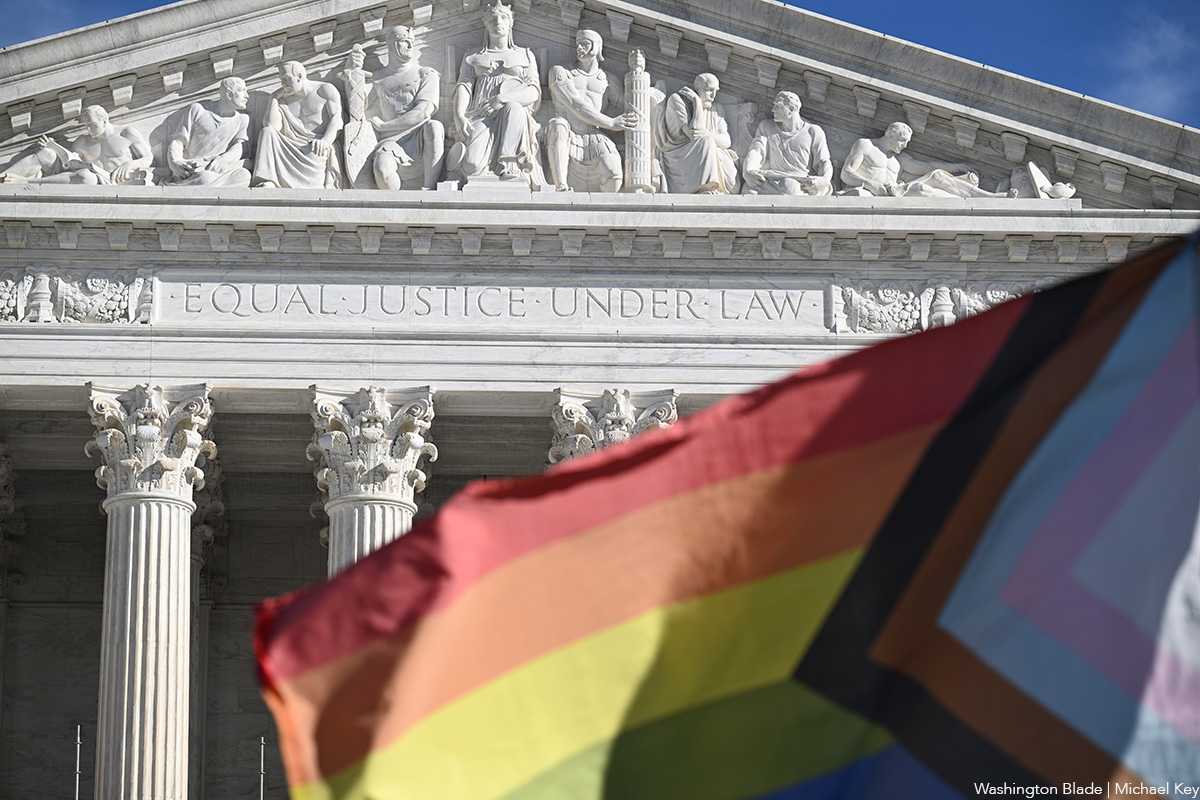
The Trump administration has asked the Supreme Court to allow its policy limiting gender-affirming treatment for federal inmates to take effect while a legal challenge plays out in court.
U.S. District Judge Royce Lamberth ordered the government to continue providing gender-affirming care, such as hormone therapy, which had become policy nearly a decade ago for inmates who were transitioning.
The Trump administration argues in its application that its policy restricting transgender rights was properly adopted and that the judge overstepped, posing nationwide “security and prison-administrative concerns.”
If allowed, the policy would halt surgeries, hormones and social accommodations such as wigs while allowing mental health therapy to continue as the legality of the policy reversal is litigated.
The government also argues in the application that the Bureau of Prisons had “determined that sex-trait-modification surgeries, hormone interventions in general, and social accommodations could no longer be justified as treatment for gender dysphoria.”
American Civil Liberties Union attorneys for the inmates said the policy is “a direct threat to the well-being of transgender people in federal custody and an open violation of their fundamental rights,” and said withholding necessary gender-affirming healthcare constitutes cruel and unusual punishment.
The Blade has covered the ongoing developments surrounding changes to Federal Bureau of Prisons transgender inmate policy that went into effect earlier in Trump’s term. The changes primarily focus on rolling back Biden-era protections for trans inmates.
Earlier this year, the Blade published a joint letter from multiple senators in response to the rollback of the policy. Multiple senators — including Edward Markey (D-Mass.), Jeffrey A. Merkley (D-Ore.) and Mazie K. Hirono (D-Hawaii) — sent a letter to Attorney General Todd Blanche and Federal Bureau of Prisons Director William Marshall III calling for them to reverse the policy change, saying it endangers inmates’ health and safety.
The senators described how the policy shift, along with President Trump’s Executive Order 14168, titled “Defending Women from Gender Ideology Extremism and Restoring Biological Truth to the Federal Government,” is forcing policy changes they argued are rooted more in political rhetoric than in medical research or evidence-based correctional practices.
Federal Bureau of Prisons responded to the Blade’s request for comment in May, declining to reconsider its transgender inmate policy.
The Blade reached out to the Federal Bureau of Prisons once again over the application to the Supreme Court, but did not hear back before publication.
U.S. Supreme Court
Supreme Court upholds state laws banning trans athletes from sports teams
Justices heard oral arguments in two cases in January
The U.S. Supreme Court on Tuesday upheld state laws that ban transgender athletes from school sports teams that correspond with their gender identity.
The justices in January heard oral arguments in two cases — Little v. Hecox and West Virginia v. B.P.J. — that challenged laws in Idaho and West Virginia respectively.
Both cases question the constitutionality of laws from both states that block trans girls from participating on girls’ teams at publicly funded schools — specifically if these bans violate the 14th Amendment’s Equal Protection Clause and Title IX. Since 2020, 27 states have banned transgender youth from playing school sports.
In a 6-3 decision made on party lines, the conservative justices asserted that laws prohibiting trans women and girls from participating in sports programs at publicly funded schools does not violate either constitutionally protected right. Notably the ruling does not require any state to categorically bar transgender girls from participating on girls’ sports teams, or transgender boys from participating on boys’ sports teams.
In the majority for the case, Justice Brett Kavanaugh delivered the opinion. It holds that schools can determine eligibility for women’s and girls’ sports teams based on biological sex. It also holds that West Virginia did not violate Title IX, which bars educational programs that receive federal funding from discriminating based on sex.
“Consistent with Title IX and the Equal Protection Clause, we hold that the States may maintain women’s and girls’ sports for biological females. They may determine eligibility for women’s and girls’ sports based on biological sex,” Kavanaugh wrote. “The Constitution and Title IX do not require an overhaul of women’s and girls’ sports throughout America.”
The Chief Justice John Roberts, along with Justices Clarence Thomas, Samuel Alito, Neil Gorsuch, and Amy Coney Barrett joined Kavanaugh’s majority opinion. It permissibly maintains female sports for biological females.
In his conclusion, Kavanaugh shares his belief of the importance of sports to women and girls but also a caution that “[n]o student-athlete on either side of the issue … deserves to be ostracized or vilified.”
Justice Sonia Sotomayor opinion was concurring in the judgment in part and dissenting in part. Justices Elena Kagan, and Ketanji Brown Jackson joined Sotomayor’s opinion.
In her dissent, Sotomayor explains that the majority opinion, while attempting to protect one groups Constitutional rights (those assigned women at birth), it puts another group’s constitutional rights (trans women) at its expense and in principle violates the Equal Protection Clause of the 14th Amendment.
“Because the majority, however, inflicts a hardship on those it disfavors without giving them the fair and full opportunity the Constitution requires to litigate their contentions, I respectfully dissent,” Sotomayor wrote, eventually pointing to how the states had evaluated issues of trans sports participants prior to these bans as evidence of general omission. “The ban eliminated this individualized approach in favor of categorical exclusion.”
She also pointed out that these rules to not equally exclude, further bolstering her argument that the majority opinion was not created with the truest sense of the Equal Protection Clause at its center.
“Teams “designated” for “females” “shall not be open to students of the male sex where selection for such teams is based upon competitive skill or the activity involved is a contact sport.” Teams “designated” for “males” do not have the same restriction.”
Jackson wrote in her dissent that this ban does explicitly allow for sex discrimination in any school or education program that receives federal funding.
“A transgender woman penalized for being perceived as aggressive has experienced discrimination ‘on the basis of sex’ just as much as a cisgender woman has, no matter that the transgender woman’s behavior matches expectations of her sex assigned at birth,” Jackson said. “Either way, the institution has imposed its gender-based expectations upon her. And either way, the institution may have violated Title IX.”
In West Virginia v. B.P.J., the case centers on B.P.J., a trans girl who was barred from competing on her school’s girls’ cross-country and track teams under West Virginia’s Save Women’s Sports Act, enacted in 2021. Under the law, it requires participation to be based on the athlete’s biological sex as indicated on their original birth certificate issued at the time of birth.
In Little v. Hecox, the details are slightly different, but ask the same 14th Amendment and Title IX questions but against Idaho’s Fairness in Women’s Sports Act. In this case Hecox, a trans woman and student at Boise State University wished to join the women’s cross-country team, but couldn’t under the law. She, with a cisgender athlete filed a suit against the governor, arguing the Equal Protection Clause of the 14th Amendment explicitly protects their rights to participate on the woman’s team.
Trans rights activists have criticized the highest court in the land’s decision, highlighting it legally allows for discrimination based on gender identity — something they argue is a foundational element of the spirit of the Equal Protection Clause.
Jennifer Levi, senior director of Transgender and Queer Rights at GLAD Law outright called the six conservative justices view of Equal Protection and Title IX as “wrong.”
“Today’s ruling gets it wrong. And it’s kids who will suffer for it. By upholding these blanket bans, the Supreme Court has allowed states to deny students even the chance to try out for a school team, simply because they are transgender,” Levi told the Washington Blade in a statement. “Policies that categorically bar students don’t advance fairness; they mandate exclusion.”
She continued, pointing out excluding some for the protection of others does not ensure fairness as the justices are arguing in their opinion.
“When a law bars every transgender girl regardless of age, hormones, or physiology, it isn’t about competitive fairness. It’s about keeping transgender kids out. We can protect women’s sports without doing that. Most of the country already does.”
Chris Erchull, senior staff attorney at GLAD Law, pointed out that while disappointing, the court does not mandate discrimination as the policy.
“This ruling does not require any state to follow West Virginia’s or Idaho’s cruel, overly-broad approach, and it does not mandate categorical bans on transgender students participating in school sports,” Erchull said. “It also leaves intact broader nondiscrimination protections for transgender students in education, including Title IX’s protections against sex discrimination for LGBTQ+ students. Discrimination has no place in our schools, and we can and should ensure that every student has the opportunity to learn, to thrive, and to know that they belong.”
Sasha Buchert, senior attorney and director of the Nonbinary and Transgender Rights Project at Lambda Legal, also emphasized the bad faith argument the majority opinion pushes for the sake of one exclusionary view of the Equal Protection Clause and Title IX.
“This ruling is deeply harmful for transgender women and girls who only asked for the ability to participate in sports with their peers,” Buchert said. “Countless studies have demonstrated the myriad benefits that come with participation in team sports. Now, one population, transgender youth and collegians, are targeted for specific and baseless discrimination. We will not be deterred and will continue to fight back to secure the equal participation that all youth, including transgender youth, deserve.”
Joshua Block, senior counsel for the American Civil Liberties Union’s LGBTQ & HIV Rights Project also echoed the lasting negative impact this ruling will have for trans Americans.
“This is a heartbreaking ruling for our clients and transgender girls like them who’ve asked for nothing more than the same opportunities afforded to their peers.” Block said. “The reality is that the equality of transgender women and girls takes nothing away from, and in fact promotes, the equality of all women and girls. We will continue to advance the fundamental principle that all young people deserve equal opportunity to thrive and succeed.”
Shannon Minter, legal director for the National Center for LGBTQ Rights, who himself is trans, issued a statement, reassuring that while upon face value the decision seems to undermine the rights of trans sports participants, it does not make that the rule.
“Today’s limited decision means that states and schools across the country still have the power to make reasonable rules to ensure fairness without banning all transgender girls,” said Minter. “Like other health or medical considerations in sports, reasonable policies for transgender student athletes rely on individual assessments rather than blanket bans. Every child deserves the chance to play sports with their friends and learn the lessons sports teach, including determination, resilience, and teamwork.”
Kelly O’Neill, an attorney for Legal Voice’s from Idaho also provided a statement to the Blade.
“It is profoundly unfair to deny a young person the benefits of teamwork and dedication because of who they are,” O’Neill said. “We should be removing barriers for girls and women in sports, not creating new ones.”
Human Rights Campaign President Kelley Robinson came to a similar conclusion.
“No kid — not my kid, not your kid, not any kid — deserves to be discriminated against. Yet this ruling is heartbreaking for transgender student athletes who are being forced to sit on the sidelines simply for who they are. When politicians convince the public that any girl could be ‘the wrong kind of girl,’ they invite harassment, intimidation, invasive questioning, or even an inspection of their body by a total stranger,” Robinson wrote in a statement shared with the Blade. “It’s sadly just the latest decision by the conservative justices on the Supreme Court to roll back protections for marginalized communities and create a second class citizenship for millions of people. We are sacrificing the dignity, privacy, and safety of America’s young people to solve a problem that was manufactured and exploited for political gain … We must continue this fight with full force until freedom, justice and equal opportunity are not flimsy promises, but nationwide guarantees.”
GLAAD President Sarah Kate Ellis, who presides over the world’s largest LGBTQ media advocacy organization, issued a statement on the ruling.
“This decision is at odds with the fundamental principles of fairness, freedom, and family that define our country and our communities. By allowing sweeping restrictions on a very small number of transgender students who simply wanted to participate in sports alongside their peers, the ruling creates an unnecessarily unfair playing field,” Ellis said. “Personal freedom and opportunity are best served when our legal protections expand access and guarantee safety for everyone. Today’s decision unfairly strips the rights of a few and threatens the ability of every girl and woman to play the sports they love.”
On the other side of the ideological isle, U.S. Sen. Jim Risch (R-Idaho) applauded the Supreme Court’s decision to uphold the state’s women and girl trans sport ban. In a statement the Republican called the court’s conservative view of as a win for “women, fairness, and the Gem State.”
“Idaho was the first state in the nation to ban biological men from competing in women’s sports and uphold the opportunities Title IX promised more than 50 years ago,” Risch said in a statement. “The Supreme Court’s decision affirms those protections and the generations of women who fought for fair, equal athletics.”
U.S. Supreme Court
11 years after Obergefell, marriage equality remains under scrutiny
Landmark ruling issued on June 26, 2015
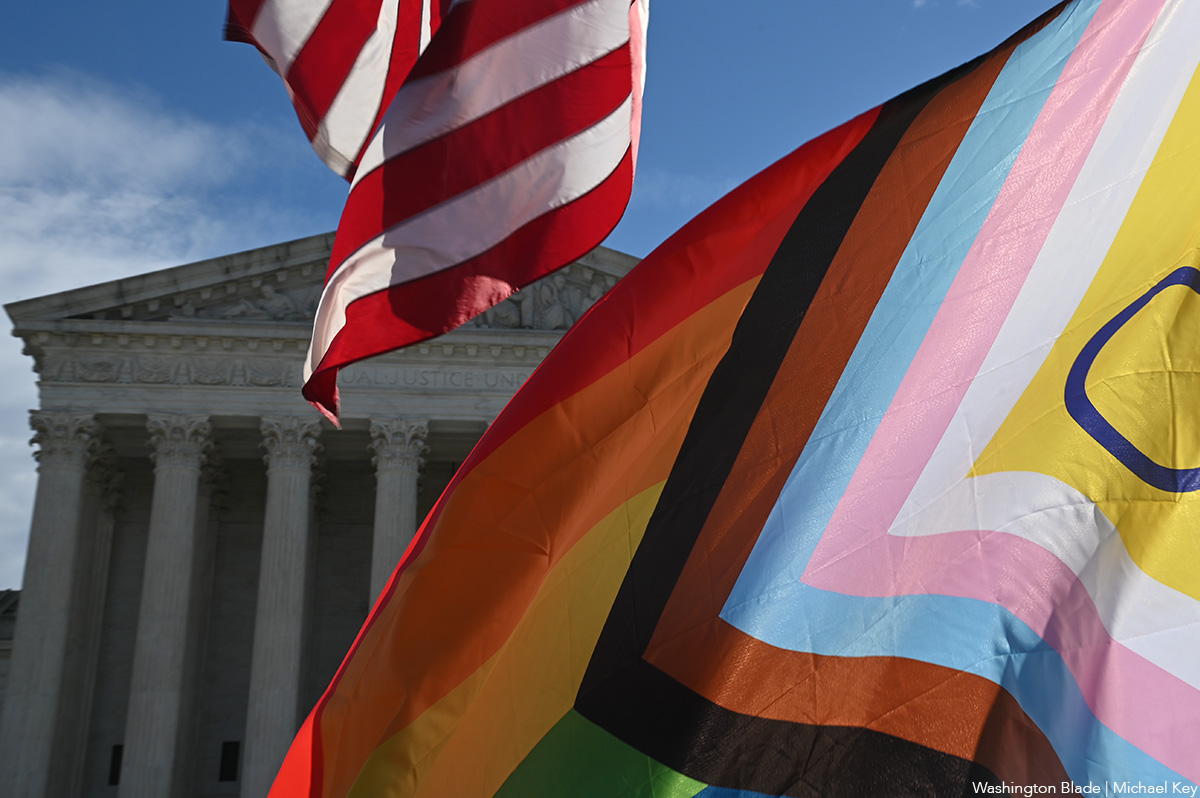
Friday marks 11 years since the U.S. Supreme Court ruled the Constitution protects same-sex marriage in Obergefell v. Hodges. Despite that major win for LGBTQ people nationwide, the case may be on shakier ground than originally thought.
Obergefell v. Hodges, the case that determined the Constitution extends its protection of rights to same-sex couples and that states must recognize marriage licenses for same-sex couples from other states, was decided using a combination of cases from several states.
The central arguments in the case rested on the 14th Amendment’s Equal Protection Clause, Due Process Clause, as well as collateral spousal and parental rights.
Cases in play
The first case came from Michigan with DeBoer v. Snyder, where a lesbian couple, who were not legally allowed to marry in the Mitten State, attempted to adopt their third child but could not both obtain legal parental rights. April DeBoer and Jayne Rowse initially received a favorable ruling in district court, with the judge finding that the Michigan Marriage Amendment — which barred same-sex marriage in the Midwestern state — violated the Equal Protection Clause. The same day, the case was appealed to the 6th U.S. Circuit Court of Appeals, eventually making its way, along with the other five cases, to the highest court in the land.
Ohio had multiple cases that ultimately contributed to the judicial acknowledgment of same-sex marriage rights in the U.S.
The Supreme Court case most commonly associated with the fight for same-sex marriage — Obergefell — originated in Ohio. Beginning as Obergefell v. Kasich in the state, James Obergefell knew his longtime boyfriend, John Arthur, was suffering from ALS. Knowing Arthur’s life would end shortly — and understanding the couple could not legally marry in Ohio — they boarded a medically equipped plane, accompanied by a nurse and Arthur’s aunt, Paulette, and flew to BWI Airport in Maryland. There, they were legally married. Over the next several months, Arthur’s health continued to decline until he eventually passed away in October.
The legal battle began after Arthur died, as Ohio law refused to acknowledge that Obergefell was his husband and would not list him as Arthur’s surviving spouse on his death certificate. Obergefell challenged the decision, arguing it was unconstitutional and pursuing legal action. The local Ohio registrar agreed that refusing to recognize their out-of-state marriage license — which Ohio had recognized for different-sex couples in the past — discriminated against the couple. Despite that, the state attorney general continued to defend Ohio’s same-sex marriage ban.
The judge ultimately ruled that “a marriage solemnized outside of Ohio is valid in Ohio if it is valid where solemnized,” marking another step toward marriage equality. Ohio appealed the ruling, and the case ultimately contributed to the establishment of same-sex marriage protections under the federal Constitution.
The second Ohio case, Henry v. Wymyslo, much like DeBoer v. Snyder, involved parental rights for adopted children. The case included four couples — three lesbian couples who lived in Ohio and adopted children while residing there, and one gay couple from New York with an adopted son born in Ohio. The four couples filed a lawsuit against Ohio, seeking to require the state to list both parents on their children’s birth certificates.
Eventually, the judge — the same one who presided over Obergefell v. Kasich — ruled that the state must list both parents on their children’s birth certificates. Like many cases that make their way to the Supreme Court, it went through multiple appeals before ultimately reaching the nation’s highest court.
Kentucky also had two cases that contributed to the legal battle for same-sex marriage.
The first, Bourke v. Beshear, revolved around Gregory Bourke and Michael DeLeon, a same-sex couple married in Canada in 2004, and Randell Johnson and Paul Campion, who were married in California in 2008. Like DeBoer v. Snyder and Henry v. Wymyslo in their respective states, the plaintiffs challenged Kentucky’s ban on same-sex marriage and its refusal to recognize same-sex marriages performed in other jurisdictions so that both parents could be acknowledged on their children’s birth certificates.
The judge ultimately ruled, much like in Obergefell v. Kasich, that states constitutionally must recognize legally performed out-of-state marriages.
Love v. Beshear is the second case from the Bluegrass State.
Maurice Blanchard and Dominique James were denied a marriage license by Kentucky county clerks. The couple’s legal team filed to join Bourke v. Beshear, another case actively challenging the state’s ban on same-sex marriage, and the motion was approved, with the case restyled as Love v. Beshear. The judge ultimately ruled that Kentucky’s bans on same-sex marriage explicitly “violate the Equal Protection Clause of the Fourteenth Amendment to the United States Constitution, and they are void and unenforceable.”
The final case, Tanco v. Haslam, involved four same-sex couples who filed suit in Tennessee. Each couple had married outside Tennessee before moving to the state, with nearly all relocating for employment. One worked for the military, whose marriage was already recognized by the Department of Defense; one worked for the state; and two were professors. Seeking to have their out-of-state marriages recognized in Tennessee, the four couples filed Tanco v. Haslam in U.S. District Court for the Middle District of Tennessee. The court eventually granted a preliminary injunction requiring the state to recognize the marriages of the three plaintiff couples but denied the request to overturn Tennessee’s same-sex marriage ban.
To SCOTUS
All of these cases contributed to the legal challenge against same-sex marriage bans across the country and ultimately led to a 5-4 ruling that allowed same-sex couples to have their marriages recognized in all 50 states, Guam, Puerto Rico, and D.C.
The justices voted as follows: Anthony Kennedy, who authored the majority opinion, Ruth Bader Ginsburg, Stephen Breyer, Sonia Sotomayor, and Elena Kagan supported Obergefell while Chief Justice John Roberts, Antonin Scalia, Clarence Thomas, and Samuel Alito all dissented.
The court held that the 14th Amendment — specifically its Due Process Clause — guarantees the right to marry as one of the fundamental liberties it protects, regardless of the gender of those getting married.
The court also ruled that another provision of the 14th Amendment — the Equal Protection Clause — extends the right to marry enjoyed by different-sex couples to same-sex couples, finding that denying same-sex couples that right violates their right to equal protection under the law.
Some of the Supreme Court justices who dissented argued that this was a state issue, not a federal one, because the Constitution makes no mention of same-sex couples. They said it was beyond the purview of the court to decide whether states must recognize or license such unions. The dissenters argued that the majority was engaging in judicial policymaking, which they contended is not permitted under U.S. law.
Another argument made by the dissenting conservative justices was that the majority opinion infringed on religious freedom by engaging in this “judicial policymaking” rather than allowing state legislatures to determine the laws governing marriage.
Since the ruling
According to data from the Williams Institute, 823,000 same-sex couples are now legally married — more than twice the number in 2015 — as a result of the Supreme Court’s decision.
The ruling also increased the number of same-sex families raising children, largely because it removed legal barriers and paperwork restrictions that had prevented same-sex couples from being listed as parents. The data shows there are nearly 299,000 children under the age of 18 being raised by married same-sex couples as a result of Obergefell.
The states that saw the largest increases — and the most favorable changes to marriage rates — were in the South. The percentage of cohabiting same-sex couples who were married between 2014 and 2023 increased from 38 percent to 59 percent.
Many of the married same-sex couples surveyed said marriage improved their sense of safety and security (83 percent), life satisfaction (75 percent), and relationship stability (67 percent).
“Marriage equality has significantly benefited the lives and well-being of same-sex couples, their families, and the communities where they live,” said Christy Mallory, interim executive director and legal director at the Williams Institute.
Future of Obergefell
While same-sex marriage remains the law of the land, there have been multiple attempts by conservative and religious figures in America to reverse it.
In 2025, Kim Davis, the clerk of Rowan County, Ky., who made headlines 10 years earlier after refusing to issue marriage licenses following the striking down of same-sex marriage bans, approached the Supreme Court with the goal of getting Obergefell overturned.
She argued that the ruling put her religious beliefs at odds with her job and asked the court to strike it down. The consensus was nearly unanimous, holding that when a person serves as an agent of the state, they cannot place their personal religious beliefs above state policy because they are acting on behalf of the government.
Thomas, one of the Supreme Court’s most conservative justices, has also attempted to plant the seeds for overturning Obergefell.
In Dobbs v. Jackson Women’s Health Organization, which ultimately restricted abortion access in the country, he wrote a concurring opinion suggesting that Obergefell, along with several other precedents, should be “reconsider[ed].”
Later, without directly addressing Obergefell, Thomas told an audience at Catholic University’s Columbus School of Law that he didn’t “think that … any of these cases that have been decided are the gospel.”
While President Donald Trump has not implemented any executive restrictions on same-sex marriage during his presidency, his administration has made it clear that it opposes continued efforts to expand protections for same-sex couples, particularly when doing so conflicts with claims of “religious freedom.” The administration has attempted to remove sexual orientation and gender identity from federal health care and housing nondiscrimination protections and has significantly restricted the rights of transgender Americans.
Currently, same-sex marriage remains federally protected by the Respect for Marriage Act, and the Supreme Court has thus far declined to overturn Obergefell.

Physician: addiction doesn’t always look the way you think it does

Calendar: October 9-15

ICC unseals arrest warrants for Taliban officials accused of persecuting LGBTQ people, women

Bet Mishpachah participates in D.C. Oct. 7 commemoration ceremony

Man charged in Mall of America shooting plot inspired by Pulse massacre: report

PHOTOS: Winchester Pride

Evan Low is not the leader the Victory Fund needs at this moment

Transgender woman elected to Brazilian Chamber of Deputies

Bowser, Office of LGBTQ Affairs announce LGBTQ+ History Month events

Alianza para la Inclusión fortalece la defensa de derechos LGBTQ en Centroamérica
-

 Photos5 days ago
PHOTOS: Winchester Pride
-
Opinions5 days ago
Evan Low is not the leader the Victory Fund needs at this moment
-
Brazil5 days ago
Transgender woman elected to Brazilian Chamber of Deputies
-
District of Columbia5 days ago
Bowser, Office of LGBTQ Affairs announce LGBTQ+ History Month events