Arts & Entertainment
Gay is ‘The New Normal’
Same-sex couple explores parenthood in new Ryan Murphy sitcom
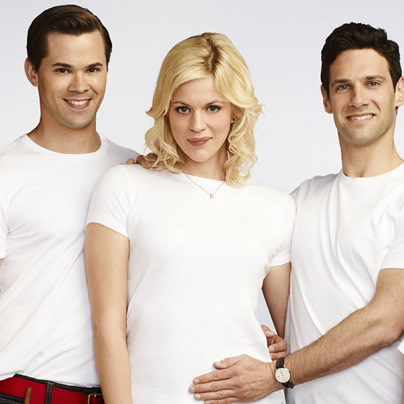
‘The New Normal’
NBC
Tuesdays at 9:30 p.m.
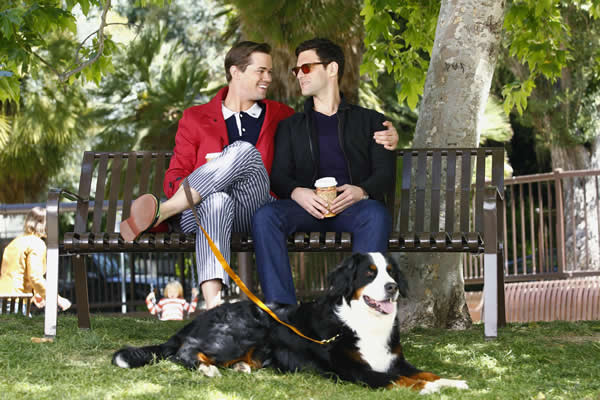
Andrew Rannells as Bryan (left) and Justin Bartha as David in the controversial new NBC comedy ‘The New Normal.’ (Photo courtesy NBC)
Now that “The New Normal” is off and running — an online pilot teased the series while its first two regular broadcasts were Monday and Tuesday this week before settling into its regular Tuesday night time slot — most TV fans know the premise.
This latest creation from gay TV mastermind Ryan Murphy (“Glee,” “Nip/Tuck,” “American Horror Story”), it tells of a happy young gay Los Angeles couple, Bryan (Andrew Rannells) and David (Justin Bartha), who convince new-in-town Goldie (Georgia King) to be a surrogate so they can start a family.
The show’s off to a decent-enough start. Monday night’s network debut found it winning its time slot drawing about 6.9 million viewers, though about 45 percent of those who’d tuned in for lead-in hit “The Voice,” cut out for “Normal.” Some critics are calling the performances a “triumph over content.”
Entertainment Weekly’s Ken Tucker calls Rannells — best known for his Broadway turn in “The Book of Mormon” — “one of the hottest young talents around and he does as much as he can with a role that co-creators Murphy and Ali Adler seem to have conceived as a cross between Charles Nelson Reilly and Rip Taylor; all Bryan is missing is a bag of confetti to throw at his costars after deliving a punchline. It’s to Rannells’ credit that he made the premiere’s attempts at heart tugging, wuch as a home video made for the future baby professing ‘how desperately you are wanted,’ seem heartfelt.”
The San Francisco Chronicle praised its “humor, solid performances” and “snappily written script.” The Los Angeles Times said the pilot “felt flat or programmatic … but much was likable as well, especially the nonchalant tenderness between the male leads.”
During a conference call last week, Rannells, Bartha and King fielded questions on everything from where the show is headed, to working with Murphy to what they think about the controversy the show has generated (Salt Lake City, Utah-based NBC affiliate KSL has refused to air the show though it claimed it was more for the “sexually explicit content, demeaning dialogue and inciting stereotypes” than its “gay characters or LGBT families; Two Utah pro-gay groups in a partnership with GLAAD are screening the show for Utah residents).
“I actually do hope people are offended by it,” Bartha says. “I think hopefully it will get conversations started in family homes and that families who love it will love it for what it is, a compassionate and loving family with many positive aspects. And the ones who are offended by it or find that it strikes them as offensive, hopefully they will maybe realize that they’re bigots and they’re ignorant and possibly our show can usher in a little more acceptance. I don’t expect it to change anyone’s life, but I do think one of the wonderful things about television is its ability to start a conversation, to inspire people to have those watercooler chats maybe the next day. It starts that discourse.”
King, a British actress with extensive film and TV credits, says realizing the show was drawing controversy was “the biggest thrill.”
“It’s bringing up topics and questions and ideas that maybe people haven’t had to consider before,” she says. “It’s a privilege to be doing something that’s starting a great conversation.”
But if the show takes off, where could it possibly go once the pregnancy storyline is played out? Some have questioned whether there’s enough meat to the setting to warrant a long-running series.
Rannells says all early signs are great as far as he’s concerned.
“We’re shooting the fifth episode so far and we’ve read six scripts so far and I have to say, the shows just keep getting better and better. If you’re asking what the second season, the third season and so on will look like, we don’t think of it that way. The main reason we all signed up was because of Ryan and Ali and I think when you see the rest of these episodes, you’ll see that it’s not only a great set up, but in the following episodes, it really does explore the depth of each character and make them each indelible.”
“Ryan’s just been extraordinary,” King says. “He’s got such a wonderful reputation for not being too kind of plucky and fake. He’s very to the point and personally, I absolutely love that. He’s so candid and so clear in his ideas in what he wants and I’m very happy to be there when he’s directing.”
And though he hasn’t said much about his personal life, Bartha admits playing gay with Rannells has been easy.
“From the first time I looked into Andrew’s eyes, I knew I could fall in love,” Bartha says. “I have such a respect for him as an actor and as a person that it was immediately apparent to me that this could work. I just thought he was a funny, good looking, talented guy and he’s easy to be around, so that was the basis of it. … I really wanted to play it as a real couple who love each other and have struggles just like everyone else. Ryan keeps reminding us of that all the time. He’s always saying, ‘Let’s keep this as real as possible.’ It’s funny, but it’s also very, very real. It’s not a sitcom in the classic sense.”
And while it’s ultimately meant to be light hearted and comical, the cast says they hope viewers will take away something deeper.
“What we’re ultimately saying is that what we’re creating is perhaps no different from your family,” Rannells says. “All families basically start as unlikely folks coming together to create this family. Initially it might seem like this is awfully different, but the story we’re telling is really universal.”




Sports
New IOC policy bans trans women from Olympics
New regulation to be in effect at 2028 summer games in Los Angeles
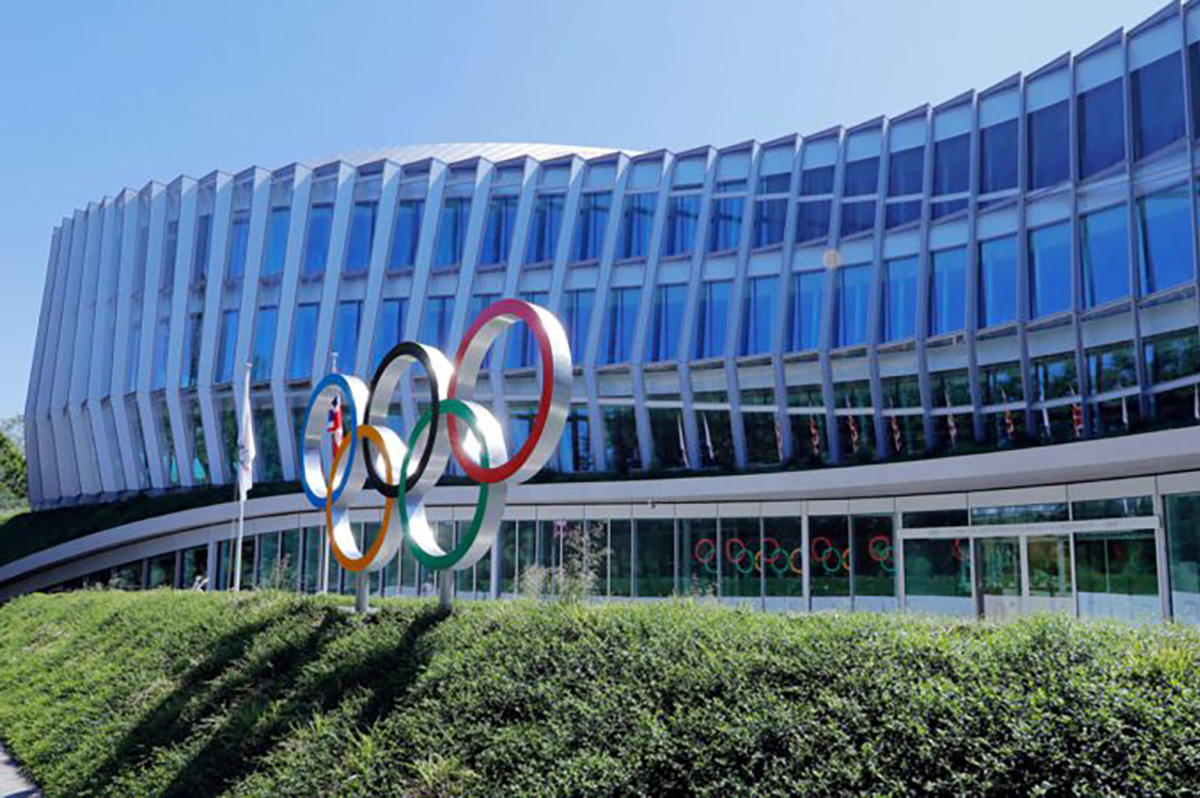
The International Olympic Committee on Thursday announced it will not allow transgender women from competing in female events at the Olympics.
“For all disciplines on the Sports Program of an IOC event, including individual and team sports, eligibility for any Female Category is limited to biological females,” reads the new policy.
The policy states “eligibility for the Female Category is to be determined in the first instance by SRY Gene screening to detect the absence or presence of the SRY Gene.”
“On the basis of the scientific evidence, the IOC considers that the SRY (sex-determining Region Y) Gene is fixed throughout life and represents highly accurate evidence that an athlete has experienced or will experience male sex development,” it reads. “Furthermore, the IOC considers that SRY Gene screening via saliva, cheek swab or blood sample is unintrusive compared to other possible methods. Athletes who screen negative for the SRY gene permanently satisfy this policy’s eligibility criteria for competition in the Female Category.”
The policy states the test “will be a once-in-a-lifetime test” unless “there is reason to believe a negative reading is in error.”
The new regulation will be in place for the 2028 Summer Olympics in Los Angeles.
“I understand that this a very sensitive topic,” said IOC President Kirsty Coventry on Thursday in a video. “As a former athlete, I passionately believe in the rights of all Olympians to take part in fair competition.”
“The policy that we have announced is based on science and it has been led by medical experts with the best interests of athletes at its heart. The scientific evidence is very clear: male chromosomes give performance advances in sport that rely on strength, power, or endurance,” she added. “At the Olympic Games, even the smallest margins can be the difference between victory and defeat. So, it is absolutely clear that it would not be fair for biological males to compete in the female category. In addition, in some sports it would simply not be safe.”
(Video courtesy of the IOC)
Laurel Hubbard, a weightlifter from New Zealand, in 2021 became the first trans woman to compete at the Olympics.
Imane Khelif, an Algerian boxer, won a gold medal at the 2024 Summer Olympics in Paris. Khelif later sued JK Rowling and Elon Musk for cyberstalking after they questioned her gender identity.
Ellis Lundholm, a mogul skier from Sweden, this year became the first openly trans athlete to compete in any Winter Olympics when he participated in Milan Cortina Winter Olympics in Italy.
President Donald Trump in February 2025 issued an executive order that bans trans women and girls from female sports teams in the U.S.
The U.S. Olympic and Paralympic Committee last July banned trans women from competing in female sporting events. Republican lawmakers have demanded the IOC ban trans athletes from women’s athletic competitions.
“I’m grateful the Olympics finally embraced the common sense policy that women’s sports are for women, not for men,” said U.S. Sen. Tom Cotton (R-Ark.) on X.
An IOC spokesperson on Thursday referred the Washington Blade to the press release that announced the new policy.
a&e features
Introducing the Torchbearers Awards honoring queer, trans women and nonbinary people
Meet the Legends and Illuminators lighting new paths
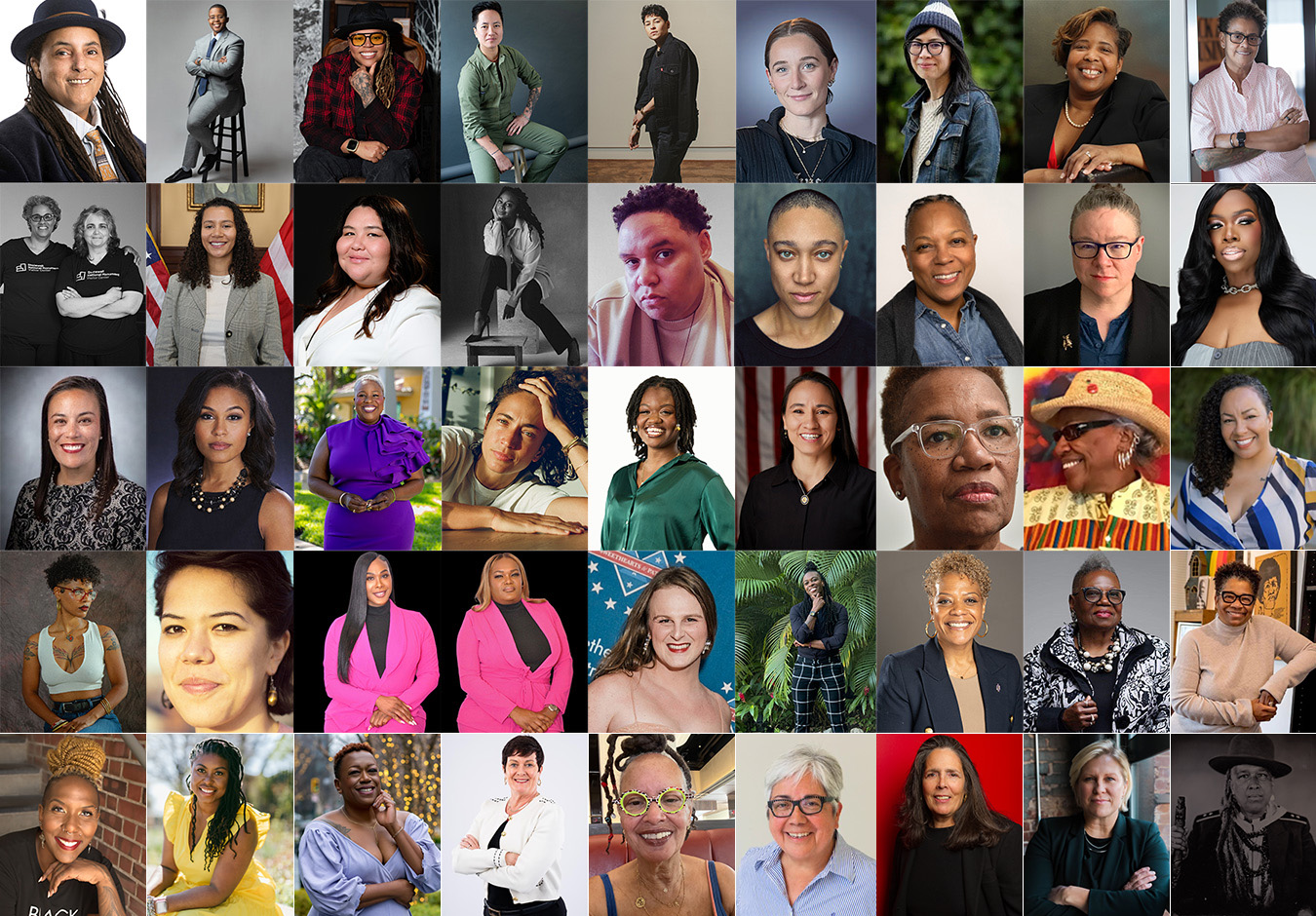
The Torchbearers Awards are more than recognition—they are a continuation of legacy. They honor the quiet architects of progress in our community: those who organize, advocate, build, and protect, often without fanfare but always with purpose. Rooted in a belief in intentional recognition, this honor names those who carry our movements forward—those who make room for others, who remind us that change is both generational and generative. In a time marked by uncertainty and challenge, these leaders push forward with courage, clarity, and an unwavering commitment to expanding opportunity and equity.
This year’s honorees reflect the full breadth of our community, spanning generations, backgrounds, identities, and industries. From Legends, with decades of leadership and having created pathways for others, to Illuminators, who are lighting new paths with creativity and innovation, each Torchbearer represents the power of intergenerational leadership and the strength found in our diversity. They are organizers, advocates, artists, policy leaders, healers, and changemakers whose lived experiences shape a shared vision for equity and liberation.
This award is our love letter to queer and trans women and nonbinary people who carry the flame when it would be easier to let it dim. To those who consistently show up, who use their voice and visibility and stand firm, often without recognition, so that others may live more freely and fully. The Torchbearers Awards celebrates not just what has been done, but the enduring spirit, responsibility, and collective care that ensure the work continues, and that the flame is always passed forward.
Co-Creators of the Torchbearers Awards: Shannon Alston, June Crenshaw, Heidi Ellis
Torchbearers Awards Advisory Board: Aditi Hardikar, Lesley Bryant, Jasmine Wilson-Bryant, Stephen Rutgers
ILLUMINATOR AWARDEES
- Representative Sharice Davids (she/her), (D, KS-03)
— U.S. House of Representatives - Greisa Martinez Rosas (she/her/ella)
— Executive Director, United We Dream - Paola Ramos (she/her)
— Journalist & Correspondent - Meagan A. Fitzgerald (she/her)
— Journalist & Correspondent - Jessica L. Lewis (she/her)
— Founder / Producer, Play Play DC - Savannah Wade (she/her)
— Founder, OAR Agency - Suhad Babaa (she/her)
— Filmmaker/ Former Executive Director of Just Vision - Ashlee Davis (she/her)
— Global Head of Inclusive Outcomes, Ancestry - Jazmine Hughes (she/her)
— Journalist and Former Editor at New York Times Magazine - Queen Adesuyi (she/they)
— Policy Advisor & Organizer, ReFrame Health & Justice - Michele Rayner, Esq. (she/her)
— Civil Rights Attorney, State Representative (Florida House of Representatives) - Gaby Vincent (she/her)
— Sports/Cultural Commentator and Community Leader - Jenny Nguyen (she/her)
— Founder & Owner, The Sports Bra - Denice Frohman (she/her)
— Independent Artist, Poet / Performer - Vida Rangel (she/her)
— Founder, Our Trans Capital - Roxanne Anderson (they/them)
— Executive Director, Our Space - Ann Marie Gothard (she/her)
— Co-Founder & President, Pride Live (Stonewall National Monument Visitor Center) - Diana Rodriques (she/her)
— Co-Founder & CEO, Pride Live (Stonewall National Monument Visitor Center) - Wendi Cooper (she/her)
— Founder / Executive Director, Transcending Women - Toya Matthews (she/her)
— City of San Antonio, Texas - Mayor Gina Ortiz Jones (she/her)
— Sports/Cultural Commentator and Community Leader - Charity Blackwell (she/her)
— Poet, LGBTQ Advocate & Community Leader - Wilhelmina Indermaur (she/her)
— Director of Communications, Tyler Clementi Foundation - Em Chadwick (she/her)
— CMO, For Them & Autostraddle - Kylo Freeman (they/he)
— CEO, For Them & Autostraddle
LEGEND AWARDEES
- Sheila Alexander-Reid (she/her)
— Executive Director, PHL Diversity, Philadelphia Convention & Visitors Bureau - Cassandra Cantave Burton (she/her)
— Interim Director of Thought Leadership & Senior Research Advisor, AARP - leigh h. mosley (she/her)
— Photographer / Educator, PhotoFlo Photography - Jenn M. Jackson, PhD (they/them)
— Assistant Professor of Political Science; Author & Columnist, Syracuse University - Jordyn White (she/her)
— COO, Washington Prodigy / VP of Leadership Development & Research, HRC Foundation - AJ Hikes (they/them)
— Deputy Executive Director, ACLU - RaeShanda Lias (she/her)
— Digital Creator, RL Lockhart - Donna Payne-Hardy (she/her)
— Educator, EEO Specialist, Former Leader at the Human Rights Campaign - Courtney R. Snowden (she/her)
— Principal, Blueprint Strategy Group - Gaye Adegbalola (she/her)
— Musician & Activist, Musician / Inductee of the Blues Hall of Fame - Cheryl A. Head (she/her)
— Independent Author, Novelist (Crime Fiction) - Letitia Gomez (she/her)
— The American LGBTQ+ Museum, Formerly of Voto Latino - Lynne Brown (she/her)
— Publisher, Washington Blade - Shay Franco-Clausen (She/Her/Ella/Queen)
— Political Strategist and Organizer - Melissa L. Bradley (she/her)
— Founder & Managing Partner, New Majority Ventures - Meghann Burke (she/her)
— Executive Director, NWSL Players Association - Victoria Kirby York, MPA (she/they)
— Director of Public Policy & Programs, National Black Justice Coalition - Joli Angel Robinson (she/her)
— CEO, Center on Halsted - Jeannine Frisby LaRue (she/her)
— CEO, Moxie Strategies - Alice Wu (she/her)
— Film Director (Saving Face, The Half of It) / Screenwriter - Storme Webber (she/her)
— Interdisciplinary Artist / Educator, University of Washington - Kim Stone
— CEO of the Washington Spirit, Washington Spirit - Mickalene Thomas
— American Visual Artist, Mickalene Thomas Studio - Erika Lorshbough (any/they/she)
— Executive Director, interACT - J. Gia Loving (she/ella)
— Co-Executive Director, GSA Network
Celebrity News
D.C. goes gaga for Gaga
Bisexual icon brought ‘The Mayhem Ball’ tour to Washington this week
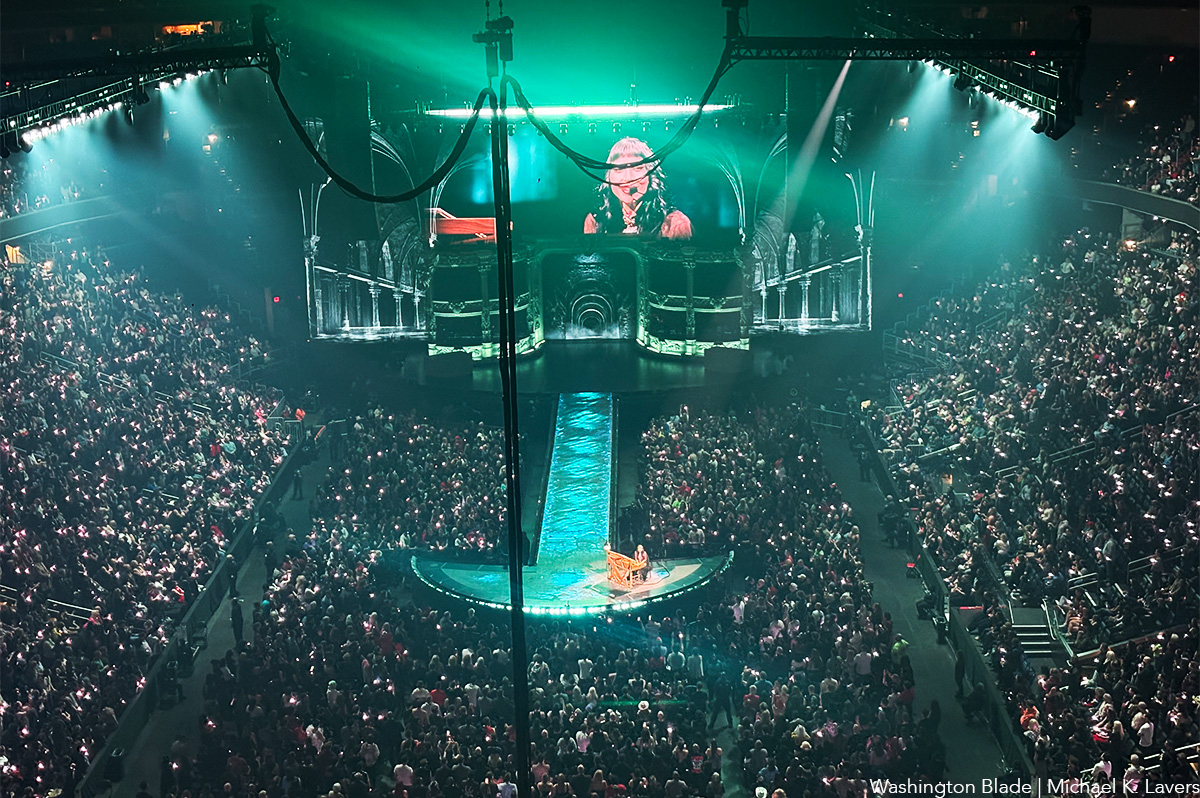
Lady Gaga this week took D.C. by storm.
The bisexual icon and LGBTQ rights champion brought “The Mayhem Ball” tour to Capital One Arena on Monday and Tuesday.
“Abracadabra,” “Paparazzi,” “Applause,” and “Bad Romance” are among the songs Lady Gaga performed during the 2 1/2-hour long concert. Lady Gaga also celebrated her many queer fans.
“You are precious to us,” she said on Tuesday night before she performed “Born This Way.”

‘No Kings’ protests set for D.C.

Border to border: modern slavery and human trafficking in refugee movements across East Africa

New IOC policy bans trans women from Olympics

Introducing the Torchbearers Awards honoring queer, trans women and nonbinary people

Pa. House passes bill to codify marriage equality in state law

PHOTOS: Capital Stonewall Democrats 50th anniversary

Small is beautiful: subcompact SUVs

‘Inherit the Wind’ isn’t about science vs. religion, but the right to think

Polish court rules country must recognize same-sex marriages from EU states

Capital Stonewall Democrats 50th anniversary gala draws sold out crowd
-

 Photos4 days ago
PHOTOS: Capital Stonewall Democrats 50th anniversary
-
Autos5 days ago
Small is beautiful: subcompact SUVs
-
Theater5 days ago
‘Inherit the Wind’ isn’t about science vs. religion, but the right to think
-
Poland4 days ago
Polish court rules country must recognize same-sex marriages from EU states