Local
Gay employee sues airline association for discrimination
Lawsuit says supervisor called him ‘fag,’ ‘bone sucker’


Airlines for America logo
A gay auditor at the D.C.-based Air Transport Association of America filed a lawsuit in September charging the group with paying him a “substantially” lower salary than others with similar job duties because of his sexual orientation.
Arlington, Va., resident Stephen Farina, who has worked for the association since 1992, charges in the lawsuit that the association, also known as Airlines for America or A4A, retaliated against him after he filed a sexual orientation discrimination complaint against the group over the salary issue before the D.C. Office of Human Rights in May.
“During plaintiff’s employment, plaintiff’s supervisor made derogatory comments about plaintiff’s sexual orientation when he stated on several occasions that he opposed gay rights and gay marriage [and] referred to plaintiff as a ‘fag’ and a ‘bonafide bone sucker’ to plaintiff’s subordinate,” the lawsuit charges.
It says the same supervisor, who is not identified in the lawsuit, “made disparaging comments towards another gay employee under his supervision.”
A4A bills itself as the leading advocacy organization for the nation’s passenger airline companies.
Victoria Day, a spokesperson for the association, responded to a request by the Washington Blade for a comment on the lawsuit with a one sentence statement: “A4A does not tolerate discrimination in any form and intends to vigorously dispute these allegations.”
D.C. Superior Court Judge Anthony Epstein, who is presiding over the case, issued a ruling on Dec. 13 denying a motion by A4A calling for the dismissal of the case based on procedural grounds.
Epstein ordered the two parties to participate in a court required mediation process while setting a timetable for pre-trial information gathering and pre-trial motions if the mediation is unsuccessful.
Farina told the Blade he spent nearly four years attempting without success to address with A4A’s upper management what he calls A4A’s discriminatory employment practices toward him regarding his salary.
His lawsuit says he began work with the A4A in 1992 as a staff auditor at a salary of $28,000. It says A4A officials “had knowledge that plaintiff is gay” throughout most of his tenure with the organization.
According to the lawsuit, in August 2001, Farina was promoted to manager of audits with an annual salary of $61,000. Around February 2008 his title changed to director of industry audits, which brought a raise to $68,000.
Farina told the Blade that authoritative studies of the industry show that people holding similar jobs with other employers and others with similar job duties at A4A make between $100,000 and $160,000.
“Plaintiff’s principal role is to provide guidance and oversight for vendors hired to operate 60 of the largest jet fuel storage and distribution systems in the United States and Canada,” the lawsuit says. “On information and belief, other similarly situated non-gay directors are paid substantially more than plaintiff.”
The lawsuit calls for $1 million or more in damages to be determined at trial to compensate for “lost pay, front pay, lost benefits, pain and suffering, emotional distress, mental anguish, interest [and] reasonable attorney’s fees,” among other things.
Farina said he dropped his Human Rights Office complaint and filed the lawsuit at the advice of his attorney after determining a lawsuit would be a more effective means of addressing his discrimination complaint.
Farina’s lawsuit was filed three months before the Human Rights Campaign released its 2012 Corporate Equality Index ratings of U.S. corporations on personnel policies pertaining to LGBT employees.
Most of the major U.S. airline companies received ratings of between 90 and 100, the highest score given to companies that ban employment discrimination based on sexual orientation and gender identity. According to the HRC Corporate Equality Index, companies receiving high ratings, like the airline companies, provide domestic partner benefits and adopt other supportive policies toward LGBT employees.
Gary Kelly, chief executive officer of Southwest Airlines, which received an HRC Equality Index rating of 90, serves as A4A’s chairman of the board, and the board is composed mostly of airline industry executives, according to industry observers.
It couldn’t immediately be determined by press time whether the airline officials who play a key role in the A4A’s operations were aware of the allegations against the association made in Farina’s lawsuit.
D.C. Superior Court Judge Laura Cordero on Dec. 26 dismissed a discrimination lawsuit filed by another gay A4A employee, David Duchow, on procedural grounds. Court records show that Duchow, who charged A4A with employment discrimination based on his sexual orientation, represented himself in the case without a lawyer.



District of Columbia
Hands Off the Arts to form ‘human chain’ around Kennedy Center
Drag performer Tara Hoot among event organizers
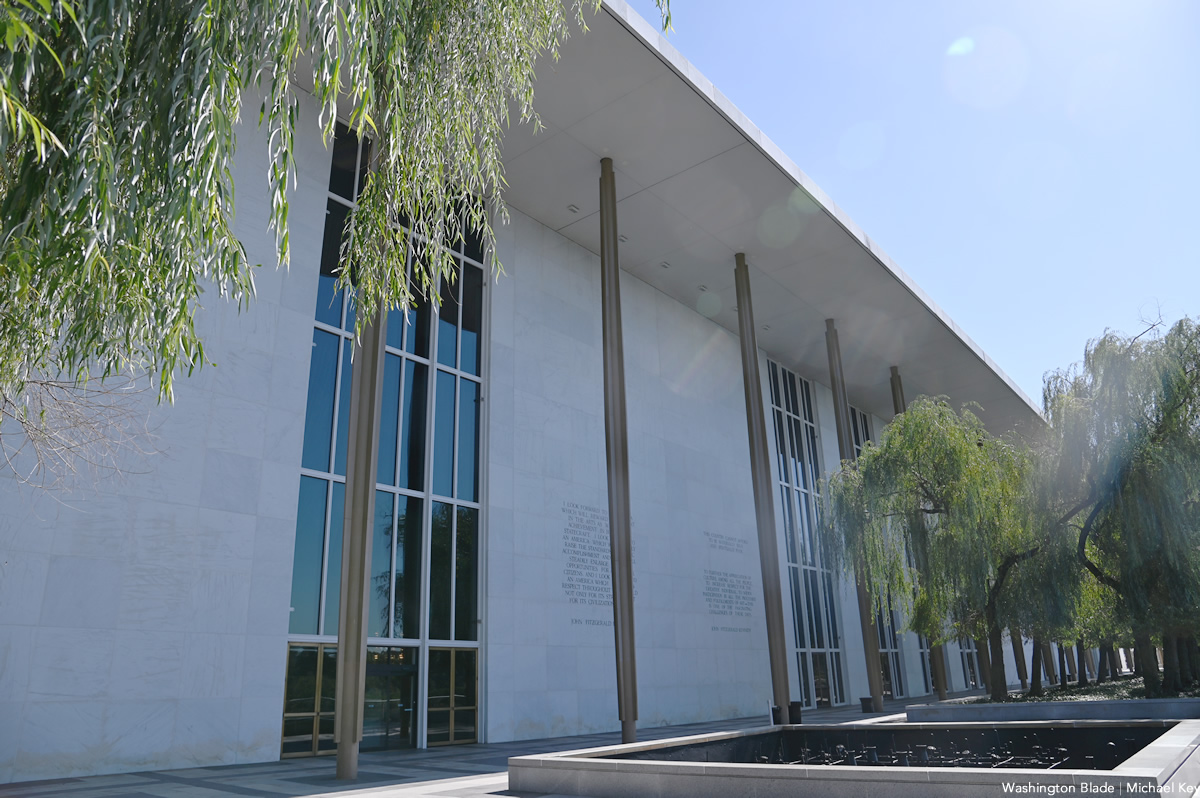
An organization called Hands Off the Arts has announced it is holding a pretest on Friday, Sept. 18, in which between 400 and 800 participants are expected to create a “human chain” around the Kennedy Center to voice their strong objection to President Donald Trump’s call for possibly demolishing the Kennedy Center.
“Hands Off the Arts is organizing a rally Sept. 18 against the president’s defacing of JFK’s memorial, his removal and censorship of art, and the threat to demolish the center if he can’t remake the site in his image,” a statement released by the group says.
The statement says the event will start with a rally at 6:30 p.m. on the Kennedy Center steps and culminate with a “human chain” around the building. “There will be musical performances, testimonials from current and former employees, along with other special guest speakers,” it says
A separate announcement by the group says longtime D.C. drag performer Tara Hoot, who has performed at the Kennedy Center in past years, was among the organizers of the Sept. 18 protest.
The planned protest follows Trump’s decision last year to use his authority to replace the existing members of the Kennedy Center’s board of directors with new members loyal to him. Over the objection of longtime Kennedy Center supporters, the Trump-appointed board changed the name of the center, at Trump’s request, from the John F. Kennedy Memorial Center for the Performing Arts to the Donald J. Trump and the John F. Kennedy Center for the Performing Arts.
But follow the threat of legal action by opponents who pointed out that the name change could not be legally made unless approved by Congress, the name change was cancelled, with Trump saying he would take steps to restore it later.
The Washington Post, meanwhile, reports in a Sept. 13 news story that because of negative publicity related to Trump’s actions, the Kennedy Center was facing “fiscal collapse” and possible bankruptcy and could be forced to shut down as early as this week.
According to the Post report, a 57-page document presented to the Kennedy Center’s board of trustees says the center was facing a financial and structural building crisis, with the recent collapse of part of the building’s inside ceiling, indicating the building was unsafe for employees and the public. Among other things, the document says the Kennedy Center may not be able to make payroll or pay for routine maintenance “within a matter of weeks,” the Post reports.
Some LGBTQ advocates were among those who joined others in boycotting the Kennedy Center to express their objections to Trump’s actions, including a statement by Trump that he objected to the Kennedy Center’s practice of hosting drag performances.
The Gay Men’s Chorus of Washington has been among the LGBTQ performing arts groups and artists that have performed at the Kennedy Center.
“With the future still very much uncertain, now more than ever, the Center needs you to stand up for freedom of expression and against authoritarian overreach into arts and culture institutions,” the Hands Off the Arts group says in its announcement of the Hands Around the Kennedy Center protest.
“You have the opportunity to make a difference — show up with Hands Off the Arts and show your power as part of Hands Around the Kennedy Center,” it says.
A spokesperson for the Kennedy Center couldn’t immediately be reached for comment.
Baltimore
Transgender woman killed in Barclay community mourned by friends, advocates
Sophie Lee shot to death on Friday morning

By DARREONNA DAVIS | Denise Johnson imagined spending Sunday with her daughter, Sophie Lee, eating crabs at the park. Instead, she stood on a Barclay street corner Sunday evening surrounded by nearly 100 people who came to remember her daughter, a transgender woman who was fatally shot there Friday.
The 27-year-old woman was found in the 2400 block of North Calvert Street around 1:15 a.m. Friday, Baltimore Police said in a news release.
Lindsey Eldridge, a police department spokesperson, said it’s unclear if her identity had anything to do with her death and the investigation is ongoing.
The rest of this article can be read on the Baltimore Banner’s website.

The Comings & Goings column is about sharing the professional successes of our community. We want to recognize those landing new jobs, new clients for their business, joining boards of organizations and other achievements. Please share your successes with us at [email protected].
The Comings & Goings column also invites LGBTQ+ college students to share their successes with us. If you have been elected to a student government position, landed an exciting internship, or are graduating and beginning your career with a new job, let us know so we can share your success.
Congratulations to Jaime Christopher Pierce on their appointment to serve as a member of the Virginia Governor’s LGBTQ+ Advisory Board. Pierce was sworn in on Sept. 3 by Greg Parks, clerk of the Alexandria Circuit Court.
Pierce currently serves as vice chair of the Alexandria City LGBTQIA+ Task Force and as a member of the Alexandria Pride planning committee. They previously served on the board of directors of Equality Virginia.
Upon being sworn in, Pierce said, “Public service has been a central part of my life for more than 30 years, and this appointment gives me an opportunity to serve the Commonwealth in a different and very personal way. My career has allowed me to work with people and communities throughout Virginia, and I hope to bring that experience, along with my own lived experience and my involvement in the LGBTQ+ community, to the work of the Board.” They added, “Having Greg administer the oath makes the occasion even more meaningful because of his own historic role as Virginia’s first openly gay elected circuit court clerk.”
Pierce also serves as Circuit Court Services Manager for the Department of Judicial Services, at the Office of the Executive Secretary of the Supreme Court of Virginia. They began their career in Virginia’s judiciary in 1994 as a deputy clerk with the Virginia Beach Circuit Court and have since held several professional and leadership positions within the court system. Pierce is a member of the National Association for Court Management (NACM) and the Mid-Atlantic Association for Court Management. At the national level, Pierce participated in the workgroup that developed the National Association for Court Management’s Diversity, Equity, and Inclusion Guide, a resource designed to help court professionals advance inclusive practices and strengthen access, fairness and belonging within the justice system.
Pierce earned a degree in Criminal Justice from Liberty University, and a certificate in Paralegal Studies from Norfolk State University.

Hands Off the Arts to form ‘human chain’ around Kennedy Center

LGBTQ issues, attacks on Democrats dominate unusual RNC midterm convention

Acclaimed Chef Patrick O’Connell’s memoir reveals the arc of a life well lived

New Hungarian government to scrap anti-LGBTQ adoption law

Fashion icon Bob Mackie dead at 87

How Dolly became a folk saint for Appalachian queers

Remembering the LGBTQ heroes of 9/11 terrorist attacks

Historiography with heart

Ind. prosecutor declines to press charges over false Buttigieg child welfare complaint

Multi-billion-dollar 9/11 Victim Compensation Fund to continue until 2090
-

 Arts & Entertainment5 days ago
How Dolly became a folk saint for Appalachian queers
-
National5 days ago
Remembering the LGBTQ heroes of 9/11 terrorist attacks
-
Books5 days ago
Historiography with heart
-
Politics5 days ago
Ind. prosecutor declines to press charges over false Buttigieg child welfare complaint