Arts & Entertainment
Oyamel’s chef wows
A night of exquisite Mexican cuisine

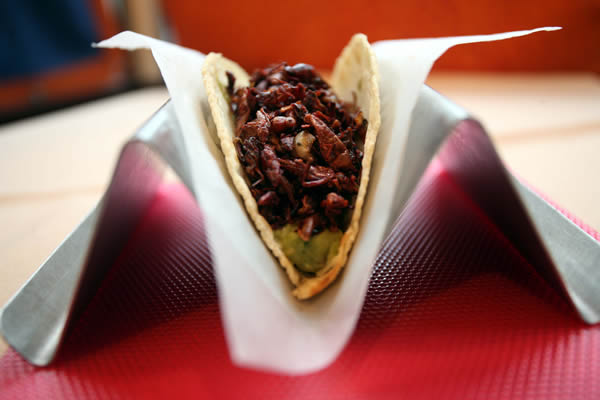
Oyamel Taco (photo courtesy Oyamel)
Chef Jose Andres is a powerhouse in the D.C. restaurant scene. Along with business partner Rob Wilder, he owns several renowned restaurants, including Jaleo, America Eats, minibar, Zaytinya, and Oyamel (401 7th St., N.W.) Andres has also won numerous awards including Outstanding Chef from the James Beard Foundation (2011) and Time magazine named him one of the world’s 100 most influential people in 2012. When Andres recently appointed a new head chef at Oyamel, it seemed like the perfect time to dine in this newly renovated space.
Chef Colin King was appointed the head chef of Oyamel after serving as the sous chef at Zaytinya under Chef Michael Costa starting in the summer of 2012. King quickly proved himself a leader in the kitchen. Prior to joining ThinkFoodGroup, Chef King worked at Market Restaurant Group in Tucson, Ariz. He served as the executive chef at Harvest Restaurant and Hacienda de Sol. Since this was our opportunity to experience all that Chef Colin King could deliver we opted for the “Oyamel Experience Menu,” where he took us on a culinary tour through Mexican cuisine for $55 per person. I personally opted to also indulge in the Artisan Bar Pairing for $35.00.
The experience began with chips, salsa, and guacamole made tableside with fresh creamy avocadoes, tomatillo, serrano chile and queso fresco. As we worked our way through the guacamole a plate of tuna ceviche was brought to the table. The tuna was lightly marinated in lime adding a fresh citrusy zip to the fish; avocado, toasted pecans and jalapenos accompanied it. After the tuna ceviche, which was an outstanding dish, we were presented with a plate of “ceviche tradicional” — raw striped bass with lime, onion, tomato, sweet potato and corn. All of these components came together perfectly and each bite erupted with freshness and well balanced flavors. To accompany the two ceviches I was served the “Sagrado Corazon,” which was tequila, cilantro, and toasted coriander gimlet over hibiscus ice. It morphed into a delightfully floral drink as the hibiscus ice melted away.
Spectacular dish after spectacular dish continued to arrive at the table, each one seeming to be better than the last. Then the seared red fish was put in front of us. This fish had a rich and meaty texture, not the flakey texture you expect from fish. It was seasoned perfectly with tomatoes, onions, olives, capers, and jalapeno chilies giving it a deep warm flavor. This was one of the true standout dishes of the evening. After the red fish we sampled a couple of tacos from the menu, including the wild mushroom taco with salsa, shallots and Mexican cream as well as the legendary sautéed grasshopper taco.
We were beginning to feel satiated when the two plates of dessert arrived at the table. The “tres leches con pina” was a cake soaked in rum, three milks, as well as pineapple salsa and it was served with a scoop of caramel ice cream. The other was the “café de olla” which was coffee ice cream, Mexican cinnamon and sugar, caramelized bananas, lime gelatin and Mexican cinnamon shortbread. Both dishes were devoured in moments and we ended up getting seconds of both.
There was not a single dish that was put in front of us that was disappointing. Head Chef Colin King does not let the diner down as he leads you through a delectable tour of Mexico. Each plate is unique and impeccably prepared, allowing the food and flavors to speak for themselves. It was a delightful evening, and the best part was, we didn’t even need to decide what to order, Chef King handled that all for us.




Theater
‘Merrily’ is for Sondheim super fans, the uninitiated, and anyone in between
Experience it in an intimate setting with beautiful design, incredible cast
‘Merrily We Roll Along’
Through Nov. 1
Signature Theatre
4200 Campbell Ave., Arlington, Va.
Tickets start at $47
Sigtheatre.org
Unfaithful. Compromised. A sellout. Just a few descriptors that might fit Frank Shepard, the talented composer in the Stephen Sondheim musical “Merrily We Roll Along.”
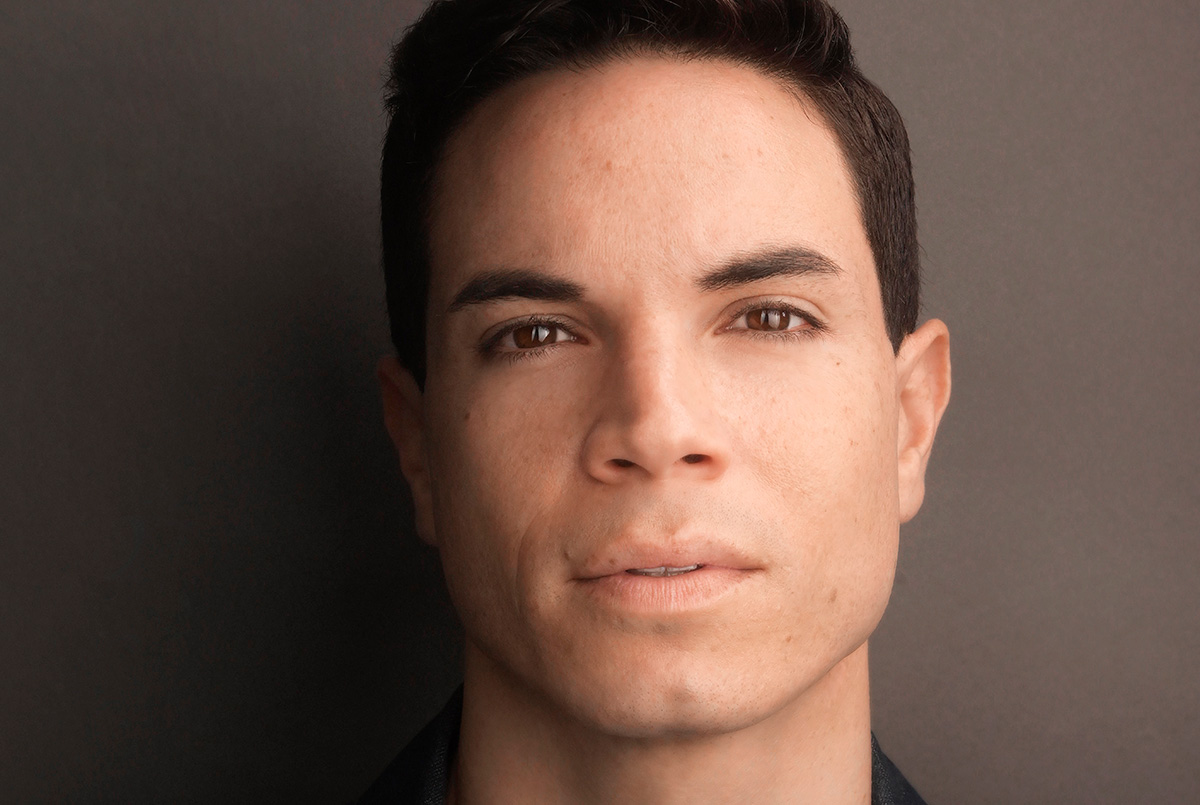
“Personally, I think he gets a bad rap,” says Jason Gotay, the gay actor who’s currently playing womanizing Frank at Signature Theatre in Arlington. “At his core he wants to be loved. He’s concerned with making those around him happy and he’s a people pleaser. That’s my window into Frank.”
Whatever your thoughts, by show’s end, we know Frank started out as a nice guy. “Merrily” famously moves in a reverse chronological order. We meet Frank and friends, lyricist Charley Kringas (Jake Loewenthal) and writer Mary Flynn (Melanie Field), disillusioned in a New York penthouse in 1976. Ensuing scenes filled with disappointments and broken relationships move toward more hopeful times, eventually leaving the trio on a rooftop in 1957, young and full of promise searching the night sky for a happy future.
“Moving backward makes it difficult to build on the prior scene,” explains Gotay. 37. “You live heightened moments followed by 30-second costume changes, and you’re meant to forget everything you just did. To be honest, it’s a bit of a mind fuck.”
A marvelous but humble tenor, he begrudgingly acknowledges his artistic versatility. At New York City Center he sang Che in “Evita” (contemporary almost operatic), and he was solemn Henrik in Lincoln Center’s “A Little Night Music,” (classical Sondheim). On Broadway, he played Homer, the loyal brother in “Floyd Collins” (folksy bluegrass), and he’s sung the sweeping songs of a few Disney princes.
“I’m asked to do a lot of things because vocally I sing in many styles; it’s something I can do and I love doing it.”
Growing up in residential Dyker Heights, Brooklyn, Gotay was immersed in school plays and community theater. For high school, he attended the Professional Performing Arts School in midtown Manhattan with a focus on musical theater.
He continued on the same track for a year at Emerson College in Boston followed by Marymount Manhattan before graduating in 201l. A year later, he made his Broadway debut as Randall in Lin-Manuel Miranda’s hip-hop inspired “Bring It On: The Musical.”
Along the way, Gotay became a huge Sondheim fan. As a musical theater kid, he was introduced to the composer’s enduring classics all written before Gotay was born: “Into the Woods,” “Sweeney Todd,” and the actor’s forever favorite “Sunday in the Park with George.”
To many theatergoers’ surprise, “Merrily” flopped badly when it premiered on Broadway in 1981. But over many years of tweaks, reimaginings and revivals, the show became a major Broadway hit in 2023, with Jonathan Groff winning a Tony Award for playing Frank.
While he was aware of “Merrily,” Gotay didn’t make a deep dive into its wild provenance until he was asked to audition for the Broadway revival. (Briefly it looked like Groff, long attached to the show, might come up against some film conflicts.) It was during this short time that Gotay fell in love with Frank.
The experience left him further determined to sink his teeth into the complex character along with Sondheim’s lush melodic score with songs like “Not a Day Goes By,” “Old Friends,” and “Our Time.” So, when Gotay learned that Signature was slated to do “Merrily” this season, he reached out to Matthew Gardiner, the company’s artistic director as well as the production’s director/choreographer, asking how the role of Frank might be his. Long story short, he sought it, got it, and is ecstatically happy that it has worked out.
Several years ago, when Audible (Audible.com) came calling with an invitation to record a cabaret entirely of his own creation, he was thrilled.
“It’s probably the most personal thing I’ve ever done. My own story is a love letter to the women – my mother, friends, mentors, Broadway icons – who helped to shape my life; it’s about self-acceptance and what it is to grow up queer.”
He titled the solo show “Where You’ll Find Me,” a nod to his first love Dorothy Gale from “The Wizard of Oz.”
Often described as “a television heartthrob” (something the once chubby 12-year-old sometimes finds hard to process), Gotay is not unfamiliar with screens large and small. He’s remembered for various screen roles including his turn as Rafa Caparros, a prep school classics teacher who becomes entangled with a male student in HBO Max’s reboot of “Gossip Girl.”
Gotay recommends Signature’s “Merrily” for Sondheim superfans, the uninitiated, and anyone in between. He says, “It’s a great opportunity to learn about this once niche now increasingly mainstream musical. And if you have seen it before, this is a chance to experience it in an intimate setting with beautiful design and an incredible cast that truly brings the show to life.”
Television
Engrossing ‘Tip Toe’ delivers tension and an ominous warning
A chilling reminder that violent homophobia is on the rise

Whenever a new project comes from queer Welsh screenwriter and producer Russell T Davies – who created the original “Queer As Folk” in 1999 before spearheading the revival of the classic BBC sci-fi series “Dr. Who” as head writer and showrunner in the mid-2000s – it generally leaps to the top of every queer “must watch” list, and with good reason.
A genuinely versatile creative force who can move easily between genres without losing the core of humanity that keeps us engaged, he’s particularly known for his unequivocal, unsentimental, and always fearlessly candid narratives about queer life, set within a social context that’s barely tolerant, at best. He has a knack for capturing both the transient beauty and persistent hardships that seem to define our beleaguered community. His most recent such endeavor, 2021’s “It’s a Sin,” took us back to the harrowing years of the AIDS epidemic, following a group of gay young Londoners as the disease – and the societal homophobia that surrounded it – wreaked its merciless havoc, even as they began to break free from their closets and embrace their queer identities; and while it may have broken our hearts, it was also somehow empowering, a tale that reminded us not just of what we lost, but of what we have survived.
His latest miniseries, however, takes place in the here and now, and it offers a markedly bleaker assessment of the state of things.
“Tip Toe,” which appeared on the UK’s Channel 4 last summer, debuts on U.S. screens via the Starz streaming service on Oct. 2, and it lets us know from its first few minutes that things are not going to end well; that’s not a spoiler – it’s a warning, because if you’re looking for a happy ending, you’re not going to find it here.
A tale of resurgent and emboldened homophobia in a modern-day Britain where open hate for the queer community has surged at an alarming rate, it’s the story of two men whose intertwining destinies feel almost like a tragic accident of fate. Leo (Alan Cumming) is a Gen-X AIDS survivor who has become a beloved figure in Manchester’s queer community, the owner of a popular gay bar that has always been a safe space for the queer, trans, and questioning souls who are struggling toward self-acceptance; his next-door neighbor, Clive (David Morrissey), is a working-class electrician with a floundering marriage and two sons who live secret lives he knows nothing about. He’s an old-school “macho man” whose ingrained misogyny and homophobia have grown increasingly unfiltered with the rise of online “culture war” rhetoric; and while there’s a kind of forced “neighborly” friendship between himself and Leo, there’s also a clear-cut line of judgement – on both sides – that gives their interactions a sense of barely concealed hostility.
When Leo is locked out of his apartment after a messy hook-up gone wrong, Clive comes to his rescue, but uses the opportunity to impose himself on Leo’s privacy. He levies the situation into an opportunity for work – an electrical revamp of Leo’s bar, where he makes no secret of his disdain for the queer “lifestyle” – and the tension between them continues to build despite Leo’s best efforts at being polite. The escalation reaches a boiling point when the secrets and lies in his own household lead Clive to suspect Leo of being a sexual predator, turning their precarious relationship into a minefield of hostility and inevitably pushing both men into a confrontation that will end in a shocking act of violence.
It might go without saying that “Tip Toe” is not the kind of show most of us would watch “for fun.” Russell’s script starts the relationship between its two antagonists at the threshold between a simmer and a boil, and shows us the outcome before either of them has even said a word, so it’s mostly impossible to avoid the sense of dread that hangs over everything that comes after. This is not a weakness; instead, aided by Peter Hoar’s masterful direction, it gives the show’s five episodes a slow build of tension that keeps us watching with morbid fascination, like the scene of a horrible road accident we’re forced to drive past in slow motion. We’re allowed to feel some hope along the way – after all, we’ve only had a glimpse of what is to happen, and there are other characters with storylines in which we can become invested along the way – but it’s a kind of grim hope, and it perfectly captures the fearful cultural zeitgeist-of-the-moment that the series is ultimately about.
The characters, too, are richly drawn and layered enough to avoid a simplistic “good guy/bad guy” dynamic. Clive is a brute – arrogant, uncivil, and forcefully antagonistic with a hair trigger that responds to anything or anyone that doesn’t meet his approval – but there’s enough broken humanity underneath all that to allow us to see a glimmer of potential for redemption. Likewise, Leo is mostly good-natured and likable, but he has an arrogance of his own, as well as some bitter resentments (most of them related to his ex-husband Curtis played by Charlie Condou), who left him for a woman), which – more than occasionally – surface to provide him with some ugly moments.
There are others, too; Melba (Paul Rhys), Leo’s gender-bending longtime bestie, who sees the growing danger in the world around them and voices it with the resigned stoicism of a reluctant Cassandra; Steph (Elizabeth Barrington), Leo’s straight friend who is not afraid to let him know when he’s too full of himself; Saul (Joseph Evans), Clive’s 20-something son who has evolved a more tolerant and easy-going outlook than his father, and teenaged George (Jackson Connor), Clive’s other son, whose struggles with his own identity take him on a roller-coaster ride of conflicted emotions; Marie (Pookie Quesnel), the wife who despises Clive but is unable to escape her unhappy existence with him; and Zee (Iz Hekseth), Leo’s employee who is trying to choose a name for herself after coming out as trans – along with a variety of other young, queer supporting players who have found refuge at the bar. All of them are written with depth and nuance, even those who remain more or less in the background, and brought to life through excellent, measured performances.
It is, however, Cumming and Morrissey who give the show its irresistible pull, their complex, bristling characters endowed with a palpable authenticity that makes us forget they are merely actors playing roles. They fully inhabit these two thorny men, creating a dynamic between them that feels like a force of nature, and it’s they who provide the terrible power that keeps us from looking away, no matter how much we might occasionally want to.
That’s a good thing, because “Tip Toe” is less a television event than it is a grim reminder that being “out” may no longer be as safe as we were finally beginning to think it was – and just because the alarm bell is coming from the UK, that doesn’t mean we shouldn’t heed its warning on our side of the Atlantic, too.
Books
Eliot Glazer’s new book an engaging collection of essays
From growing up gay to turning down ‘Queer Eye’
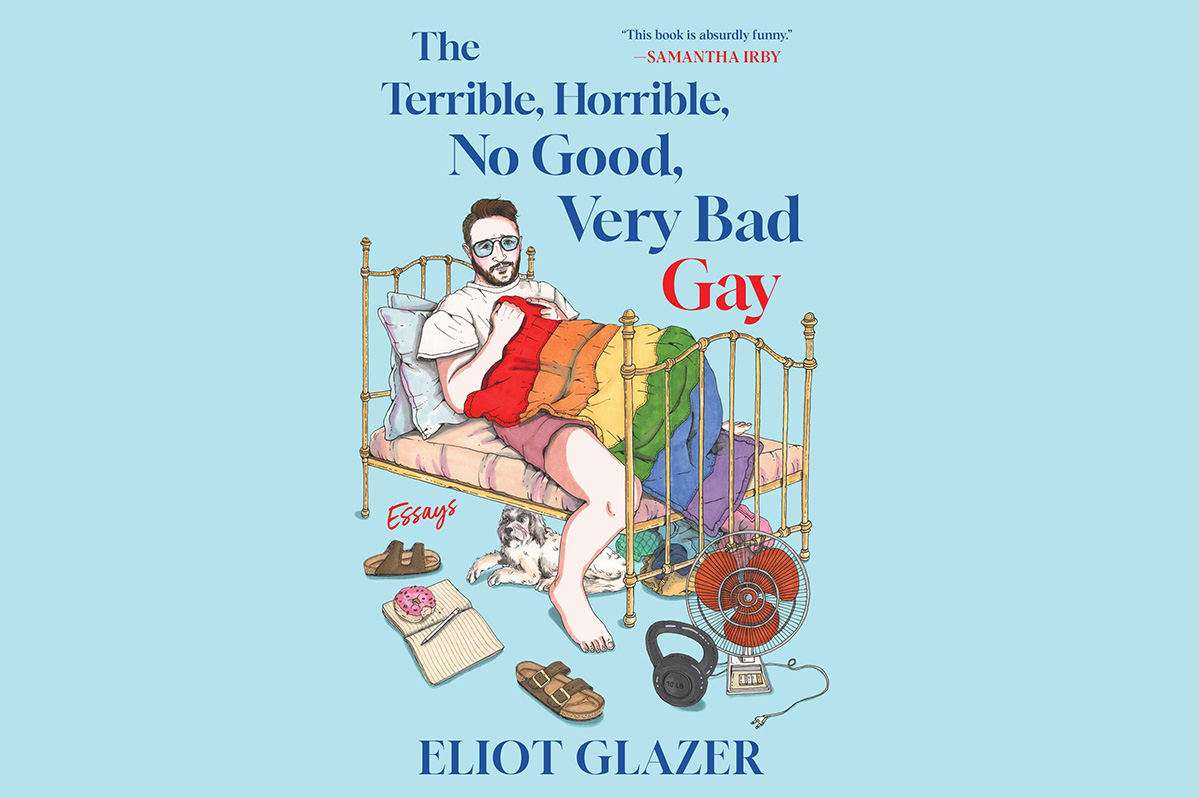
“The Terrible, Horrible, No Good, Very Bad Gay: Essays”
By Eliot Glazer
c.2026, Gallery Books
$28.99/240 pages
You try and you try.
Once, twice, you go back at that thorny issue, the dream you have, the punchline that’s not hitting quite right. Sometimes, time is all you need to make it better, or a new approach, or a second look. And then there are days when you actually get things right, as in “The Terrible, Horrible, No Good, Very Bad Gay” by Eliot Glazer, and it’s all good.

Throughout his life, Eliot Glazer has made mistakes. And it’s OK, everybody trips and falls now and then. In his case, though, he’s perfectly willing to document his failures, foibles, and whoopsies in this book.
He writes of his mother, Sandi, “a Queens-born balabosta” who wouldn’t tolerate laziness in herself or Glazer. He found work as soon as he was legally able to do so, and he had many jobs throughout high school. He was a gardener, ice cream scooper, camp counselor, golf caddy, chocolatier, telemarketer, and video store clerk. The one that fit him best, however, was working at Talbots, a department store for older women, where he found his people.
Even with all those jobs, he was a theater kid in his time off, little though it was. Back then, he was just a boy growing up on Long Island but swagger was important, so swagger he did. He still appreciates a good Broadway show, even the silliest ones.
Glazer says that he had just recently come out when gayness exploded on TV with “Will & Grace” and “Queer Eye for the Straight Guy,” with which he was obsessed. It helped him feel not othered, he says. Producers of the reboot asked him to be a second-generation Eye, but Glazer turned them down, though he thinks he’d have been good at it.
The show helped him with love of décor. His unexpected advisory skills came naturally, through age and wisdom and learning that wild partying isn’t really so much fun.
As for finding love, well, that’s a long, boy-meets-boy-meets-boy story…
So you’re looking for something to easily pick up and put down, something that speaks to your inner impatience? You’ll find that in “The Terrible, Horrible, No Good, Very Bad Gay,” a book that’s practically meant for you to skip around and you don’t have to read everything.
Essays can be like that, which is nice, even refreshing. Author Eliot Glazer is entertaining enough to make things work, engaging enough to keep it moving, and funny enough to make you want more of what he has to say. He’s open with his life and, despite his fame, his writing isn’t lofty; you can expect stories that’ll make you snort and ones with spice, but also some surprisingly tender moments that soften this book in a way that’s just right.
Readers who want a quick, mostly light book to finish will find something appealing in this collection of essays. If you don’t mind a bit of non-linearity and you need a laugh, “The Terrible, Horrible, No Good, Very Bad Gay.” is worth a try.
The Blade may receive commissions from qualifying purchases made via this post.

Lula, Flávio Bolsonaro to face off in second round of Brazilian presidential election

The financial realities facing LGBTQ+ first-time buyers

‘Merrily’ is for Sondheim super fans, the uninitiated, and anyone in between

Engrossing ‘Tip Toe’ delivers tension and an ominous warning

Eliot Glazer’s new book an engaging collection of essays

Meet the LGBTQ candidates running for U.S. House, Senate

Ana Brnabić becomes world’s first openly lesbian head of state

Vote now! Best Of LGBTQ DC readers’ choice awards

Gay Va. couple hopeful voters will enshrine marriage equality in state constitution

Victory Fund board investigates former staffers’ allegations against CEO Evan Low
-

 2026 Midterm Elections5 days ago
Meet the LGBTQ candidates running for U.S. House, Senate
-
Serbia5 days ago
Ana Brnabić becomes world’s first openly lesbian head of state
-
Arts & Entertainment5 days ago
Vote now! Best Of LGBTQ DC readers’ choice awards
-
Virginia4 days ago
Gay Va. couple hopeful voters will enshrine marriage equality in state constitution