Local
Virginia marriage lawsuit about ‘equal protection’
Two lesbian couples file suit against commonwealth’s gay ban
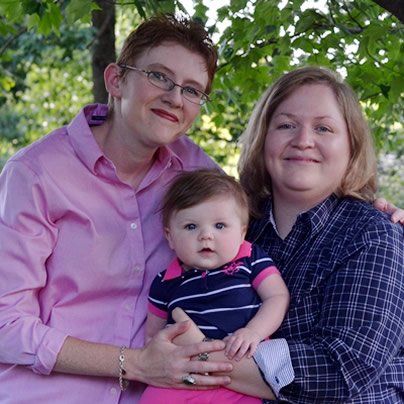
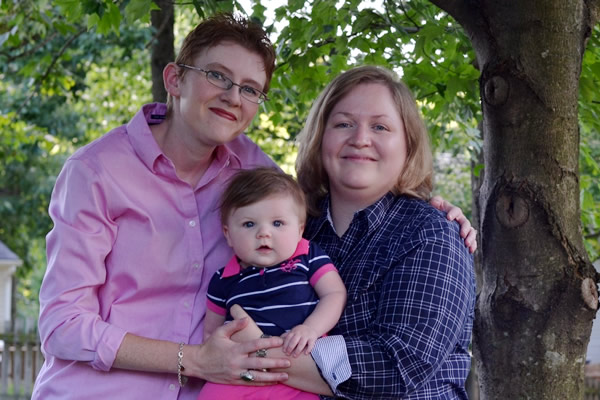
Victoria Kidd and Christy Berghoff of Winchester, Va. (Photo courtesy of the ACLU)
The two lesbian couples challenging Virginia’s same-sex marriage ban maintain their lawsuit is simply a matter of protecting their families.
“What I’m doing this for is to protect my wife and our daughter,” Christy Berghoff of Winchester, who married her partner of more than nine years, Victoria Kidd, told the Washington Blade. The couple also has a 9-month-old daughter.
Berghoff, an Air Force veteran who works at the U.S. Department of Justice spoke to the Blade a day after the American Civil Liberties Union and Lambda Legal filed a lawsuit on behalf of her and her spouse and Staunton residents Joanne Harris and Jessica Duff in U.S. District Court for the Western Division of Virginia in Harrisonburg on Aug. 1.
Berghoff said she and Kidd paid a lawyer hundreds of dollars to make her spouse their daughter’s co-custodian so she could make some legal decisions for her in Virginia. The couple in 2007 was also unable to secure a spousal loan to refinance their home through a Veterans’ Administration program.
“I have always been a strong advocate for our family and for the idea of equal protection of our family,” Kidd told the Blade while she was at home with her daughter. “We are your everyday family, in every sense of the word.”
Harris and Duff, who have been together for more than nine years and are raising a 4-year-old son, tried to apply for a marriage license in Staunton Circuit Court on July 29.
Like Kidd, Duff told the Blade that she and Harris have “always been advocates for our family.”
“We know that sharing our story is important to help change hearts and minds,” Duff said. “When we had the opportunity to participate, we wanted to do our part to bring the freedom to marry in Virginia.”
The ACLU and Lambda Legal filed the lawsuit against the commonwealth’s same-sex marriage ban that voters approved in 2006 slightly more than a month after the U.S. Supreme Court found a portion of the Defense of Marriage Act unconstitutional and struck down California’s Proposition 8.
Tony London and Timothy Bostic of Norfolk, who have been together 25 years, last month filed a separate federal lawsuit against Virginia’s gay nuptials ban after they unsuccessfully tried to apply for a marriage license.
Neither they, nor their lawyer, Bob Ruloff, returned the Blade’s requests for comment.
Neighboring Maryland is among the 13 states and D.C. in which same-sex couples can marry.
The federal government also recognizes the marriages of gays and lesbians who legally tie the knot, although their ability to receive Social Security and other federal benefits depends upon whether the state in which they live will recognize their unions.
“I still have a lot of questions about the protections that I’m not afforded,” Berghoff told the Blade. “I’m here at work in D.C. and I’m married and I go home I’m a single parent.”
LGBT rights advocates across Virginia applauded the lawsuit.
“It seems contrary to the rights and liberties guaranteed to us by our Constitution, that a trip across the Potomac River, an arbitrary geographical line would somehow grant or deny any citizen equal treatment under the law,” said James Parrish, executive director of Equality Virginia.
State Sen. Adam Ebbin (D-Alexandria) said he knows of “too many couples” that have moved out of the commonwealth because of “a lack of protections now offered to our neighbors in the District of Columbia and Maryland.”
“Virginia is at a competitive and economic disadvantage,” Ebbin said. “After all, forward thinking companies of all sizes locate where their diverse workforces will enjoy a high quality of life.”
Tucker Martin, a spokesperson for Gov. Bob McDonnell, who is named as a defendant in the lawsuit, defended Virginia’s same-sex marriage ban.
“The voters of Virginia passed a constitutional amendment in 2006 defining marriage in the commonwealth as being only a union of one man and one woman,” Martin said in a statement to the Blade. “It is the law in this state based on the popular will of the voters as expressed at the ballot box.”
Attorney General Ken Cuccinelli’s office declined to comment on the lawsuit, although spokesperson Brian Gottstein referred to a statement he released after the Supreme Court issued its DOMA and Prop 8 rulings.
“Virginia has followed the traditional definition of marriage as being between one man and one woman for more than 400 years,” Cuccinelli said in a June 26 statement on the justices’ rulings. “Virginians voted overwhelmingly to add this traditional definition to their constitution.”
Cuccinelli, who will face off against former Democratic National Committee Chair Terry McAuliffe in Virginia’s gubernatorial election in November, highlighted his opposition to same-sex marriage last month during a debate at the Homestead in Hot Springs. GOP lieutenant gubernatorial candidate E.W. Jackson and Mark Obenshein, who is running to succeed Cuccinelli as attorney general, also oppose nuptials for gays and lesbians.
McAuliffe in February publicly backed same-sex marriage. State Sens. Ralph Northam (D-Norfolk) and Mark Herring (D-Loudoun,) who are running for lieutenant governor and attorney general respectively, also support the issue.
Harris told the Blade she feels there has “always been support for gay couples” in Virginia.
A Quinnipiac University poll released on July 18 noted 50 percent of Virginians support same-sex marriage. A survey that Public Policy Polling unveiled a week before found 55 percent of commonwealth residents back nuptials for gays and lesbians.
“History has shown that we evolve and opinions evolve,” Harris said. “Virginians are smart and they are fair-minded people.”
Kidd agreed.
“A lot has changed in Virginia since that amendment went to the ballot box [in 2006,]” she said.




District of Columbia
‘Out for McDuffie’ event held at D.C. gay bar
Mayoral candidate cites record of longtime support for LGBTQ rights
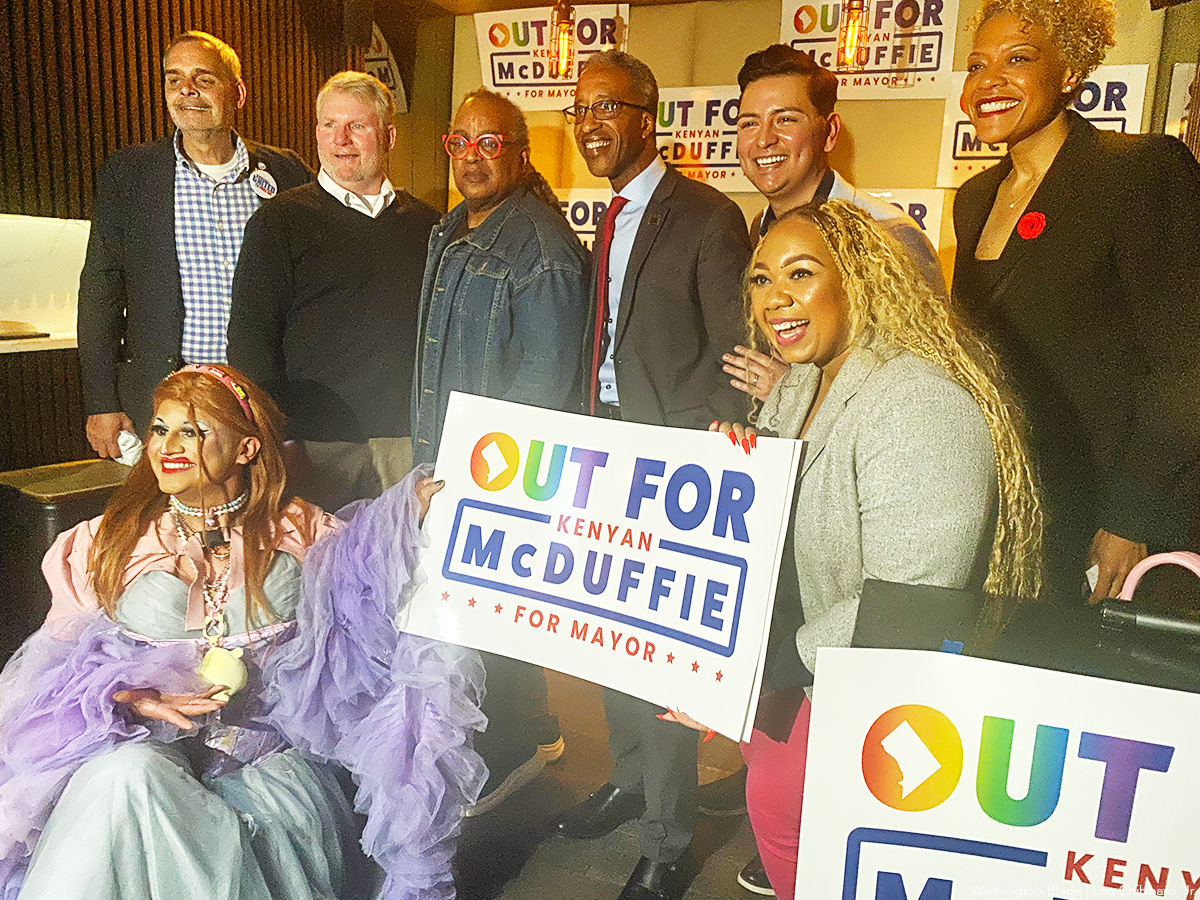
More than 100 people filled the upstairs room of the D.C. gay bar Number 9 on Thursday night, March 26, to listen to D.C. mayoral candidate Kenyan McDuffie at an event promoted as an “Out for McDuffie” meet and greet session.
Several local LGBTQ activists who attended the event said they support McDuffie, a former D.C. Council member, in his run for mayor while others said they had not yet decided whom to vote for in the June 16 D.C. Democratic primary election.
As of March 27, eight other Democrats were competing against McDuffy in the June 16 primary, including D.C. Council member Janeese Lewis George (D-Ward 4), considered McDuffie’s lead opponent. Lewis George also has a record of strong support on LGBTQ issues.
Most political observers consider McDuffie and Lewis George the two lead candidates in the race, with the others having far less name recognition.
The two lead organizers of the Out for McDuffie event were LGBTQ rights advocates Courtney Snowden, a former D.C. deputy mayor in the administration of Mayor Muriel Bowser, and Cesar Toledo, a local LGBTQ youth housing services advocate.
“I’m a candidate for mayor of Washington, D.C. and I’m running for mayor because I love this city,” McDuffie told the gathering after being introduced by Snowden. “And now more than ever we need leadership to take us to the future,” he said, adding that he and his administration would “stand up and fight” against President Donald Trump’s efforts to intervene in local D.C. affairs.
“Our strength is in the 700,000 beautifully diverse residents of Washington, D.C.” he told the gathering. “And as Courtney said, I didn’t just show up and run for mayor and then start saying that I’m going to be an ally for the queer community, for the LGBTQ+ community,” he said, “I’ve lived my entire professional life fighting for justice and fighting for fairness.”
Following his speech, McDuffie told the Washington Blade, “We’re going to fight to protect our LGBTQ+ community every single day. That’s what I’ve spent my career doing, making sure we have a beautifully diverse and inclusive city.”
He remained at Number 9, located at 1435 P St., N.W., for nearly an hour after he spoke, chatting with attendees.
District of Columbia
‘No Kings’ protests set for D.C.
Anti-Trump demonstrations to take place across country on Saturday

As President Donald Trump and his administration escalate rhetoric targeting transgender youth and student athletes, push efforts to restrict voting access for millions of Americans, and pursue foreign policy decisions that critics say bypass congressional authority, organizers across the country are once again mobilizing in protest.
For many LGBTQ advocates, the moment feels especially urgent.
In recent months, activists have pointed to a surge in anti-trans legislation, attacks on gender-affirming care, and efforts to roll back nondiscrimination protections as direct threats to the safety and visibility of queer and trans communities. Organizers say the demonstrations are not just about policy, but about defending the right of LGBTQ people — particularly trans youth and people of color — to live openly and safely.
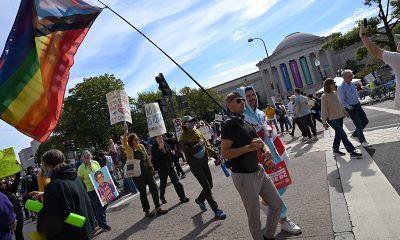
Thousands of “No Kings” protests are planned nationwide, with multiple demonstrations set to take place in D.C.
One of the primary events, “No Kings Washington,” will be held in Anacostia, an overwhelmingly Black area of D.C. that is often at the center of conversations around racial justice, policing, and access to resources in the nation’s capital.
The protest in Anacostia is focused on what organizers describe as the “power behind the throne,” specifically Stephen Miller, the White House Deputy Chief of Staff for Policy and Homeland Security Advisor. Miller has been closely associated with the administration’s “zero tolerance” immigration policy, including the family separation practice that resulted in thousands of children being separated from their parents at the Southern border.
Activists have also linked immigration enforcement policies to broader concerns about LGBTQ migrants, including queer asylum seekers who often face heightened risks of violence and discrimination both in their home countries and within detention systems.
Anacostia protest details:
Participants are asked to gather starting at 1:30 p.m. on the southeast side of the Frederick Douglass Bridge. The closest Metro station is Anacostia on the Green Line, about an 8-minute walk from the starting point. Organizers strongly encourage attendees to use public transportation, as street parking is limited.
The march will proceed past Fort McNair and conclude near the Waterfront Metro station.
D.C. icon and LGBTQ activist Rayceen Pendarvis is set to speak at the protest around 2 p.m.
Kalorama protest details:
A separate protest will take place earlier in the day in Kalorama, a neighborhood long associated with political power and home to presidents, cabinet officials, and foreign ambassadors. Demonstrators are expected to gather at 10 a.m., with a march running until approximately noon near the intersection of Connecticut Avenue and Kalorama Road.
Arlington/National Mall protest details:
Another group is expected to assemble at Memorial Circle near Arlington National Cemetery at 10 a.m. before crossing the Memorial Bridge into D.C., passing the Lincoln Memorial and continuing on to the Washington Monument. Organizers say the march is intended to defend “American democracy, the rule of law, and a healthy planet.”
Unlike last June — when organizers discouraged large-scale demonstrations in D.C. due Trump’s military/birthday parade — activists are now explicitly calling on people to show up in the nation’s capital and surrounding areas.
The protests also coincide with Transgender Day of Visibility weekend, which includes additional gatherings and celebrations on the National Mall. At the same time, peak bloom for the National Cherry Blossom Festival is expected to draw large crowds to the city. With multiple major events happening simultaneously, officials and organizers anticipate significant congestion, increased traffic, and crowded public transit throughout the weekend.
Organizers are urging participants to plan ahead and come prepared.
“Bring your signs, noisemakers, music, and creative ideas, and gather in joyful, nonviolent protest,” they said. “Children are very welcome.”
For more information, visit nokings.org.
District of Columbia
Gay priest credited with boosting church support for LGBTQ Catholics
Fr. Tom Oddo’s biographer speaks at Dignity Washington event
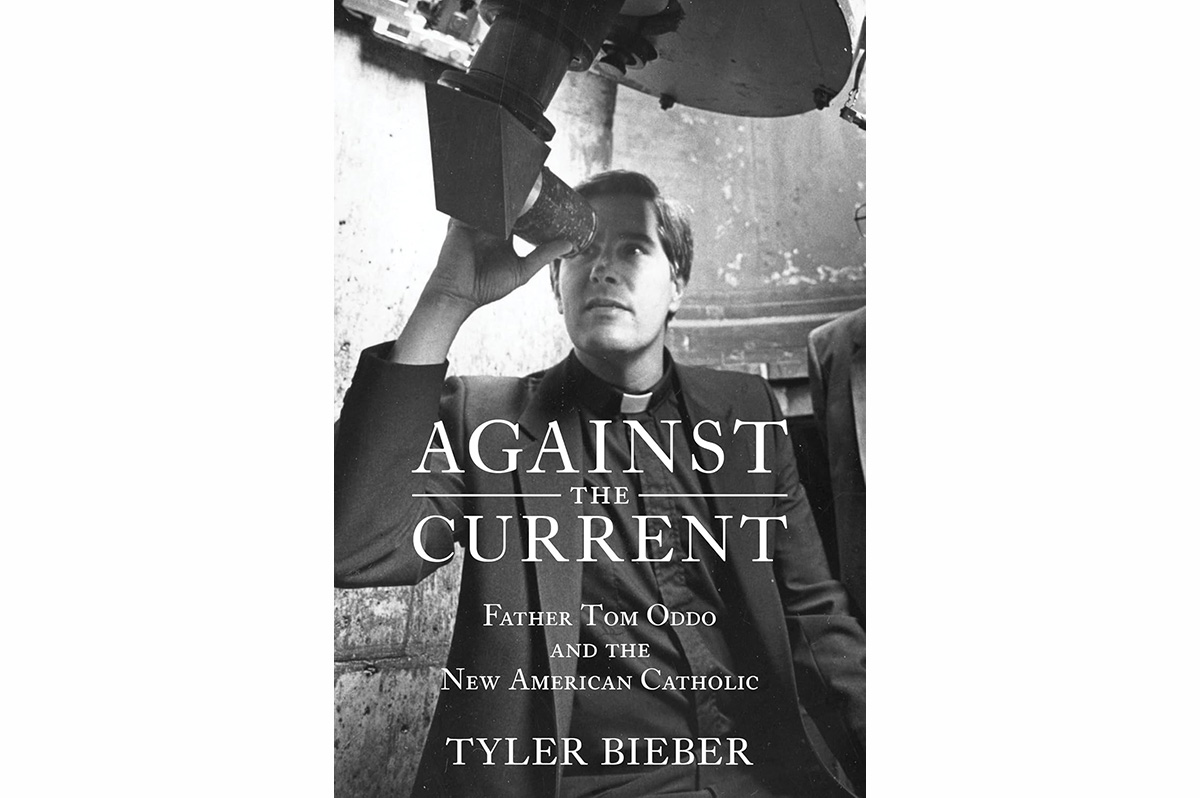
The author of a biography of a U.S. Catholic priest said to have advocated for support by the Catholic Church of gay Catholics in the early 1970s has called Father Thomas ‘Tom’ Oddo a little known but important figure in the LGBTQ rights movement.
Tyler Bieber, author of the recently published book “Against The Current: Father Tom Oddo And the New American Catholic,” told of Oddo’s life and work on behalf of LGBTQ rights at a March 22 talk before the local LGBTQ Catholic group Dignity Washington.
Among Oddo’s important accomplishments, Bieber said, was his role as a co-founder of the national LGBTQ Catholic group Dignity U.S.A. in 1973 at the age of 29.
But as reported in the prologue of his book, Bieber presented details of the sad news that Oddo died in a fatal car crash in 1989 at the age of 45 in Portland, Ore., where he was serving as the highly acclaimed president of the University of Portland, a Catholic institution.
“He was a major figure in the gay rights movement in the 1970s, an unsung hero of that movement,” Bieber told Dignity Washington members, who assembled for his talk in a meeting room at St. Margaret Episcopal Church near Dupont Circle, where they attend their weekly Catholic mass on Sundays.
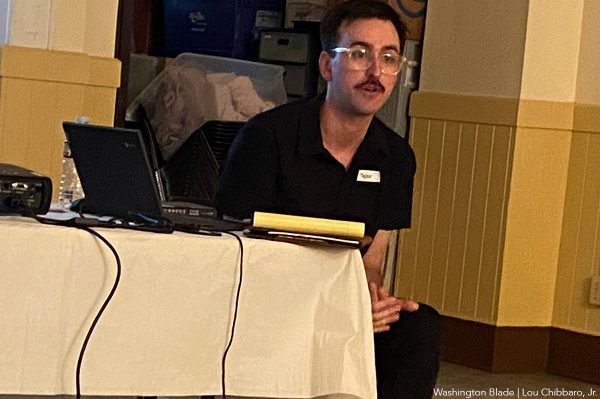
“And Dignity U.S.A. saw intense growth in membership and visibility” during its early years under Oddo’s leadership, Bieber said. “The story of Father Tom and his contemporaries is a story largely untold in the history of the gay rights movement, but one worth knowing and considering,” he said.
As stated in his book, Bieber told the Dignity Washington gathering Oddo was born and raised in a Catholic family on Long Island, N.Y., and attended a Catholic high school in Flushing Queens. It was at that time when he developed an interest in becoming a priest, according to Bieber.
After studying at the University of Notre Dame and completing his religious studies he was ordained as a priest in 1970 and began his work as a priest in the Boston area, Bieber said. It was around that time, Bieber told the Dignity Washington audience, that gay Catholics approached Oddo to seek advice on how they should interact with the Catholic Church. It was also around that time that Oddo became involved in a group supportive of then gay Catholics that later became a Dignity chapter in Boston.
In a development considered unusual for a Catholic priest, Bieber said Oddo in 1973 testified in support of gay rights bill before a committee of the Massachusetts Legislature and collaborated with then Massachusetts gay and lesbian rights advocate Elaine Noble.
In 1982, at the age of 39, Oddo was selected as president of the University of Portland following several years as a college teacher in the Boston area, Bieber’s book states. It says he was seen as a “vibrant and capable administrator who delivered real results to his campus,” adding, “His magnetism was obvious. One student described him as ‘John Kennedyesque’ to the university’s student newspaper.”
Bieber said that although Oddo was less active with Dignity U.S.A. during his tenure as UP president, he continued his support for gay Catholics and what is now referred to as LGBTQ rights.
“For those that knew him prior to his term at UP, though, he represented something greater than an accomplished university administrator and educator,” Bieber’s book states. “He was a new kind of priest, a gay man living and ministering in a world set loose from tradition by the Second Vatican Council,” the book says.
It was referring to the Vatican gathering of worldwide Catholic leaders from 1962 to 1965 concluding under Pope Paul VI that church observers say modernized church practices to allow far greater participation by the laity and opened the way for sympathetic consideration of gay Catholics.

Ghanaian president welcomed to Philadelphia amid backlash over anti-LGBTQ bill

PHOTOS: ‘No Kings’ rally and march

‘Out for McDuffie’ event held at D.C. gay bar

‘Jonah’ an undeniably compelling but unusual memory play

The Oscar-losing performance that’s too good to miss

Menaka Guruswamy celebrated as India’s first openly LGBTQ MP

Pa. House passes bill to codify marriage equality in state law

DeSantis signs emergency bill that restores Fla. ADAP funding

Introducing the Torchbearers Awards honoring queer, trans women and nonbinary people

New IOC policy bans trans women from Olympics
-

 India5 days ago
Menaka Guruswamy celebrated as India’s first openly LGBTQ MP
-
Pennsylvania4 days ago
Pa. House passes bill to codify marriage equality in state law
-
Florida5 days ago
DeSantis signs emergency bill that restores Fla. ADAP funding
-
a&e features4 days ago
Introducing the Torchbearers Awards honoring queer, trans women and nonbinary people