News
IOC prohibits athletes from challenging anti-gay Russian law at Olympics
Those who violate the rule could face potential disqualification from Sochi games
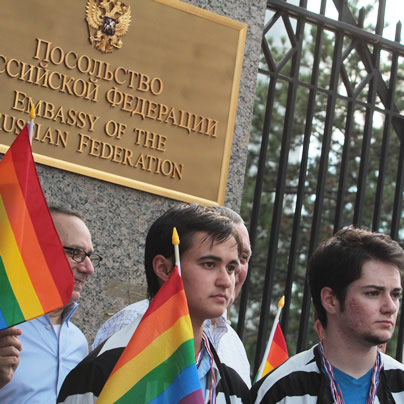
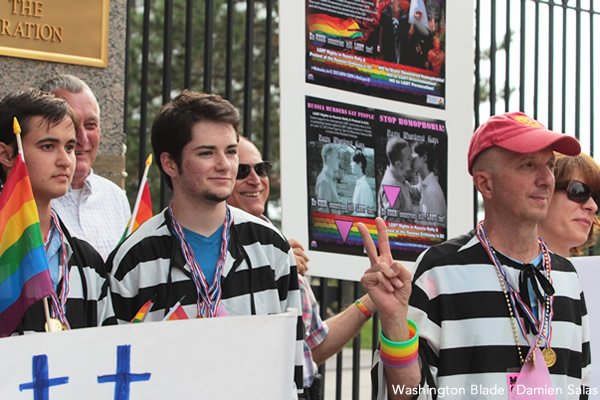
Protesters gathered outside of the Russian Embassy on Wednesday, July 31, 2013. (Washington Blade photo by Damien Salas)
The IOC referred the Blade to a portion of the Olympic Charter adopted in 2001 that states “no form of publicity or propaganda, commercial or otherwise, may appear on persons, on sportswear, accessories or, more generally, on any article of clothing or equipment whatsoever worn or used by the athletes or other participants in the Olympic Games” outside of a manufacturer’s logo.
“This rule has been in place for many years and aims to separate sport from politics, honor the context of the Olympic games and ensure the peaceful gathering of athletes from over 200 nations, officials and spectators from all kinds of different cultures and backgrounds,” the IOC told the Blade in a statement. “By its nature, the Olympic games cannot become a platform for any kind of demonstration and the IOC will not accept any proactive gesture that could harm their spirit and jeopardize their future.”
The Olympic Charter further states any athlete who violates the aforementioned rule could face disqualification or loss of their accreditation at the Sochi games.
The IOC Executive Board’s decisions “shall be final,” but the Olympic body told the Blade it would “always treat case individually and take a sensible approach depending on what was said or done.” The IOC did not respond to a follow-up question about what other potential sanctions an athlete who publicly criticizes the law while competing in Sochi could face.
The IOC’s comments come amid widespread outrage over Russia’s ban on gay propaganda that President Vladimir Putin signed into law in June.
Actor and playwright Harvey Fierstein last month called for a boycott of the Sochi games. Author Dan Savage and LGBT rights advocate Cleve Jones are among those who have called for a boycott of Russian vodka.
Andy Cohen on Wednesday told E! News he turned down a request to co-host the 2013 Miss Universe pageant that will take place in Moscow in November, in part, because “he didn’t feel right as a gay man stepping foot into Russia.”
Gay Olympic diver Greg Louganis, who was unable to compete in the 1980 Summer Olympics in the Russian capital because then-President Jimmy Carter boycotted them over the Soviet Union’s invasion of Afghanistan the year, is among those who feel the U.S. should compete in the Sochi games. President Obama, retired tennis champion Martina Navratilova and a coalition of LGBT advocacy groups that include Outsports.com also oppose an Olympic boycott.
Gay New Zealand speed skater Blake Skjellerup last month announced he will wear a Pride pin while in Sochi.
American runner Nick Symmonds on August 13 criticized the gay propaganda ban during an interview with the Russian news agency RIA Novosti after he completed the men’s 800 meter final at the International Association of Athletics Federations World Championship in Moscow. Figure skater Johnny Weir, whose husband is of Russian descent, told CBS News earlier this month he is “not afraid of being arrested” while at the Sochi games.
IOC has ‘received assurances’ from Russian government over law
The IOC reiterated to the Blade its previous statements that said it has “received assurances” from the highest level of the Russian government that the gay propaganda ban will “not affect those attending or taking part” in the Sochi games.
The Russian Interior Ministry said in a statement it released on August 12 that it would enforce the law during the Olympics. Russian Sports Minister Vitaly Mutko told reporters during a Moscow press conference last week that those who continue to criticize the statute need to “calm down.”
The IOC did not return the Blade’s follow-up request for comment on Mutko’s statements. It also did not respond to an additional question about Navratilova and others who maintain the IOC should have never awarded Russia the 2014 Winter Olympics because of concerns over its human rights record.
“The International Olympic Committee is clear that sport is a human right and should be available to all regardless of race, sex or sexual orientation,” the IOC told the Blade. “The games themselves should be open to all, free of discrimination and that applies to spectators, officials, media and of course athletes. We would oppose in the strongest terms any move that would jeopardize this principle.”


The Comings & Goings column is about sharing the professional successes of our community. We want to recognize those landing new jobs, new clients for their business, joining boards of organizations and other achievements. Please share your successes with us at [email protected].
The Comings & Goings column also invites LGBTQ college students to share their successes with us. If you have been elected to a student government position, gotten an exciting internship, or are graduating and beginning your career with a great job, let us know so we can share your success.
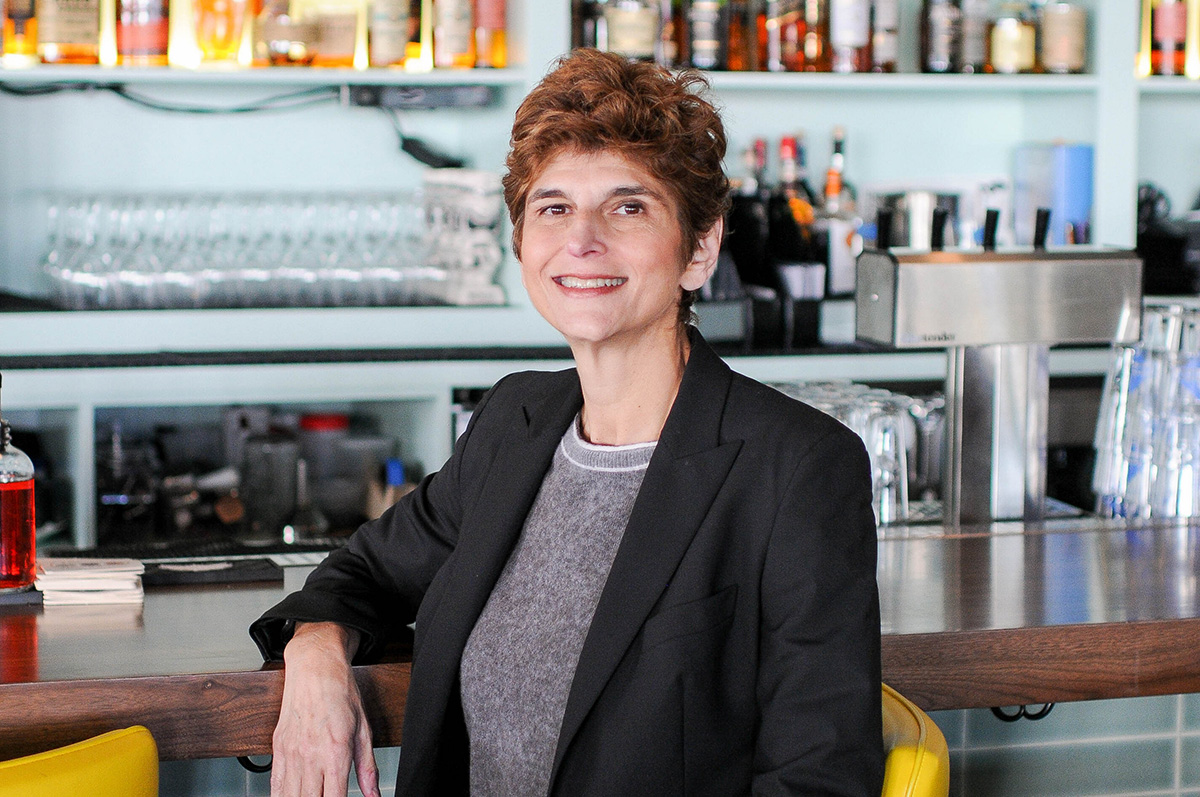
Congratulations to Jamie Leeds, chef extraordinaire, and owner of Hank’s Oyster Bars, as she ventures into some new areas. Leeds is an award-winning Washington, D.C.–area chef, restaurateur, and entrepreneur with more than three decades of experience shaping the region’s dining scene.
Her first new venture is a restaurant opening in Alexandria this week. It will be called Hank’s Pasta Bar, bringing a personalized twist to classic Italian dining with a hiddenrestaurant-inside-a-restaurant in Old Town, Alexandria. The new trattoria is above Hank’s Oyster Bar, and will feature a build-your-own menu, marking a new direction for Leeds in partnership with chef Darren Norris. Norris brings more than three decades of experience to Hank’s Pasta Bar, with a foundation grounded in Italian cooking. The grand opening was scheduled for May 14. The elevated casual eatery blends an inventive chef-driven menu with an easy-going, sit-down dining experience that puts guests in charge. Hank’s Pasta Bar bridges the gap between elevated fast casual, like Norris’s Shibuya, and full-service dining, like Leeds’s Hank’s Oyster Bar. Diners order electronically at the table, but unlike fast casuals, food and beverages are delivered on plate ware, and a server is on site at all times.
The restaurant-inside-a-restaurant, welcomes guests to dine in with a full bar, including Italian wines and craft cocktails, maintaining its focus on traditional Italian fare with contemporary touches, including a build-your-own pasta bowl experience starting at $16. Create your own pasta bowl from seven artisanal pastas (including gluten-free), nine made-in-house sauces, proteins, vegetables, and toppings. Leeds said, “It’s the kind of place you’d find down a side street in a Tuscan hill town, after being tipped off by a friend who says, ‘trust me.’ If you know, you know.”
The restaurant will continue Hank’s community partnerships, including with Real Food for Kids, supporting programs that improve school food and nutrition equity.
In addition to this you should try Jaimie’s other new venture. Back Door Taco at Hank’s in Dupont Circle. You walk down the alley from 17th Street to the back door of Hank’s, and enter a small patio to partake of great tacos and interesting cocktails.
District of Columbia
HIV Vaccine Awareness Day set for May 18
Whitman-Walker joins nationwide recognition of efforts to develop vaccine
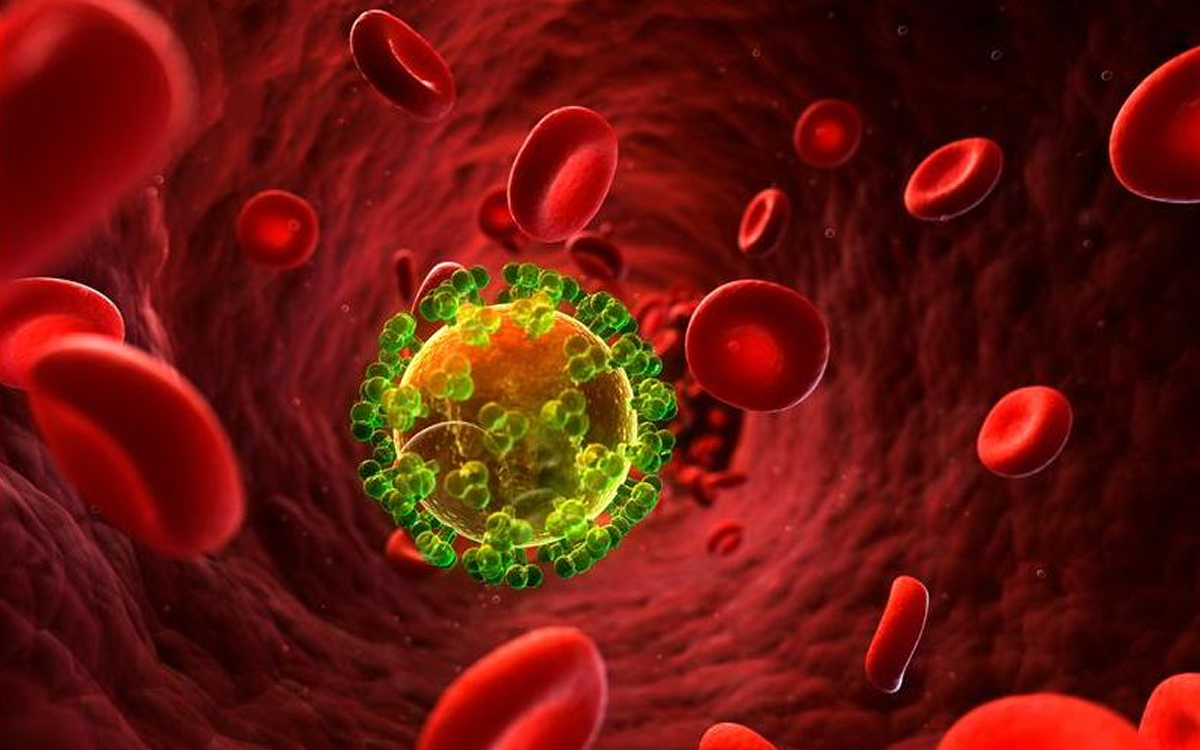
Whitman-Walker Health, the D.C.-based community healthcare center that specializes in HIV/AIDS and LGBTQ-related health services, will join health care advocates from across the country to support efforts to develop an HIV vaccine on HIV Vaccine Awareness Day on May 18.
“HIV Awareness Day, observed annually on May 18, was established to recognize and thank the volunteers, scientists, health professionals, and community members working toward a safe and effective prevention HIV vaccine,” Whitman-Walker said in a statement.
“Led by the National Institutes of Health’s National Institute of Allergy and Infectious Diseases (NIAID), the day is also an opportunity to educate communities about the critical importance of preventive HIV vaccine research,” the statement says.
It adds, “The reality is that any new vaccine discovery must be built community by community, institution by institution, and then it must reach everyone – especially the communities who have carried the heaviest burden of this epidemic.”
On its own website, the National Institutes of Health says HIV Vaccine Awareness Day also highlights its longstanding efforts, coordinated by its Office of AIDS Research, to support researchers’ efforts to develop an HIV vaccine.
“Researchers are making promising headway in efforts to develop a safe, effective HIV vaccine,” it says in a statement on its website.
A Whitman-Walker spokesperson said Whitman-Walker was not holding a specific event to observe HIV Vaccine Awareness Day, but it will recognize the day as a way of encouragement for its ongoing work to address the AIDS epidemic and support for vaccine research.
“Today, no one has to die from HIV,” said Whitman-Walker’s Health System division’s CEO, Dr. Heather Aaron in the Whitman-Walker statement. “We have the treatments, the technology, and the research to change outcomes, and yet people in our community are still dying from HIV//AIDS,” she said in the statement.
“That is unacceptable, and it is exactly why our work continues,” she added. “Here in D.C. with more focus on Southeast D.C., the Whitman-Walker Health System remains committed to making a difference through cutting-edge research, policy advocacy, and philanthropy, because fair access to life-saving treatment is not a privilege. It is a right.”
World
This year’s IDAHOBiT to highlight democracy
Criminalization laws, US funding cuts among global movement’s challenges
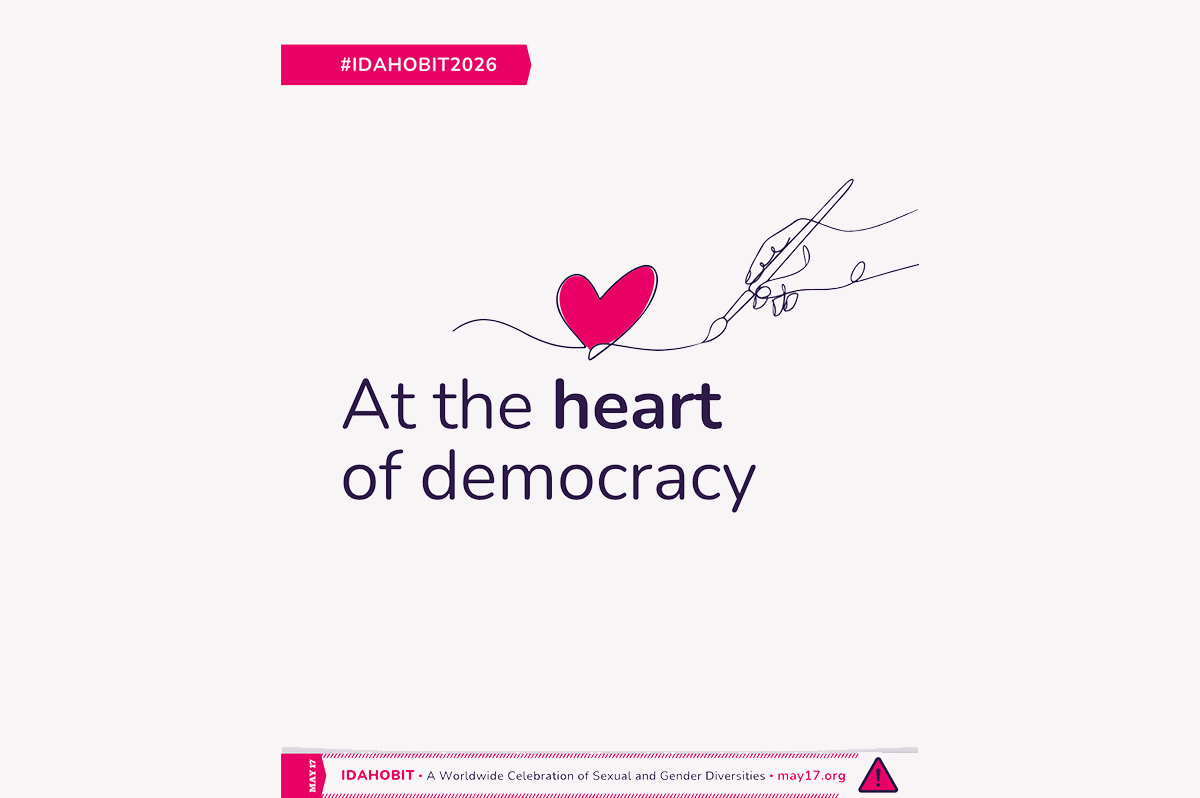
Activists around the world on Sunday will mark the International Day Against Homophobia, Transphobia, and Biphobia.
The IDAHOBiT Advisory Group — which includes 18 LGBTQ and intersex rights organizations around the world — in a press release notes IDAHOBiT events are expected to take place in more than 60 countries. Advocacy groups are also using IDAHOBiT to highlight discrimination and violence based on sexual orientation and gender identity and other LGBTQ-specific issues.
Caribe Afirmativo, a Colombian advocacy group, on May 8 released a report that notes one LGBTQ person was reported murdered in the country every 32 hours in 2025. Caribe Afirmativo also said the Colombian government has not done enough to address anti-LGBTQ violence.
“The evidence is clear: violence against LGBTIQ+ persons in Colombia does not begin with homicide, but with tolerated prejudice and ignored threats,” reads Caribe Afirmativo’s report. “In 2025, the State not only failed to protect — it also failed to count, investigate, and sanction. The crisis is not invisible. It is structural. And it requires an urgent, comprehensive, and sustained response.”
The Initiative for Equality and Discrimination, a Kenyan group known by the acronym INEND, issued a report that details how the country’s law enforcement treats LGBTQ and intersex people. “A widespread pattern of arbitrary arrests, extortion, and both physical and sexual violence” are among the abuses the INEND report notes.
“These abuses not only inflict severe physical and psychological trauma but also foster a widespread distrust of the law enforcement, further marginalizing the community and hindering its ability to seek justice, access essential services such as healthcare, and fully enjoy fundamental freedoms,” it reads.
IDAHOBiT commemorates the World Health Organization’s declassification of homosexuality as a mental disorder on May 17, 1990. This year’s IDAHOBiT theme is “At the Heart of Democracy.”
This year’s IDAHOBiT will take place against the continued impact that the lack of U.S. funding is having on the global LGBTQ and intersex rights movement.
The IDAHOBiT Advisory Group notes consensual same-sex sexual relations remain criminalized in 65 U.N. member states, and the number of countries with criminalization laws increased in 2025. The IDAHOBiT Advisory Group also indicates more than 60 countries have laws that restrict “freedom of expression related to sexual and gender diversity issues.”
“No matter where we live, who we are, or the faiths that drive us, most people want to nurture neighborhoods and communities where every life can bloom,” said the IDAHOBiT Advisory Group. “But today, reactionary governments worldwide are poisoning our gardens with the invasive weeds of their authoritarian policies and exclusionary legislations.”
‘Progress is still happening’
Activists around the world since last year’s IDAHOBiT have seen several legal and political victories.
New Hungarian Prime Minister Péter Magyar on April 12 defeated his predecessor, Viktor Orbán, whose government faced widespread criticism over its anti-LGBTQ crackdown.
The Eastern Caribbean Supreme Court last July struck down St. Lucia’s colonial-era laws. The Dominican Republic’s Constitutional Court a few months later ruled the country’s National Police and Armed Forces cannot criminalize consensual same-sex sexual relations among its members. Botswana late last month repealed a provision of its colonial-era penal code that criminalized homosexuality.
A Hong Kong judge last September ruled in favor of a lesbian couple who sought parental recognition for their son. The European Union Court of Justice over the last year issued two landmark decisions: one said EU countries must recognize same-sex marriages legally performed in other member states and another directed member states to allow transgender people to legally change their name and gender on ID documents.
“Time and again, LGBTQIA+ people have resisted, rolled up their sleeves together with all the good people caring about their communities, and sowed the seeds of change,” said the IDAHOBiT Advisory Group in its press release.

PHOTOS: Blade Summer Kickoff Party

PHOTOS: Taste of Point

Honey, have we been priced out of gay paradise?

Comings & Goings

IDAHOBiT a reminder we all must stand up against transphobia

European Commission says all EU countries should ban conversion therapy

Pride faith services in Washington, D.C.

Blade Foundation awards 9th journalism fellowship to AU student

UK government makes trans-inclusive conversion therapy ban a legislative priority

Bureau of Prisons declines to reconsider transgender inmate policy
-

 European Union5 days ago
European Commission says all EU countries should ban conversion therapy
-
Delaware5 days ago
Blade Foundation awards 9th journalism fellowship to AU student
-
District of Columbia4 days ago
Pride faith services in Washington, D.C.
-
United Kingdom4 days ago
UK government makes trans-inclusive conversion therapy ban a legislative priority