Living
Queery: Michael Amesquita
The George Washington summer housing assistant director answers 20 gay questions

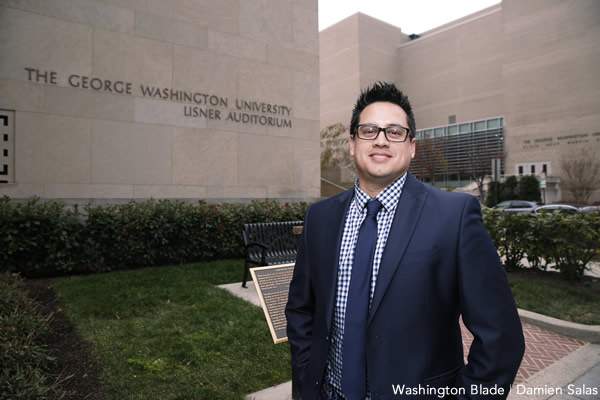
Michael Amesquita (Washington Blade photo by Damien Salas)
For many gays who grew up in conservative religious households, going home for the holidays can be a tough notion.
Michael Amesquita was out among friends in college but having been raised in the Church of Jesus Christ of Latter-day Saints and in a small town in Illinois where he says he literally didn’t know one other gay person, coming out to everyone in his life was a tough prospect especially because until a few years ago, he was still active in his church.
“Well, they’ve quit asking if I’m seeing any girls,” the 38-year-old Sterling, Ill., native says of his family with a chuckle. “It’s kind of the big elephant in the closet but I’m sure that will change when I bring somebody home for Christmas.”
Amesquita is assistant director of the summer housing program at George Washington University, a year-round position that involves coordinating the schedules of about 19,000 people who stay on campus for varying lengths of time each summer. After many years in Las Vegas, Amesquita came to Washington in 2007 to look for graduate schools and stayed. He came out fully in 2009 and found support in Affirmation (a gay Mormon group) and the Gay Men’s Chorus of Washington, which has its holiday show this weekend (details at gmcw.org).
Amesquita is single and lives in the Logan Circle area. He enjoys volleyball, kickball, singing, camping and biking in his free time.
How long have you been out and who was the hardest person to tell?
I have two “coming outs.” I came out to my fraternity brother and everyone at college back in 2003 but didn’t start coming out to my family and church till December 2009. The hardest person would be my father. He is very much an introvert and I knew it would be hard to gauge his reaction.
Who’s your LGBT hero?
There are so many wonderful people who champion our cause. I belong to two organizations that I care about deeply — Affirmation: LGBT Mormons, Family and Friends and The Gay Men’s Chorus of Washington. Both have histories that go back more than 30 years. Thirty years of standing up for equality and paving the way so we can be where we are today.
What’s Washington’s best nightspot, past or present?
When I do go out I have always had a good time at Town but that could be the Vegas in me. Usually it is a karaoke bar with buddies or a game night with friends and drinks. Anywhere with friends.
Describe your dream wedding.
Either on the beach with the ocean next to us or in the Utah mountains with the cornucopia of colors of fall. In either case it would be with all my loved ones.
What non-LGBT issue are you most passionate about?
Immigration.
What historical outcome would you change?
The assassination of Kennedy. I would really like to see what kind of impact he could have had in the long run.
What’s been the most memorable pop culture moment of your lifetime?
When I was in Vegas I worked at the MGM and was lucky enough to be able to check-in the VIPs for the ESPYs and Billboards for two years. I got to chat it up with Drew Breeze, R. Kelly, Avril Lavigne, etc. as they checked in. Most of them were really nice and Kathy Griffin was absolutely hysterical.
On what do you insist?
That people have integrity and be authentic. There just isn’t time to waste on people who spend time putting on an image or false facade. When I do find friends who are true to themselves and have good values I hold on tight.
What was your last Facebook post or Tweet?
It was picture of my Holland America Tour Director vest with all these pins from the various cities in Alaska. So much flair!
If your life were a book, what would the title be?
“Pioneering My Own Faith: A Gay Mormon’s Story”
If science discovered a way to change sexual orientation, what would you do?
Stay the same. Changing people from LGBT to straight would be like taking all the color out of the world.
What do you believe in beyond the physical world?
I believe we have a father in heaven that loves us all and wants us all to return back to him.
What’s your advice for LGBT movement leaders?
Keep moving forward on behalf of all LGBT people.
What would you walk across hot coals for?
Definitely for my family and loved ones. Probably for being the sole winner of Mega Bucks!
What LGBT stereotype annoys you most?
That LGBT people do not play sports.
What’s your favorite LGBT movie?
“The Birdcage.” My straight fraternity brother actually told me about it in college.
What’s the most overrated social custom?
Saying something after someone sneezes.
What trophy or prize do you most covet?
I just completed my master’s this year so I have my eye on a Ph.D. in the future.
What do you wish you’d known at 18?
That high school doesn’t really matter and life begins in college.
Why Washington?
Came to check out graduate schools and I have stayed this long because of all that D.C. has to offer.






One of the biggest headaches of the new home process is the actual moving part. By the time someone is buying a home, most people are beyond the “I just need a pickup truck, a pizza and a case of beer for my friends.”
If that is still someone’s preferred way to move, that’s great. However, many people find they need a much more robust plan. It can also trigger a lot of feelings about items one owns, what to do with them, do they have too much, should I keep this memento that I never use? Etc.
Moving is a chance for a person to “clean house” literally, figuratively, spiritually and energetically. A person can figure out which items they want to keep, and which need to go. As someone who recently moved across the country, I can speak to this experience. It’s also time for what people call “the fresh start effect.” This phenomenon, according to psychologists, can happen in little moments (like the start of a new work week) and bigger moments (such as moving from one home to the next).
The fresh start effect offers these benefits often mentioned by psychologists:
- Mental Accounting: Dates act as chapter breaks, letting you put past failures into a previous period.
- Psychological Distance: You separate your flawed past self from your aspirational future self (“That was the old me”).
- Optimism Boost: New beginnings clear mental clutter and increase your sense of agency and control
Does this mean that “the new you” will be the perfect version you envisioned? Probably not. We are humans. But it might mean you get a chance to “leave some of the old you behind” within the walls you used to live in, and now have a chance to have a new layout, a new décor, a new color pattern, new wallpaper, donate old furniture and books or magazines, throw out clothes you no longer use or fit in, and enjoy the opportunity to literally use the, “Does this spark joy?” method that was made so popular by Marie Kondo in her Netflix series.
So, for all its hassle and headache, moving is a chance to shake off the “old you” and try on the new you, to incorporate the items you would like to keep and use more of, and shed the items, habits, and ways of thinking that you feel no longer serve you.
I can speak to the experiences that several of my clients had when they moved from a previous residence to a newer one. It usually coincided with a change in relationship status, a change in employment, a change in family size, but sometimes it just seemed to correlate to a new attitude and perspective that the client was really hoping for.
I have literally had clients come to me after the fact, in tears, that they were so happy they made the decision to move out of a situation that no longer served them, and move into one that felt like a much better fit.
Change can be annoying and overwhelming at times, but usually most people come out the other side, not wanting to return to the way they were before.
Joseph Hudson is a referral agent with RLAH. Reach him at 703-587-0597 or [email protected].

Despite a U.S. political climate that has made electric vehicles about as welcome as a vegan at a Texas barbecue, automakers haven’t gotten the memo. The 2027 BMW iX3 and Rivian R2—in showrooms soon—prove the point. But think of them as distant cousins: one arrives impeccably dressed; the other probably has a kayak strapped to the roof.
BMW iX3
$62,000
Range: Up to 434 miles
0 to 60 mph: 4.7 seconds
Cargo space: 30.4 cu. ft.
PROS: Huge driving range. Distinctive styling. Cutting-edge interior.
CONS: Quirky digital controls. Only one U.S. trim level. Pricey options.
WHAT’S NEW: This is BMW’s first production model on its state-of-the-art Neue Klasse platform, radically changing the technology, cabin and electric drivetrain.
The iX3 arrives on our shores in one trim level, the iX3 50 xDrive. Load it up with options and you can sail well past $80,000.
Depending on configuration, this luxe EV delivers an astonishing range before recharging. And a dual-motor, all-wheel-drive system produces 463 horsepower, which allows you to tootle around as fast as a Porsche 718 sportster.
The new “Panoramic iDrive” spreads information across the base of the windshield, supplemented by a central display and steering-wheel controls. An available 3D head-up display adds even more info. It’s futuristic, busy and unmistakably BMW—like someone decided the dashboard needed its own coming-out party.
Then there’s the “Heart of Joy” computer, which coordinates the motors, braking and steering for sharper responses and smoother control. The name may sound like something from a self-help retreat, but the innovation makes the iX3 seriously entertaining to drive.
You also can charge the iX3 from 10 percent to 80 percent in just 21 minutes. Nice.
This isn’t merely an electric X3 with the gasoline bits removed. It’s a tech reset for BMW. Compared with the R2, the iX3 is more polished, more luxurious…but, alas, considerably pricier.
RIVIAN R2

$45,000
Range: Up to 345 miles
0 to 60 mph: 5.9 seconds
Cargo space: 28.7 cu. ft.
PROS: Affordable luxury. Rugged looks. Clever storage.
CONS: No smartphone integration. No glass-roof shade. Touchy touchscreen.
WHAT’S NEW: Everything—the R2 is Rivian’s all-new, smaller electric SUV, and it brings the brand’s adventure-first attitude to a price point far below the larger R1S.
If the BMW iX3 is wearing a beautifully tailored jacket, the Rivian R2 has its sleeves rolled up.
With edgy styling, this is no anonymous crossover wearing an EV costume. Chunky details. Upright proportions. Distinctive lighting all give off an outdoorsy vibe without turning the R2 into a rolling REI catalog.
There are four configurations, with pricing from $45,000 to $58,000. That’s a big difference from the BMW—and potentially the R2’s biggest weapon.
The stats aren’t shabby, either. Driving range is from 275 to 345 miles. The dual-motor, all-wheel-drive setup produces between 350 horsepower and a frankly bonkers 656 horsepower. And the high-performance model lets you zip from 0-to-60 mph in just 3.6 seconds.
Drag-racing credentials? Absolutely!
Inside, there is lots of clever packaging, with flexible seating and generous storage. This EV is designed to carry actual stuff, not merely impress your neighbors.
Yes, there are quirks. Rivian skips Apple CarPlay and Android Auto, while everyday controls—some of which are less than intuitive—live on the touchscreen. And the panoramic glass roof lacks a conventional shade. Huh?
For some owners, those will be minor annoyances. For others, they’ll become daily reminders that Rivian marches to its own beat.
Perhaps that’s not a bad thing, though. The R2 feels less buttoned-up, more mischievous. It’s the automotive equivalent of Billy Porter ignoring the dress code and somehow looking better than everyone who followed it.
Advice
We’re getting married but our parents object
Will their disapproval and shortcomings derail our hopes for a happy life?

Dear Michael,
My girlfriend and I are getting married! We’re really excited, but we’ve got some big concerns as well.
All of our parents have had multiple marriages. I think 10 between the four of them. So we don’t have much in the way of role models for a successful marriage.
Also, we don’t have any parental support. Except for one of my ex-stepmothers whom I’m close to, none of our parents are happy that their daughter is getting married to another woman. That’s an understatement. Religious objections, moral objections, being angry that we’re “embarrassing them,” these are some of the things we’ve been told.
We do have some supportive siblings and step-siblings, which is great, although they’re getting pushback from parents about attending our wedding.
Given all this, what suggestions do you have for how we can make a go of our marriage? The divorce rate is over 50 percent for everyone. With all this baggage, we’re worried that we have even less of a chance. Thank you.
Michael replies:
First, congratulations!
Regarding your lack of family support: I’m sorry that you both have to deal with so much criticism, disdain, and judgment. Please don’t let your parents’ negativity influence your own views of yourselves and your relationship. Focus instead on the love and caring you will get from friends, community and the family who are present on your big day (I hope your siblings are brave enough to make it!). Being the recipients of that support is one of the sweetest parts of getting married.
Don’t worry about the high divorce rate. While some couples really shouldn’t stay married, lots of people get divorced because they don’t know what is required to have a good marriage, or don’t put in the effort to do so. That does not have to be your fate.
Similarly, your parents’ terrible track record doesn’t mean you have to repeat their marital histories. The skills to have a strong marriage are learnable.
To that end, here are the best tips I can offer the two of you:
- If you want a loving marriage, be a loving partner. Don’t snipe, sulk, or do the silent treatment when you’re mad. Unconditional love is largely a myth. Even our dogs won’t love us if we are mean to them.
- Don’t spend much time or effort focusing on what your spouse is doing wrong or how she is letting you down. Doing so leads to resentment and feeling like you’re a powerless victim. Instead, ask yourself what your own contribution is to the problem, and what you can do to make things better. You don’t have much power over your partner, but you have a lot of power over yourself.
You can certainly ask your spouse for what you’d like from her, but don’t expect to always get it. And don’t base your own wellbeing or good behavior on what your partner does or doesn’t do.
- Because any two people are always different in some important ways, there is no way that you both can always want the same things, or think the same way, or have the same priorities. Accept this! There has to be room for each of you to be an individual, not only part of a couple.
- Be generous as often as you can be, and have a boundary when it’s important for you to have one.
- When your spouse states that she has a boundary, respect it. Do not push her to back off from something that is important to her.
- Don’t keep score, including how much more you do or how often you don’t get your way. Instead, work together to have a collaborative marriage where you work together to make decisions and get things done.
- Strive not to weigh the relationship down with neediness. Once we’re grownups, it’s mainly our own job to soothe ourselves. You don’t want to burn out your partner’s empathy.
Of course you can ask for a hug, love, reassurance, support, advice, and a shoulder to cry on when you’re down. Just aim be the first person you turn to when you’re upset, and do your best to keep your own mood steady.
- Do not wait for your significant other to go first. Not on planning a date, not on apologizing, not on loading the dishwasher or cleaning the bathroom. If you wait for her to make the first move, you will have a resentful relationship where nothing good ever happens.
Keeping these principles part of your operating system, even — and especially — at those moments when your spouse isn’t doing her best, will go a long way toward helping you build and maintain a loving and happy marriage.
Michael Radkowsky, Psy.D. is a licensed psychologist who works with couples and individuals in D.C., Maryland, Virginia, New York, and all PSYPACT states. He can be found online at michaelradkowsky.com. All identifying information has been changed for reasons of confidentiality. Have a question? Send it to [email protected].

Tyler Clementi Foundation to host fundraiser in Rehoboth

Calendar: September 25-October 1

Former Capital Pride board member reiterates sexual harassment allegation

Grace Meng sharply criticizes DOJ over hospital settlements

‘Star Trek: Strange New Worlds’ star Celia Rose Gooding breaks down that finale time travel twist

PHOTOS: Shenandoah Valley Pride

White House press pool pushes back after Trump bars three outlets

Long-time DignityUSA executive director announces retirement

For lesbian victims of domestic violence, competent care is scare

United States Conference on HIV/AIDS grapples with federal budget cuts
-

 Photos5 days ago
PHOTOS: Shenandoah Valley Pride
-
White House5 days ago
White House press pool pushes back after Trump bars three outlets
-
National5 days ago
Long-time DignityUSA executive director announces retirement
-
National4 days ago
For lesbian victims of domestic violence, competent care is scare