News
Perez says ENDA executive order under consideration
Labor sec’y says extending existing directive to protect trans workers ‘under review’
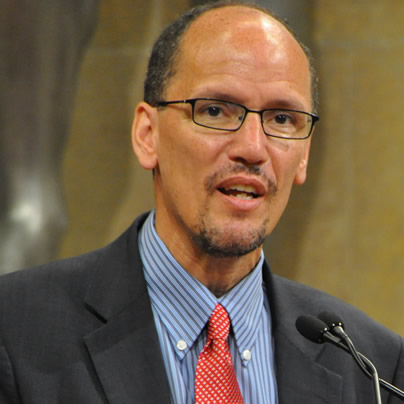
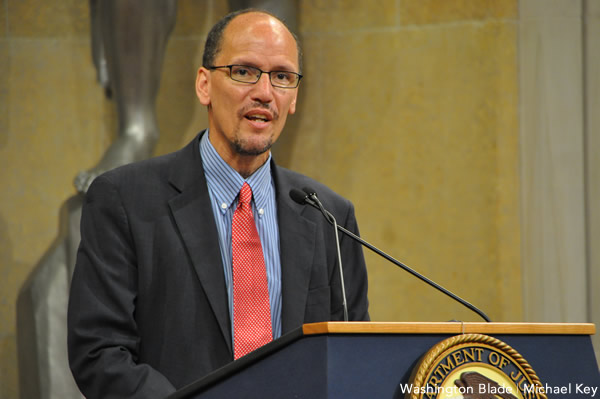
Labor Thomas Perez said the administration continues to “contemplate” the issue of an ENDA executive order. (Washington Blade file photo by Michael Key).
Labor Secretary Thomas Perez said Wednesday the issue of an executive order prohibiting anti-LGBT discrimination among federal contractors is something “we continue to contemplate and work on” as he declined to comment on whether his department could implement the order.
Under questioning by the Washington Blade, Perez said during a surprise appearance at the regular White House news briefing that he’s aware of the long-sought directive to protect workers on the basis of sexual orientation and gender identity.
“I can’t get into what ifs,” Perez said. “I’m certainly aware of the executive order that was proposed that you’re talking about, and the president takes a back seat to no one in his commitment for equal access to opportunity for people regardless of race, religious, sexual orientation or gender identity. And it’s an issue that we continue to contemplate and work on.”
Sources close to the administration have already told the Washington Blade the Labor Department, as well as the Justice Department, have already green-lighted the executive order for the White House.
Also during the briefing, Perez was asked by the Blade whether the Labor Department would apply Executive Order 11246 — the existing directive that prohibits gender discrimination among federal contractors — to transgender workers in the wake of the U.S. Equal Employment Opportunity Commission’s decision two years ago in Macy v. Holder.
“That issue is under review in the aftermath of the Macy decision,” Perez said. “I’ve asked my staff to expedite that review so that we can bring that issue to a conclusion at the Department of Labor.”
Asked when the process of review would come to an end, Perez said, “I’m hoping it will to come to an end as soon as possible.”
As Buzzfeed notes, his comments indicate the Labor Department isn’t currently implementing the existing executive order to protect transgender workers in the same way that Title VII is enforced — even though that law governs the enforcement of the executive order.
Ever since the decision two years ago in Macy v. Holder, which interpreted Title VII of the Civil Rights Act to protect transgender workers from discrimination, the Labor Department previously hasn’t responded to requests for comment on whether it will implement Executive Order 11246 to protect transgender workers.
Buzzfeed published a series of reports saying the Labor Department has refused to comment on whether it would extend the protections via executive order. Most recently, a Buzzfeed reporter was blocked from accessing a news conference with Perez on Monday reportedly because officials didn’t believe he would ask questions relevant to the veterans event.
With regard to a new executive order for both sexual orientation and gender identity, Perez’s remarks that the administration continues to “contemplate” the issue is consistent with White House counselor John Podesta’s remarks that the directive is “under consideration” as well as other hints the order is coming.
But when Reuters’ Jeff Mason followed up during the same briefing on Perez’ “contemplate” comments, White House Press Secretary Jay Carney attempted to tamp them down and reiterated support for legislation known as the Employment Non-Discrimination Act. However, Carney spoke generally about discussions taking place.
“I think what I can say is what I’ve said in the past is that I don’t have updates for you on obviously the discussion in Washington and beyond about that kind of executive action,” Carney said. “What our position is and has been is that we strongly support the Employment Non-Discrimination Act. We note the progress made in the Senate, there’s been movement in the Senate, against some of the conventional wisdom, we’ve seen movement on this.”
Carney concluded, “I just don’t have any update on the discussion around other hypothetical EOs, and I think that’s what Secretary Perez has indicated.”
Asked by Reuters for clarification about whether the media should read any shift from the administration in Perez’s remarks, Carney spoke broadly about “opportunities” under examination.
“I think broadly speaking, the administration looks at all opportunities to advance an agenda that expands opportunity that levels the playing field that sustains the equal opportunity for all that is part of the president’s vision,” Carney said. “That’s a broad matter. On specific, would the president do this executive action or that executive action? That list could be endless, and I don’t have any update for you that kind of proposition.”
Workplace protections issues weren’t the only LGBT matter that came up during the briefing. CBS News’ Major Garrett asked for an update from the White House on Missouri defensive lineman Michael Sam, who recently came out as gay, seeking placement on a team in the NFL.
Carney said since the last White House briefing he talked to President Obama about the development, but didn’t convey whether Obama called Sam as he did with NBA player Jason Collins.
“I don’t have any details on the president’s conversations or phone calls,” Carney said. “I can tell you that I have spoken about this with him and he, like the first lady, like so many others, admires Michael Sam’s courage and believes that the action he’s taken is an important step and looks forward to seeing him playing in the NFL.”
A transcript of the exchanges on workplace issues follow:
Washington Blade: Speaking of executive orders, there’s been a lot of discussion recently about a potential executive order that would bar federal contractors from discriminating on the basis of sexual orientation and gender identity. If the President were to sign such an executive order, could the Labor Department implement it?
Secretary Tom Perez: Well, I can’t get into what-ifs. I’m certainly aware of the executive order that was proposed that you’re talking about. And the President takes a backseat to no one in his commitment for equal access to opportunity for people regardless of race, religion, sexual orientation or gender identity. And it’s an issue that we continue to contemplate and work on.
Blade: On a related note, there’s also been talk about implementing existing order — Executive Order 11246, which prohibits discrimination on the basis of gender, and apply that to transgender workers to prohibit discrimination against them in the wake of Macy v. Holder. Will the Labor Department take that step?
Perez: That issue is under review in the aftermath of the Macy decision. And I’ve asked my staff to expedite that review so that we can bring that issue to conclusion at the Department of Labor.
Washington Blade: When will the review come to an end?
Perez: I’m hoping it will come to an end as soon as possible.
…
Reuters: Jay, two questions. One, I’d like to follow up on something that Secretary Perez said in response to Chris’s question. Is the administration contemplating executive action on LGBT workplace non-discrimination? That was the word that he used.
Jay Carney: Well, I think what I can say to that is what I’ve said in the past, is that I don’t have any updates for you on obviously the discussion in Washington and beyond about that kind of executive action. What our position is and has been is that we strongly support the Employment Non-Discrimination Act. We note the progress made in the Senate, the fact that there’s been movement in the Senate on this, and I think against some of the conventional wisdom we’ve seen movement on this.
On the broader range of issues around LGBT rights, we’ve seen dramatic progress, and we’re going to keep pressing Congress to catch up with the country on these issues. Turning the Employment Non-Discrimination Act into law would be a huge step forward by Congress, and the President looks forward to that happening. But I just don’t have any update on the discussion around other hypothetical EOs, and I think that’s what Secretary Perez was indicating.
Reuters: It wasn’t a hypothetical, so I just wanted to clarify, should we read into that any sort of a shift in the position of maybe going away from just a congressional push back to the possibility of an executive order?
Jay Carney: I think broadly speaking, the administration looks at all opportunities to advance an agenda that expands opportunity, that levels the playing field, that sustains equal opportunity for all that is part of the President’s vision. That’s as a broad matter. On specific — would the President do this executive action or that executive action, I mean, that list could be endless, and I don’t have any update for you on that kind of proposition.
What I can tell you is that it is our policy position that the House ought to and the Congress ought to send the Employment Non-Discrimination Act to the President’s desk so he can sign it into law.


Ghana
Ghanaian lawmakers approve anti-LGBTQ bill
Measure that would criminalize allyship awaits president’s signature
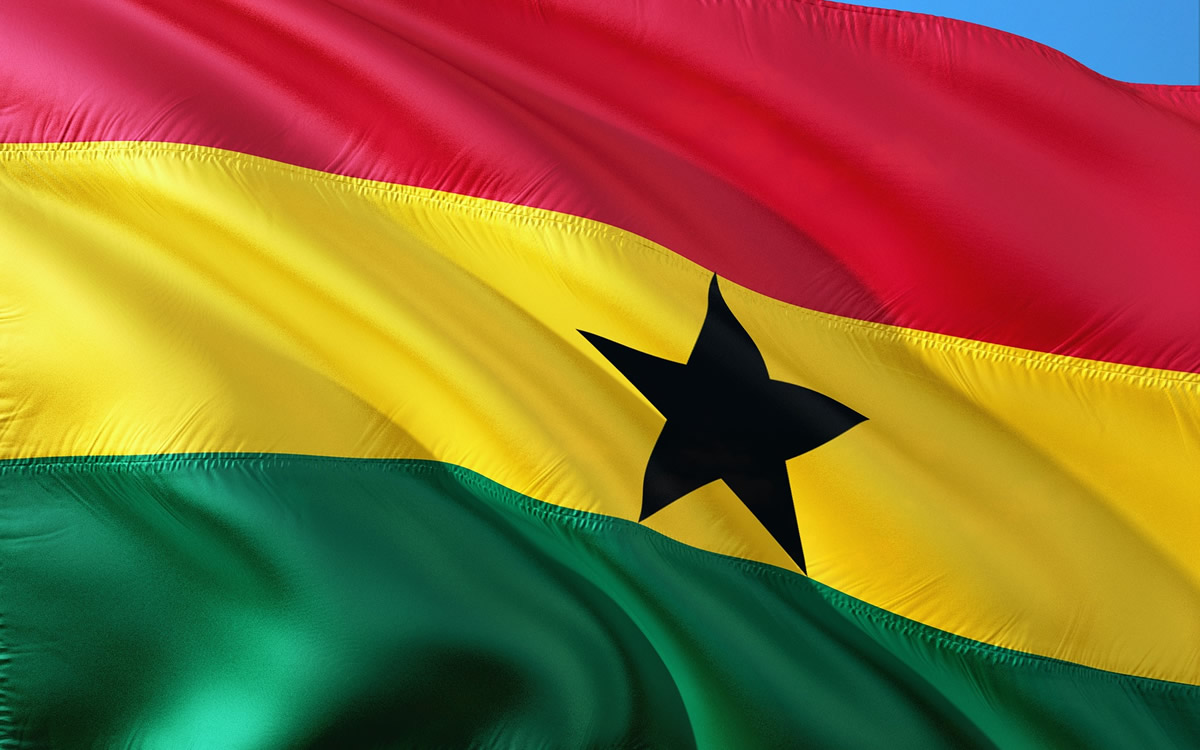
Ghanaian lawmakers on Friday approved a bill that would, among other things, criminalize LGBTQ allyship.
Reuters reported MPs approved the Human Sexual Rights and Family Values Bill, 2025, in a voice vote after parliament’s Constitutional and Legal Affairs Committee backed it.
MPs in 2024 approved a similar bill, but it faced legal challenges and then-President Nana Akufo-Addo didn’t sign it. Lawmakers last year reintroduced the measure after President John Dramani Mahama took office.
The bill awaits his signature.
Rightify Ghana, a Ghanaian LGBTQ advocacy group, in a series of social media posts notes MPs passed the bill days before the 4th African Inter-Parliamentary Conference on Family Values and Sovereignty will take place in Accra, the country’s capital.
Russia
Nine Russian LGBTQ groups deemed ‘extremist’ banned
Human Rights Watch: authorities ‘intensifying their criminalization’ of queer people
Nine LGBTQ groups in Russia have been banned so far this year after authorities deemed them as “extremist.”
Human Rights Watch on Thursday noted courts in seven regions between March and May banned Coming Out, the LGBT Resource Center, Parni Plus, the Moscow Community Center for LGBT+ Initiatives, Irida, the Russian LGBT Network, the Kallisto movement, T9 NSK, and Center T. Human Rights Watch also pointed out a lawsuit has been filed against the Alliance of Straights and LGBT for Equality.
Parni Plus is an LGBTQ media outlet.
“Russian authorities are intensifying their criminalization of those who provide critical support to the very LGBT people they have systematically persecuted,” said Human Rights Watch Europe and Central Asia Director Hugh Williamson in a press release. “Authorities should vacate all court decisions and criminal convictions based on these spurious ‘extremism’ charges.”
The Kremlin over the last decade has faced global criticism over its crackdown on LGBTQ rights.
The Russian Supreme Court in 2023 ruled the “international LGBT movement” is an extremist organization and banned it.
The country in January designated ILGA World, a global LGBTQ and intersex rights group, as an “undesirable” organization. ILGA World in response to the designation noted Russians who are found guilty of engaging with “undesirable” groups face up to six years in prison.
District of Columbia
D.C. Pride flag raising ceremony set for June 1
Mayor, council members to participate
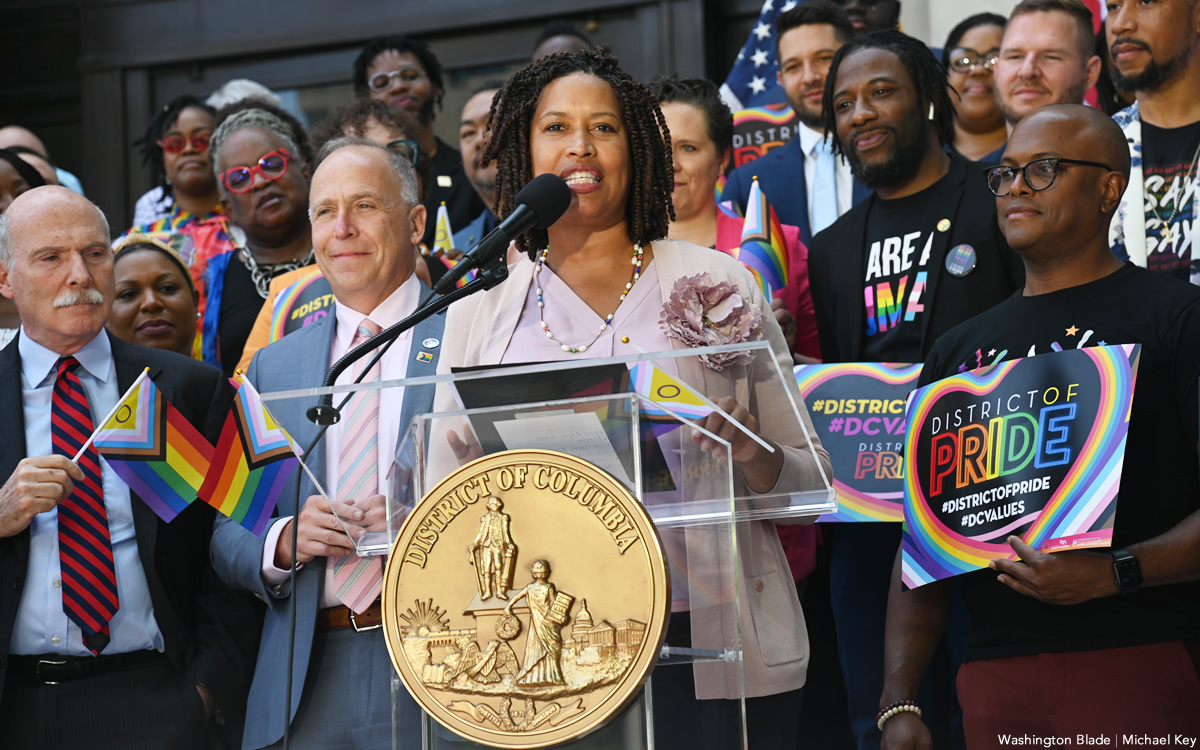
D.C. Mayor Muriel Bowser’s Office of LGBTQ Affairs is inviting the LGBTQ community and friends to attend the city’s annual Pride flag raising ceremony scheduled for 4 p.m. Monday, June 1, outside the John Wilson Building that serves as the D.C. City Hall.
Like in prior years, members of the D.C. Council and officials with the Office of LGBTQ Affairs were expected to join Bowser in delivering remarks on the front entrance steps at the Wilson Building before raising the Pride flag atop one of the tall flagpoles next to the building’s entrance.
Gaby Vincent, a spokesperson for the LGBTQ Affairs Office, said attendees of the flag raising ceremony will be invited to attend a reception immediately following the ceremony in the main lobby of the Wilson Building, which is located on Pennsylvania Avenue at 14th Street, N.W.
She said the reception will feature a DJ, dancing, and refreshments provided by the D.C. LGBTQ bar and café Spark Social House.
Vincent said the flag raising event will also mark the 20th anniversary of the opening of the D.C. Mayor’s Office of LGBTQ Affairs.
In its official announcement of the flag raising event the LGBTQ Affairs Office also announced it is hosting the 7th annual District of Pride Showcase event to be held Friday, June 17, at 7 p.m. at the Lincoln Theater.
The announcement says LGBTQ community members, families, and allies are also invited to walk with Bowser in the Capital Pride Parade scheduled for Saturday, June 20. It says the mayor’s parade contingent will assemble at 2 p.m. at the parade’s starting location at 14th and U Streets, N.W.
“As we also celebrate the 20th anniversary of the Mayor’s Office of LGBTQ Affairs, we invite residents, community members, families and allies to join us throughout June for moments of pride, connection, visibility, and joy,” the announcement says.

Ghanaian lawmakers approve anti-LGBTQ bill

‘The Stranger’ queers an existentialist classic

Nine Russian LGBTQ groups deemed ‘extremist’ banned

D.C. Pride flag raising ceremony set for June 1

Still marching: Rev. Troy Perry and the ongoing fight for liberation

Bree Fram’s congressional campaign ends but her fight continues

Peppermint made her mark on ‘Drag Race.’ Now, her advocacy is front and center

Why this Black Pride, I ranked Janeese Lewis George #1 for D.C. mayor

From Media Matters to massive queer ragers: the rise of Tara Dikhof

Man accused of threatening to shoot D.C. bar employee after making anti-gay slurs
-

 2026 Midterm Elections3 days ago
Bree Fram’s congressional campaign ends but her fight continues
-
Celebrity News3 days ago
Peppermint made her mark on ‘Drag Race.’ Now, her advocacy is front and center
-
Opinions3 days ago
Why this Black Pride, I ranked Janeese Lewis George #1 for D.C. mayor
-
a&e features3 days ago
From Media Matters to massive queer ragers: the rise of Tara Dikhof