News
Republicans ignore LGBT issues at CPAC
Log Cabin criticizes organizers for exclusion from ‘outreach’ panel
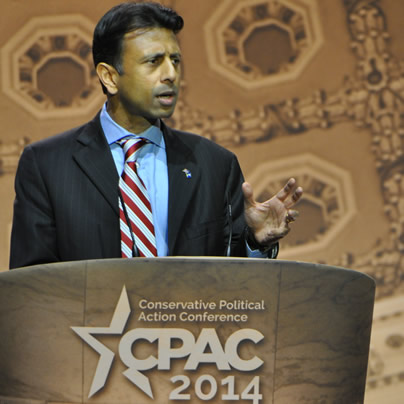
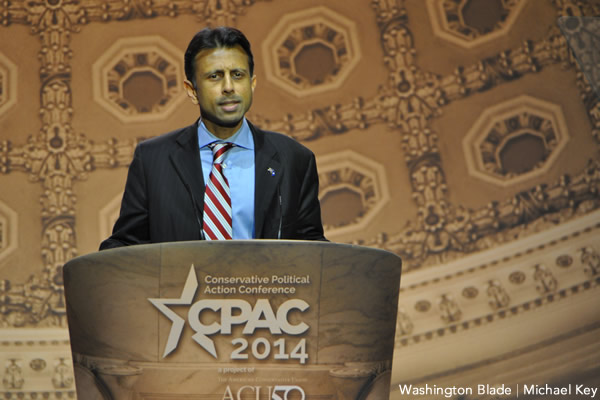
Gov. Bobby Jindal (R-La.) speaking at the 2014 Conservative Political Action Conference. (Washington Blade photo by Michael Key)
NATIONAL HARBOR, Md. — Amid growing support for LGBT rights and following a string of court victories on marriage equality, high-profile Republican speakers avoided those subjects at the first day of the 2014 Conservative Political Action Conference.
Although many of the speakers have previously articulated their opposition to same-sex marriage — with some going as far as supporting a Federal Marriage Amendment — none took the opportunity while speaking before an estimated 8,500 conservatives in attendance to attack gay rights or made statements against the many recent judicial rulings in favor of marriage equality.
Republican Gov. Bobby Jindal (R-La.) most closely approached LGBT issues when he defended his earlier statement supporting Phil Robertson of “Duck Dynasty” for controversial comments equating homosexuality to sinful behavior.
“But the reality is this: I stood up for their right to speak up and articulate their beliefs because I’m tired of the left,” Jindal said. “I’m tired of the left that claims they’re tolerant, claims they’re for diversity — and they are — they are tolerant and they are for diversity except for when you dare to disagree with them.”
Jindal made the reference to “Duck Dynasty” after criticizing the Obama administration for supposedly impinging on the religious liberties of Americans.
Another veiled reference to LGBT issues came up when Sen. Tim Scott (R-S.C.) praised the restaurant chain Chick-fil-A — despite the company’s history of anti-gay donations and controversial comments in opposition to same-sex marriage by owner Dan Cathy.
You would have to look off stage at CPAC to find anti-LGBT sentiments. According to Right Wing Watch, the ultra-conservative Catholic group Tradition, Family, and Property distributed fliers at the event depicting the gay conservative group GOProud as a rainbow-colored beaver, explaining “Why GOProud Does Not Belong at CPAC.”
“Why is GOProud a welcomed and official guest at CPAC, when it advocates the legalization of same-sex ‘marriage,’ thus undermining the votes and dreams of millions of God-fearing Americans?” the flier reportedly says.
Ross Hemminger, co-director of GOProud who helped the group regain its guest status at CPAC after two years of being banned, responded to the flier succinctly.
“I think it’s hilarious,” Hemminger said. “We will proudly be the rainbow beavers.”
Even though no one on stage at CPAC took the opportunity to oppose LGBT rights, no one speaking on stage said anything in favor of them either.
That absence was most acute during a panel titled “Reaching Out: The Rest of the Story,” which looked at the ways the conservative movement can expand into minority groups.
On the panel, moderated by Revolvis Consulting partner Jason Roe, was Republican U.S. Senate candidate from Virginia Ed Gillespie; Robert Woodson, president of the Center for Neighborhood Enterprise and Elroy Sailor, CEO of J.C. Watts Companies.
Although the panel talked at length about the Republican Party entering the black and Latino communities to win over those heavily Democratic constituents, not once did any mention of LGBT outreach come up, nor was the word “gay” even uttered.
Gregory Angelo, executive director of the Log Cabin Republicans, attended CPAC as a guest and criticized the lack of LGBT outreach on the panel in an interview with the Blade.
“The silence is deafening there, as least as far as I’m concerned,” Angelo said. “This is a constituency that the conservative movement needs to reach out to and formally acknowledging that in some capacity is something I think it needs to do.”
In the wake of GOProud’s readmission as a guest to CPAC, Angelo penned an op-ed piece for The Daily Caller saying Log Cabin had sought “meaningful” participation at CPAC, such as a seat on the outreach panel, but was “rebuffed.” The American Conservation Union, which hosts CPAC, didn’t respond to a request for comment.
“Our ask was that we have a voice at the conference — that’s it — whether that was introducing speakers, introducing panelists, or being part of a panel,” Angelo said. “From our perspective, that was a simply non-controversial proposal that would have shown the country that gay conservatives are a meaningful part of this movement, in a vehicle that wasn’t all about ‘gay policy issues.'”
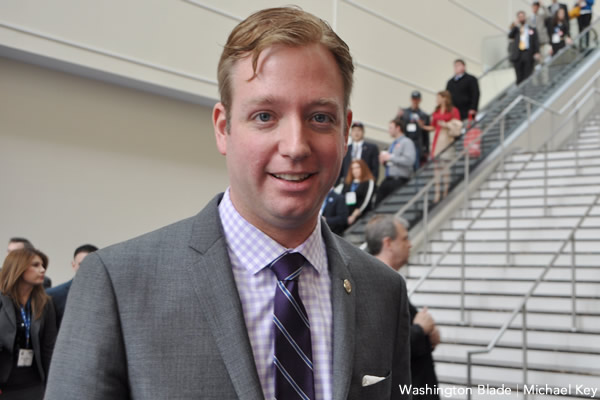
Log Cabin executive director Gregory Angelo (Washington Blade photo by Michael Key)
While remaining silent on LGBT issues, a number of prominent Republicans who spoke on stage at CPAC — many of whom are seen as Republican presidential contenders — addressed other relevant issues of the day, often attacking President Obama.
New Jersey Gov. Chris Christie (R) talked about the importance of the “three-legged stool” of the conservative movement — social issues, fiscal issues and national security issues — that Republicans say led to Ronald Reagan’s wide victories during presidential elections in the 1980s.
“When we say that we’re pro-life, and that we’re proudly pro-life, that doesn’t mean that we’re pro-life just when that human being is in the womb,” Christie said. “It means we have to be in favor of an educational system that’s accountable, so that child, as they grow, can have a world-class education. It means that we have to be in favor of a society that creates opportunity and jobs for them — not one that has the government control what they think is good or fair in our society.”
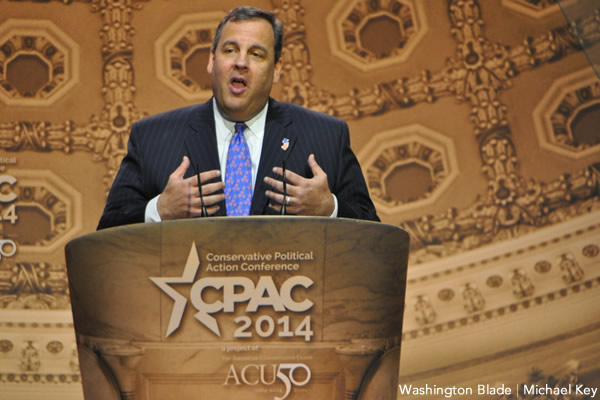
Gov. Chris Christie (R-N.J.) speaking at the 2014 Conservative Political Action Conference. (Washington Blade photo by Michael Key)
Amid concern over Russia’s military incursion into Ukraine, Sen. Marco Rubio (R-Fla.) derided the Obama administration for what he said was allowing the growth of totalitarian regimes in North Korea, Iran, China and Russia.
“All the problems of the world, all the conflicts of the world are being created by totalitarian regimes who are more interested in forcing people to do what they want them to do than truly achieving peace and prosperity and respect for the rights of others,” Rubio said.
Sen. Ted Cruz (R-Texas), another rising Republican star, enumerated several policy items he wanted to achieve, including repeal of Obamacare and Dodd-Frank financial reform, abolition of the IRS and the establishment of the flat-tax.
Following his speech, Cruz took a shot at former Secretary of State Hillary Clinton, whom many see as the likely Democratic presidential nominee in 2016, when asked about her candidacy.
“I’m less concerned about Hillary Clinton than I am about the direction this is country is going,” Cruz said. “We will have had eight years of a failed economic agenda that is resulting in a lack of leadership across the world. It is allowing Russia and China and Iran to expand their spheres of influence and make the world a much more dangerous place, and at home people are hurting. We’ve got the lowest labor force participation since 1978. Let me tell you, we can’t afford eight more years of this: Hillary Clinton would continue the failed Obama economic agenda.”
It should be noted Cruz is an opponent of marriage equality and has introduced in the Senate the State Defense Marriage Act, which would prohibit the federal government from recognizing same-sex unions in states where they’re illegal.
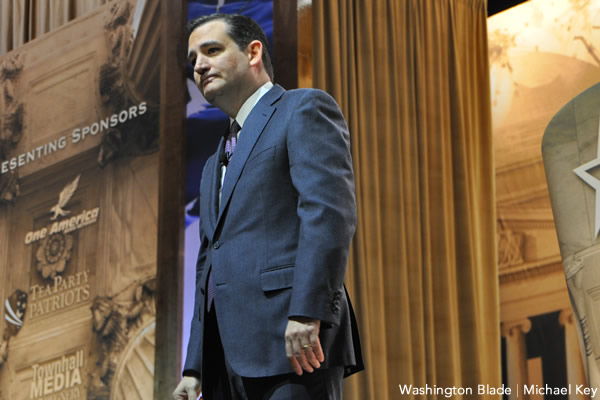
Sen. Ted Cruz (R-Texas) speaking at CPAC 2014. (Washington Blade photo by Michael Key)



2026 Midterm Elections
As Washington shifts right, Democratic Socialists gain ground
Next major test for movement comes in Midwest

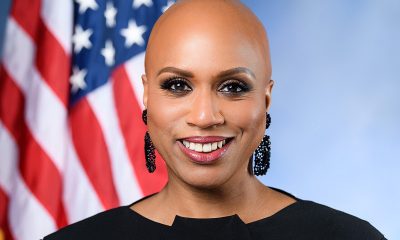
As President Donald Trump’s second administration has pushed the federal government further to the right on issues ranging from immigration to LGBTQ rights, a different political movement has been gaining momentum inside the Democratic Party.
From industrial communities in upstate New York to Colorado’s Front Range, candidates aligned with the Democratic Socialists of America (DSA) have won a series of victories in Democratic primaries this year, in several cases defeating longtime incumbents who had represented Democratic strongholds for years. Their success has reignited debate over the Democratic Party’s future, as a growing faction of progressive voters calls for a more confrontational approach to economic inequality, healthcare, housing, labor rights, climate policy, and LGBTQ protections rather than what they view as the party’s increasingly cautious establishment.
These victories also reflect a broader ideological divergence in American politics. While Republicans under Trump have embraced a more conservative governing agenda, many Democratic primary voters in safely blue districts appear to be rewarding candidates running on unapologetically progressive platforms that reject incremental change in favor of more sweeping reforms.
The Democratic Socialists of America (DSA), the nation’s largest socialist organization, says it has more than 100,000 members and chapters in all 50 states. The organization advocates what it describes as democratic socialism — promoting social and economic equality through democratic government while supporting a larger public role in healthcare, housing, labor protections, education, and other social programs alongside a regulated market economy.
On its website, the DSA explains its goals are to utilize “progressive movements for social change while establishing an openly democratic socialist presence in American communities and politics.”
For LGBTQ Americans, the organization has long supported expansive nondiscrimination protections, marriage equality, transgender rights, and broader legal protections through a platform first adopted in 2017. Its LGBTQ policy calls for federal legislation prohibiting discrimination, expanded access to gender-affirming healthcare, reproductive freedom, and opposition to laws targeting LGBTQ people.
The movement’s biggest victories came in New York.
Just months after the election of New York City Mayor Zohran Mamdani, a democratic socialist, candidates backed by the DSA and allied progressive organizations swept Democratic primary elections that many political observers viewed as a referendum on the party’s ideological direction.
Among the most notable victories were Brad Lander’s defeat of incumbent Rep. Dan Goldman in New York’s 10th Congressional District, Claire Valdez’s victory over Brooklyn Borough President Antonio Reynoso in the 7th District, and Darializa Avila Chevalier’s upset of five-term incumbent Rep. Adriano Espaillat in New York’s 13th Congressional District.
Overall, nine of the 10 New York City candidates backed by the DSA won their Democratic primaries, further cementing the organization’s growing influence in the nation’s largest city and demonstrating that democratic socialist candidates can compete beyond isolated local races.
Outside New York, the trend continued.
In Colorado, Melat Kiros defeated 15-term incumbent Rep. Diana DeGette in one of the cycle’s biggest primary upsets. Kiros campaigned without accepting corporate PAC contributions and criticized DeGette’s fundraising practices and foreign policy positions, presenting herself as an alternative to the Democratic establishment.
While socialist movements have existed in the United States for more than a century, democratic socialism remained largely on the political margins for decades. That began to change following Sen. Bernie Sanders’ presidential campaigns in 2016 and 2020, which introduced millions of Americans to democratic socialist ideas and energized a younger generation of progressive activists.
Although Sanders never won the Democratic nomination, his campaigns helped reshape the party’s left flank by elevating issues such as universal healthcare, tuition-free public college, stronger labor protections, and economic inequality into the mainstream Democratic conversation.
Today, the movement’s most recognizable elected officials include Rep. Alexandria Ocasio-Cortez and several members of the congressional “Squad,” who have helped normalize the democratic socialist label among younger Democratic voters and increasingly challenged party leadership from the left.
For LGBTQ voters, democratic socialist candidates have frequently positioned themselves among the Democratic Party’s strongest advocates for transgender rights, particularly as the Trump administration has sought to restrict access to gender-affirming healthcare, military service, and other legal protections for transgender Americans.
The next major test for the movement may come in the Midwest.
In Michigan, progressive candidate Abdul El-Sayed is locked in a closely watched Democratic Senate primary, while in Wisconsin, DSA-backed Francesca Hong is seeking her party’s nomination for governor. The outcomes of those races could offer another measure of whether democratic socialism’s recent gains represent a lasting realignment within the Democratic Party or are concentrated primarily in deep-blue urban districts.
Rehoboth Beach
Susan Stewart could make history as Rehoboth’s first openly gay mayor
Aug. 8 election features four candidates for top job
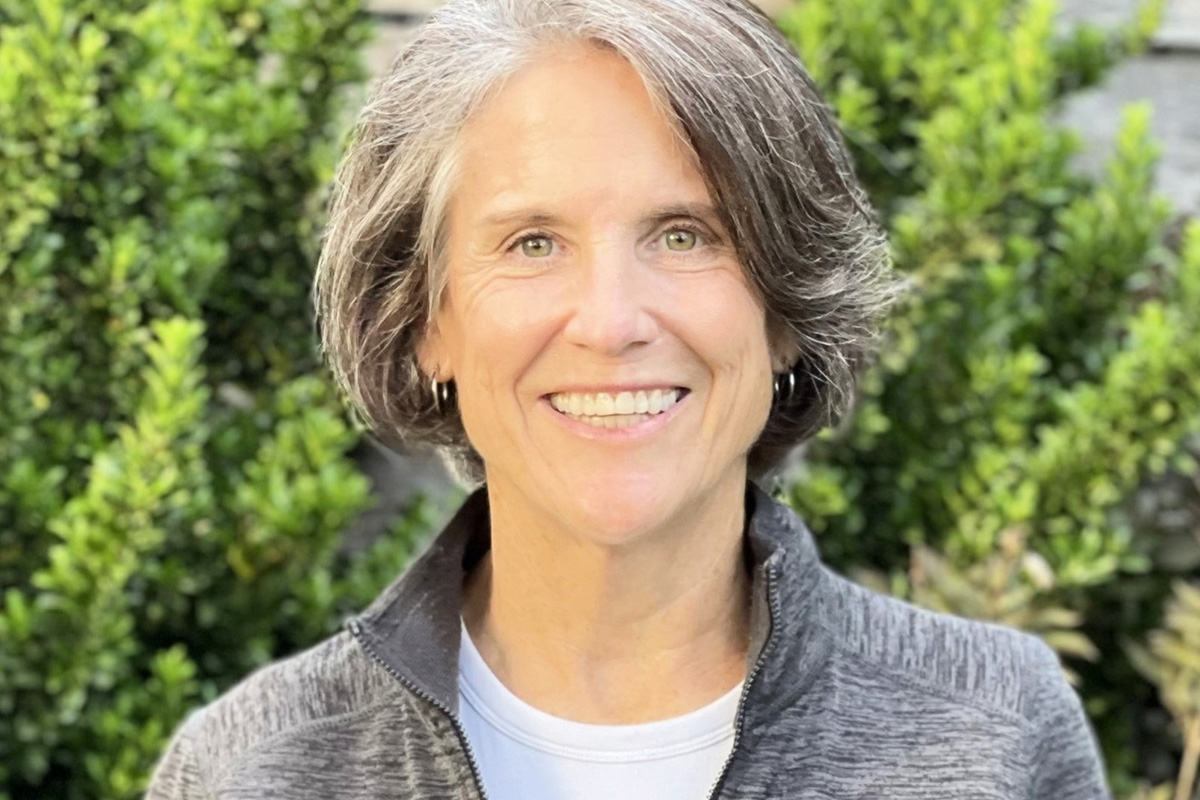
(Editor’s note: This is the first installment in a three-part series profiling the candidates for mayor of Rehoboth Beach, Del.: Commissioners Suzanne Goode, Susan Stewart, and Craig Thier; a fourth candidate, William Raak, filed to join the race but has not responded to Blade inquiries.)
Residents of Rehoboth Beach, Del. will elect a new mayor this summer after Stan Mills announced plans to retire after serving six years as mayor and 12 as a commissioner. One candidate who could make history is Commissioner Susan Stewart, who identifies as part of the LGBTQ community, a potential first for the town, which has never had an openly gay mayor.
Stewart is a current city commissioner for Rehoboth Beach and has served as a member of the Mixed-Use and Stormwater Utility Task Forces.
A Pennsylvania native who spent her adult life working in Washington, D.C., Stewart has owned a home in Rehoboth since 2013 with her partner of more than 20 years and began living there full time during COVID.
Stewart described her campaign as offering vision, leadership, and integrity. She has a background as an attorney and financial adviser.
She spoke about the work that she is doing as city commissioner that she would continue as mayor, specifically with Reimagine Rehoboth.
“I’ve been shepherding through a master planning initiative for the first time,” she said. “We’ve never really had an overall study with urban planners and transportation consultants.”
Stewart highlighted the upcoming ‘Charrette Week’ from July 13-17 when members of the community can learn about the city from urban planners and give their input on the planning initiative.
“We’ve got this natural beauty and we’ve got some things we can work on,” said Stewart. During ‘Charrette Week’, Stewart said that the community will also have the chance to rename ‘Reimagine Rehoboth’ due to the pushback it initially received.
“Getting the community engaged and united behind is the big goal,” said Stewart.
Stewart also mentioned that she is the liaison with Clear Space Theatre Company as it aims to build their own venue in town. She expressed hope in bringing this vision to fruition as she values the art and culture that the company brings to town.
“It hasn’t been lost on us that the Kennedy Center has sort of cut loose a lot of its patrons,” said Stewart.
Stewart also said she wants to increase age and racial diversity in Rehoboth through supporting the construction of more workforce housing.
“We don’t generally have [racial and age diversity] here. I wish we did,” said Stewart.
According to the 2024 census, the median age of Rehoboth in 2024 was 63 with 44% of the population being 65 and over. Additionally, 89% of the city’s population was reported to be white.
Stewart also said that she aims to maintain Delaware’s perfect score on the Human Rights Equality Index in 2025, which she credits to the work of the assistant city manager, Evan Miller, and CAMP Rehoboth for getting Rehoboth to be recognized.
“Rehoboth is a great place for our broader LGBTQ+ community,” said Stewart.
She also said that she is proud to support organizations like CAMP Rehoboth, which the city was able to give a grant to for the first time this year according to Stewart.
“The city and CAMP Rehoboth have such a productive and wonderful relationship.”
Stewart said that she wants CAMP to know that they are always welcome to reach out if they ever have issues that require help from the city.
“We’ll continue to have a very productive and warm relationship.”
The Blade also asked Stewart about her public disagreement with fellow City Commissioner and mayoral candidate Suzanne Goode in March of this year.
During a commissioners meeting on March 9, Stewart outlined allegations that Goode used derogatory language in emails, particularly toward City Manager Taylour Tedder.
“All of our emails are public information under FOIA. I simply asked the city to link them on the website, and then the city published a transcript of [Goode’s emails].”
Stewart said that she did this on behalf of the city’s employees such as Tedder: “We have a moral and legal obligation to support our employees.” She also said that this situation has escalated since the March 9 meeting.
At the meeting, Goode denied all of the allegations and said that they were based on falsehoods.
“The challenge with Suzanne Good is that she burns through so much time in a public hearing because she wants to talk about all these things in the past,” said Stewart.
If elected mayor, Stewart said that she would look into measures to help meetings run smoother and prevent disruptions such as turning off mics and moving public comment to the end of the meeting instead of the end of each topic.
“We want public input, but the people that come there for good reasons to talk about things that they need help with get drowned out by these disruptions.”
The election will take place on Aug. 8, from 10 a.m.-6 p.m. at the Rehoboth Beach Convention Center.
National
Madonna roundup: Reviews, sales, and love for ‘Danceteria’
Pop legend’s new album ‘Confessions II’ earning raves

Madonna isn’t just back, she’s ubiquitous.
From a Times Square takeover to Graham Norton’s couch, the pop legend is busy promoting her new album, “Confessions II,” a sequel to 2005’s “Confessions on a Dance Floor,” that is earning rave reviews.
“Madonna’s back in peak form with a fresh and honest dance record that’s not only her best in 20 years, but a genuinely vital addition to her canon,” says Pitchfork.
“Facing grief and loss has made Madonna’s music deeper than it’s been in 20 years, but also more alive,” the Guardian proclaims.
“If everyone in the club is a work of art, as ‘Danceteria’ says, then to live loudly is to make an indelible mark,” according to Vulture.
The album features upbeat dance productions along with some melancholic views on death and loss. On the song “Betrayal,” she reflects on the recent death of her stepmother Joan, singing, “You’ll never take my mother’s place … you betrayed me, you enslaved me.”
On “L.E.S. Girl,” she revisits her early days living on the Lower East Side and struggling to pay the rent. “Bizarre” seems to reference her failed 1980s marriage to actor Sean Penn. “Test” is a duet with daughter Lola Leon, in which she sings, “I wish I knew / The pain I’ve caused / My butterfly / Was always being watched.”
But the emotional high point of the album comes on “Fragile,” which she wrote about the death of her brother Christopher. The two were close early in Madonna’s career and he designed sets for early tours, including “Blonde Ambition.” But they had a falling out after her marriage to Guy Ritchie and he wrote a scathing tell-all book about his sister that led to years of estrangement. The two reconciled after Christopher’s cancer diagnosis and shortly before he died in 2024 at age 63. She sings, “Late last night I was fast asleep/You came to me in a dream/You said, ‘Don’t forget about me/Don’t forget to be happy.’”
Death emerges again but in a much more upbeat context in “Danceteria,” an ode to the iconic New York nightclub that has emerged as a gay favorite single and seems destined to be the song of the summer in queer nightlife. She recounts her pre-fame days trying to convince a DJ to play her first single “Everybody” at the club and name checks Jean-Michel Basquiat, Keith Haring, best friend Debi Mazar, and DJ Mark Kamins on the track.
Streaming numbers and sales are strong for the new album with projected first week sales of 100,000 ensuring a No.1 debut in the U.S.

As Washington shifts right, Democratic Socialists gain ground

Susan Stewart could make history as Rehoboth’s first openly gay mayor

Silky Nutmeg Ganache talks sex and dating, gender, politics, weight loss journey

Madonna roundup: Reviews, sales, and love for ‘Danceteria’

Three overlooked court rulings limited White House anti-trans policies

‘Transcendent’ a tough but important read

Under-the-radar Delaware beach towns smart buyers are targeting

‘My Favorite Sociopath’ debuts at Shepherdstown’s CATF

In Trump’s divided America, Michael Weinstein’s AHF responds