Opinions
Republicans ignore youth vote at their peril
Young constituents turned off by party’s anti-gay antics

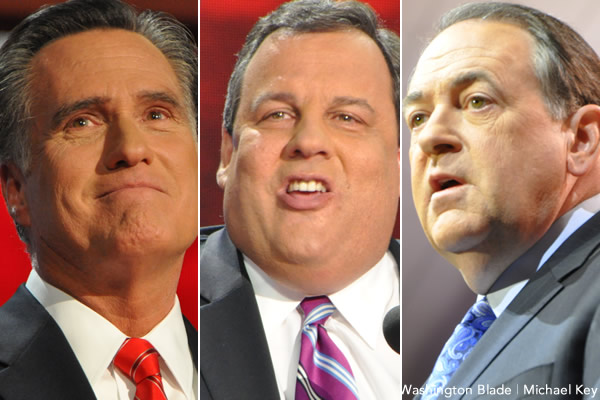
From left, former Gov. Mitt Romney (R-Mass.), Gov. Chris Christie (R-N.J.) and former Gov. Mike Huckabee (R-Ark.) (Washington Blade photos by Michael Key)
The idea of a “President Mitt Romney” proved a pipe dream for Republicans in 2012 – and there’s evidence that the youth vote played a big role in that outcome.
Nearly 23 million people between 18 and 29 voted in 2012, according to the Center for Information and Research on Civic Learning and Engagement at Tufts University, many of whom were likely energized by Barack Obama’s socially liberal stances on issues like marriage equality.
Obama certainly has his flaws, both in his policy and his prose. Look no further than last week, when Obama said to a YouTube interviewer that he hopes the Supreme Court makes the “right decision” on same-sex marriage because “even if you disagree with their lifestyle choice, the fact of the matter is, they’re not bothering you.”
That kind of flippant language – implying that being gay is fine with Middle America as long as we keep it to ourselves – denigrates Obama’s office and should not score points with young progressive constituencies who helped put him there.
But looking ahead to 2016, the options on the other side of the aisle are more frightening, venturing to rhetorical and philosophical places Obama has never gone.
Take, for example, Republican Louisiana Gov. Bobby Jindal, who appeared at a rally alongside Cindy Jacobs, an evangelical televangelist “prophet,” who in 2011 drew a parallel between the repeal of “Don’t Ask, Don’t Tell” and thousands of animal deaths in Arkansas. Rachel Maddow first reported this odd connection on her MSNBC show this week.
“There is a potential that there is something that actually happened in the land where 100,000 drumfish died and also where these birds just fell out of the air,” Jacobs said. “It could be because we have said it’s OK for people who commit these kind of acts to be recognized in our military for the first time in our history.”
Also within the last week, Republican New Jersey Gov. Chris Christie, lauded even by some liberals in his state for his theatrical and bombastic public performances, capitalized on his socially conservative credentials in Iowa.
“He vetoed the gay-marriage bill in New Jersey,” Rep. Steve King (R-Iowa) said while introducing Christie to the annual Iowa Freedom Summit. “He is pro-life.”
After same-sex marriage victories in 36 states and a Supreme Court case expected to settle the question once and for all on the docket this term, why is touting anti-marriage views still a viable selling point for Republicans?
On “Meet The Press” this week, former presidential candidate Mike Huckabee rebuffed the widely accepted premise that sweeping court action on same-sex marriage means that it is, in fact, legal.
“I’m advocating an adherence to the Constitution,” said Huckabee, who has admitted to considering yet another bid for America’s top office. “I’m really saying that there’s a process to change the law and it doesn’t involve one unilateral branch of government.”
Even former Florida Gov. Jeb Bush – regarded by many as an early frontrunner and a voice of reason amid an otherwise crowded and disjointed field – didn’t do much to differentiate his thinking from others in his party.
“The state decided. The people of the state decided,” Bush said in an interview with the Miami Herald about same-sex marriage in Florida. “But it’s been overturned by the courts, I guess.”
In 2012, 60 percent of young voters supported Obama. That percentage was even higher in 2008. And the study from Tufts shows that if the youth vote was more evenly divided among the candidates in key swing states like Florida, Pennsylvania, Ohio and Virginia, Romney could have claimed the presidency.
The point is this: Victory in 2016 is within reach for the GOP. In fact, three consecutive terms with a Democrat in the White House would be a feat liberals haven’t accomplished since Harry Truman succeeded Franklin Roosevelt’s three and a half terms in office in 1945.
But Republicans won’t get there if they continue to throw away the younger, more liberal voting bloc with anti-gay commentary. It behooves none of us to ignore hateful rhetoric that could turn into discriminatory laws should any of these candidates eventually go on to win the electoral college.
Justin Peligri is a student at George Washington University.





Opinions
The facts about Victory Fund’s investigation and the path forward
Probe did not find legal or policy violations by Evan Low
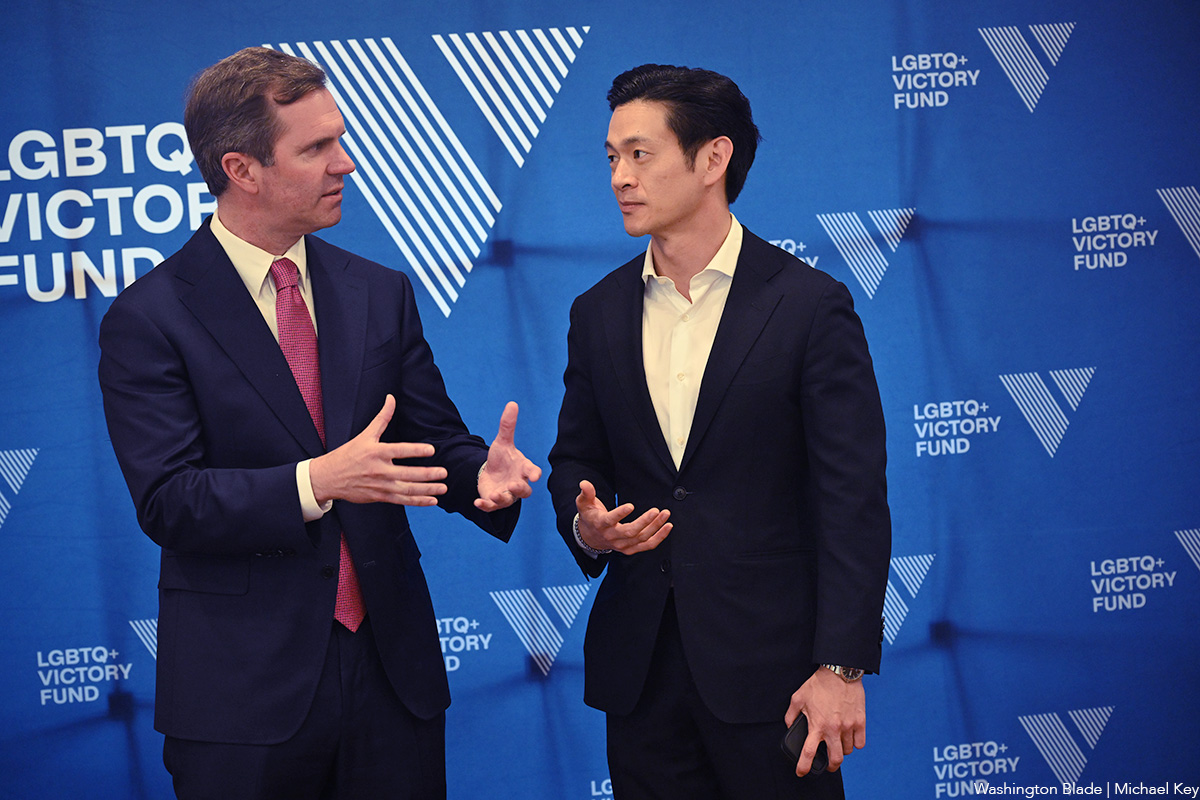
William Waybourn helped found an organization whose mission has never been more important, but his recent op-ed in the Washington Blade leaves readers with a fundamentally inaccurate impression about how the LGBTQ+ Victory Fund and Institute Boards responded to concerns raised about our organizations, their leadership, and our governance responsibilities.
The boards did not dismiss or minimize concerns. We did what responsible governing bodies should do: We took them seriously, retained experienced independent legal counsel, and authorized a thorough investigation to establish the facts.
The investigation proceeded without interference from the boards or organizational leadership, and the full boards were briefed on its eventual finding.
The conclusion matters: The investigation did not substantiate any legal or policy violations. After the briefing, the boards voted unanimously to accept the findings and close the investigation.
An independent investigation is meaningful only if we are prepared to respect its conclusions — whatever they may be. In this case, after reviewing the investigation and its findings, the boards continue to have confidence in President and CEO Evan Low.
That does not mean our work as governing bodies is finished or that any organization is beyond improvement. The boards will continue to work with staff strengthening Victory, including reviewing and updating policies to ensure they reflect best practices and support a strong working environment.
We can take matters raised seriously while also being clear about what an independent investigation did and did not find. Those are not contradictory positions. In fact, maintaining both is essential to treating everyone involved fairly.
Victory has endured for more than three decades because its mission is bigger than any one individual — a founder, board member, CEO, staff member, candidate, elected official, or donor. Generations of people have built Victory into an indispensable force for LGBTQ+ political representation, and those entrusted with governing it today take seriously our responsibility to protect that legacy and strengthen Victory for what comes next.
And what comes next could not be more consequential. Election Day is weeks away, LGBTQ+ candidates across the country are facing enormously important races, and our community continues to confront attacks on our rights and representation.
We will continue exercising the oversight expected of us, strengthening the Victory organizations, and focusing on the urgent work Victory was created to do: training and helping elect LGBTQ+ leaders, and ensuring our community has a voice wherever decisions about our lives are made.
Opinions
Evan Low is not the leader the Victory Fund needs at this moment
The board must recognize what is at stake and act before org’s legacy is lost
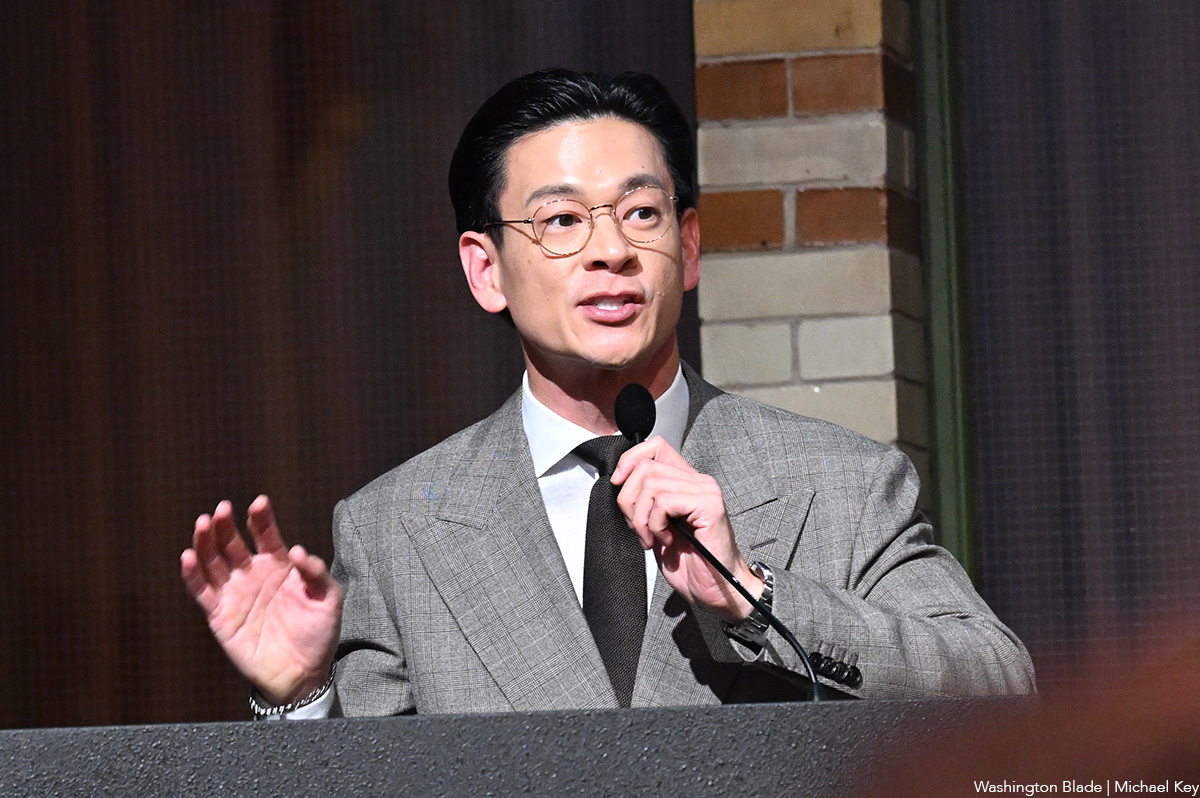
As co-founder and the first executive director of the Victory Fund and Victory Institute, I find the ongoing turmoil between a dozen or more employees and the organization’s new president, Evan Low, deeply distressing—particularly during such a critical election year.
The Victory Fund’s mission has always been clear and important: to elect and support qualified LGBTQ candidates for public office and, in doing so, secure a “seat at the table” from which LGBTQ issues can be advanced. That mission is too important to let internal turmoil diminish it.
I applaud the employees for going public with their concerns. When harassment allegations and other serious complaints threaten to derail an organization that was once so effective, where else are employees supposed to turn? The board of directors has a legal and fiduciary responsibility to the organization and to its donors.
I do not know Mr. Low, nor have I ever met him. Given my role as a founder, former executive director, and major donor, I found that somewhat remarkable. I was also surprised by the organization’s lack of contact with me at any level—whether to seek my financial support, ask for help with fundraising, or simply seek the perspective of someone involved in building the organization from its earliest days.
When Mr. Low was hired, members of the press contacted me about reports concerning his involvement in previous election-law matters. I declined to comment beyond saying that the board had hired an outside search firm to conduct the search and that I was in no position to assess any issues in Mr. Low’s past.
In hindsight, however, I have come to believe that Mr. Low is not the leader the Victory Fund needs at this particular moment. Ultimately, though, this is a matter for the board of directors to resolve. The board has an obligation to act decisively and independently before this internal conflict further damages an organization whose stature, effectiveness, and reputation were built over decades. The work of the founding board, subsequent boards of directors, and former leaders David Mixner, Brian Bond, Chuck Wolfe, and Annise Parker should not be so easily undone.
The Victory Fund once commanded the admiration, confidence, and financial support of countless people—including me. I hope the board recognizes what is at stake and acts before that legacy is lost.
(Correction: An earlier version of this op-ed called for the board to conduct an independent investigation of the allegations. The board did conduct such an investigation.)
William Waybourn is co-founder and the first executive director of the Victory Fund and Victory Institute.

For years, transgender Americans have been told that visibility is important. We should tell our stories, educate people, speak publicly about our experiences and show younger transgender people that a future is possible. I understand that argument because I have participated in that kind of visibility myself. Nearly a decade ago, I appeared in National Geographic’s “Gender Revolution,” in 2017, hosted by Katie Couric. I have written publicly about being transgender, participated in LGBTQ politics and spent years thinking about what it means to transition in America. My history is hardly a secret. But as I have gotten older, I have increasingly found myself wanting something considerably less dramatic: I want the right to be an ordinary man.
That does not mean I am ashamed of being transgender, nor does it mean that transgender activists should stop fighting for our rights. Many of the freedoms I enjoy exist because previous generations of LGBTQ people were willing to be conspicuous when visibility carried considerable personal risk. But equality cannot require permanent visibility. There is a strange expectation placed upon members of minority groups that our lives should contain some larger social meaning. A transgender person who overcomes adversity is called “brave.” Someone who talks openly about transition becomes “inspiring.” Someone who succeeds becomes an example of “trans resilience.” Sometimes those descriptions are deserved and sincerely appreciated. But sometimes I do not want to represent resilience. Sometimes I just want to walk my dogs, sit in a coffee shop with my laptop, complain about Northern Virginia traffic, go swimming, write books and figure out what I am having for dinner. I also want to be able to gossip with my friends in meaningless ways and do off kilter things that resemble fun: axe throwing, bowling, and karaoke.
When I was younger, being transgender occupied an enormous amount of psychological territory. Transition required decisions, explanations and difficult conversations. Other people had questions. My body seemed consequential in a way that other people’s bodies did not. There was always another milestone ahead of me, and for a while it was difficult to imagine reaching a point when gender would no longer dominate my thoughts. Eventually, however, something unexpected happened: life became life again. The questions that occupy me today are increasingly the same mundane questions that occupy millions of other adults. What kind of career do I want? Am I being a good friend? What should I write next? What kind of person do I want to become?
Most strangers who meet me today simply see a man. They do not know my medical history or what I looked like years ago. They don’t know that I looked like a skinny track star, and then was put into the resemblances of a meager nonbinary body. They do not know the chronology of my transition unless I decide to tell them. There is tremendous freedom in that, and I have come to think of it not as deception but as privacy. Nobody introduces himself by providing strangers with a complete inventory of his medical history, childhood insecurities and previous identities. Human beings reveal themselves gradually. Different people know different parts of us, and intimacy develops when we decide that somebody has earned access to more of our story.
Yet transgender people are frequently encouraged to regard disclosure as a measure of authenticity. I no longer believe that it is. There are circumstances in which being transgender matters enormously, and there are others in which it barely matters at all. When I am writing, I want somebody to care about the quality of the sentence. When I am working, I want somebody to care whether I did the job well. When I make a friend, I want that person to discover the complicated human being underneath the surface: my ambitions, flaws, anxieties, ridiculous stories and sense of humor. Being transgender may eventually become part of that conversation, but it does not have to be the first thing somebody knows about me.
That, to me, is one of the least discussed promises of equality. For decades, LGBTQ people fought for the right to be seen because invisibility was often enforced through shame and discrimination. Visibility therefore became a form of liberation. But perhaps successful visibility should eventually produce another freedom: the freedom to become unremarkable. A gay couple should be able to bore their neighbors with complaints about their mortgage. A lesbian should not have to become an ambassador for lesbianism whenever she enters a room. A transgender man should not have to turn his body into a public seminar about gender. He should occasionally be allowed to be some guy. Transgender people, in a sense, should also have the right to be flawed: sometimes we yell at our romantic counterparts, and other times we get fired from jobs for being obnoxious. But we are only human, just like you.
There are, of course, transgender people who cannot or do not want to disappear into ordinary life, and there are young transgender people desperately searching for evidence that adulthood is possible for them. Visible transgender people can provide that evidence. But there should be another story available to those young people as well: you can grow up, transition and eventually spend less time thinking about transition. You can become preoccupied with your career, fall in love, get divorced, write a terrible first draft and spend three days fixing it, worry about your parents, buy groceries and acquire all the wonderfully tedious problems of adulthood.
That might not sound revolutionary, but perhaps that is precisely what makes it meaningful. The ultimate promise of transgender equality should not be that every transgender person becomes visible, celebrated, courageous, or inspirational. It should include the possibility that a transgender man can walk into a room and nobody finds his gender history particularly interesting. He can simply be a man living his life. Increasingly, I think that ordinary freedom is what I wanted from transition all along.
Isaac Amend is a transgender man and writer based in D.C. In 2017, he starred in National Geographic’s ‘Gender Revolution’ documentary. He sits on the board of the LGBT Democrats of Virginia. His author’s portfolio is available at isaacamend.com, and you can catch him on Instagram at: @isaacamend.

Trump uses anti-trans slur against Democratic Senate candidate

D.C.’s LGBTQ homeless facilities face possible hit from Trump funding cuts

10 years later, we still can’t shake Barry Jenkins’s ‘Moonlight’

‘Some Like It Hot’ a wild ride at renovated Bernard Family Theatre

Bessent says Trump chose him for his qualifications, not his sexuality

Eliot Glazer’s new book an engaging collection of essays

Equality Chamber hosts Pride in Business Expo and Profits & Pours

Learn more about Virginia’s queer history

Lula, Flávio Bolsonaro to face off in second round of Brazilian presidential election

‘Merrily’ is for Sondheim super fans, the uninitiated, and anyone in between
-

 Books3 days ago
Eliot Glazer’s new book an engaging collection of essays
-
Out & About3 days ago
Equality Chamber hosts Pride in Business Expo and Profits & Pours
-
Out & About3 days ago
Learn more about Virginia’s queer history
-
Brazil3 days ago
Lula, Flávio Bolsonaro to face off in second round of Brazilian presidential election