Opinions
Army enters the 21st century
Fanning confirmation highlights changing times
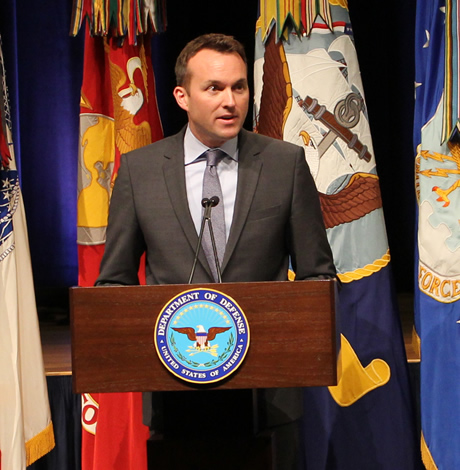
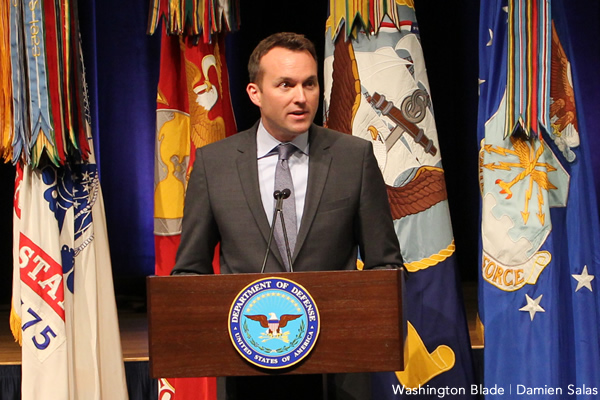
Secretary of the Army Eric Fanning (Washington Blade photo by Damien Salas)
Last Sunday’s New York Times editorial section was interesting. Reading has-been columnist Maureen Dowd trash Hillary Clinton, maybe for the 100th time, letting her apparent frustration and jealousy over Hillary’s success show was trivial and annoying.
There was, however, an exciting and important editorial that was the real news of the week in which history was made. The Times only had half the story in an editorial headline most likely to embarrass them in the future when they look back on it. It read “An Openly Gay Man Now Runs the Army.” Maybe one day soon the Times will realize if they wanted to make a real point the headline would have been: “Most Qualified Man Confirmed to Run the Army” and then could have added “Who Also Happens to Be Gay.”
It must be a dream of Eric Fanning’s one day to be written about without the word “gay” in front of his name as if it was actually his first name. One day they will simply write Eric Fanning, brilliant and qualified Secretary of the Army, was the first man to serve in a leadership capacity in three branches of the military.
Eric has already had an illustrious career. He was on the staff of the House Armed Services Committee and served in two positions for the president, first as a special assistant in the Immediate Office of the Secretary of Defense and then as associate director of political affairs in the White House.
His career has included working at the Business Executives for National Security, a D.C.-based think-tank and at Robinson, Lerer & Montgomery, a strategic communications firm in New York. At the Department of Defense he served as deputy undersecretary and deputy chief management officer for the Department of the Navy and deputy director of the Commission on the Prevention of Weapons of Mass Destruction Proliferation and Terrorism.
President Obama nominated him and he was confirmed as Under Secretary of the Air Force in 2013. He then became Acting Secretary of the Air Force when Michael Donley resigned, serving for six months. His exemplary career continued and President Obama nominated him to be Secretary of the Army. On May 17, after eight months of waiting, the Senate confirmed him.
One of his first acts as secretary was to participate in the West Point graduation this past Saturday. I can only imagine what went through his mind that day. According to the New York Daily News, the speaker, Vice President Joe Biden said, “greater diversity, including more women and openly gay soldiers, will strengthen the country’s armed forces. Having men and women together in the battlefield is an incredible asset, particularly when they’re asked to lead teams in parts of the world with fundamentally different expectations and norms.” They went on to report, “More than 950 cadets received their degrees and commissions as second lieutenants. Among them were the first seven women to be commissioned into combat divisions since combat restrictions for them were lifted.” Then the vice president in a salute to class president Eugene “E.J.” Coleman who had come out as gay said, “Before the repeal of the military’s ‘Don’t Ask, Don’t Tell’ policy in 2010, E.J. would have been discharged from the Army, and we would have lost an incredible talent. Thanks for your courage, E.J., and I expect we’re going to hear big things from you, pal.” So at West Point Saturday morning Fanning saw one of his troops, the newly minted second Lieutenant Coleman, a young African-American gay man from Virginia, lead his graduating class. Both these men make our country and the LGBT community proud.
But there was a downer this week that shows us vigilance is still needed. The San Diego Gay Men’s Chorus was heckled off stage and not allowed to sing at a San Diego Padres baseball game. The team issued the following apology: “This evening during the pre-game ceremony a mistake was made in the Petco Park control room that prevented the San Diego Gay Men’s Chorus from performing the National Anthem as scheduled. We apologize to anyone in the ball park who this may have offended, and have reached out to the chorus to express our deep regret for the error.”
Clearly they miss the point. They should be apologizing to all Americans who should be offended by what happened.
Peter Rosenstein is a longtime LGBT rights and Democratic Party activist. He writes regularly for the Blade.




Today nearly 99% of us watch wars on television. We see news reports, and watch bombs exploding and people dying, somewhere else. The only people actually involved are those who volunteered to serve in the military, and the national guard. I am sure most of them didn’t join to fight illegal wars like the one the felon in the White House is waging in Iran. But I respect them, and their willingness to serve our country.
But we are in Iran, and the felon is now asking Congress for $200 billion more for this war. We have been spending over a billion dollars a day. Who is paying for this? Right now, no one. We are simply adding it to the national debt, for our children to worry about. I propose a 5 or 10% surtax on every person, to cover the cost of this illegal war. Just have it added to your tax bill. If Congress passed such a surtax, I am sure we would already be out of Iran, as people would rise up to stop this illegal and unnecessary war very quickly.
I am old enough to remember the Vietnam War, and what we did to try to end it. It took time, but the people spoke. I did not serve, but unlike the felon in the White House, was willing to. I got my draft notice, along with a subway token, and reported to Whitehall street in NYC. It was as the Arlo Guthrie song, “Alice’s Restaurant,” said it would be. I got there at 7 a.m. and at 3 p.m. was told they wouldn’t take me because of my bad knee, sending me home with my 1Y designation. My friends had given me a going away party the night before, and my mom cried. So, it was a little embarrassing when my friends found I was still home. But my mom was happy and cried again.
I had been to anti-war demonstrations in D.C. in front of the DOJ, and got tear gassed. I demonstrated in London, in Russel Square, in front of the American embassy. While so many more were involved in that war because of the draft, we knew then if a 5% surtax had been levied, it would have ended much faster. Seems we never learn.
Today there is no draft, and no surtax. It is taking a while for people to recognize the felon who opposes any help for people to pay for their healthcare, easily asks for the $200 billion in funds for a totally unnecessary war. He closed USAID, which showed the United States in a positive light, helping people around the world, and that agency’s budget was only $25 billion. On top of not asking Americans to pay for this illegal war, he is giving tax breaks to millionaires, billionaires, and corporations, adding more to the national debt. What is the definition of insanity? Today it is clearly having voted for, and still supporting, the felon in the White House.
To make things worse and give us even less chance to stop his destruction of our democracy, the felon is trying to make it harder to vote. Millions of women who changed their names for marriage will not have a birth certificate with their current name on it, or a passport with their current name, allowing them to vote if the felon has his way. Reality is less than 50% of Americans even have a passport. The fact the Constitution gives states the right to set voting procedures, isn’t deterring the felon and his fascist cohorts, from trying to do it. He is doing it while we are losing American lives, the lives of heroes, who he has fighting a war he would have never signed up to fight himself. He is running it from the gold-leaf painted Oval Office, and from Mar-a-Lago, where he is golfing. He is a racist, sexist, homophobic, POS, working with the war criminal in Israel, causing a renewed spate of antisemitism and Islamophobia, and possibly creating World War III.
If you care about the future of the United States, you must stand up and speak out. We must defeat every Republican sycophant of his in the midterms — it’s the only way to let the felon know that we will not put up with his shit anymore. His grifting, and that of his family and appointees, must end. We the people, must not let him destroy 250 years of democracy, because he thinks he is a king. We fought a king once before and won. We will defeat him too. We will not let the felon implement the rest of Project 2025 and will take his name off everything he illegally plastered it on. He will be relegated to the trash heap of history, where he belongs, and we will reclaim our democracy for the next 250 years.
Peter Rosenstein is a longtime LGBTQ rights and Democratic Party activist.
Opinions
SAVE Act could silence millions of trans voters
New administrative barriers pose threat to voting rights
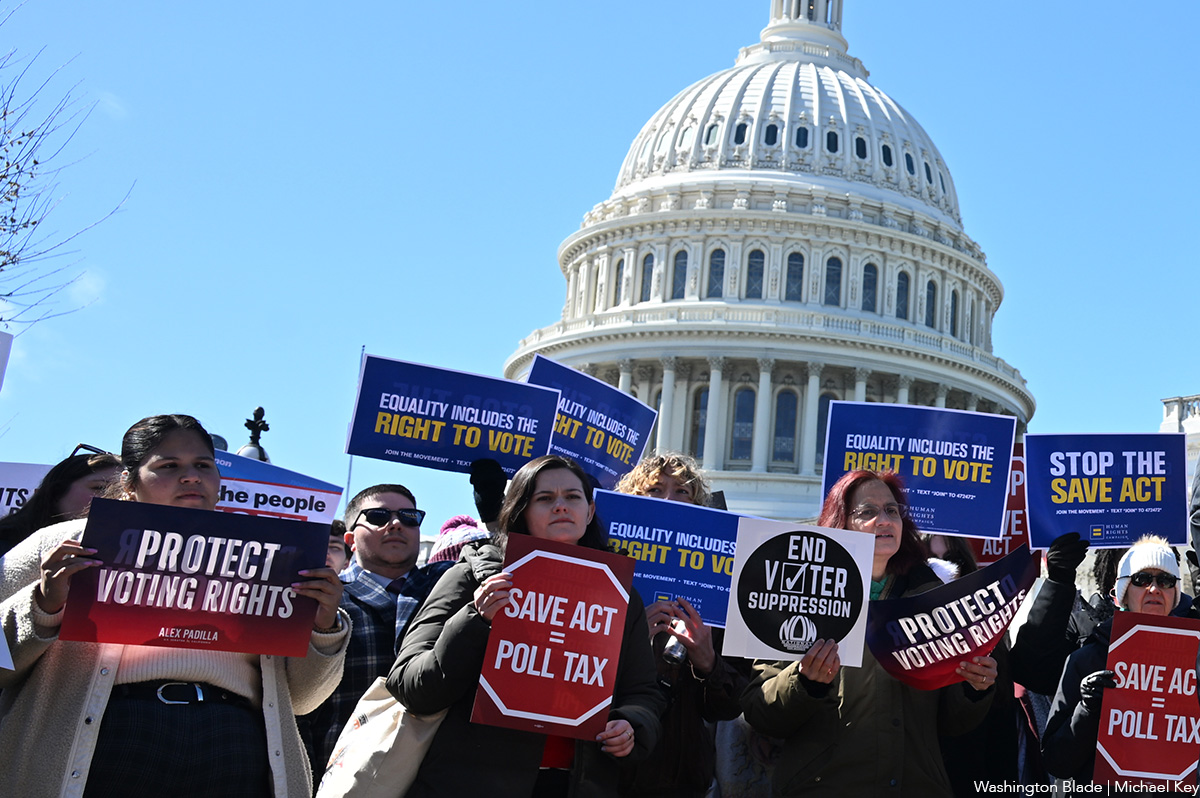
In Washington, debates over voting rights usually arrive loudly — through court rulings, protests, or sweeping legislation that captures national attention.
The Safeguard American Voter Eligibility (SAVE) Act, now under debate in Congress, may reshape voting access in a quieter way — through paperwork. The bill would require Americans registering to vote in federal elections to present documentary proof of citizenship, such as a passport or birth certificate. Supporters argue the measure would strengthen election integrity and restore public confidence in the voting process. But for millions of eligible voters, particularly transgender Americans, the practical consequences could be far more complicated.
According to Gallup, about 1.3% of U.S. adults identify as transgender, representing roughly 3.3 million Americans. Far from disengaged politically, transgender voters participate in elections at high rates. Data released by Advocates for Trans Equality shows 75% of transgender respondents reported voting in the 2020 election, compared with 67% of the general population. Registration rates are also higher.
This is a community that shows up for democracy. Yet the SAVE Act could place new administrative barriers directly in its path. Birth certificates, the document many supporters believe should verify citizenship are among the most difficult identity records for transgender Americans to update. According to data released by The Williams Institute at UCLA Law School and the U.S. Transgender Survey, 44% of transgender adults had updated their name on government identification, but only 18% had successfully updated their birth certificates.
That gap matters.
If birth certificates become a central requirement for voter registration, millions of eligible transgender Americans could face bureaucratic obstacles that other voters rarely encounter.
History offers a warning. According to the Bipartisan Policy Center, Kansas implemented a similar proof-of-citizenship law that blocked more than 30,000 eligible voters from registering before the Kansas Supreme Court struck it down as unconstitutional.
At the same time, evidence suggests voter fraud remains extraordinarily rare. Research cited by the American Immigration Council estimates fraud at roughly 0.0001% of votes cast.
The question before lawmakers is not whether election security matters. It clearly does. The question is whether policies designed to solve a rare problem could intentionally disenfranchise legitimate voters.
The broader cultural debate surrounding gender identity often becomes emotionally charged, particularly when conversations turn to pronouns or language. Yet polling suggests the issue remains unfamiliar to many Americans. A 2022 YouGov poll found only 22% of Americans personally know someone who uses gender-neutral pronouns.
Meanwhile, the problems weighing on everyday Americans are far larger: rising grocery prices, health care costs, housing shortages, and economic struggles in both rural towns and urban neighborhoods. Yet, many conservatives choose to focus unnecessary time, energy, and resources litigating the use of pronouns.
A healthy democracy should be able to debate cultural questions without allowing them to become barriers to the ballot box.
So, what should transgender Americans, and allies, do in this moment? First, stay engaged politically. Contact legislators and explain how identification requirements affect real voters. Personal stories often reach policymakers in ways statistics alone cannot.
Second, document the impact. Write letters to local newspapers, share experiences publicly, and ensure the real-world effects of voting policies are visible.
Third, consider running for office. Local school boards, city councils, and state legislatures shape many of the rules governing elections. Finally, protest with discipline and purpose. The most transformative movements in history — from Mahatma Gandhi to Dr. Martin Luther King Jr. — were rooted in peaceful persistence and moral clarity.
The SAVE Act may ultimately pass, fail, or change significantly as Congress debates it. But the larger principle at stake should guide the conversation. America’s democracy has always grown stronger when more citizens can participate, not when the path to the ballot becomes harder to navigate. For transgender voters, and for the country as a whole, that principle remains the quiet foundation of the republic.
James Bridgeforth, Ph.D., is a national columnist on the intersection of politics, morality, and civil rights. His work regularly appears in The Chicago Defender and The Black Wall Street Times.
Opinions
The frightening rise of antisemitism, Islamophobia
Trump, Netanyahu to blame for inflaming tensions

We can lay the rise in antisemitism and Islamophobia directly at the feet of the felon in the White House, and the criminal at the head of the Israeli government. Both Trump and Netanyahu belong in jail, not leading their governments.
I am a proud Jewish, gay man, and the homophobia and antisemitism the felon in the White House is generating are truly frightening. I am assuming my Muslim friends are feeling the same way about the Islamophobia he is causing to rise. While people have always been racist, homophobic, Islamophobic, and antisemitic, Trump has given tacit permission, with his statements, actions, and now his war on Iran, for those feelings to be shouted in the public square, and in the worst-case scenarios, acted on with violent attacks.
We can clearly attribute the rise in antisemitism around the world, to the actions of the right-wing, war criminal, leader of the Israeli government, Benjamin Netanyahu, and what he is doing to destroy Gaza, murdering innocent Palestinians, and now again bombing innocents in Lebanon.
This is all seeping into the politics of our nation. One organization promoting antisemitism and expecting it of the candidates they endorse, is the Democratic Socialists of America (DSA). They went so far as to take away an endorsement at one point, from one of their most ardent supporters, Rep. Alexandria Ocasio-Cortez (D-N.Y.), because she refused to fully support their anti-Zionist platform and their support of BDS. The DSA took issue with “[Ocasio-Cortez’s] votes, including a vote in favor of H.Res.888, conflating opposition to Israel’s ‘right to exist’ with antisemitism,” and a press release in April she co-signed that “support[s] strengthening the Iron Dome and other defense systems.” In their 2025 platform DSA called for a single state from the ‘river to the sea’ as the Palestinian right to resist, thereby eliminating the State of Israel. It goes with their support of BDS and anti-Zionist positions. It is fair to see that as antisemitism.
I am a Zionist, in the sense of the term as coined by Theodor Herzl. I am a believer in, and supporter of, the State of Israel. I am also for a Palestinian state. I am opposed to what Israel’s current government, led by a war criminal, is doing. I had hoped he would have abided by what former President Biden said to him immediately after Oct. 7. “Don’t make the same mistake we did after 9/11. Temper your response.” But instead, Netanyahu has murdered Palestinians by the thousands, destroying Gaza. He was rightfully declared a war criminal and should be brought to justice. He has made things worse both for the people of Israel, and Jews around the world. He has been responsible for antisemitism around the world once again rearing its ugly head. Now, two and a half years after Hamas’s attack on Israel, he is still murdering Palestinians, and now again more people in Lebanon and Iran. He still denies the Palestinian people need a home, a state of their own. He promotes settlements on the West Bank that should be part of a Palestinian state and refuses to prosecute settlers who commit crimes against the Palestinian people there.
My parents and relatives had to flee Hitler. Some came to the United States, and some immigrated to Israel. My father’s parents were killed in Auschwitz. I believed it could never happen again. But the felon in the White House, and criminal in Israel, are abusing me of that notion. Their policies of greed and corruption are leading to danger for all the people of the world. They are leading us into a third world war. The felon is attempting to steal, yes steal, billions through his phony ‘Board of Peace’ where he is screwing the Palestinian people out of their homes in Gaza. It is insanity, and we are all suffering for it; Jews, Muslims, and the rest of the world, as we are thrown into war none of us wants.
Now as I wrote, the DSA, tells people all Zionists are the enemy, without a definition of what a Zionist is. They expect their supporters not to recognize the State of Israel. They create antisemitism, and now in D.C. we have a candidate running for mayor, Janeese Lewis George, asking for, and getting their support. They also have in their platform to defund the police. Those things should frighten all the people of D.C. Any candidate who can run on the DSA platform must be deemed unacceptable to anyone who opposes prejudice and discrimination of any kind. One prejudice leads to others and gives rise to people feeling they can be open about not only their antisemitism, but their Islamophobia, racism, and sexism, as well.
We need all the good voters in the District of Columbia to find these DSA positions unacceptable, and reject any candidate who solicits, and takes their endorsement.
Peter Rosenstein is a longtime LGBTQ rights and Democratic Party activist.

Pa. House passes bill to codify marriage equality in state law

A surtax would end this war quickly

DeSantis signs emergency bill that restores Fla. ADAP funding

Menaka Guruswamy celebrated as India’s first openly LGBTQ MP

Trans-led HIV clinic in Portsmouth struggles amid funding cuts

‘How We Survived’ panel set for March 25

Calendar: March 21-26

PHOTOS: Capital Stonewall Democrats 50th anniversary

‘Inherit the Wind’ isn’t about science vs. religion, but the right to think