Sports
Long-distance swimmer pursues triple crown
Marty Filipowski to tackle 20 bridges race in mid-Aug.
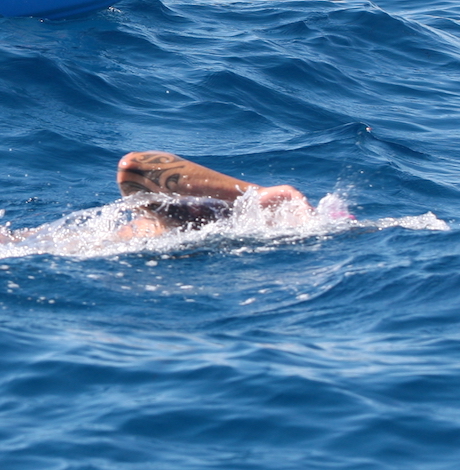
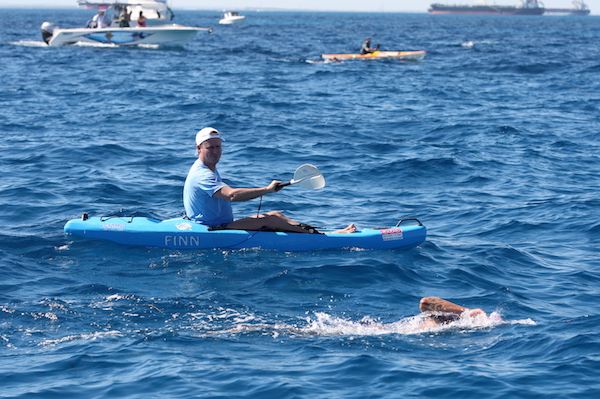
Marty Filipowski crossing the Rottnest Channel with his husband, Sonny, paddling alongside him. (Photo courtesy Filipowski)
To gain membership into the triple crown of open-water swimming, one must have authenticated completion of three famous marathon swims: the English Channel between England and France, the Catalina Channel in Southern California and the Manhattan Island marathon swim.
On Aug. 15, 53-year-old openly gay marathon swimmer Marty Filipowski will attempt to complete the triple crown when he swims 20 bridges, a circumnavigation swim of Manhattan that is 28.5 miles in distance.
Jewel number one
In August 2013, his crossing of the English Channel was 31 miles in rough water that was 59 degrees. He was the only swimmer to finish the crossing that day and he was awarded the most meritorious swim of the year by the Channel Swimming Association. His time was 14 hours, 39 minutes.
“The English Channel swim absolutely changed me in terms of how I approach my life, work and swimming,” Filipowski says. “Everything takes a great plan, and you have to have initiatives step by step to complete your plan.”
Filipowski grew up in Valparaiso, Ind., and was in competitive swimming until his sophomore year of high school. He left the sport because he felt he didn’t fit in and turned his extracurricular attentions to working as the yearbook photographer.
After graduating with a degree in journalism from Indiana University, his work took him to several states including a stint in D.C. as press secretary for U.S. Sen. Connie Mack of Florida.
He credits the LGBT swimming community for getting him back into the sport as he swam with Atlanta Rainbow Trout and Team New York Aquatics during his work assignments. He is now living in Sydney, Australia and has been with Dell since 2006 working as corporate director of communications for Asia Pacific and Japan.
It was after he joined Vladswim in Sydney that he became interested in marathon swimming. Its members train four days a week in the pool and longer open-water swims on weekends.
“Vladswim had people training for triathlons and open-water swimming so I started competing in Sunday races in distances of 1.5K to 10K,” Filipowski says. “There were also people training for the English Channel and I figured if they could do it, so could I.”
He started his marathon training in 2011 and during his first attempt at an eight hour training swim in 59 degree water, he was pulled out at four-and-a-half hours. It was a lesson that led to Filipowski working with a dietician to add weight, becoming more comfortable training in cold water, adopting feeding plans and working with a massage therapist.
“You are able to train all year long in Sydney, but you really need a good support network to accomplish the training needed for a marathon swim,” he says. “There are time management issues as well and that support extends to my boss at work and my husband at home.”
Jewel number two
He picked up the second piece of the crown by completing the 22-mile Catalina Channel in August, 2015. His training for that race included a lot of practicing at night as half the swim was completed in the dark.
A constant in the journey to complete both the English Channel and the Catalina Channel was Filipowski’s husband, Sonny, who paddles alongside him in a kayak. The two were married at Alki Beach in Seattle following the English Channel crossing.
“During the lead-up to the English Channel, Sonny kayaked alongside me during all my long open-water training swims,” Filipowski says. “He also did the same as I trained for Catalina and also during the actual swim. He spent 13 hours in the kayak for that crossing.”
Jewel number three and beyond
Filipowski won’t be hanging up his suit after he completes the Manhattan swim next month. While traveling the world working for Dell, he will continue to train at pools in China, India, Singapore and Japan along with pool and ocean training in Australia.
Next year, he will attempt to cross Cook Strait in New Zealand which is about 14 miles wide and considered one of the most dangerous and unpredictable waters in the world.
“I love being a marathon swimmer because you are swimming against yourself and the water conditions all while pushing through mental barriers,” Filipowski says. “It gives me balance between my work and my personal satisfaction.”
He also identifies himself as an “out” swimmer when he receives recognition for his swims.
“I like being a visible gay athlete,” Filipowski says. “It would have been helpful to have a role model when I was growing up. I want to be visible to others.”
Sports
New IOC policy bans trans women from Olympics
New regulation to be in effect at 2028 summer games in Los Angeles
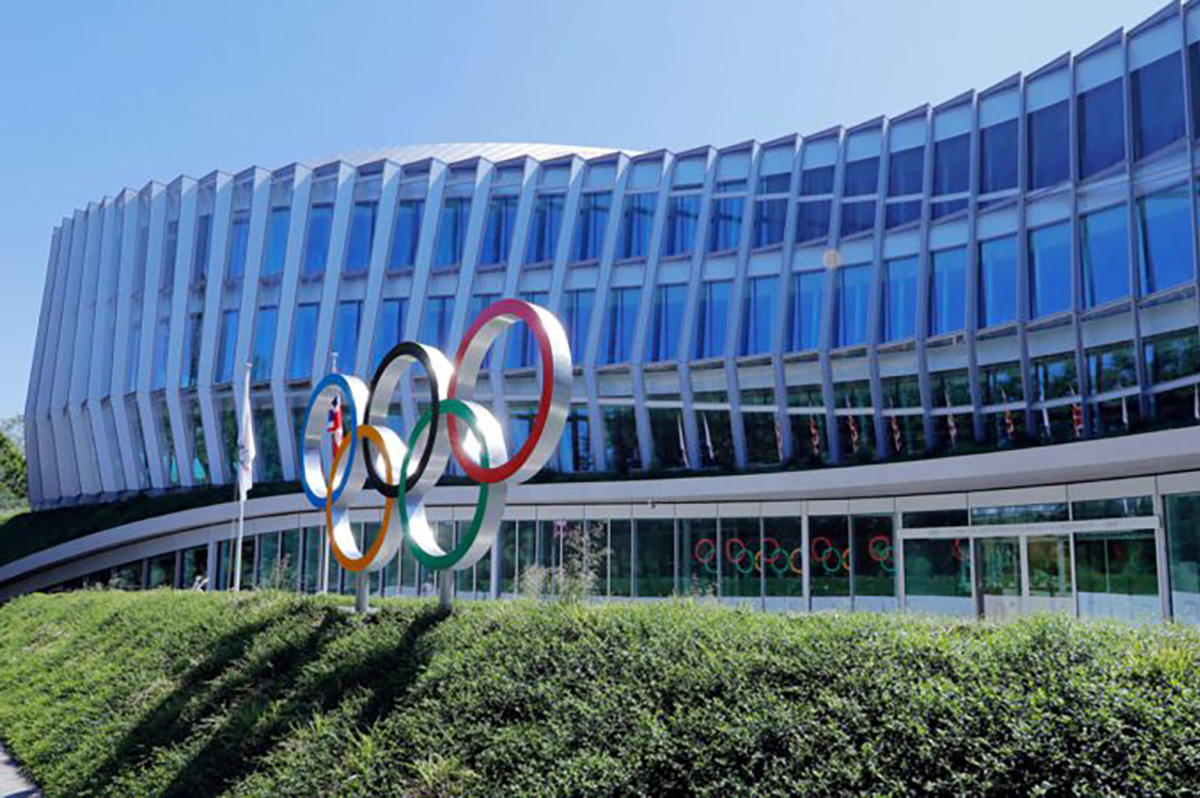
The International Olympic Committee on Thursday announced it will not allow transgender women from competing in female events at the Olympics.
“For all disciplines on the Sports Program of an IOC event, including individual and team sports, eligibility for any Female Category is limited to biological females,” reads the new policy.
The policy states “eligibility for the Female Category is to be determined in the first instance by SRY Gene screening to detect the absence or presence of the SRY Gene.”
“On the basis of the scientific evidence, the IOC considers that the SRY (sex-determining Region Y) Gene is fixed throughout life and represents highly accurate evidence that an athlete has experienced or will experience male sex development,” it reads. “Furthermore, the IOC considers that SRY Gene screening via saliva, cheek swab or blood sample is unintrusive compared to other possible methods. Athletes who screen negative for the SRY gene permanently satisfy this policy’s eligibility criteria for competition in the Female Category.”
The policy states the test “will be a once-in-a-lifetime test” unless “there is reason to believe a negative reading is in error.”
The new regulation will be in place for the 2028 Summer Olympics in Los Angeles.
“I understand that this a very sensitive topic,” said IOC President Kirsty Coventry on Thursday in a video. “As a former athlete, I passionately believe in the rights of all Olympians to take part in fair competition.”
“The policy that we have announced is based on science and it has been led by medical experts with the best interests of athletes at its heart. The scientific evidence is very clear: male chromosomes give performance advances in sport that rely on strength, power, or endurance,” she added. “At the Olympic Games, even the smallest margins can be the difference between victory and defeat. So, it is absolutely clear that it would not be fair for biological males to compete in the female category. In addition, in some sports it would simply not be safe.”
(Video courtesy of the IOC)
Laurel Hubbard, a weightlifter from New Zealand, in 2021 became the first trans woman to compete at the Olympics.
Imane Khelif, an Algerian boxer, won a gold medal at the 2024 Summer Olympics in Paris. Khelif later sued JK Rowling and Elon Musk for cyberstalking after they questioned her gender identity.
Ellis Lundholm, a mogul skier from Sweden, this year became the first openly trans athlete to compete in any Winter Olympics when he participated in Milan Cortina Winter Olympics in Italy.
President Donald Trump in February 2025 issued an executive order that bans trans women and girls from female sports teams in the U.S.
The U.S. Olympic and Paralympic Committee last July banned trans women from competing in female sporting events. Republican lawmakers have demanded the IOC ban trans athletes from women’s athletic competitions.
“I’m grateful the Olympics finally embraced the common sense policy that women’s sports are for women, not for men,” said U.S. Sen. Tom Cotton (R-Ark.) on X.
An IOC spokesperson on Thursday referred the Washington Blade to the press release that announced the new policy.
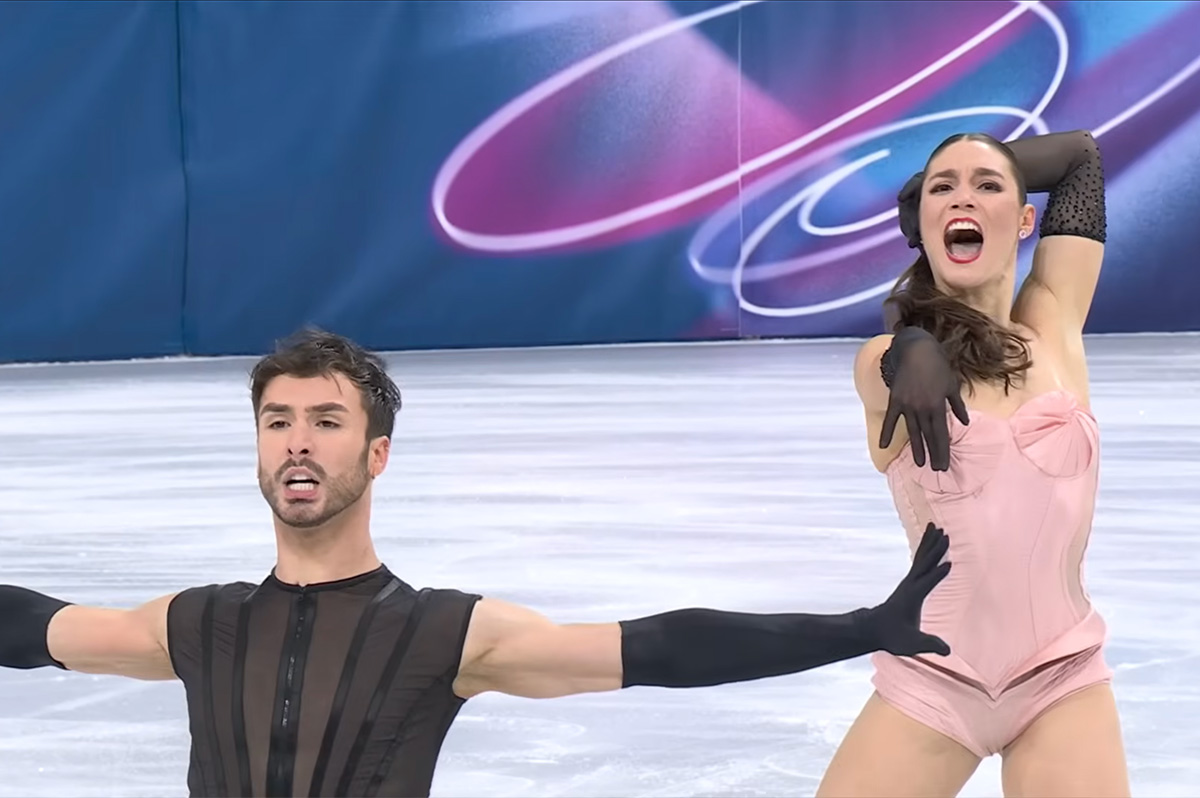
More than a dozen LGBTQ athletes won medals at the Milan Cortina Winter Olympics that ended on Sunday.
Cayla Barnes, Hilary Knight, and Alex Carpenter are LGBTQ members of the U.S. women’s hockey team that won a gold medal after they defeated Canada in overtime. Knight the day before the Feb. 19 match proposed to her girlfriend, Brittany Bowe, an Olympic speed skater.
French ice dancer Guillaume Cizeron, who is gay, and his partner Laurence Fournier Beaudry won gold. American alpine skier Breezy Johnson, who is bisexual, won gold in the women’s downhill. Amber Glenn, who identifies as bisexual and pansexual, was part of the American figure skating team that won gold in the team event.
Swiss freestyle skier Mathilde Gremaud, who is in a relationship with Vali Höll, an Austrian mountain biker, won gold in women’s freeski slopestyle.
Bruce Mouat, who is the captain of the British curling team that won a silver medal, is gay. Six members of the Canadian women’s hockey team — Emily Clark, Erin Ambrose, Emerance Maschmeyer, Brianne Jenner, Laura Stacey, and Marie-Philip Poulin — that won silver are LGBTQ.
Swedish freestyle skier Sandra Naeslund, who is a lesbian, won a bronze medal in ski cross.
Belgian speed skater Tineke den Dulk, who is bisexual, was part of her country’s mixed 2000-meter relay that won bronze. Canadian ice dancer Paul Poirier, who is gay, and his partner, Piper Gilles, won bronze.
Laura Zimmermann, who is queer, is a member of the Swiss women’s hockey team that won bronze when they defeated Sweden.
Outsports.com notes all of the LGBTQ Olympians who competed at the games and who medaled.
Sports
US wins Olympic gold medal in women’s hockey
Team captain Hilary Knight proposed to girlfriend on Wednesday
The U.S. women’s hockey team on Thursday won a gold medal at the Milan Cortina Winter Olympics.
Team USA defeated Canada 2-1 in overtime. The game took place a day after Team USA captain Hilary Knight proposed to her girlfriend, Brittany Bowe, an Olympic speed skater.
Cayla Barnes and Alex Carpenter — Knight’s teammates — are also LGBTQ. They are among the more than 40 openly LGBTQ athletes who are competing in the games.
The Olympics will end on Sunday.

Trump’s war threats trigger rare 25th Amendment discussion

A Sondheim masterpiece ‘Merrily’ rolls onto Netflix

ROSENSTEIN: Vote McDuffie for mayor of D.C.

New book celebrates 1970s dance music icons

Report: Grenell wants Russian ambassadorship

Risking it all for love during World War II

PHOTOS: The Bonnet Ball

D.C. is the place for the Democratic Socialists of America

Key lifestyle changes can help patients cope with diabetes