News
Trumpcare appears defeated, but LGBT opponents remain wary
‘I don’t think we’ve heard the last from the GOP on healthcare’


President Trump poses in cab of firetruck on day GOP support for Trumpcare crumbles. (Image courtesy of C-SPAN)
After Republican support crumbled for Trumpcare, LGBT advocacy groups that sought to preserve the Affordable Care Act are quietly confident it will remain in place — although they say they’re keeping a watchful eye.
Late Monday night, two Republicans — Sens. Mike Lee (R-Utah) and Jerry Moran (R-Kansas) — announced they’d vote “no” on the latest version of the Better Care Reconciliation Act proposed by Senate Majority Leader Mitch McConnell (R-Ky.). With Sens. Susan Collins (R-Maine) and Rand Paul (R-Ky.) already opposed to the bill, the defections of Lee and Moran assured defeat of the bill if it came to the floor.
David Stacy, government affairs director for the Human Rights Campaign, said despite the apparent failure of Trumpcare, now is not the time to rest.
“While we’re glad to see the Trump/McConnell plan to strip health care from millions of Americans has failed up until this point, by no means are we claiming complete victory,” Stacy said. “The ACA provides unprecedented access to health care for LGBTQ people and we simply cannot afford for this access to be taken away. HRC will continue to engage our millions of members across the country and keep the pressure on Congress to reject any proposals to dismantle our health care system.”
LGBT groups like the Human Rights Campaign oppose Trump’s effort to repeal and replace the ACA on the basis that many LGBT people gained insurance as a result of President Obama’s signature legislative achievement and because the measure would deny Medicaid reimbursements to Planned Parenthood, which touts its health services for LGBT people.
McConnell has pledged to bring to the floor legislation in the coming days that would repeal Obamacare without offering any replacement — a move that in addition to eliminating health care for millions of people would explode the deficit.
Even though the same bill passed the chamber in 2015, it’s unlikely to pass this time around without assurance of a presidential veto. Key Republicans — Sens. Lisa Murkowski (R-Alaska) and Shelly Moore Capito (R-W.Va.) — have said they’d vote “no.” Collins voted “no” in 2015 and said she’d do so again.
Mara Keisling, executive director of the National Center for Transgender Equality, nonetheless cautioned “cynical efforts to hurt Americans for political purposes” may still be on the way despite projections Trumpcare is dead.
“We are not confident that efforts to defund Planned Parenthood are dead,” Keisling said. “We are not confident that efforts to take healthcare away from trans service members and veterans are dead. We will continue to fight side-by-side with so many allies to make sure our healthcare system is improved and not dismantled and made accessible only to the wealthy. We are extremely confident that our side will fight harder and with solidarity to protect people’s lives than the powers that be will fight to hurt us.”
After the loss of GOP support for the Better Care Reconciliation Act, President Trump took to Twitter to lambast lawmakers, blaming the failure on “all of the Democrats and a few Republicans.”
“Most Republicans were loyal, terrific & worked really hard,” Trump tweeted. “We will return!”
The White House has maintained Trump made phone calls to lawmakers and met with them to encourage their support for the Senate health care bill. On Wednesday, Trump was set to hold a working lunch at the White House State Dining Room with Republican members of Congress to discuss health care.
Nonetheless, the general perception is Trump has been disengaged from efforts to repeal Obamacare — a signature promise during Trump’s presidential campaign. On Monday, the same day GOP support for Trumpcare crumbled, Trump posed for a photo-op in the cab of a firetruck parked on the White House lawn for “Made in America” week.
White House Deputy Principal Press Secretary Sarah Huckabee Sanders blamed Democrats on Tuesday for the failure of Trumpcare, even though they’re in the minority in Congress and weren’t responsible for GOP withdrawal from the bill.
“They’re responsible for passing Obamacare,” Sanders said. “They’re responsible for creating the mess that we’re in. They’re responsible for being unwilling to work with Republicans in any capacity to help fix a system that they know is completely flawed and have publicly said so. I think that it’s pretty clear, and I think the responsibility lies on their shoulders.”
Gregory Angelo, president of Log Cabin Republicans, said contrary to expectations that Trumpcare is dead, he wouldn’t rule out Republican efforts to reform health care law.
“I don’t think we’ve heard the last from the GOP on healthcare,” Angelo said. “Whether it’s repeal, replace, reform, or some combination thereof, the continuing collapse of Obamacare, spikes in premiums and insurer exits from exchanges will necessitate that Republicans act sooner or later.”
Trump himself may take unilateral action. On Tuesday, he told reporters “we’re probably in that position where we’ll let Obamacare fail” in the aftermath of crumbling support for the bill.
“We’re not going to own it. I’m not going to own it,” Trump said. “I can tell you the Republicans are not going to own it. We’ll let Obamacare fail and then the Democrats are going to come to us and they are going to say ‘how do we fix it, how do we fix it’ or ‘how do we come up with a new plan?’”
Trump’s position for some time has been that Obamacare is a dead program, but his remarks raise questions about whether the Trump administration would seek to administratively undermine the Affordable Care Act, such as by denying subsidies to health care recipients who qualify for them.
At the White House, Sanders wouldn’t commit the president to support the subsidies and the executive sustenance required under the Affordable Care Act.
“As has been the case since we got here, we’ll continue to keep you posted as decisions and changes are made, or if they’re not,” Sanders said.
Meanwhile, bipartisan talks on health care are happening. Sen. Tom Carper (D-Del.) told the Daily Beast a bipartisan group of senators spoke Tuesday night about possible fixes to Obamacare that don’t involve repealing the law.
“Democrats, Republicans, and I think one independent slipped in as well,” Carper was quoted as saying. “I’m more encouraged at this point than I’ve been in quite some while that we might somehow be able to find a road, a path together.”
A major criticism from LGBT groups — as well as HIV/AIDS advocacy groups — was the inclusion in GOP plans to replace Obamacare of a provision to undo the Medicaid expansion under the Affordable Care Act. That rose the income level to qualify for care under that program to 133 percent of the poverty level — provided the states agreed to it.
An estimated 40 percent of people with HIV — a disease that still disproportionately affects LGBT people — received coverage under Medicaid.
Carl Schmid, deputy executive director of AIDS Action, said he expects Obamacare to remain the law and is “greatly relieved,” but nonetheless noted the need for change of the health care system.
“There is much that the administration can do through regulation to alter health care — private insurance plans and Medicaid — and [we] expect them to do that, actually they have started to make changes as well,” Schmid said. “As they make changes, we want to make sure they do not restrict access and benefits and loosen important patient protections. Legislative fixes are still needed, premiums and patient cost-sharing are too high, and we hope that they can happen on a bi-partisan basis.”




The White House
Kristi Noem ‘devastated’ as husband’s alleged fetish spending surfaces
Former DHS head ‘blindsided’ by allegations
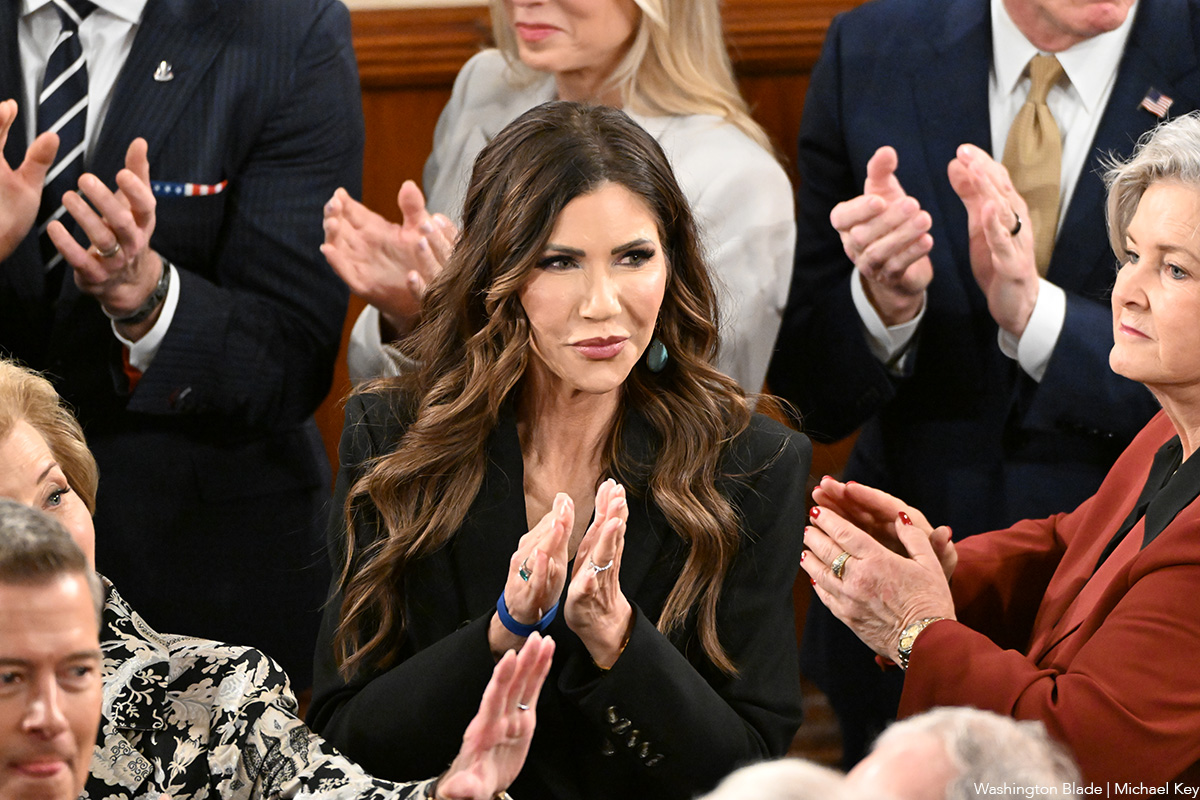
Former Department of Homeland Security Secretary Kristi Noem said she is “devastated” after reports alleged her husband paid large sums to fetish models and shared cross-dressing photos while married to her.
The Daily Mail first reported the story on March 31, accusing 56-year-old Bryon Noem — the former second gentleman of South Dakota and husband to the former DHS secretary — of exchanging hundreds of messages with three women in the “bimbofication” fetish scene. According to the report, he praised their surgically enhanced bodies and was asked to send them money though various online accounts during the 14 months his wife led the nation’s largest federal law enforcement agency.
He sent them at least $25,000 via Cash App and PayPal, according to the story, that also included photos reportedly show him wearing pink shorts and a flesh-colored top with balloons simulating breasts.
When the payments were delayed or failed to be sent, the women would get mad and ignore him, the story reads. At least one woman who didn’t receive money after texting Noem was so disgruntled she posted about his behavior on social media before later deleting it.
The allegations quickly went viral across social media and major news outlets. Representatives for Kristi Noem told the New York Post she was “devastated” and that her family was “blindsided” by the claims, while requesting privacy and prayers.
President Donald Trump, when asked by the Daily Mail, expressed surprise that the Noem family had confirmed the photos’ authenticity.
“They confirmed it? Wow, well, I feel badly for the family if that’s the case, that’s too bad,” Trump told the outlet that broke the story. “I haven’t seen anything. I don’t know anything about it. That’s too bad, but I just know nothing about it.”
Kristi and Bryon Noem met in high school and married in 1992, according to the Daily Mail. They have two daughters, Kassidy, 31, and Kennedy, 29, and a son, Booker, 23.
The controversy comes after Noem’s recent removal from one of the highest-ranking positions in Trump’s Cabinet. Markwayne Mullin was sworn in as Homeland Security Secretary last week, though Noem remains part of the president’s team as special envoy to the Shield of the Americas, a U.S.-led regional security organization focused on coordinating efforts to combat organized crime, drug trafficking, and illegal migration throughout the Western Hemisphere.
Noem’s political career spans more than a decade across state and federal government jobs. She served in the South Dakota House of Representatives from 2007 to 2011, in the U.S. House of Representatives from 2011 to 2019, and as Governor of South Dakota from 2019 to 2025.
She was confirmed as Secretary of Homeland Security during Trump’s second term, serving from 2025 until her removal following widespread backlash over escalating U.S. Immigration and Customs Enforcement operations, which included separating children from their families and two separate fatal shootings of U.S. citizens by ICE officers during protests. Trump reportedly decided to fire Noem from DHS after her congressional hearing related to the deaths, in which she stated that the president had approved a $200 million-plus government-funded DHS advertising campaign that prominently featured her.
The reports about her husband have also reignited speculation about Noem’s personal life, including rumors involving Trump supporting political operative Corey Lewandowski, described by some as the “worst-kept secret in D.C.”
Some accounts suggest Bryon Noem was aware of the alleged relationship — and benefited from it. Political commentator Ryan James Girdusky fueled that speculation during an August 2025 episode of the It’s a Numbers Game podcast, citing what he described as “D.C. gossip” that a top Cabinet official — rumored to be Noem — had privately claimed her husband was gay.
“A reporter walked up to her and said, ‘Why are you having this affair? Why haven’t you met up with your husband? Why aren’t you divorcing your husband?’” Girdusky said on the podcast. “And she blurted out to this reporter, who I know, and said, ‘Oh, my husband’s gay.’”
Unlike the unverified claims surrounding her husband, Noem’s political record on LGBTQ issues is well documented.
In 2024, while serving as governor, her administration canceled a contract with a community health worker organization, resulting in a $300,000 settlement with a transgender advocacy group. The contract had included a roughly $136,000 state-administered federal grant, of which about $39,000 had already been distributed, according to the group’s attorneys.
Noem also championed a series of policies restricting trans rights. She signed executive orders in 2021 barring transgender girls and women from competing on women’s sports teams at public schools and colleges in the state. In addition to using executive authority to enact these policies, she signed legislation into law. She enacted House Bill 1080, which bans age-appropriate, medically necessary health care for trans youth — despite widespread support for such care from major medical associations and global health authorities.
Noem also supported legislation aimed at restricting trans athletes, though she ultimately vetoed one bill, citing potential legal challenges from the NCAA while maintaining support for its intent. Additionally, she signed a Religious Freedom Restoration Act that LGBTQ advocates say enables discrimination under the guise of protecting religious liberty.
U.S. Supreme Court
Colo. activists condemn SCOTUS conversion therapy ruling
8-1 decision could have sweeping implications
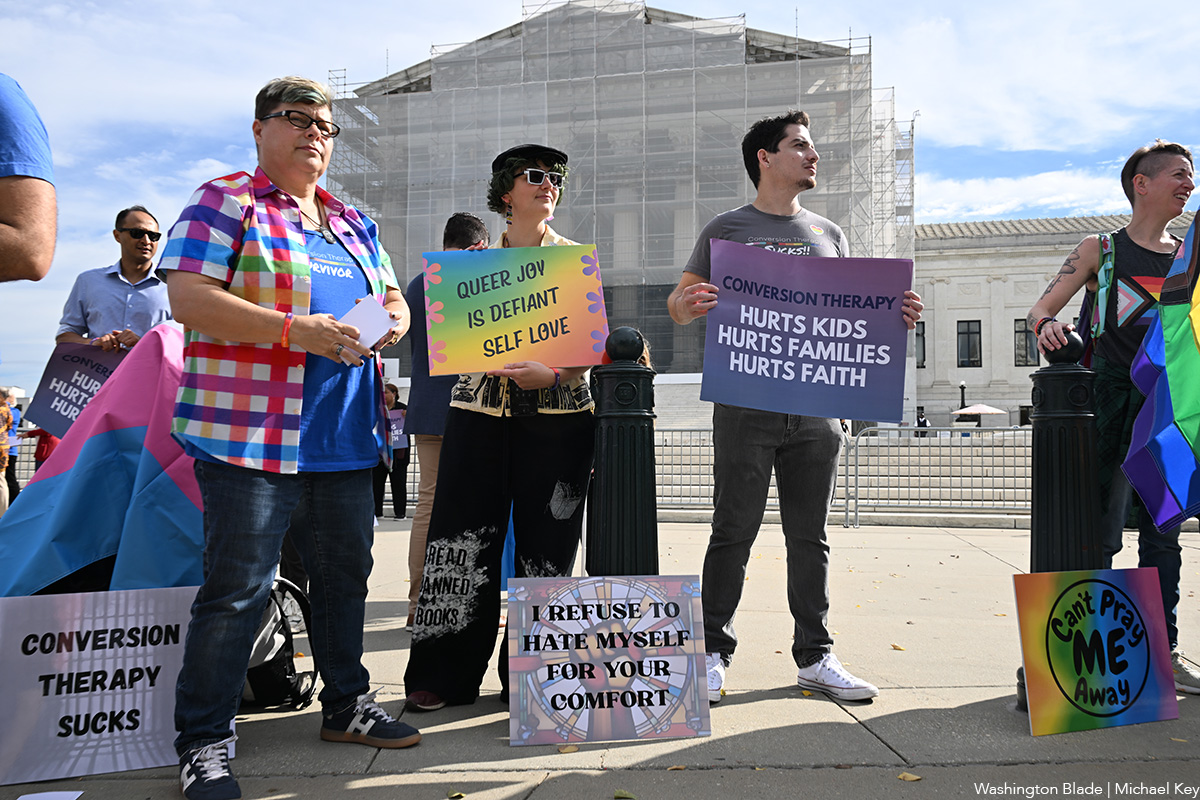
The Supreme Court ruled in Chiles v. Salazar that a Colorado law banning conversion therapy is unconstitutional, striking down the state’s 2019 statute and potentially impacting similar laws across the country. Religious advocates have hailed Tuesday’s decision as a victory for the First Amendment and evangelical Christians, while LGBTQ activists warn it could lead to increased harm for LGBTQ youth.
The conservative majority, joined by two progressive members of the court, sided 8–1 with Kaley Chiles on March 31 in what some critics are calling a landmark ruling for religious zealots, placing the teachings of the Bible above established medical consensus. Chiles, a Christian therapist who practices what she describes as “faith-based talk therapy for children,” challenged Colorado’s House Bill 19-1129, a law prohibiting licensed professionals from engaging minors in efforts to change their sexual orientation or gender identity through conversion therapy. She successfully argued that she and her clients have a constitutional religious right to choose the type of therapy they seek, effectively nullifying the Colorado law banning conversion therapy.
When the court heard oral arguments in October 2025, early questions indicated that the justices were likely to rule against the state in a matter involving LGBTQ rights, making this the fourth major LGBTQ rights case to come from Colorado since 1996.
In 1996, the Supreme Court overruled state initiative Amendment 2 in Romer v. Evans, which tried, but ultimately failed to restrict rules on gay people’s protected status in Colorado. Then in 2018, SCOTUS presided over Masterpiece Cakeshop v. Colorado Civil Rights Commission, when a Lakewood baker refused to make a cake for a gay client, which the state argued violated it’s civil rights commission order, but the court sided with the baker, ruling the commission had violated his Christian beliefs. In 2023 the court ruled in 303 Creative LLC v. Elenis that a Denver-based web designer is legally allowed to refuse to make wedding websites for same-sex couples, and successfully arguing she was constitutionally protected under the First Amendment.
Chiles, who practices in Colorado Springs, combines traditional psychological approaches — including cognitive, behavioral, psychodynamic, and humanistic therapies — with Christian beliefs. She argued that the law violated her First Amendment rights by restricting her ability to practice therapy aligned with her religious values, as well as limiting the rights of clients seeking that form of care.
Conversion therapy, widely discredited by major medical and psychological associations, is defined as practices that attempt to change a person’s sexual orientation or gender identity. Under Colorado law, providers found in violation could face fines up to $5,000, suspension, or loss of licensure.
Lower courts — including a district court and the 10th Circuit — previously upheld the law, finding it regulated professional conduct rather than speech and therefore required only minimal constitutional scrutiny. However, the Supreme Court, with three Trump-appointed justices, determined that the lower courts failed to apply “sufficiently rigorous First Amendment scrutiny,” raising concerns about violations of both the Establishment Clause and the Free Exercise Clause. The ruling sends the case back to a lower court for further review.
The decision reflects a broader trend in recent years, with the current court — often referred to as the Roberts Court — more frequently siding with religious liberty claims, particularly those involving Christian plaintiffs.
To better understand the implications of the ruling, the Washington Blade spoke with Colorado-based LGBTQ advocacy organization Rocky Mountain Equality, which has spent decades organizing, educating, and providing services across the state.
Founded in 1994 as Boulder Pride, the organization has since expanded into a statewide force addressing LGBTQ issues, including healthcare, housing, and youth services. Now operating as Rocky Mountain Equality, the group saw a 62 percent increase in 2024 operating revenue, growing to more than $3.765 million while running the Equality Center of the Rocky Mountains in Boulder.
Mardi Moore, the chief executive officer of Rocky Mountain Equality, sat down with the Blade to discuss the ruling and its impact on the broader LGBTQ community, calling it both expected and deeply concerning.
“When the ruling came out today, I think we all knew it wasn’t going to be a winning battle after hearing arguments, but the 8-1 decision made me sad, and honestly, it’s turning into anger,” Moore told the Blade on Tuesday morning. “This is a really sad day — not just for LGBTQ kids, but for all kids in Colorado.”
Moore explained that the law passed with support from Colorado lawmakers and felt like progress toward making the state safer for LGBTQ residents.
While oral arguments were being heard in October, the Blade spoke to a group of conversion therapy survivors who came to the nation’s capital to protest the ban’s removal and support one another. Their stories detailed the emotional and physical toll of conversion therapy.
“We all know the horror stories, and we know conversion therapy is pseudoscience,” she continued. “About a decade ago, Colorado passed a bill — under the leadership of then-Rep. Daniel Ramos — that banned conversion therapy with religious exceptions, which was a huge step forward.”
That step forward now feels like a step back, Moore suggested. While the ruling currently applies to Colorado, she warned it could embolden similar legal challenges nationwide.
“In our initial reading, this ruling only impacts Colorado and isn’t a broader issue for other states. But that doesn’t mean people who oppose LGBTQ rights won’t start fighting state by state,” Moore said. She pointed to the state’s history, including the fight against Amendment 2. “Here in Colorado, we’re used to these battles — we fought Amendment 2, and we’re still fighting now. There are two ballot measures this November: one targeting gender-affirming care for minors, and another banning trans youth from sports at all levels.”
These ballot measures, Moore explained, represent another attempt to restrict trans youth. One would limit gender-affirming surgeries for minors — procedures that research shows are extremely rare — while another would restrict sports participation based on sex assigned at birth.
“These efforts are trying to wipe trans kids off the map. This ruling is sickening — the religious right is still very active, and people who think voting doesn’t matter need to understand that presidents shape Supreme Courts.”
Moore emphasized that while national advocacy is critical, the fight increasingly comes down to local organizing and direct support.
“Here at Rocky Mountain Equality, we advocate for the community, train providers, and support people who have gone through conversion therapy. We have a strong youth program and will continue supporting young people in every way we can.”
“Colorado may seem progressive, but it’s still a purple state,” she added. “Messaging that works in Denver doesn’t always reach families who might send their kids to conversion therapy.”
The timing of the ruling — released on Trans Day of Visibility — also drew criticism.
“Releasing this decision on Trans Day of Visibility feels calculated. It takes a day meant for joy and turns it into another setback,” Moore said.
When asked about next steps, Moore pointed to state-apponited officials who support LGBTQ rights are likely reviewing options.
“I don’t have specifics yet on organized legal responses, but our attorney general, Phil Weiser, argued this case,” she said. “I imagine his office is reviewing every possible option right now.”
Despite the opinion dropping so recently, the emotional toll is already being felt.
“I texted a colleague this morning who went through conversion therapy — it was a sad emoji kind of day,” she said, also referencing a similiar feeling to the one she has now the case of Alana Chen, a University of Colorado Boulder student who died by suicide after experiencing conversion therapy.
“Her story devastated so many, including her mother,” she shared, adding that despite her death “is still advocating for young people” in the battle over conversion therapy — one that feels like it is getting worse with each ruling, with no end in sight.
“I think the real battle started this morning at kitchen tables. There are parents telling their kids, ‘I told you being queer was wrong — the Supreme Court says so,’” Moore said. “Those are the conversations we don’t hear, but they’re happening.”
Rocky Mountain Equality says it will continue focusing on direct support, specifically in rural communities which will face a particularly difficult time as LGBTQ rights become restricted.
“When people reach out to us from rural communities, we help connect them with affirming providers — locally if possible, or in places like Boulder County. We also help with financial support so they can access care. This work is about meeting people where they are,” she explained. “We’re working with organizations across the state, including in more conservative areas like Mesa County. The environments are very different, but we collaborate to share resources and support each other. Leading an organization right now is incredibly tough work.”
The organization is also mobilizing politically ahead of the ballot measures, using the anger from this case as fuel for the long hual to getting LGBTQ rights protected.
“Just last night, we had over 100 people at a kickoff event in Boulder for our campaign to defeat these ballot measures. People signed up to volunteer, donate, and write letters. We’re going to fight to make sure Colorado doesn’t become a ‘hate state’ again,” she said.
Moore also explained that as Colorado has become a leading destination for affirming healthcare and LGBTQ rights, people from more conservative neighboring states are seeking care there. She added that if the Centennial State can provide access to specialized care that has been politicized elsewhere, it should work to protect those services.
“People are coming to Colorado from surrounding states for gender-affirming care, abortion access, and support. We’re not going to let a small group of hateful voices take that away.”
She called on allies to take action, regardless of how small or meaningless it might seem at first.
“People can help by having conversations in their own communities about the value of every person. They can connect others with resources and support systems,” she said. “And for Colorado specifically, they can donate, share our work, and stand in solidarity.”
Moore drew parallels from past crises the LGBTQ community has had faced, yet many of the LGBTQ people she faught with in the seemingly impossible times of the past are still here and still fighting, emphasizing the community’s resilience..
“I was telling my staff — I’m an old dyke, and I remember the fight during the AIDS crisis. We were trying to make sure people were fed, cared for, and treated, all while our rights were under attack. We lost many lives, but we made it through — and we will again,” she recalled.
“They think if they attack us from every direction, they can erase us, but they’ve only made us stronger. We will continue supporting LGBTQ youth and all children who deserve protection from unregulated, harmful practices like conversion therapy.”
Other LGBTQ advocates also spoke out about the ruling’s impact.
Carl Charles, a member of the Elayne Cassidy Nicholas Memorial Counsel for Trans and Nonbinary Rights at Lambda Legal, issued a statement following the court’s ruling, while touching on and his personal experience with conversion therapy.
“I know firsthand the long-lasting harms of conversion therapy, having been subjected to it when I was 15 years old. This practice did not change my sexual orientation or gender identity. Instead, it destroyed important relationships and created shame and fear that took time and effort to undo. For many survivors, it is a reverberating life-long harm,” he said as he shared his story to the world via a friend-of-the-court brief with the Conversion Therapy Survivor Network, detailing the harms of conversion therapy they experienced.
“I am fortunate to have been able to transcend the trauma of that experience, to celebrate my identity as a transgender man, and to nurture a loving relationship with my husband. But so many young people do not have the familial or community support to withstand the impact of this unethical practice. LGBTQ+ youth do not need to be changed. Rather, like all youth, they need to be supported and celebrated for the unique and important people they are becoming.”
Human Rights Campaign President Kelley Robinson issued a statement following announcement of the court’s verdict, condemning the homophobic ruling as thinly veiled intolerance as masquerading a religious right fight. Before the case was heard, the HRC submitted amicus brief detailing how the legislation in question was not religous in nature, but is regulatory speech restriction that helping LGBTQ Americans.
“The court has weaponized free-speech in order to prioritize anti-LGBTQ+ bias over the safety, health and wellbeing of children,” her statement reads. “So-called ‘conversion therapy’ is pseudoscience, not real therapy. It has been condemned by every mainstream medical and mental health association and harms families, traumatizes children, and robs people of their faith communities. It is cruel and should never be offered under the guise of legitimate mental healthcare. To undermine protections that keep kids and families safe from these abusive practices is shocking — and our children deserve better.”
Commentary
Is Ghana’s selective justice a human rights contradiction?
Country’s commitment to human rights appears inconsistent

Ghana’s mission to have the United Nations recognize the trafficking of enslaved Africans and racialized chattel enslavement as the gravest crime against humanity is a historic milestone. The resolution adopted on March 25, 2026, with 123 out of about 180 countries in support, marks a major step toward global acknowledgement of the brutality and inhumanity of slavery. A 2022 report by the Equal Justice Initiative, “The Transatlantic Slave Trade,” highlights how during the slave trade, Africans who were enslaved had no rights, freedom, recognition or protection under the law. They had no voice, no bodily autonomy, no respected identity and could be brutally violated with no legal protection. This history represents a grave crime against humanity.
In my opinion, Ghana and the other countries that voted in favor are entirely right to say that such historic events cannot be sanitized or reduced to diplomatic language. Recognition is the first step towards accountability. This matter is important because it is arguably the foundation of the modern-day injustice and inequality people experience, including wealth inequality, racism, sexism, xenophobia, and queerphobia.
The double standard
Yet, despite this important step on the world stage, Ghana’s commitment to human rights appears inconsistent. The same government advocating for justice for enslaved Africans is enacting laws that jeopardies the rights of Africans today. This contradiction between Ghana’s international stance and its domestic policies is at the heart of the discussion.
In February 2026, the Ghanaian parliament formally received the Human Sexual Rights and Family Values Bill. The bill is a grave threat to the rights to nondiscrimination, protection under the law, privacy and freedom of association, assembly, and expression. It expands criminalization of LGBTQ+ people, and anyone associated with them. This Human Sexual Rights and Family Values Bill calls for a three-year imprisonment for anyone who identifies as LGBTQ+, anyone who has gender affirming treatment, anyone who enters into a same-sex marriage or attends a same-sex wedding and anyone who promotes equal rights for LGBTQ+ people. It turns enforcement into a societal obligation rather than just a state function, encouraging people to report anyone who looks suspicious or different. This further legitimizes the brutal attacks on LGBTQ+ people socially, which leaves the people of Ghana with blood on their hands.
Ghana’s proposed and reintroduced anti-LGBTQ+ legislation is said to be among the most restrictive in the world and will result in the inhumane treatment of LGBTQ+ people. It not only further criminalizes consensual same-sex relations but also targets civil society organizations that are perceived to be supporting equal rights for LGBTQ+ people. So, if this law passes, it will be illegal to support equal rights and challenge the inhuman treatment of queer Ghanaians and allies. Is this not a double standard? Ghana seeks justice for the ill-treatment of Africans during the transatlantic slave trade but is actively in the process of seeking to harm its own people.
This is not theoretical harm; it is practical harm. According to the Human Rights Watch, LGBTQ+ people in Ghana already face systemic stigma, discrimination, harassment and violence, often enabled by both legal frameworks and social stigma, resulting in a hostile climate.
Ghana falls short of upholding human rights at home
On the global stage, Ghana is arguing that the dehumanization of Africans through slavery was so severe that it constitutes the gravest possible violation of human dignity. This argument rests on a core principle that reducing people to less than fully human is unacceptable under any circumstances.
Back at home, the state is endorsing laws that do exactly that to LGBTQ+ people. Criminalizing identity, suppressing expression, clamping down on civic space, monitoring and surveilling citizens and advocating for social exclusion. These are elements of dehumanization signaling that some are less deserving of protection, dignity, respect, and justice. That is the definition of a double standard.
Supporters of these laws often frame homosexuality as un-African, but this claim does not hold up under scrutiny. In his article, “The ‘Deviant’ African Genders That Colonialism Condemned”, Mohammed Elnaiem emphasizes that historical and anthropological evidence shows that diverse sexualities and gender expressions existed across African societies long before colonial rule. Ironically, many of the laws used to criminalize LGBTQ+ people today trace directly back to the colonial-era. This is even supported by the African Court, which, in December 2020, through its Advisory opinion, made it clear that these colonial-era laws are discriminatory and perpetuated marginalization. The African Court also called on African states to take action in this regard.
It is no secret that anti-rights actors are actively operating in Ghana and supporting leaders to advance their anti-rights agenda. They are increasingly organized, visible, well-funded, and influential in shaping state policy. The upcoming 4th African Inter-Parliamentary Conference on Family and Sovereignty, scheduled to take place in Accra from May 27-30, 2026, is a clear example of this coordination. The conference endorses the so-called African Charter on Family Values, a deeply contested initiative that frames LGBTQ+ people as a threat to children and positions queer identities as foreign ideologies. This platform is being used to legitimize and advance anti-LGBTIQ+ legislation, restrict comprehensive sexuality education and roll back sexual and reproductive health rights. In this context, the treatment of LGBTQ+ people in Ghana cannot be viewed as isolated policy choices, but rather as part of a broader coordinated anti-rights agenda that normalizes and legalizes discrimination. It fuels increasingly inhumane conditions for queer communities and civil society. Ghana is simultaneously rejecting colonial injustice in one breath while enforcing colonial-era morality laws in another.
There is also a legal inconsistency worth noting. Ghana’s own Constitution guarantees the right to life, protection from violence, the right to personal liberty, the right to human dignity, equality and freedom from discrimination and the right to a fair trial. Yet, in practice these rights are not equally applied to LGBTQ+ individuals. Depriving equal rights to LGBTQ+ persons is the same as what the slave owners did to slaves.
You cannot build a credible human rights position on selective application
To be clear, recognizing slavery as a crime against humanity is not diminished by pointing out this contradiction. Both truths can coexist: the UN resolution is a victory and Ghana’s domestic policies remain deeply troubling. In fact, holding both realities together is necessary if the language of human rights is to mean anything at all. Ghana has taken a powerful stand on the global stage. The question now is whether it is willing to apply that same moral clarity at home.
Bradley Fortuin is a consultant at the Southern Africa Litigation Center and a human rights activist.

Kristi Noem ‘devastated’ as husband’s alleged fetish spending surfaces

Colo. activists condemn SCOTUS conversion therapy ruling

Is Ghana’s selective justice a human rights contradiction?

Supreme Court ruling against conversion therapy bans could affect Md. law

Glisten report details hostile climate for LGBTQ students

‘Out for McDuffie’ event held at D.C. gay bar

The Oscar-losing performance that’s too good to miss

‘Jonah’ an undeniably compelling but unusual memory play

PHOTOS: ‘No Kings’ rally and march