Sports
FIFA seeks to combat homophobia in soccer
Chile, Mexico among countries fined for anti-gay fans

‘Sport should give us pride and never should come with discrimination,’ said gay Brazilian Congressman Jean Wyllys.
(Photo by Cristina Gallo/Agência Senado; courtesy Wikimedia Commons)
Homophobia remains a serious problem in global soccer in spite of FIFA’s efforts to fight it.
Article 67 of FIFA’s Disciplinary Code states “the home association or home club is liable for improper conduct among spectators, regardless of the question of culpable conduct or culpable oversight, and, depending on the situation, may be fined.” The provision also says “the visiting association or visiting club is liable for improper conduct among its own group of spectators, regardless of the question of culpable conduct or culpable oversight, and, depending on the situation, maybe fined.”
“Improper conduct includes violence towards persons or objects, letting off incendiary devices, throwing missiles, displaying insulting or political slogans in any form, uttering insulting words or sounds, or invading the pitch,” reads Article 67.
Article 67 does not specifically include sexual orientation, but FIFA has used it to sanction countries over their fans’ anti-gay conduct.
FIFA since 2015 has fined Chile 180,000 Swiss francs ($187,149) for “homophobic chants by supporters” and “improper conduct among spectators” that included “homophobic chants” and “homophobic and insulting chants.” Three of the nine incidents that prompted FIFA to fine the South American country also resulted in banning matches at the National Stadium in Santiago.
FIFA imposed a one-game ban on official matches at the Metropolitan Olympic Stadium in San Pedro Sula, Honduras, and fined the country 40,000 Swiss francs ($41,589) after fans shouted “homophobic chants” and threw water bottles during a Nov. 11, 2016, game against Panama.
FIFA since November 2015 has fined Mexico 130,000 Swiss francs ($135,163) for “homophobic chants” among its supporters during matches against the U.S., El Salvador, Canada, Honduras, Panama and Costa Rica.
Mexican soccer fans routinely taunt an opposing team’s goalkeeper by chanting “puto,” which roughly translates as “faggot” in English.
FIFA on June 20 issued a warning to Mexico after fans used the homophobic chant during a pre-2018 World Cup match that took place in Russia. The Mexican Football Association subsequently warned its fans to stop using the chant.
“As you know, FIFA is very serious about the chanting that we do when the goalkeeper takes a kick, and the possible sanctions are serious,” it said in a statement, according to NBC News. “Our efforts on the pitch will come to nothing if, because of this (behavior), we lose the match, the game is suspended or you are expelled from the stadium.”
“We lose, you lose, everyone loses,” added the Mexican Football Association.
FIFA since 2015 has also fined Argentina, Brazil, Colombia, El Salvador, Greece, Panama, Paraguay, Peru and Uruguay for “homophobic chants by supporters” during matches.
FIFA rules specifically ban discrimination based on sexual orientation and gender, but the organization awarded the 2018 World Cup to Russia in spite of the country’s LGBT rights record. A FIFA spokesperson told the Washington Blade the organization has a gay-inclusive “comprehensive strategy to combat discrimination” that includes a guide on how to promote diversity and fight discrimination.
“FIFA is committed to fighting all forms of discrimination in football, including homophobia,” said the spokesperson. “The sanctions related to homophobic chants applied around the FIFA World Cup qualifiers are proof of how seriously FIFA takes this issue.”
LGBT advocacy groups in Latin America have launched campaigns that are designed to combat homophobia in soccer.
The LGBT Federation of Argentina launched a campaign ahead of the 2014 World Cup in Brazil that featured retired soccer player Sergio Govcochea and Argentine sports reporter Juan Manuel Varela. The campaign, which incorporates FIFA’s Fair Play initiative, also featured clips of fans using homophobic and racist chants to taunt players from opposing teams during games.
“We believe in the value of Fair Play that FIFA launched years ago,” then-LGBT Federation of Argentina President Esteban Paulón in a statement that launched the campaign. “It has to leave the fields and reach the fans and also strongly fight against discrimination — not only against lesbians, gays, bisexuals and trans people — in the stands.”
GLAAD, Google and YouTube also launched campaigns during the 2014 World Cup that promoted LGBT acceptance in soccer and other sports.
“Sport should give us pride and never should come with discrimination or exclusion; regardless of ethnicity, social status, gender, sexual orientation or any other type (of factor,)” said gay Brazilian Congressman Jean de Wyllys in Google’s “Play with Pride” campaign.
Chile’s National Association of Professional Soccer last October signed an agreement with the Movement for Homosexual Integration and Liberation, an LGBT advocacy group, in which it pledged to fight homophobia and other forms of discrimination in professional soccer.
The two groups earlier this year launched a campaign to combat homophobic, racist and xenophobic chants in the country’s soccer stadiums. The Movement for Homosexual Integration and Liberation in a March 29 press release applauded fans for their “good and respectful behavior” during a game between Chile and Venezuela that took place the day before at Monumental Stadium in the Santiago suburb of Macul.
“We did not hear, nor were we aware of any xenophobic, homophobic or racist chants or shouts, even during the second half when the Chilean team was in a tense moment,” said the Movement for the Homosexual Integration and Liberation. “What happened yesterday was, without doubt, an advance for respect and pacifism that we hope will continue.”





Sports
2 former NBA players launch cheap anti-trans stunt to exploit WNBA rules
Enes Kanter Freedom and Royce White are attempting to extend their finished sports careers through vague gender eligibility policy in the WNBA.

As transgender sports policy continues to make headlines, two former NBA players are attempting to use vague WNBA wording on players’ gender identity to extend their finished professional sports careers.
Enes Kanter Freedom and Royce White, two male former professional basketball players who have aligned themselves with the ‘far-right’ political spectrum, have announced that they plan to self-identify as transgender in order to meet the requirements to declare themselves eligible for the WNBA draft.
Freedom last played for the NBA in 2022, while White played his last professional game in 2018.
Both players have explicitly stated that this choice is an attempt to exploit the policy currently in place in the WNBA — one that assumes those who say they identify as transgender women are women — unlike what these two have done.
The WNBA’s collective bargaining agreement states that “only players who are women are eligible to play in the WNBA,” but it does not include more specific language about gender identity or sex assigned at birth, according to The Athletic, The New York Times’s sports publication.
Neither Freedom nor White has previously made any statements about being trans.
“If simply declaring who you are is all that’s required, then I meet every single requirement necessary to compete in the WNBA,” Freedom wrote on X. “Based on the current guidelines, I can and am officially declaring my eligibility for the upcoming WNBA draft in April 2027.”
Hours later, White made a similar statement to Fox News, emphasizing that this was solely an attempt to exploit the policy — an attempt at inclusion — and use it as a loophole to stay relevant in the sport he left in 2018.
“I’m transgender. I’m a woman. I identify as sometimes identifying as a woman for purpose of basketball, professional basketball, so I’ll be declaring for the WNBA draft in 2027 as well,“ White told Fox News. “I think I’d be unstoppable. But I’m a team-first guy. I’m a pass-first kind of player. I do the little things. I led my team in all five major stat categories at Iowa State University, so I do a little bit of everything. I’ll do whatever the coach needs me to do. I’ll do whatever the girls need me to do.”
White also said that he would be open to suing the WNBA if he were not allowed to be a part of the draft, while making transphobic comments about genitalia in the same breath.
“I think the WNBA could come out and make a definitive statement about guys with a pair of balls playing in the Women’s Association,“ White said, saying he doesn’t “want to be discriminated against.”
“I want fair treatment,” White continued while also using the opportunity to promote his run for the U.S. Senate seat in Minnesota. “I’m a young Black, hopefully United States Senator that would like a fair chance to participate as a sometimes-identifying-as-a-transgender-woman athlete.”
“We’re gonna have to have a huge legal battle about discrimination if I can’t play,” he added.
White has made multiple failed attempts to run for office as a Republican since leaving the NBA, with statements surrounding conspiracy theories and his support for Trump coming under fire.
He has faced court actions after falling behind on court-mandated child support payments and has faced family repercussions for his political activities.
White’s grandfather has distanced himself from White, stating: “There’s no way I can support my grandson supporting the GOP, and in essence, Trump.”
In response to Freedom’s X post and White’s announcement, the Women’s National Basketball Players’ Association, the players’ union for the WNBA, released a statement doubling down on its commitment to inclusivity in the sport.
“We embrace justice, equity, diversity, and inclusion. Those are the values that unite this Union and allow it to protect women’s sports while creating transformational change,” the statement said in a post on Instagram.
“Hate, abuse, and demonization of any person or group of people, including transgender people, only fuel fear, division, and harm. We will continue to have hard conversations,” the post continued. “But we will not be used as political pawns.”
The statement comes just days after WNBA Commissioner Cathy Engelbert sent a memo to teams attempting to address ongoing discussions around transgender athletes in women’s basketball.
“I know many of you have received questions in recent weeks regarding transgender athlete participation in women’s basketball, and I expect this topic will continue to receive significant attention,” Engelbert wrote in the memo, which was sent Friday afternoon and published in the Associated Press. “I wanted to reach out to share how we are approaching these conversations at the league office and to thank those of you who have responded to questions from the media with thoughtfulness and professionalism.”
“We recognize that this is a complex and nuanced topic, and we will continue to have important conversations with all of you and the Players Association in the weeks and months ahead,” Engelbert said. “We also plan to convene additional discussions and offer listening sessions for any team leaders who would like to participate. Your perspectives and feedback are invaluable, and I appreciate those who have already reached out to share their thoughts.”
The memo, which does not clarify whether the league’s stance on gender eligibility will change or what the ongoing conversations have looked like, comes as political figures — particularly those on the right — continue to fuel debates over transgender participation in women’s sports across the country and across sports.
Republican Florida Gov. Ron DeSantis also commented on the ongoing eligibility meetings the WNBA is holding, using the issue to criticize transgender participation in women’s sports.
“WNBA meeting to decide whether 2+2=4 or 2+2=5,” Desantis wrote on X on Saturday.
Indiana Fever player Sophie Cunningham voiced support for barring transgender girls and women from girls’ and women’s sports. Cunningham’s comments sparked small rallies and protests in Seattle and Portland when the Fever were on the road last week.
Despite the loudest voices — and those being covered by non-LGBTQ outlets — highlighting negative takes on transgender inclusion on female sports teams, multiple WNBA members have voiced their support for transgender women participating in sports.
Seattle Storm center Stefanie Dolson and Minnesota Lynx coach Cheryl Reeve have used their platforms to continue their vocal support for transgender women participating in sports.
“We need to protect trans kids,” Reeve said on Aug. 1. “To me, it’s a human rights issue. Every kid has a right to sports.”
A source familiar with the league told the Blade that the WNBA is not taking Freedom and White’s announcements seriously and is not entertaining what the source characterized as bad-faith efforts to demonize the transgender community. The source emphasized that there are no serious or immediate eligibility issues involving the two men and said their attempts to enter women’s sports do not represent an effort to protect women’s sports.
“The WNBA will not allow bad-faith publicity stunts designed to mock or demean others to dictate serious conversations about league policy,” the source told the Blade on Tuesday. “There are no immediate eligibility issues affecting the WNBA.”

Iran and Egypt on Friday faced off during the World Cup’s “Pride Match” in Seattle.
Iran is among the handful of countries in which consensual same-sex sexual relations remain punishable by death. Discrimination and persecution based on sexual orientation and gender identity is commonplace in Egypt.
Friday’s match coincided with Pride weekend in Seattle. The Egyptian Football Association and the Football Federation Islamic Republic of Iran both objected to playing in the “Pride Match.”
Egypt and Iran tied 1-1.
FIFA, for its part, allowed Pride flags inside the stadium during the match.
“The FIFA World Cup 2026 is an inclusive event that welcomes people from all backgrounds,” a FIFA spokesperson told the Washington Blade in a statement. “Fans of all sexual orientations and gender identities are welcome at matches and events. General statements of human rights, including rainbow flags and other flags representing sexual orientation and gender identity, are permitted under the FIFA World Cup 2026™ Stadium Code of Conduct and may be displayed inside stadiums provided they are used in a manner consistent with the code.”
Human Rights Watch welcomed FIFA’s decision to allow Pride flags inside the stadium. Outright International, a global LGBTQ and intersex rights group, distributed Pride flags in Seattle on Friday, which was Pride Match Day.
“Visibility matters,” said Outright International Executive Director Maria Sjödin. “Pride is now being celebrated in more than 100 countries, including this weekend in Seattle. For many LGBTIQ people, seeing a Pride flag in public is a reminder that they are not alone, and that their rights and dignity are recognized.”
FIFA President Gianni Infantino earlier this year told Die Weltwoche, a Swiss magazine, that “there will be no ‘Pride Match’ at the (FIFA) World Cup.”
“There will be a FIFA World Cup match in Seattle, and on the same day, events organized by external organizations will be taking place in the city,” said Infantino. “But that has nothing to do with the match itself.”
Peter Tatchell, a long-time LGBTQ activist from the U.K. who is director of the Peter Tatchell Foundation, was among those who traveled to Seattle for Friday’s match. Tatchell accused FIFA of not vetting World Cup teams — specifically Iran, Egypt, Saudi Arabia, Ghana, Senegal, Qatar, Tunisia, Morocco, Iraq, Uzbekistan, and Algeria — over whether they would allow gay players.
“FIFA is protecting LGBT+ visibility in the stands while failing to protect LGBT+ players on the pitch,” said Tatchell.
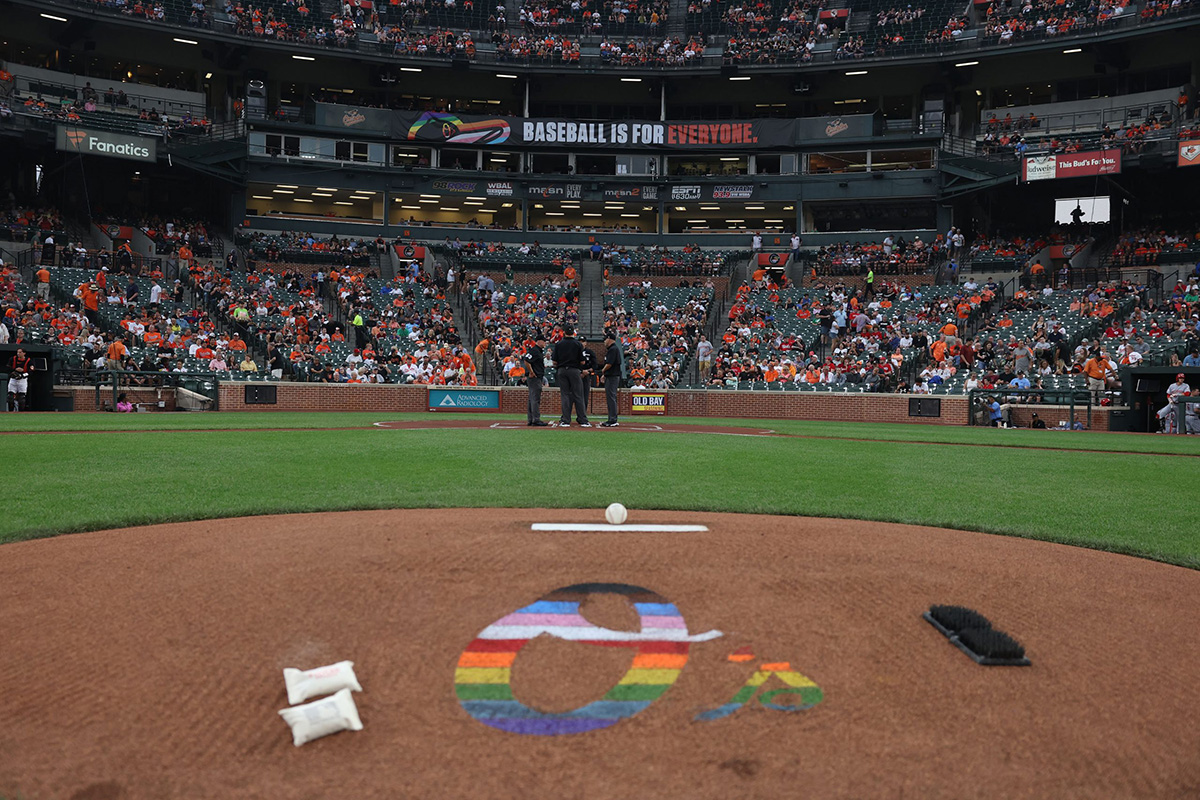
The Baltimore Orioles will take on the Washington Nationals on Friday, June 26 at 7 p.m. for Pride Night at Oriole Park.
The first 15,000 fans will receive an exclusive Pride Night Orioles jersey. The Washington Blade is a media sponsor of this event.
To purchase tickets, visit Orioles.com/Tickets.

Annie Andrews denounces trans athletes after Trump targets her

On Republican Long Island, gay Democrat Chris Gallant bets on public service over politics

Report: LGBTQ exclusion costs Japanese economy billions a year

Center for Black Equity honors leaders, activists at BE. Gala

In ‘The Lost Brontë,’ a complicated lie can lead to danger

U.S. int’l trade negotiator, consultant James Bedore dies at 82

Campaign urges Virginia High School League to reverse stance on trans athletes

Calif. GOP gubernatorial candidate ad ‘disgusting attempt to exploit lesbian intimacy’

Center Arts Gallery celebrates 10 years with reception, auction

Trump, Netanyahu, and Putin are all war criminals
-

 Obituary5 days ago
U.S. int’l trade negotiator, consultant James Bedore dies at 82
-
Virginia5 days ago
Campaign urges Virginia High School League to reverse stance on trans athletes
-
California5 days ago
Calif. GOP gubernatorial candidate ad ‘disgusting attempt to exploit lesbian intimacy’
-
Commentary4 days ago
Center Arts Gallery celebrates 10 years with reception, auction