News
Gay U.S. couple arrested in Thailand for exposing their butts at Thai temple
the pair face a possible long jail sentence


(Photo via Instagram.)
A couple is facing jail time for exposing their butts at the Temple of Dawn in Bangkok, Thailand.
Travis and Joseph Dasilva, both 38, run the Instagram account “Traveling Butts,” which features pictures of the couple exposing their butts at international locations. The Instagram account has since been deleted.
According to the Bangkok Post, the couple was taken into custody at the airport on Tuesday while preparing to depart on their flight home.
The couple admitted to bending over and posing for the photo at the temple. They face the charge of getting naked in public which carries a fine of up to 5,000 baht ($150).
Pol Col Choengron Rimpadee, deputy spokesman of immigration police, told the Bangkok Post that, “Tourists should have respect for places of cultural, historical and religious importance because it is simple good manners.”
The Thai government released a statement saying that they could also face a long jail sentence due to the location.
“The charge would not be a normal public indecency charge. Instead, they would be charged with committing indecency in a place of worship, which carries a long jail term,” the statement reads. “This is a reminder that everyone should have respect for Thai religion and culture.”
The pair live in the Hillcrest neighborhood of San Diego and are in contact with San Diego’s City Commissioner Nicole Murray-Ramirez.
‘Though I am very disappointed in their actions, I am talking to U.S. government officials to see what assistance we can give them,’ Murray Ramirez told San Diego Gay and Lesbian News.
Rehoboth Beach
Women’s FEST returns to Rehoboth Beach next week
Golf tournament, mini-concerts, meetups planned for silver anniversary festival
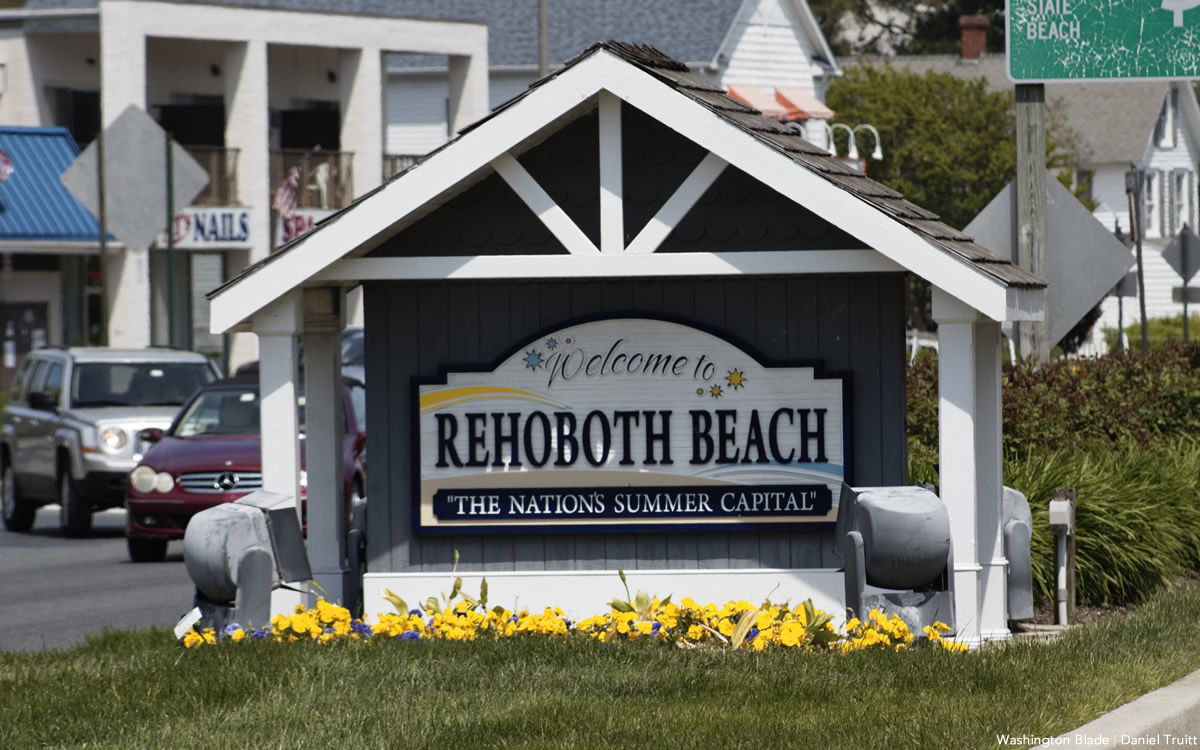
Women’s+ FEST 2026 will begin on Thursday, April 9 at CAMP Rehoboth Community Center.
The festival will celebrate a remarkable milestone in 2026: its silver anniversary. For 25 years, Women’s+ FEST has brought fun and entertainment for all those on the spectrum of the feminine spirit. There will be a variety of events including a golf tournament, mini-concerts and happy hour meetups.
For more information, visit Camp Rehoboth’s website.
Belarus
Belarusian lawmakers approve bill to crackdown on LGBTQ rights
Country’s president known as ‘Europe’s last dictator’

Lawmakers in Belarus on Thursday approved a bill that would allow the government to crack down on LGBTQ advocacy.
The Associated Press notes the bill would punish anyone found guilty of “propaganda of homosexual relations, gender change, refusal to have children, and pedophilia” with fines, community labor, and 15 days in jail.
The House of Representatives, the lower house of the Belarusian National Assembly, last month approved the bill. The Council of the Republic, which is the parliament’s upper chamber, passed it on Thursday.
President Alexander Lukashenko is expected to sign it.
Belarus borders Poland, Ukraine, Russia, Latvia, and Lithuania. Lukashenko — known as “Europe’s last dictator” is a close ally of Russian President Vladimir Putin.
Kazakhstan is among the countries that have enacted Russian-style anti-LGBTQ propaganda laws in recent years.
Vika Biran, a Belarusian LGBTQ activist, is among those arrested during anti-Lukashenko protests that took place in 2020 after he declared victory in the country’s presidential election.
District of Columbia
How new barriers to health care coverage are hitting D.C.
Federally qualified health centers bracing for influx of newly uninsured patients

Washington, D.C. has the second-lowest rate of people who lack health insurance in the country, but many residents are facing new barriers to health care due to provisions of the sweeping federal law passed in July, which threatens access for thousands.
Changes to insurance eligibility and the rising cost of premiums, which kicked in for some in October and others more recently, are expected to leave many more patients uninsured or unable to afford medical care. Federally qualified health centers, including D.C.’s Whitman-Walker Health, where 10 to 12 percent of patients are uninsured, are bracing for an influx of newly uninsured patients while facing their own financial challenges.
Even in D.C., where uninsured rates have been among the lowest in the country, changes brought on by the passage of the Republican mega bill (known as the “Big Beautiful Bill”) will have major effects.
The changes from the bill affect Medicaid, which is free to low-income patients, and subsidies for insurance that people buy on the health insurance exchanges that were started under the Affordable Care Act, which were allowed to expire on Dec. 31.
Erin Loubier, vice president for access and strategic initiatives at Whitman-Walker Health, says some Whitman-Walker Health patients have received notices about premium increases, including several who say the increases are up to 1,000 percent more than they were paying.
“That is like paying rent,” she says. “We live in an expensive city, so any increases are going to be really, really hard on people.”
Whitman-Walker Health and other healthcare providers are expecting the changes to have multiple effects — some patients may not be able to afford coverage or may avoid going to the doctor and allow health conditions to worsen because they can’t afford care, and many more will be seeking care who don’t have insurance.
“I’m worried that we’re going to not just have people who can’t get care, but that they delay care until they’re really sick, and then the care is not as effective because they might have waited too long, and then we may have a less healthy population,” Loubier says.
Loubier says delaying care, and serving more people without insurance has major implications for Whitman-Walker Health and other health centers serving the community.
“There’s going to be a lot of pressure on us to try to find and raise more money, and that’s going to be harder, because I think all organizations who provide health care are going to be facing this,” she says.
The U.S. health care system is the most expensive in the world, and has much higher out-of-pocket costs for individuals. But in other countries like the United Kingdom, Australia, Canada, and many others, health care is much less expensive — or even free.
Even though the U.S. has a high-priced healthcare system, critics say there are still ways to bring down costs by forcing insurance and pharmaceutical companies to absorb more of the costs, rather than transferring the costs to patients.
“In the U.S., they end up trying to cut costs at the person’s level, not at the level of the different corporations or structures that are making a lot of money in healthcare,” said Loubier. “Our system is so complicated and there is probably waste in it, but I don’t think that that cost and waste is at the ‘people’ level. I think it’s higher up at the system level, but that is much, much harder to get people to try to make cuts at that end.”
Ultimately at Whitman-Walker Health, healthcare providers and insurance navigators are planning to help with everyday necessities when it comes to healthcare coverage and striving to provide healthcare in partnership with patients, said Loubier.
“The key here is we’re going to have a lot of people who may lose insurance, and they’re going to rely on places like Whitman-Walker Health and other community health centers, so we have to figure out how we keep providing that care,” she said.
(This article was written by a student in the journalism program at Bard High School Early College DC. This work is part of a partnership between the Washington Blade Foundation and Youthcast Media Group, funded through the FY26 Community Development Grant from the Office of D.C. Mayor Muriel Bowser.)

Women’s FEST returns to Rehoboth Beach next week

Belarusian lawmakers approve bill to crackdown on LGBTQ rights

Calendar: April 3-9

How new barriers to health care coverage are hitting D.C.

Kenyan advocacy groups launch LGBTQ voter mobilization campaign

‘Out for McDuffie’ event held at D.C. gay bar

‘Jonah’ an undeniably compelling but unusual memory play

The Oscar-losing performance that’s too good to miss

Thousands attend ‘No Kings’ protests in D.C.