Sports
All Stars spotlight: D.C. Aquatics offers team camaraderie however members ID
Local swimmers say water kept beckoning despite varied life circumstances
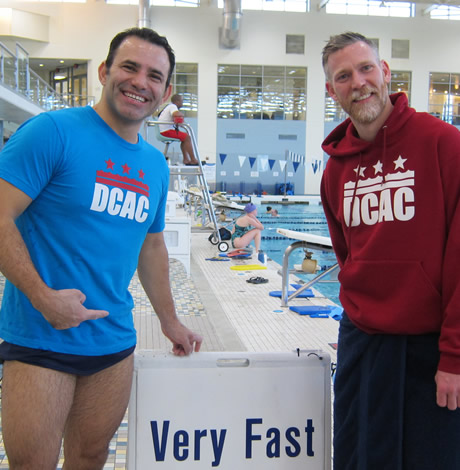
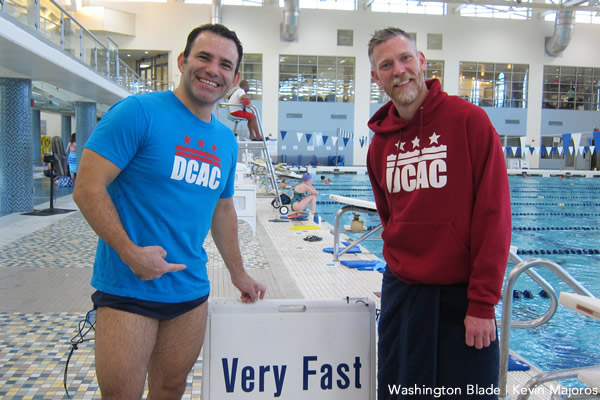
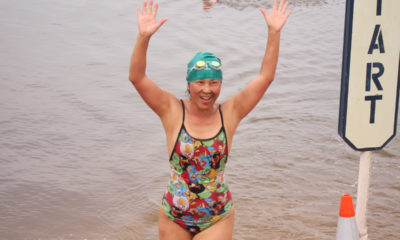
JULIAN CABALLERO, left, and DANA CONNORS, members of D.C. Aquatics. (Washington Blade photo by Kevin Majoros)
D.C. newbies often don’t realize our local LGBT sports leagues are equally welcoming to straight folks and varied skill levels.
D.C. Aquatics members Dana Connors, who’s gay, and Julian Caballero, straight, are perfect examples.
Boasting everything from beginning swimmers to Olympians, D.C. Aquatics is a dynamic team that offers structured, coached practices year around, six days a week. The coaching staff guides the swimmers on their path to either fitness or competition in U.S. Masters Swimming.
Team captain Connors describes his childhood in Corkscrew, Fla., as the typical gay kid story. He was not athletic and always felt different from other kids. He found exhilaration from horse training and learning to jump with horses at his grandmother’s house in Cape Cod.
At his brother’s urging, he joined the cross country team in high school and became addicted to daily running. That led to him completing a few triathlons before he graduated. In the years that followed, his life has taken him all over the world with sports being a constant companion.
“My sports journey was born out of ignorance, propelled by addiction and maintained by a desire for health and fitness,” Connors says. “It’s not about competition. Sports fuels my spiritual, mental and physical health. One of the things I love about D.C. Aquatics is that we are a mix of people who don’t have the same end goals.”
Connors spent four years at the University of Florida on the triathlon team where his coach encouraged him to sign up for U.S. Masters Swimming. After college were stints in France and Holland where he completed marathons, continued to swim and went to grad school. The Fulbright Program next took him to Korea.
He eventually landed a job with a biotech company in Annapolis before moving to the Shenandoah Valley where he started a bluegrass band. Connors had been playing all along with orchestras and symphonies, but his proficiencies in violin, fiddle, mandolin and guitar led him to the banjo.
The first thing that he did when he moved to D.C. in 2012 was to join D.C. Aquatics. He now works at the Foundation for the National Institutes of Health where he runs a biomarker and cancer portfolio. He also plays locally in the band the October Sessions.
While he competes a few times a year with D.C. Aquatics, Connors likes to focus on other aspects of what sports mean to him.
“Masters swimming does a great job of getting all types of people into the water together. I have trained in the same lane as Olympians, but also with swimmers who are just getting started,” Connors says. “I have very few friends who are not on this team. These swimmers are my teammates, my family and my friends.”
Finding out what a sport really means to you happens when work commitments and life in general prevent you from pursuing it. Julian Caballero has stopped and started swimming multiple times and in each instance, was drawn back into the sport.
Growing up in Bogotá, Colombia meant that soccer was the overwhelming sport of choice for most children. Caballero played through his youth and then switched over to karate before swim lessons led to competitive swimming at 13.
Economic reasons ended his competitive swimming, but he picked it up again on the club team while attending the Universidad Nacional de Colombia. After completing his master’s degree, he was left with no options for competitive swimming. There were no spaces in Bogotá for adults to swim.
An internship with Inter-American Development Bank brought him to D.C. in 2003. He had studied English but had to start taking night classes to improve his skills. Once again, swimming was put on hold.
Caballero left D.C. to pursue his Ph.D. in economics at University of California, Santa Cruz and found himself in a swimming hotbed.
“I started swimming with a masters team there and it was outdoor training, all year long,” Caballero says. “I had been running and going to the gym all along, but swimming is different. I realized how much I was missing it.”
He returned to the D.C. area with his wife in 2011 to work as the lead economist for IDB Invest who provide funding to private enterprises in Latin America. His new job and married life in Arlington kept him from finding a team that worked with his schedule. He fit in lap swimming on his own whenever he could and completed a couple triathlons.
In 2017 he experienced a change in his personal life. Divorced and with too much time on his hands, he moved back into D.C. and started looking for a swim team.
“I tried a couple practices with D.C. Aquatics because they had the best schedule and locations for me. I knew they were LGBT-based, but they were very welcoming,” Caballero says. “Being on a team is something I really love. It’s more fun and a chance to meet people who will motivate me.”
Caballero has not competed in eight years but is open to returning. These days his main motivation is fitness and relaxation.
“I find solutions to things while I am swimming and it helps me to disconnect from life,” Caballero says. “Everything is better when I am in the pool. Outside of work, the people I see the most in my life are my teammates.”

More than a dozen LGBTQ athletes won medals at the Milan Cortina Winter Olympics that ended on Sunday.
Cayla Barnes, Hilary Knight, and Alex Carpenter are LGBTQ members of the U.S. women’s hockey team that won a gold medal after they defeated Canada in overtime. Knight the day before the Feb. 19 match proposed to her girlfriend, Brittany Bowe, an Olympic speed skater.
French ice dancer Guillaume Cizeron, who is gay, and his partner Laurence Fournier Beaudry won gold. American alpine skier Breezy Johnson, who is bisexual, won gold in the women’s downhill. Amber Glenn, who identifies as bisexual and pansexual, was part of the American figure skating team that won gold in the team event.
Swiss freestyle skier Mathilde Gremaud, who is in a relationship with Vali Höll, an Austrian mountain biker, won gold in women’s freeski slopestyle.
Bruce Mouat, who is the captain of the British curling team that won a silver medal, is gay. Six members of the Canadian women’s hockey team — Emily Clark, Erin Ambrose, Emerance Maschmeyer, Brianne Jenner, Laura Stacey, and Marie-Philip Poulin — that won silver are LGBTQ.
Swedish freestyle skier Sandra Naeslund, who is a lesbian, won a bronze medal in ski cross.
Belgian speed skater Tineke den Dulk, who is bisexual, was part of her country’s mixed 2000-meter relay that won bronze. Canadian ice dancer Paul Poirier, who is gay, and his partner, Piper Gilles, won bronze.
Laura Zimmermann, who is queer, is a member of the Swiss women’s hockey team that won bronze when they defeated Sweden.
Outsports.com notes all of the LGBTQ Olympians who competed at the games and who medaled.
Sports
US wins Olympic gold medal in women’s hockey
Team captain Hilary Knight proposed to girlfriend on Wednesday
The U.S. women’s hockey team on Thursday won a gold medal at the Milan Cortina Winter Olympics.
Team USA defeated Canada 2-1 in overtime. The game took place a day after Team USA captain Hilary Knight proposed to her girlfriend, Brittany Bowe, an Olympic speed skater.
Cayla Barnes and Alex Carpenter — Knight’s teammates — are also LGBTQ. They are among the more than 40 openly LGBTQ athletes who are competing in the games.
The Olympics will end on Sunday.
Sports
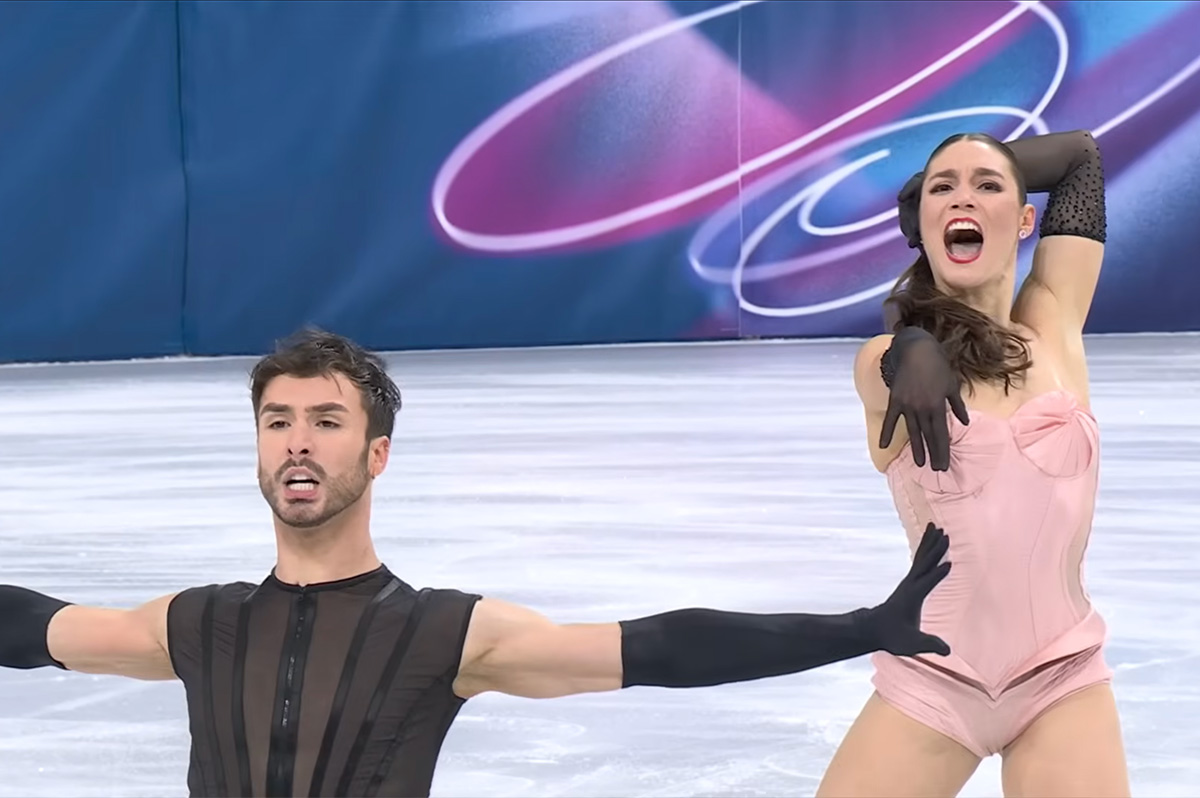
Attitude! French ice dancers nail ‘Vogue’ routine
Cizeron and Fournier Beaudry strike a pose in memorable Olympics performance
Madonna’s presence is being felt at the Olympic Games in Italy.
Guillaume Cizeron and his rhythm ice dancing partner Laurence Fournier Beaudry of France performed a flawless skate to Madonna’s “Vogue” and “Rescue Me” on Monday.
The duo scored an impressive 90.18 for their effort, the best score of the night.
“We’ve been working hard the whole season to get over 90, so it was nice to see the score on the screen,” Fournier Beaudry told Olympics.com. “But first of all, just coming out off the ice, we were very happy about what we delivered and the pleasure we had out there. With the energy of the crowd, it was really amazing.”
Watch the routine on YouTube here.

Black transgender woman murdered in Va.

Trans Day of Visibility events planned

Virginia General Assembly’s 2026 legislative session ends

Polish court rules country must recognize same-sex marriages from EU states

Capital Stonewall Democrats 50th anniversary gala draws sold out crowd

Protesters say SAVE Act targets voters, transgender youth

Housewives take Capitol Hill by storm

Queer American in Israel discusses Iran war’s impact

‘How We Survived’ panel set for March 25