Opinions
Dear Mayor: Get your name off the High Heel Race
Must every LGBTQ event be sponsored by a politician or corporation?
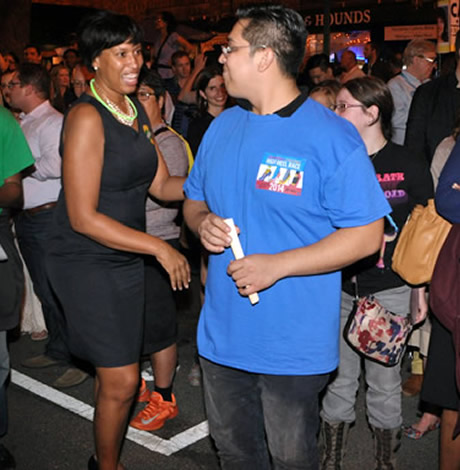
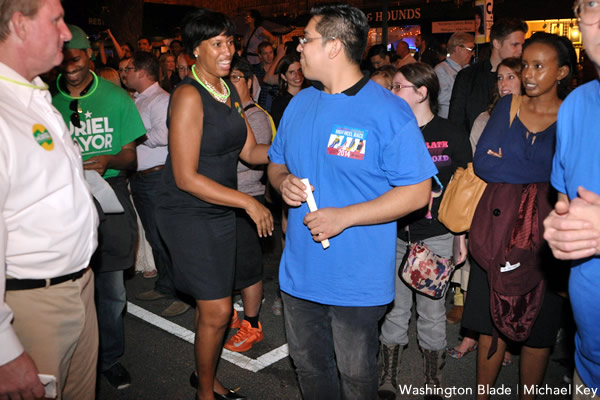
(Washington Blade photo by Michael Key)
Mayor Muriel Bowser wants to co-opt the annual High Heel Race, claiming it as her own to present. Must every LGBTQ event be sponsored or presented by a politician, a big bank, or corporation, or do we deserve to have our events stand on their own?
Every year thousands come to 17th Street to watch drag queens, drag kings, and every queer Halloween concoction imaginable race, strut, or prance to the finish line of Washington, D.C.’s High Heel Race. But this year, it won’t be the community’s event, it is now called “Mayor Muriel Bowser presents” the High Heel Race.
It’s wonderful that Bowser has been a grand marshal at the High Heel Race for the last two years. It’s great that she hosts an annual race reception, which this writer can attest has been a delight to attend. It says a lot about the District that for nearly 20 years, mayors have ensured the District absorbs many of the event’s costs. But, there is a fine line between being a supportive friend and being that tacky person that throws their name on everything.
This annual running of the heels is an event free from politics, corporate sponsors, and judgement — it’s just a fun night. Slapping one’s name onto the event — that just happens to be one week before Election Day — makes the event more a campaign rally than the fun night free of politics it has been. It is the sort of thing we’ve come to expect from Donald Trump, not the mayor of our nation’s capital.
It is also a glaring reminder to the LGBTQ community that we can’t have anything that isn’t presented by someone or something. Nothing is truly our own anymore. Almost every Pride parade in America is presented by some company: Here in Washington, D.C., it’s the Pride Parade Presented by Marriott International, and in Pittsburgh, Pride celebrations are named after a fracking company. Meanwhile, nearly every major LGBTQ organization has lists of sponsors whose names are plastered all over their events and websites. Now, even a fun night of queers in heels needs to be presented by a sponsor too.
Mayor Bowser shouldn’t have put her name on the High Heel Race, but she is not the problem. The problem is we as a community have become complacent. We must not let every company that wants our money, or politician that wants our vote, think they can court us by simply throwing us a few dollars or whisper a few soothing words in our ears.
My friendly advice to Bowser, don’t speak a few nice words and go to a few fun events. Work to help the LGBTQ community. Washington, D.C., has seen multiple hate crime attacks in the U Street corridor. In July, Fox 5 reported that half of all LGBTQ hate crimes between 2016-2018 in D.C. ended in charges being dismissed and not a single perpetrator was convicted under the District’s hate crimes law. Hate crime prevention is just one of many important issues facing Washington. Nearly half of all homeless youth in Washington are LGBTQ. The District also needs to confront how its criminalization of sex workers impacts transgender women.
Mayor, instead of politicizing the High Heel Race, tell LGBTQ people what you have done for our community. Your answers may earn you more praise than you think.
Alex Morash is a D.C.-based writer. The views expressed here are his own.


Opinions
Protection should mean protection
Disbelief as court modifies protective order against Pasha

There is a particular kind of disbelief that Black queer women know intimately. It is not always explicit. It shows up in hesitation, in “both sides” framing, and in systems that require us to prove, again and again, that we are worthy of safety.
We see that disbelief happening now with the temporary protection order (TPO) involving an individual, D. Pasha. He is accused of repeatedly harassing staff, board members, and volunteers at the Capital Pride Alliance, which led the organization to ask the court for protection.
The Capital Pride Alliance did not seek this order lightly. They spent over a year documenting his harassment, and several witnesses gave almost two hours of testimony about a pattern of behavior that caused real fear. The organization also spent months working out how to legally protect its staff, volunteers, board, and contractors from this individual.
At first, the Court agreed and issued a stay-away order that included CPA’s office and other locations, setting a clear boundary to protect staff, volunteers, and community members.
But that protection did not last.
After the order was issued, Pasha spoke with a reporter from the Washington Blade and learned that CPA shares office space with the DC LGBTQ Center. It is important to note that he didn’t know this detail before. He then sought an emergency hearing, claiming he needed access to “vital services” from the CPA and DC LGBTQ Center shared offices.
The Court granted it, allowing access with a 24-hour notice to CPA. According to the Court, the modification was based on Mr. Pasha’s claim that denying him entry to the DC Center would prevent him from accessing essential support services provided there. Although CPA objected and highlighted the lack of recent service usage and the availability of alternatives, the Court determined that his stated need for services warranted an exception to the stay-away order.
Let’s be clear about what this means.
There is no record of him accessing services or being at the DC LGBTQ Center in over a year. Numerous organizations across DC provide the same services he cited: food, clothing, computers, Wi-Fi, without placing him in proximity to the people who testified against him.
And yet, the Court modified the order to allow exactly that.
Then it escalated. Following the modification, he sent more than 20 emails and text messages in attempts to gain access to our office space, triggering another emergency hearing. At that second emergency hearing, the court maintained its previous decision, allowing Mr. Pasha continued access to the location.
This is not a technicality. This is a failure of real protection.
The outcome was shaped not just in the courtroom, but in how it was presented afterward.
Recent coverage centered the acceptance of a less restrictive order, while giving the person at the center of this case a platform to define the narrative in his own words. He was described as an LGBTQ activist, quoted at length, and presented with his name, voice, and image, including statements like “I am happy with what we have accomplished so far,” “even if I lose this case, I am glad that I spoke up,” and that “the truth will come out.”
That framing does not exist in a vacuum. It omits important context about the pattern of conduct that led to this case, including the history and the events that followed the Court’s initial order. It also gives weight to claims about access to services that are not reflected in actual usage.
At the same time, the hours of testimony describing a pattern of conduct that caused fear, serious alarm, and emotional distress are reduced to a small part of the story. The individuals who came forward are largely unnamed, unseen, and unheard. The record that was built in court is condensed, while his narrative is expanded.
When one side is given visibility, voice, and narrative, and the other is reduced to summary, that is not balance. It is distortion.
We also need to be honest about who is being asked to bear the consequences of that failure.
Two Black queer women testified. They followed the process. They showed up, told the truth, and trusted the system to do what it is designed to do: protect them.
Instead, the system created a pathway back to proximity, back to fear.
That is not a neutral outcome. It is a choice about whose safety matters most and whose safety can be compromised.
This is not an isolated incident. It reflects a broader pattern in how systems fail Black women, survivors, and LGBTQ+ people, especially at the intersections of those identities.
According to the Human Rights Campaign, data shows that over 60% of bisexual women and more than 40% of lesbian women experience physical violence or stalking.
Violence does not start with homicide. It starts with being dismissed, with being minimized, and with systems that do not act fairly or quickly when harm is reported.
It starts when people question the credibility of Black queer women.
When access is granted to those who cause fear, instead of protection being fully extended to those who experience it.
And it continues when we treat these outcomes as unfortunate, rather than unacceptable.
Capital Pride Alliance believes in access. We invest in it. We help sustain the very services being cited in this case. But access cannot come at the expense of safety, especially when alternatives exist, and risk is known.
The question here is not complicated: what does protection actually mean, and who deserves it?
If a court acknowledges harm but still allows proximity, is that protection?
If Black queer women testify and are still placed within reach of the person they testified against, what message does that send?
We cannot keep calling these systems fair if they keep putting the same people at risk.
Courts need to think about safety in a broader sense, one that reflects real life rather than just following procedures. This means looking at not only direct threats, but also ongoing harassment, intimidation, and the real fear survivors feel when they must share space with someone who has harmed them.
Real changes could include ensuring stay-away orders are enforced even in shared spaces, working with community groups to offer alternative ways to access services, and asking survivors about their safety needs before changing protection orders. Courts should also get training on the experiences of Black queer women and LGBTQ+ survivors, so their voices and realities are at the center of decisions.
Our community needs to work toward real safety and protection. Because visibility without safety is not liberation. Protection that can be so easily undone is not protection at all.
May 28 is LGBTQ+ Domestic Violence Awareness Day.
#SeenAndBelieved is a call to action: recognize the harm, trust survivors, and create systems that truly protect them.
June Crenshaw is COO of the Capital Pride Alliance.
Opinions
Barney Frank, a hero of mine
There’s never been a stronger, smarter LGBTQ advocate in Congress
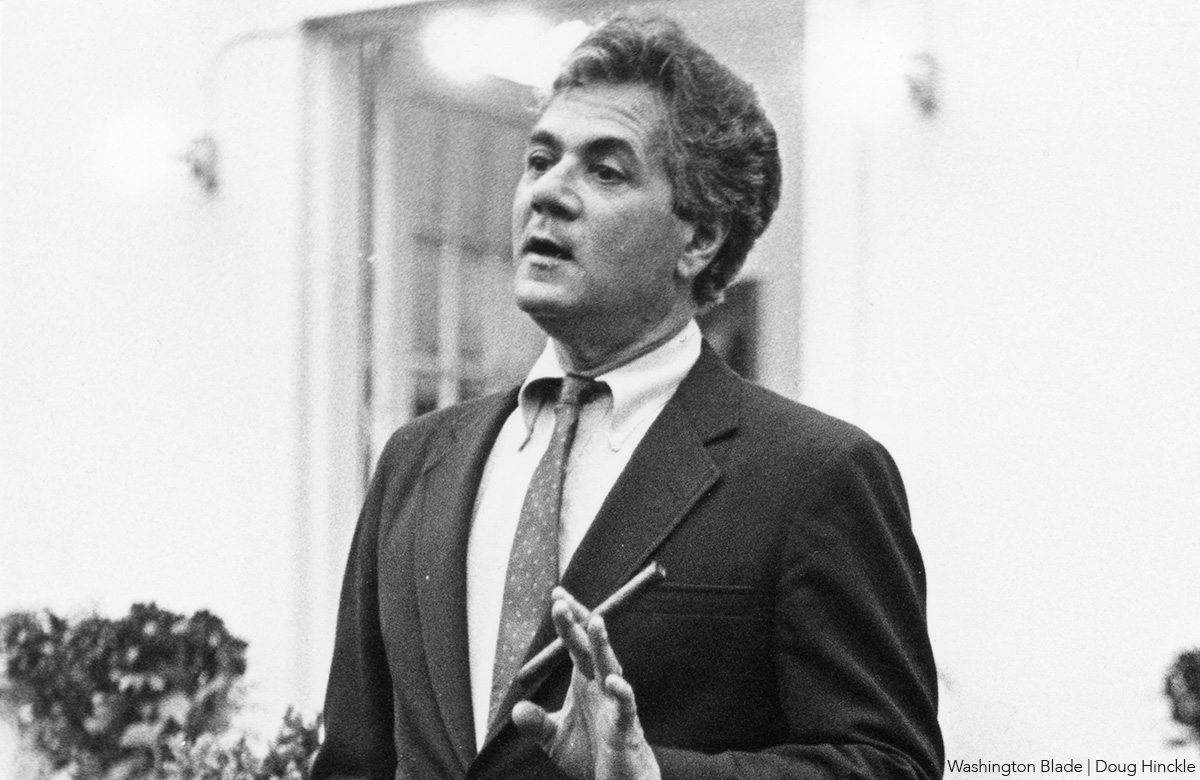
Barney Frank has always been a hero of mine. We grew up in similar circumstances, he in New Jersey, me in upper Manhattan. Both of us knew at a young age we were gay, though that was not a term used when we were young. It was a time when one definitely couldn’t come ‘out’ if you wanted to go into politics.
I met Barney when a mutual friend brought him to brunch at my home in D.C. I had moved to D.C. in 1978 to work for the Carter administration, directing the follow-up to the White House Conference on Handicapped Individuals. That is the term we used back then. I never went back to New York. Barney had been elected to Congress when we met. Neither one of us was publicly out.
Barney Frank is brilliant, and I was honored to meet him. I always enjoy listening to him speak, whether it was at a congressional hearing, or an event we were both attending. Barney was never one for small talk. When we both ended up living in Dupont, he would see me sitting at a coffee shop when he walked by, and simply nod hello, not stopping to chat. If he ever did stop, I always knew it was to suggest something I should be doing, or writing about. Barney has a sparkling wit, when he wants to share it, and knows more about most topics than anyone else. In 2004, 2006, 2008, and 2010, Washingtonian magazine reported that congressional staffers named him the brainiest member of Congress. CBS News reported in 2008 and 2011 that Leslie Stahl and others, referred to him as the smartest guy in Congress. They were right. I had worked for another brilliant member of Congress, Bella S. Abzug (D-N.Y.), but she was out of Congress by the time Barney got there. It would have been fun seeing them work together. I was working for her when she introduced the first Equality Act in 1974. At the time I was deeply closeted.
I ended up coming out in 1984, which was before Barney did. But then I wasn’t running for office. He came out in 1987 and became an even more passionate supporter of the LGBTQ community than he was before. Because now he could make his speeches, and support, more personal. He spoke eloquently trying to pass the Equality Act which didn’t pass the House until after he retired, and then it died in the Senate. I was, and am, a passionate supporter of the Equality Act, and still believe in my lifetime it will pass Congress, and we will have a president who will sign it into law. Hope springs eternal as they say.
Barney is more than just an LGBTQ advocate. He has worked tirelessly on so many issues, in his effort to make life better for all Americans. He recently said the bill he is proudest of, is the Dodd-Frank Wall Street Reform and Consumer Protection Act. It is a sweeping law enacted to overhaul financial regulation following the 2008 financial crisis. Its primary purpose was to end ‘Too big to fail’ bailouts, and protect consumers from abusive financial practices. It was signed into law by President Obama in 2010.
As it has become public that Barney Frank was entering home hospice, and being cared for by his husband Jim, so many of us are looking back at his amazing career. We are recognizing the giant he is, both during his time in Congress, and during his life before, and after. He is the first member of the LGBTQ community who married while in Congress. He is one of the people in our community who really made a difference, and in doing so made so many of our lives better.
Barney has said he is in the process of writing another book on politics, and I already look forward to reading it. I keep visualizing Barney as our community’s Art Buchwald. Those of you who are old enough may remember Buchwald. He was an American humorist, best known for his columns in the Washington Post. He also went into hospice care. But in his case, after five months there, and giving many interviews, he left hospice and wrote another book. It was titled ‘Too Soon to Say Goodbye’ about his five months in hospice. Barney, I am praying I will get to hear you, and see you, on that next book tour.
But if that shouldn’t be, I want to thank you for a life well lived, and all you have done to make my life, the lives of the rest of us in the LGBTQ community, better. We could have never asked for a stronger, or more passionate, advocate.
Peter Rosenstein is a longtime LGBTQ rights and Democratic Party activist.
Commentary
How do you vote a child out of their future?
Students reportedly expelled from Eswatini schools over alleged same-sex relationships

There is something deeply unsettling about a society that turns a child’s future into a public referendum. In Eswatini, there were reports that students were expelled from school over alleged same-sex relationships, and that parents were invited to vote on whether those children should remain, forcing us to confront a difficult question on when did education stop being a right and become a favor granted by collective approval? Because this is a non-neutral vote.
A vote reflects power, prejudice and personal beliefs, which are often linked to tradition, culture, politics and religion. It is shaped by fear, by stigma, by long-standing narratives about morality and belonging. To ask parents, many of whom may already hold hostile views about LGBTIQ+ people, to decide the fate of children is not consultation. It is deferring the responsibility and repercussion. It is placing the lives of young people in the hands of those most likely to deny them protection.
And where is the law in all of this?
The Kingdom of Eswatini is not operating in a vacuum. It has a constitution that guarantees the promotion and protection of fundamental rights, including equality before the law, equal protection of the laws, and the right to dignity. The constitution further goes on to protect the rights of the child, including that a child shall not be subjected to abuse, torture or other cruel, inhuman and degrading treatment or punishment.
The Children’s Protection and Welfare Act of 2012 extends the constitution and international human rights instruments, standards and protocols on the protection, welfare, care and maintenance of children in Eswatini. The Children’s Protection and Welfare Act of 2012 promotes nondiscrimination of any child in Eswatini and says that every child must have psychosocial and mental well-being and be protected from any form of harm. The acts of this very instance place the six students prone to harm and violence. The expulsion goes against one of the mandates of this act, which stipulates that access to education is fundamental to development, therefore, taking students out of school and denying them education contradicts the law.
Eswatini is a signatory to the United Nations Convention on the Rights of the Child and the African Charter on the Rights and Welfare of the Child. These are not just commitments made to make our governments look good and appeasing. They are obligations. The Convention on the Rights of the Child is clear regarding all actions concerning children. The best interests of the child MUST be a primary consideration and NOT secondary one. According to the CRC, as indicated in the Declaration of the Rights of the Child, “the child, by reason of his physical and mental immaturity, needs special safeguards and care, including appropriate legal protection, before as well as after birth.” It is not something to be weighed against public discomfort and popularity.
The African Charter on the Rights and Welfare of the Child reinforces this, grounding rights in non-discrimination (Article 3), privacy (Article 10) and protection from all forms of torture (Article 16). Access to education (Article 11) within these frameworks is not conditional but is a foundational right. It is not something that can be taken away because a child is perceived as falling outside social norms and threatening the moral fabric of society. It is a foundational right and determines one’s ability to participate in civic actions with dignity.
So again, where is the law when children are being expelled?
It is tempting to say the law is silent but that would be too generous. The law is not silent rather, it is being ignored and bypassed in favor of systems of decision-making that make those in power comfortable. When schools and their leadership defer to parental votes rather than legal standards, they are not acting neutrally. Expelling a child from school because of allegations is not a decision to be taken lightly. It disrupts education and limits future opportunities and for children already navigating identity and social pressure, this kind of exclusion can have profound psychological effects. It isolates them. It marks them for potential harm. Imagine being a child whose future is discussed in a room where people debate your worth. That is exposure. That is harm. There is a tendency to justify these actions in the language of culture, tradition, religion and protecting social cohesion. But culture is not static and the practice of Ubuntu values is not an excuse to violate rights. If anything, the principle of Ubuntu demands the opposite of what is happening here.
Ubuntu is not about conformity. It is about recognition and is the understanding that our humanity is bound up in one another. That we are diminished when others are excluded. That care, dignity, respect and compassion are not optional extras but central to how we exist together. Where, then, is Ubuntu in a school where some children are deemed unworthy of access to education?
Why are those entrusted with protecting children are failing to do so?
There is a very loud contradiction at play. On one hand, there is a claim to shared values and to the importance of community. On the other hand, there is a willingness to isolate and exclude those who do not fit within the narrow definition of what is acceptable. You cannot have both. A community that thrives on exclusion is neither cohesive nor safe.
It is worth asking why these decisions are being made in this way. Why not follow the established legal processes? Why not ensure that any disciplinary action within schools aligns with national and international obligations? Why introduce a vote at all? The answer is uncomfortable and lies in legitimacy and accountability. A vote creates the appearance of a collective agreement. But again, I reiterate, it distributes responsibility across many hands, making it hard to hold anyone accountable. It allows the school leadership to say “lesi sincumo sebantfu”(“This is what the community decided, not me”) rather than confronting their own role in human rights violations. If the law is clear and rights, responsibilities and obligations are established, then the question is not what the community feels. The question is why those entrusted with protecting children are failing to do so.
There is also a deeper issue here about whose rights are seen as negotiable. When we talk about children, we often speak of care, of understanding, of protection and safeguarding them because they are the future. But that language becomes selective when it intersects with sexuality, particularly when it involves LGBTIQ+ identities. Suddenly, care, understanding, protection, and safeguarding give way to punishment.
Easy decisions are not always just ones.
If the kingdom is serious about its commitments under its constitution, the Convention on the Rights of the Child and the African Charter on the Rights and Welfare of the Child, then those commitments must be visible in practice, not just in policy documents. Rather, they must guide decision-making in schools and in communities. That means recognizing that a child’s right to education cannot be overridden by a show of hands. It means ensuring that schools remain spaces of inclusion rather than sites of moral policing. It means holding leaders and institutions accountable when they fail to protect those in their care.
Bradley Fortuin is a consultant at the Southern Africa Litigation Center and a human rights activist.

Protection should mean protection

LGBTQ people, weed, and mental health: what you need to know

Repression, toxic masculinity fuel intense queer drama ‘Half Man’

Barney Frank, a hero of mine

Your guide to D.C. region’s many Pride celebrations

Diverse cast tackles ‘Aguardiente’ at GALA Hispanic Theatre

Under new extremism laws, LGBTQ Russians must fight to survive

New books reveal style trends for a more enlightened century

How do you vote a child out of their future?

Gay ICE detainee freed after 150 days in detention
-

 Theater4 days ago
Diverse cast tackles ‘Aguardiente’ at GALA Hispanic Theatre
-
Russia4 days ago
Under new extremism laws, LGBTQ Russians must fight to survive
-
Books4 days ago
New books reveal style trends for a more enlightened century
-
Commentary4 days ago
How do you vote a child out of their future?