Arts & Entertainment
Magnum ad criticized for comparing ice cream ‘guilty pleasure’ to homophobic discrimination
The Spotify commercial aired in the U.K.


Magnum is under fire for an ad that aired on Spotify in the U.K. which compared the “guilty pleasure” of eating ice cream to being imprisoned for being gay.
Newsweek reports that the ad features a narrator with “an indeterminate accent” saying, “A hug for my boyfriend—that’s my guilty pleasure. Because in my country, just a simple hug with the man I love could send me to prison for more than 10 years.”
Some people didn’t think the “guilty pleasure” of eating ice cream equated with homosexuality being illegal in some countries.
I know most of y'all probs have Spotify premium so don't hear the ads, but really unsure about the Magnum ad that's talking about homosexuality being a "guilty pleasure" in countries where homosexuality is illegal, like thanks for the awareness but also like not okay
— Kyle Flynn-Davies (@kflynndavies) August 2, 2019
What the hell?!? There are at least 3 versions of the magnum ice cream ad that does a bit about being gay would get me X years in prison followed by a get a magnum, pleasure should be guilty. That's fucked. pic.twitter.com/T0j6Hbxl4g
— Tia (@Tatty_is_ALIVE) August 4, 2019
Magnum is comparing the guilt of eating an ice cream to the guilt of being gay in a country where homosexuality is illegal. Bold move Magnum, but maybe no:https://t.co/klfR0jtjpp
— Hidayah (@HidayahLGBTQI) August 9, 2019
An ad for #Magnum ice cream bars just popped up on my #Spotify and it is the cringiest/funniest gay baiting ad ever. A foreign accented man laments how dangerous it is to hug his boyfriend in his country, but he won't get arrested for eating a Magnum! pic.twitter.com/S6WdzW9p51
— Christa Blackmon (@TheOdalisque) August 2, 2019
@MagnumIceCream your advert comparing the potential to be killed if you're gay to the guilty pleasure of eating a magnum is disgusting, racist and homophobic. Please withdraw it immediately.
— nell blane (@firegoat67) August 5, 2019
A Magnum spokesman told Newsweek that the ad was meant “to remind people that what is considered a guilty pleasure isn’t always what you would expect.”





Theater
Timothy Nelson on the premiere of his opera ‘Song of Sakuntala’
Story of love, loss, redemption unfolds amid Indian classical music

‘The Song of Sakuntala’
IN Series
In Washington and Baltimore
Atlas Performing Arts Center, 1333 H St., N.E.
(Selected dates June 6-14)
Baltimore Theatre Project, 45 W. Preston St., Baltimore
(June 19-21)
$25-35
Inseries.org
As the artistic director of IN Series, Timothy Nelson rarely blows his own horn, but for the world premiere of his own opera “The Song of Sakuntala,” he’ll make an exception.
During a recent interview squeezed in between afternoon and evenings rehearsals, Nelson took time to talk about his opera (while nearby his “blessing of a husband” prepared a giant dinner for the entire cast and crew).
As smart and gracious as ever, Nelson explains that he wrote the opera a decade ago at a low point in his life: He was divorcing and wanted to immerse himself into something musical, all-consuming, a project tantamount to writing a thick novel.
At the time, Nelson’s mentor, the influential American stage and opera director Peter Sellers, pushed him to write again. Nelson recalls, “I hadn’t composed for some time. I wanted to see if I could do it, and I wanted to revisit Indian classical music.”
He adds, “There was never any anticipation of it being produced. It was a way of processing and dealing with life in a healthy way.”
Adapted from Kālidāsa’s 5th-century dramatic masterpiece, “The Song of Sakuntala” brings together Western baroque and Indian classical musical traditions into a story of “love, loss, memory, and redemption.” His libretto, a reflection of South Asian storytelling, includes the words of the great Indian poets Tagore, Naidu, and Vidyapati.
The story follows “a prince and a woman of the forest who fall in love and wed in secret. He departs, and she later seeks him out, only to have him deny all recognition of her. She disappears in sorrow; he spends the rest of his life searching. At the end, in the same forest where they first met, they find each other again and are transfigured.”
At 90 minutes, the uninterrupted piece features three singers (Aryssa Leigh Burrs, Teresa Ferrara, Marvin Wayne Allen) accompanied by an instrumental ensemble led by acclaimed sitarist Rajib Karmakar, who specializes in bridging Indian and Western classical traditions, and conducted by Nelson who also joins the music making on drone and harmonium.
Burrs plays the prince. Originally written for a countertenor, Nelson imagined a man singing the role but ultimately cast a woman to play the part.
Because the piece is “fiendishly difficult in almost unnecessary ways,” Nelson explains with a wicked chuckle, he knew that Burrs had the talent and sharp brain required for the role.
The prince is cruel without explanation. Despite that, 40-something Nelson admits to relating to the opera’s prince: “In midlife, you reflect on your mistakes. At least for now that’s how I feel. I might have felt different earlier and it could change later on.”
Nelson lived in India for nine months, backpacking and studying in different places, absorbing different musical styles and playing pieces as varied and complex as any Western music.
And while based in D.C., IN Series performs in both Washington and Baltimore using various borrowed venues. “The Song of Sakuntala” is playing at both the Atlas Performing Center in D.C. (6/6-6/14) and Baltimore’s beloved Baltimore Theatre Project (6/19-6/21) with its terrific acoustics.
In a past conversation, Nelson who lives in Adams Morgan, shared that all audiences bring something specific to the table. Baltimore tends to attract more risk taking while D.C. audiences often lean into the intellectual side of what the company does.
At the helm of IN Series for eight years, Nelson has relished reimagining opera and musical theater, but only recently did he decide to program his latest work. The way in which “The Song of Sakuntala” blends Western and non-Western music is very much a part of the IN Series music brand, so it seemed the perfect selection to close the season.
“I do this humbly with great hesitancy. And I know it feels a little unseemly to cheer on your own work, but I will say, it’s a piece that is successful in sitting in both places (Western and South Asia) and the Indian musicians on board are responding to it.”
Movies
Controversial ‘Blue Film’ pushes past taboos for gripping drama
Two-character psychosexual drama explores Dom-sub encounter
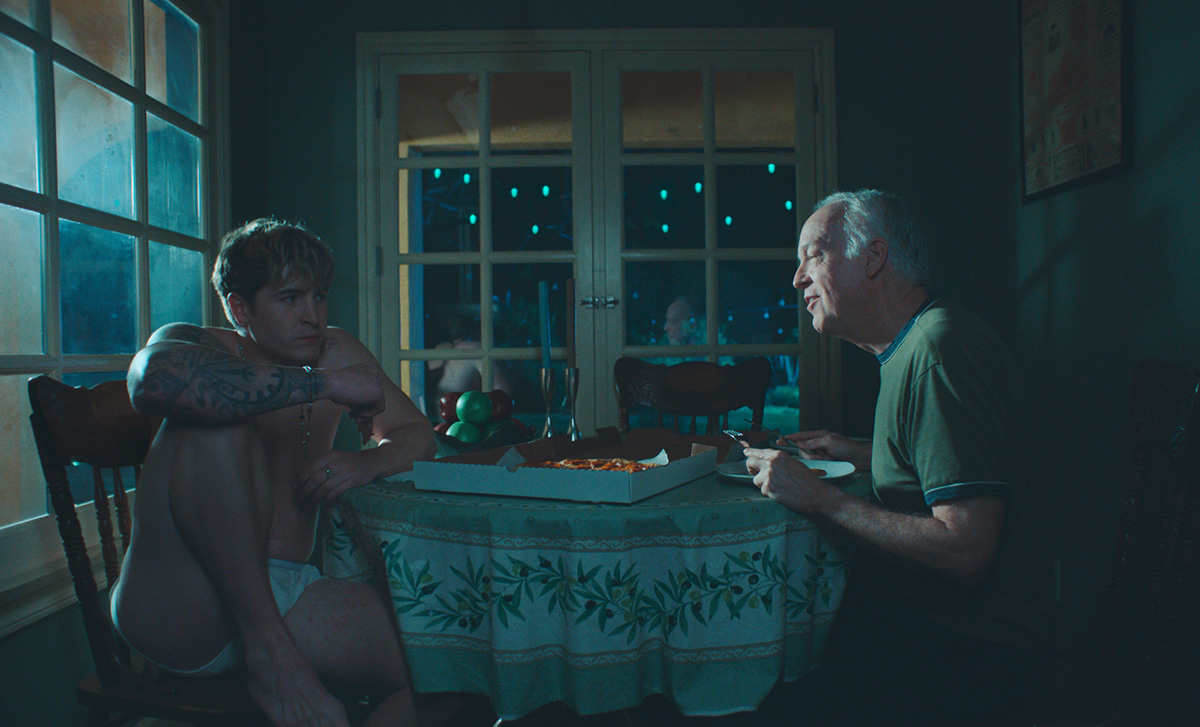
When movies are labeled as “controversial,” the effect is often akin to Oscar Wilde’s quip that “there’s only one thing in life worse than being talked about, and that is not being talked about.”
Indeed, a whiff of controversy can be the best publicity of all, turning a movie that might otherwise have been no more than a blip on the cultural radar into the buzziest “hidden gem” of the season – and “Blue Film,” a two-character psychosexual drama about an encounter between a male sex worker and a much-older client, is a perfect example. The debut feature of filmmaker Elliot Tuttle, it was rejected for inclusion at last year’s Sundance and SXSW festivals before finally premiering at the Edinborough International film fest; and even then, some audience members were walking out of the theater in disgust.
It’s easy to see why, really. The taboos it breaks run far deeper than just frank depiction of queer sexuality to rattle some among the ones most hard-coded into our cultural DNA, and the directness with which it pushes past our comfort zones is merciless. It begins with Aaron Eagle (Kieron Moore), a Los Angeles “fetish cam-boy” who specializes in financial humiliation and domination, proudly performing for his online fans by fondling his stacked physique on camera while deriding them with homophobic slurs and other forms of verbal abuse. He also taunts them by bragging that one of them is paying $50,000 to be abused in person overnight.
When he shows up for the gig, he’s greeted by an older man in a ski mask (Reed Birney), who wants to begin their session by asking him questions on camera about his personal life. Aaron agrees, but makes up the answers, only to have the client call out his lies; the mask soon comes off, revealing that the man behind it is Hank Johnson, a teacher who had been fired from Aaron’s home town middle school after attempting to molest a student in the boys’ restroom, and who confesses that he has spent his life savings to set up this meeting because he was once “in love” with Aaron from afar. Claiming he doesn’t want a sexual experience, but simply the chance to “get to know” each other and achieve a kind of closure in his old age, he convinces a wary-but-intrigued Aaron to stay, setting the scene for a night of charged conversation, true confessions, and secretive soul-baring, which leads them to discover unexpected common ground.
It’s clear from even the barest description that Tuttle’s movie is not designed for all audiences. Even within the “niche” of queer cinema, these are “problematic” characters: sex workers, despite years of growing acceptance and decriminalization, are still largely stigmatized by the culture at large; and as for convicted pedophiles, you’re more likely to find tolerance for them in the halls of government than on a big screen. Yet in “Blue Film,” these are the characters we get, and as a result, it’s a movie in which almost everything that is said or done has a layer – and often, several layers – that’s likely to be objectionable to someone in the audience.
That’s not by mistake. In his director’s statement, Tuttle calls his film an “essay on perversion,” born from “the accumulation of a lifetime of private thoughts regarding sex, fetish, and relationships,” and fueled by his frustration with what he calls the “conceptualization” of sex on the screen. His purpose in presenting a two-person “echo chamber” is an exploration of how these sexually stigmatized individuals find a “reckoning with the ways in which they can and cannot connect with those around them,” in which his explicit intention is to make sex on the screen “feel uncomfortable, scary, and laced with significance.” It’s safe to say that he succeeded.
Of course, it would be easy enough to stave off the discomfort “Blue Film” creates for us to sit in by dismissing the whole thing as deliberately sensational, if not for the fact that it’s so well done. Tuttle directs it like a thriller – a fitting approach, considering the uneasy dynamic between its characters, each of whom might easily be operating with malicious intent, and the generally “sketchy” circumstances of their arranged meeting – and he uses the resulting tension as a subliminal undercurrent that keeps us feeling unsettled. When things do begin to get sexy (because of course they do, Hank’s protestations of wholesome intent notwithstanding), he plays into the anticipated uneasiness of sexually squeamish viewers by layering in some particularly ominous strains from Isaac Eiger’s moody electronic score; it feels like we’re about to see something horrible, when in fact we don’t even get any full-frontal nudity.
In fact, it’s in these sexual moments – which, though explicit enough to get the point across, never feel pornographic – that “Blue Film” may deliver its most directly transgressive imagery. Though both men are adults, participating in consensual acts, what we are watching is probably the ultimate sexual taboo of all, not because of what we see but because we know the fantasy being played out in their minds. It’s unsettling, perhaps even for the most open-minded fetishists out there, yet in the unvarnished honesty with which the movie strives to deliver its uncomfortable truths, it somehow plays as something almost sweet.
As always in a film that presents characters who push the limits of our ethical and moral boundaries, the actors carry the weight of responsibility for transcending (or at least tempering) our judgment of them; in this case, the two star players face a monumental task, and they rise to it with unflinching commitment. Birney, a Tony-winning actor who also served as an executive producer on the film, has the more challenging burden, but he defies the odds by bestowing Hank with both the grace of a man who has learned how to endure shame and the cageyness that comes from a life of keeping it hidden. Moore, an up-and-coming British actor (recently seen in the gays-in-the-military series, “Boots”), leans into the aggressive toxicity of his fetish “Dom” persona with a ferocity that makes the “sub” vulnerability he slowly makes visible feel even more delicate; indeed, they both navigate the spectrum of that dynamic in a way that emphasizes its subtle fluidity, and “Blue Film” could not work without their contributions.
But work it does, for those who are able to get past their many layers of discomfort over its subject matter; it will speak most directly to those who have already come to embrace their own alternative sexualities, who understand that sex work can be empowering, who recognize that forbidden desires are not a choice and can find empathy for those who must live with them. Still, a movie that acknowledges (among other things) the validity of rape fantasies, the ancient cultural traditions of pederasty, and the transcendence of self-loathing through fetish is a movie that has appeal for only a particular kind of viewer; and with “Blue Film” coming to VOD platforms June 12, you’re the only one who can decide if you’re one of them.

Celebrate the start of Pride month at the Queer Magic Dance Party at the Black Cat on Saturday, June 6. Doors open at 9 p.m.
There will be pole performances and demonstrations, a free photo booth with glitter bar, a queer vendor market, tarot readings by Skye Marinda Tarot, a drag performance by Sapphica, and dancing to a blend of smooth R&B, Afrobeats, hip-hop and pop by Slammer & Saba. Tickets are $20 at the door or $15 (plus fees) in advance, purchased here.

Timothy Nelson on the premiere of his opera ‘Song of Sakuntala’

Controversial ‘Blue Film’ pushes past taboos for gripping drama

‘Girlfriends’ wanted for murder in Silver Spring, Md.

Queer Magic dance party planned

NLGJA-DC Pride happy hour at Trade

Why Michelle Visage needs you to get ‘PrEP Wise’

Advocates push back on proposed FCC warning labels

D.C. kicks off Pride month with flag raising ceremony

White House Correspondents’ Dinner rescheduled after shooting

Outright International honors Cyndi Lauper at annual NYC gala
-

 Celebrity News4 days ago
Why Michelle Visage needs you to get ‘PrEP Wise’
-
Federal Government5 days ago
Advocates push back on proposed FCC warning labels
-
District of Columbia5 days ago
D.C. kicks off Pride month with flag raising ceremony
-
National4 days ago
White House Correspondents’ Dinner rescheduled after shooting