World
Violent mob forces cancellation of Tbilisi Pride in Georgia
March organizers’ offices ransacked, journalists attacked
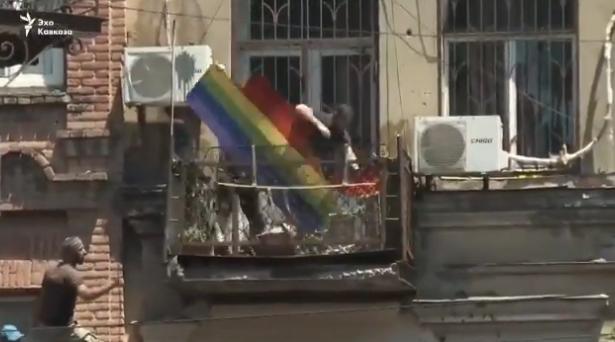
A violent mob forced the cancellation of a Pride march that was to have taken place in Georgia’s capital on Monday.
Videos show what one source described to the Washington Blade as a “marginal mob of Christian and far-right extremists” ripping down a Pride flag that Tbilisi Pride had hung from the balcony of its offices. Tbilisi Pride Director Giorgi Tabagari later posted to social media a video that showed the mob ransacked them.
❗️This is how our office looks like after todays attack. @GovernmentGeo and @MIAofGeorgia failed to protect people and didn’t stop aggressive groups to destroy our property..#TbilisiPride21 #Georgia #Pride pic.twitter.com/mLADg7BMgP
— Giorgi Tabagari (@Tabagari) July 5, 2021
Media reports indicate the mob attacked journalists and stabbed at least one person.
“They declared war against civil society, democratic values and the European course of the country,” said Tbilisi Pride in a statement it released after it officially cancelled the march.
Tbilisi Pride and other Georgian LGBTQ activists accused the former Soviet republic’s government of not doing enough to protect march participants. Tbilisi Pride in its statement also sharply criticized Prime Minister Irakli Garibashvili, Patriarch Ilia of the Georgian Orthodox Church and “pro-Russian groups” for comments they made before and after the march’s cancellation.
“The (Georgia) Ministry of Internal Affairs, despite having all opportunities to ensure the safety of Pride Week participants, did not take any action to protect the fundamental rights of people,” said Tbilisi Pride. “Tbilisi Pride members, representatives of international organizations and (members of the) diplomatic corps had a number of meetings with MIA representatives. They knew our action strategy. They were offered specific plans … but instead of measures, we have been watching from the morning government representatives encouraging violent groups.”
The American, Austrian, Bulgarian, British, Bulgarian, Czech, Dutch, Estonian, Finnish, French, German, Greek, Hungarian, Irish, Israeli, Italian, Latvian, Lithuanian, Norwegian, Slovenian, Spanish and Swedish embassies in a joint statement condemned the violence. The U.N. and European Union missions in the country were also signatories.
“We condemn today’s violent attacks on the civic activists, community members and journalists, as well as the failure of the government leaders and religious officials to condemn this violence,” reads the statement. “Participation in peaceful gatherings is a human right guaranteed by Georgia’s Constitution. Violence is simply unacceptable and cannot be excused. Those who incite or threaten violence or commit violent acts are interfering with the efforts of Georgia’s law enforcement professionals to uphold a safe and secure environment. They should be prosecuted to the full extent of the law.”
“We call on all Georgia’s leaders and law enforcement to act swiftly to protect those exercising their Constitutional rights to freedom of expression and assembly, to protect journalists exercising freedom of the press, and to publicly condemn violence,” it adds.
ILGA-Europe is among the LGBTQ rights groups that have also condemned the violence. Civil.ge, a Georgian news website, reported that authorities have launched an investigation.
NOM president traveled to Tbilisi in June
The first Tbilisi Pride march was to have taken place in June 2019, but organizers postponed it amid protests against a Russian MP who spoke at the Georgian Parliament. A small Pride demonstration took place a few weeks later.
U.S. Ambassador to Georgia Kelly Degnan in May faced criticism after she met with Georgian Orthodox Church Archbishop Iakob.
Civil.ge Editor-in-Chief Otar “Otto” Kobakhidze in a series of tweets noted Iakob “led a program against LGBTQ activists in downtown Tbilisi” on the International Day Against Homophobia, Transphobia and Biphobia in 2013.
US Ambassador to Georgia Kelly Degnan comes under mounting criticism from liberal/leftist Georgians for her Friday visit to Bodbe Monastery, where she met Archbishop Iakob, the man who led a pogrom against LGBTQ activists in downtown Tbilisi on #IDAHOT 2013.
1/3 pic.twitter.com/4UPslLM0nB
— Otar (Otto) Kobakhidze (@Otto_Kobakhidze) May 16, 2021
National Organization for Marriage President Brian Brown traveled to Georgia last week. Brown on June 23 participated in a Tbilisi press conference with Levan Vesadze, an anti-LGBTQ Georgian businessman who recently founded an ultranationalist political party.
“In country after country we find men and women, men like Levan, who act and stand for truth, for the family,” said Brown. “No lies, no slurs will stop us.”



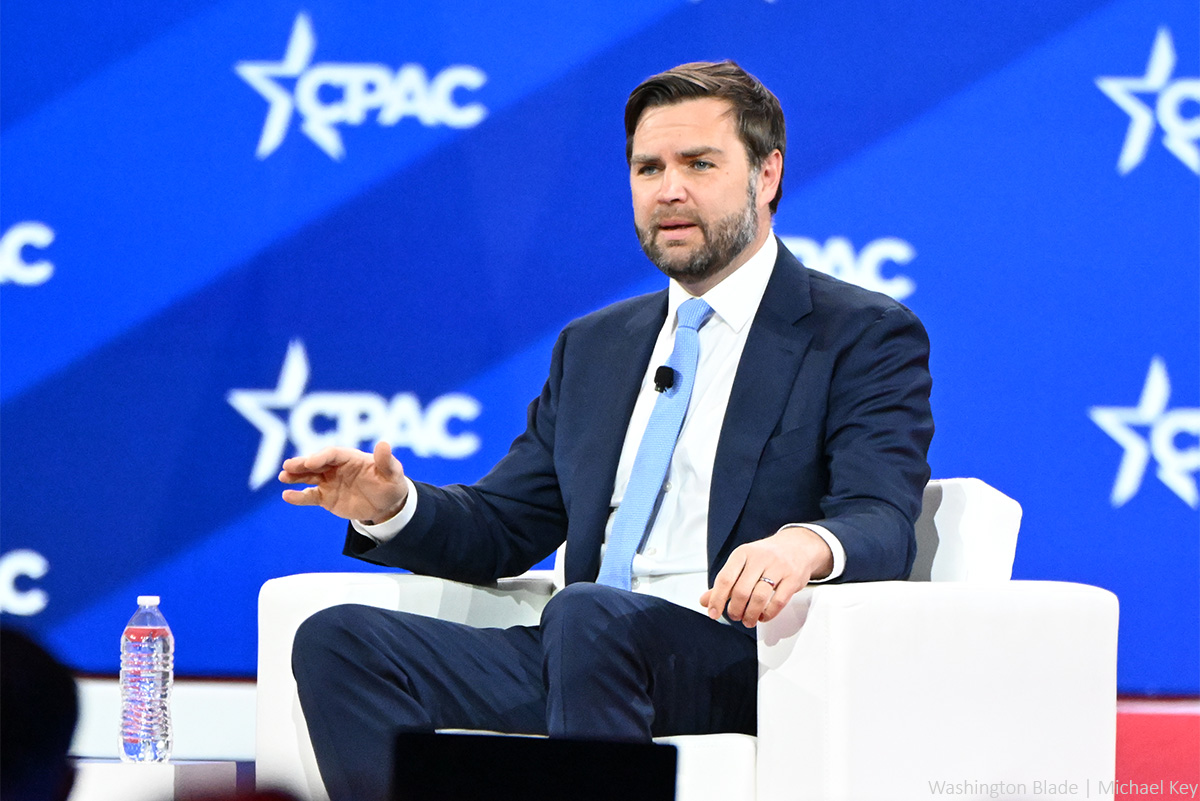
Vice President JD Vance and his wife, second lady Usha Vance, will visit Hungary next week.
An announcement the White House released on Thursday said the Vances will be in Budapest, the Hungarian capital, from April 7-8.
JD Vance “will hold bilateral meetings with” Hungarian Prime Minister Viktor Orbán. The announcement further indicates the vice president “will also deliver remarks on the rich partnership between the United States and Hungary.”
The Vances will travel to Hungary less than a week before the country’s parliamentary elections take place on April 12.
Orbán, who has been in office since 2010, and his Fidesz-KDNP coalition government have faced widespread criticism over its anti-LGBTQ crackdown.
The Associated Press notes polls indicate Orbán is trailing Péter Magyar and his center-right Tisza party.
It was never meant to become something big.
When I say that I created the first pro-neurodiversity self-advocacy group in Russia and Ukraine, made by autistic people for autistic people, everyone imagines something grand. But it wasn’t. We had three blogs. One of them was updated every day at first, then every two days, with original translations of blog posts, personal stories, and studies about autism and neurodiversity, as well as articles written by our autistic followers.
We held a peer support group meeting once every two weeks, provided one-to-one peer support online, and sometimes offered legal and psychological advice. We also organized workshops for solicitors, psychologists, and social workers, took part in public protests, and distributed free materials.
But all of it was just me and volunteers that were coming and leaving. We had some donations, but we never had any grants while I was living in Russia, nor any sponsors. We have never had an office. The biggest support we received came from our subscribers, most of whom were queer, and from LGBTQ groups.
And here is the important part of the story: from the very beginning, we were LGBTQ-friendly, and queer people played a key role in the existence of my Autistic Initiative for Civil Rights.
Today, on World Autism Acceptance Day, I want to tell a story about how the autistic self-advocacy community in Russia, Ukraine, the U.S, Australia and the UK worked side by side with the LGBTQ movement — and how LGBTQ autistic people changed the pro-neurodiversity movement, using my personal journey and the story of one group as an example.
When I was 17, I started to realize that I might be autistic. There wasn’t much information about autism in my home city, Donetsk, in Ukraine — most post-Soviet psychiatrists believed that autism was a form of childhood schizophrenia, and my parents believed that my autistic behavior was the devil’s work. It wouldn’t be surprising to say they thought the same about my queerness.
So I started digging online, and from the very beginning, the work of three amazing queer autistic authors stood out to me.
Jim Sinclair, a pioneer of the modern pro-neurodiversity movement and the leader of one of the first autistic self-advocacy groups Autistic Network International, is an openly intersex person.
Ly Xīnzhèn Zhǎngsūn Brown is a queer, nonbinary transgender activist who developed an educational program about autism for police in the U.S. Like me, they grew up among intensely conservative and religious people and were interested in the Middle East and politics.
And finally, Julia Bascom, a lesbian woman, wrote the essay “Quiet Hands” about stimming, which deeply resonated with teenage me after my parents’ constant attempts to make my body language more “normal.”
These were people whose writing saved me from suicidal thoughts created by toxic ideas promoted in the Russian- and Ukrainian-language internet at the time — the idea that autistic people are a burden and would never be accepted as they are.
These amazing American queer autistics also made me question my own queerphobic thoughts. At the time, I was an extremely religious Christian, with severe OCD around prayer and a constant fear of going to hell. For the first time, I read statistics showing that autistic people are more likely to be queer. Actually, now we know that they are up to six times more likely to be trans and nearly three times more likely to be LGB.
As a young person who had decided to make autism acceptance the work of my life, I began to think that maybe it wasn’t so frightening to be openly queer. After all, if I believed that God never made mistakes and that I was destined to be autistic, then perhaps some people were destined to be queer as well.
When Donetsk was occupied by pro-Russian forces in 2014, and my family moved to Russia (political consistency had never been their strong point), I moved in with my autistic best friend in St. Petersburg, who later became my wife.
And so, away from my abusive parents, my work in autism advocacy began. But it was autistic activists who helped me to realise that I’m queer and accept it.
LGBTQ activists were our first real supporters. My first public speech about autistic acceptance was at a Rainbow Tea meeting, a space for LGBTQ teenagers. Our autistic peer support group took place in LGBT community center, such as the Coming Out group in St. Petersburg (now recognized as an extremist organization), and the Deystvie community center.
The Alliance of Heterosexuals and LGBT for Equality was our main partner in organising autistic public actions and protests, contacting Russian liberal media, and, finally, I became one of the leaders of the first Russian LGBTQ-disability group, Queer Peace. It worked side by side with my autistic informational projects, organizing workshops and masterclasses for solicitors, psychologists, and LGBTQ group leaders to bring inclusion into LGBTQ services.
Meanwhile, autism initiatives led by non-autistic people and supporters of social Darwinism were often strongly homophobic or considered work with the LGBTQ community — or support for LGBTQ autistic people — to be “unbeneficial.”
Of course, even within Russian LGBTQ organizations, it wasn’t all inclusive. Many high-ranking LGBTQ leaders in Russia are still ableist, at least on an everyday level. But when LGBTQ community in the West began moving towards disability inclusion, post-Soviet countries followed that trend.
More importantly, my LGBTQ-autistic projects were supported by other autistic queer people, including folks from Indigenous nations under Russian control, people from villages, and those from unsupportive families.
Autistic queer people in Ukraine soon started their own — often stronger — work in promoting neurodiversity and LGBTQ rights, both within LGBTQ communities and in wider society. In part, this was because they knew Ukrainian much better than I did. Although I understand Ukrainian and can use it, it has never been my mother tongue.
Also, a Russian vlogger and autism support group leader, Jarry, a trans autistic person, began creating the first accessible video materials about autism, sharing many stories from the perspective of autistic AFAB people.
More and more autistic people in post-Soviet countries began to argue that autism is wrongly framed as a disorder, even if it can be a disability due to the misunderstanding and discrimination autistic people face — and queer people were ahead of this shift.
Finally, Bascom, the same American autistic lesbian who inspired me as a teenager and later the executive director of the Autistic Self-Advocacy Network, began mentoring our translation projects, including brochures and free books from English into Russian. The Autistic Women and Nonbinary Network, one of the most trans-inclusive and intersectional groups in the U.S., also showed us full support.
In Australia, Beinannon Lee, an autistic lesbian raising children with her wife, helped us share parenting advice for post-Soviet autistic parents and parents of autistic children. As part of the Autistic Family Collective, she opened new perspectives on homeschooling for neurodivergent families worldwide, while also showing that same-sex couples can be deeply supportive and respectful parents.
When I was stuck in Israel for four months while trying to obtain an American visa, the first organisation that supported my autistic initiative was an LGBTQ group in Tel Aviv that also supported Palestinian refugees and refugees from African countries. In the UK, Lesbian Asylum Support Sheffield was the first LGBTQ group I connected with — and the first to ask me to help with inclusion. Autistic UK, an autistic-led organization, was the first autistic group I worked with here and showed strong queer inclusivity.
And if you go to Trans Day of Remembrance events or trans protests in Sheffield, you will see just how many autistic activists are there.
In my 11 years of LGBTQ and autism activism, I have seen how much autistic and LGBTQ people have done for each other — and how those who are both queer and autistic continue to fight for their rights. It is something stronger than borders, stronger than any one country’s direction. Now, when politicians around the world are arguing against the rights of trans people to be themselves, attacking LGBTQ rights, and trying to dehumanize autistic people and take away our agency, we need to remember this — and stay together.
Commentary
Is Ghana’s selective justice a human rights contradiction?
Country’s commitment to human rights appears inconsistent
Ghana’s mission to have the United Nations recognize the trafficking of enslaved Africans and racialized chattel enslavement as the gravest crime against humanity is a historic milestone. The resolution adopted on March 25, 2026, with 123 out of about 180 countries in support, marks a major step toward global acknowledgement of the brutality and inhumanity of slavery. A 2022 report by the Equal Justice Initiative, “The Transatlantic Slave Trade,” highlights how during the slave trade, Africans who were enslaved had no rights, freedom, recognition or protection under the law. They had no voice, no bodily autonomy, no respected identity and could be brutally violated with no legal protection. This history represents a grave crime against humanity.
In my opinion, Ghana and the other countries that voted in favor are entirely right to say that such historic events cannot be sanitized or reduced to diplomatic language. Recognition is the first step towards accountability. This matter is important because it is arguably the foundation of the modern-day injustice and inequality people experience, including wealth inequality, racism, sexism, xenophobia, and queerphobia.
The double standard
Yet, despite this important step on the world stage, Ghana’s commitment to human rights appears inconsistent. The same government advocating for justice for enslaved Africans is enacting laws that jeopardies the rights of Africans today. This contradiction between Ghana’s international stance and its domestic policies is at the heart of the discussion.
In February 2026, the Ghanaian parliament formally received the Human Sexual Rights and Family Values Bill. The bill is a grave threat to the rights to nondiscrimination, protection under the law, privacy and freedom of association, assembly, and expression. It expands criminalization of LGBTQ+ people, and anyone associated with them. This Human Sexual Rights and Family Values Bill calls for a three-year imprisonment for anyone who identifies as LGBTQ+, anyone who has gender affirming treatment, anyone who enters into a same-sex marriage or attends a same-sex wedding and anyone who promotes equal rights for LGBTQ+ people. It turns enforcement into a societal obligation rather than just a state function, encouraging people to report anyone who looks suspicious or different. This further legitimizes the brutal attacks on LGBTQ+ people socially, which leaves the people of Ghana with blood on their hands.
Ghana’s proposed and reintroduced anti-LGBTQ+ legislation is said to be among the most restrictive in the world and will result in the inhumane treatment of LGBTQ+ people. It not only further criminalizes consensual same-sex relations but also targets civil society organizations that are perceived to be supporting equal rights for LGBTQ+ people. So, if this law passes, it will be illegal to support equal rights and challenge the inhuman treatment of queer Ghanaians and allies. Is this not a double standard? Ghana seeks justice for the ill-treatment of Africans during the transatlantic slave trade but is actively in the process of seeking to harm its own people.
This is not theoretical harm; it is practical harm. According to the Human Rights Watch, LGBTQ+ people in Ghana already face systemic stigma, discrimination, harassment and violence, often enabled by both legal frameworks and social stigma, resulting in a hostile climate.
Ghana falls short of upholding human rights at home
On the global stage, Ghana is arguing that the dehumanization of Africans through slavery was so severe that it constitutes the gravest possible violation of human dignity. This argument rests on a core principle that reducing people to less than fully human is unacceptable under any circumstances.
Back at home, the state is endorsing laws that do exactly that to LGBTQ+ people. Criminalizing identity, suppressing expression, clamping down on civic space, monitoring and surveilling citizens and advocating for social exclusion. These are elements of dehumanization signaling that some are less deserving of protection, dignity, respect, and justice. That is the definition of a double standard.
Supporters of these laws often frame homosexuality as un-African, but this claim does not hold up under scrutiny. In his article, “The ‘Deviant’ African Genders That Colonialism Condemned”, Mohammed Elnaiem emphasizes that historical and anthropological evidence shows that diverse sexualities and gender expressions existed across African societies long before colonial rule. Ironically, many of the laws used to criminalize LGBTQ+ people today trace directly back to the colonial-era. This is even supported by the African Court, which, in December 2020, through its Advisory opinion, made it clear that these colonial-era laws are discriminatory and perpetuated marginalization. The African Court also called on African states to take action in this regard.
It is no secret that anti-rights actors are actively operating in Ghana and supporting leaders to advance their anti-rights agenda. They are increasingly organized, visible, well-funded, and influential in shaping state policy. The upcoming 4th African Inter-Parliamentary Conference on Family and Sovereignty, scheduled to take place in Accra from May 27-30, 2026, is a clear example of this coordination. The conference endorses the so-called African Charter on Family Values, a deeply contested initiative that frames LGBTQ+ people as a threat to children and positions queer identities as foreign ideologies. This platform is being used to legitimize and advance anti-LGBTIQ+ legislation, restrict comprehensive sexuality education and roll back sexual and reproductive health rights. In this context, the treatment of LGBTQ+ people in Ghana cannot be viewed as isolated policy choices, but rather as part of a broader coordinated anti-rights agenda that normalizes and legalizes discrimination. It fuels increasingly inhumane conditions for queer communities and civil society. Ghana is simultaneously rejecting colonial injustice in one breath while enforcing colonial-era morality laws in another.
There is also a legal inconsistency worth noting. Ghana’s own Constitution guarantees the right to life, protection from violence, the right to personal liberty, the right to human dignity, equality and freedom from discrimination and the right to a fair trial. Yet, in practice these rights are not equally applied to LGBTQ+ individuals. Depriving equal rights to LGBTQ+ persons is the same as what the slave owners did to slaves.
You cannot build a credible human rights position on selective application
To be clear, recognizing slavery as a crime against humanity is not diminished by pointing out this contradiction. Both truths can coexist: the UN resolution is a victory and Ghana’s domestic policies remain deeply troubling. In fact, holding both realities together is necessary if the language of human rights is to mean anything at all. Ghana has taken a powerful stand on the global stage. The question now is whether it is willing to apply that same moral clarity at home.
Bradley Fortuin is a consultant at the Southern Africa Litigation Center and a human rights activist.

Mayor Bowser signs bill requiring insurers to cover PrEP

JD Vance to travel to Hungary next week

Pam Bondi ousted as attorney general

VIDEO: Gay journalist detained for booing Trumps at ‘Chicago’ opening night

Idaho Gov. signs harshest anti-trans bathroom bill in the country

‘Out for McDuffie’ event held at D.C. gay bar

‘Jonah’ an undeniably compelling but unusual memory play

The Oscar-losing performance that’s too good to miss

Thousands attend ‘No Kings’ protests in D.C.