Commentary
What I Learned from Joe Biden 45 (Gulp!) Years Ago
Why The Lessons Give Me Hope for 2022
The twin threats that still loom over us — the anti-democratic radicalization of the Republican Party and the persistence of the pandemic — are making this a tough time to appreciate the many first-year successes of the Biden Administration.
We are in an undeniable moment of peril and there is every reason for alarm, but also for hope. I will continue beating the drum on the urgency of passing measures such as the John Lewis Voting Rights Advancement Act, the Freedom to Vote Act, the Protecting Democracy Act, and the Judiciary Act, as well as holding those attacking our democracy accountable.
And in this end-of-year piece, I reflect on how what I learned from President Biden so many years ago gives me hope that in 2022 we can turn a corner. We can prevail in the work of defending and righting our democracy.
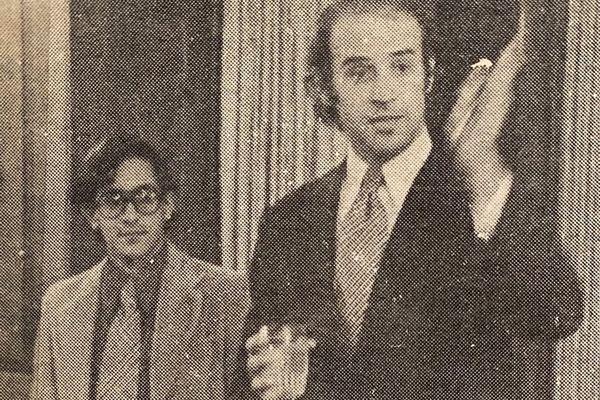
It was the summer of the Bicentennial. The summer I first saw a fax machine (which, during several minutes of noise, laboriously spooled out, on a curl of smelly, waxy paper, documents arriving from Wilmington to Washington). The summer after my sophomore year in college. The summer of 1976, when I interned for a then-wunderkind senator named Joe Biden.
Even as a kid, I was into history and politics. I knew that Biden, at the age of 29 — still too young to serve — had defeated a seemingly unbeatable incumbent. I was aware of the horrible car accident following his election, and how he rode back and forth by train to be there with his two little boys at bedtime. I watched Biden become “a liberal who breaks ranks” (as I described him in my diary), a gregarious, energetic, precocious, ambitious young senator.
My diary from 1976 shows me also to have been energetic, precocious, and — sometimes cringe-worthily — ambitious. I had a diverse network of friends and roommates. Despite a cascade of plays, movies, lectures, pleasure reading, and other distractions catalogued in my diary, I was excelling academically. I had succeeded in winning election as Speaker of the Yale Political Union, climbing to the top of the greasy pole among the other greasy pols at a school full of wannabes. And as my diary recounts, in blow by blows, 1976, as it happened was also the year I first had sex. With a woman.
When I reread the diary now, I am struck by how much this 19-year-old kid was doing, how well he was doing, how insightful and passionate he was about so much. And that, indeed, is how I’ve long remembered that year — a time of growth, accomplishment, and adventure.
But the diary also records what I had forgotten: so much second-guessing and self-doubt, a sense of losing ground and erratic confidence, critiques of my friends and myself… so much yearning outpacing my undeniable striving. I had forgotten how much perspective I did not have then on what really mattered, even as I was doing stuff that mattered and wrote endlessly in the diary about wanting to matter.
One of the things I wanted back then was to land a job in Washington. And so I was thrilled when the hotshot young Senator Biden agreed to come speak to the Political Union. After presiding, as Speaker, over his appearance, I wrote in my diary:
February 10: Senator Biden was impressive tonight. Young, energetic, warm, and intelligent. Egotistical to some extent…. I want to work for him…. I want a summer job in DC. This is important, unlike the Speakership. It’ll show that my credentials stand up in the ‘real world’ and will be that critical initial involvement leading to other jobs.
Over the next couple months — while juggling impressive courses and activities, and wrapping up the Speakership — I wrote letters, made calls, and even traveled to DC in hopes of securing an internship. My diary displays the determination and idealism with which, in the midst of my studies and activities, I pursued that ambition. For instance:March 8: A day of firsts and things that would have been orgasmic at one point in my life. Lunch with a congressman (we talked politics and then job), going on the floor of the House, sitting in the Speaker’s chair and standing at the podium where Truman gave the Truman Doctrine speech, where State of the Union speeches are given. Riding in Members Only elevators, hobnobbing with Senator Biden like a friend [but] no definite job…. Biden and I are becoming real chummy. His AA asked me back tomorrow, as the Senator and I kibitzed our time away. Good luck. I want a job so badly….
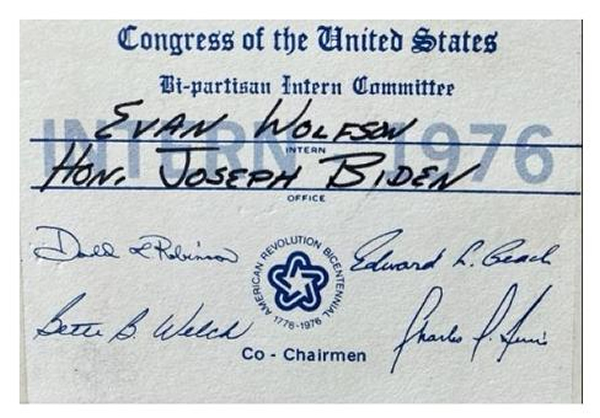
Then, on April 20, I got the call.
For the next several months, my diary contains voluminous descriptions of an exciting, busy Bicentennial Summer in DC, and my thrills, frustrations, and aspirations as a witness to, and sometime participant in, the activities of an office of a Senator on the go. The numerous entries tended to go like these:
May 25: Attended my first Foreign Relations Committee hearing…. I sat on the stage behind the Senators and entered through the private doors. Funny how when I see the sign STAFF on the elevator, I almost turn away until I realize and then get a kick out of it…. Am going to slowly widen my activities until they see I’m reliable and capable. Did some press work (phoning in ‘actualities,’ quotations on tape from Biden…to radio stations in Delaware). I used a computer research machine, ‘Scorpio,’ to read a report on Rhodesia and took such stuff out on own initiative this evening, having ordered it from the Library of Congress. Tomorrow — sale of nuclear reactors. Must remember that my goal this year should be to know how an office and Congress run…not to make policy. I have eleven years (at least) to go on that….
June 3: To my great joy, I was assigned as the Intern for Foreign Relations. I’ve handled some relatively thorny constituent requests…. I also decided that the only way I would advance from office work (not exactly crap, but not policy-making either) would be to take initiative and show them what I can do. I figured that the one thing I know I’ve gotten from a Yale education that I would not have gotten on my own is the ability to write quickly and well. So, I made impressive inquiries at the Congressional Research Service, including a jaunt to the Library of Congress (where my researcher was shocked and probably a little annoyed to discover that I was younger than he, and not a Legislative Assistant) …. I submitted it to my L.A. [legislative assistant], a former C.I.A. guy who knows everyone in the foreign relations business (!); he seemed pleasantly surprised. I hope he’ll consider it good and timely enough to: A) submit it to Biden, and B) warrant including me, at least as an observer, in the substantive areas of senatoring.
June 9: Started work at Roy Rogers [where I moonlit nights to make some money during that unpaid summer internship].
July 21: Was walking down the hall to the Foreign Relations Committee when [Vice Presidential nominee Walter] Mondale popped out (he has the office right across from us). He began walking right in front of me, and the TV people ran backwards ahead of us with bright lights and cameras. I was flanked with Secret Service — and hadn’t even tried to get into the picture! Couldn’t have done better if I’d tried. Had a low today, too: had to go pick up the Senator’s lunch. Although LA’s do it (and in other offices, it’s one of the high points of an intern’s day), it still rankled.
Even during that long-ago summer, I noted firsthand how much Biden cared about policy and government across a broad range of areas, tapping many sources of expertise and input, putting in the work. I wrote on June 16 that the Senator “does look at every single letter that goes out with his signature. He also rejects drafts and demands a lot — rightfully so.” I saw how engaged he was, and what a people person.
One diary entry, for instance, gives the flavor, recounting an outing at the beach with the Senator and the woman he was then dating whom I was introduced to as Jill — now our First Lady Dr. Jill Biden — whom I liked right off the bat and every time I was with her.
August 1: Yesterday…I went to Delaware to spend time at the Biden picnic for volunteers and supporters…. What a folksy state. The Senator running around clowning and taking pictures in his bathing suit, splashing with his kids in the water. The Governor [Sherman Tribbitt]– ‘howaya, Sherm’ — in loafers and short sleeves walking on the sand. Me playing ‘football’ with Beau and Hunt Biden (7, 6), then taking them in the cold ocean, counting continually to make sure — like a camp counselor — that there were 5 kids all the time, heads above the water and all….The kids gave me something to do other than fawn on the Senator, as I knew very few of the people there. At one point the Senator grabbed me and made a joke about Yale; I had walked in front of someone taking a picture with him — boy, was I embarrassed. He and I bantered a little, in and out of the water — but I still am not sure he knows my name… I still don’t know where I stand. I so want to be a part of things…
Back at school in the fall, I stayed in touch with the Senator’s office, and occasionally heard from him as well — treasuring every contact.
September 27: Got a nice note from Biden…. He says that he is glad I took him up on the suggestion that I keep in touch with ideas for legislation. He said, ‘You have always been a reservoir of ideas. [!] … In light of all your outside interests, I trust your studies are not suffering. Keep in touch… Joe.’
Soon, though, my diary reveals that I was busier than ever — juggling highs and lows of friendships, teaching Sunday School, and diving into a new role as Yale campus co-coordinator for the Carter-Mondale campaign, all while shouldering another challenging course load (my favorite semester at college, it turned out). And throughout, figuring out for myself what it was going to mean to be gay.
Of course, 1976 was a long time ago, and very early in my life. Still ahead of me lay graduating college and law school; the Peace Corps; decades of lawyering and activism; founding and leading the successful and transformative campaign to win the freedom to marry; teaching at Georgetown and Yale; close circles of friends (including, still, the college roommates I had written and worried about, and now, our respective spouses and partners); uncle-hood; travels; and a happy marriage to the man I love. In 1976, I had no way of knowing that this was what life held in store for me — but as I reread the diary, I can see now that the 19-year-old me was finding his way to at least two major lessons that have shaped my life (and been hallmarks of my work) ever since.
First, I learned that year that greatness as in “I want to be great” comes, if at all, from actual service, making a difference for others, rather than from the credentials and things I’d begun the year by pursuing — to be Speaker of the Political Union, or to be in politics for the sake of glory or even attention. I discovered that after striving to get elected Speaker, the actual position didn’t feel as worthwhile as I had thought it would, whereas engaging in debates (and meeting visitors like Biden), my grunt work organizing the campus and helping deliver a Connecticut win for Jimmy Carter, teaching students at Sunday School, and digging as an intern into substantive research — not to mention my actual studies — felt gratifying and proved meaningful.
I was learning for myself the lesson best conveyed in my favorite speech of Martin Luther King, Jr.’s, the one I hang on the wall of every office I’ve had. When they give my eulogy, Dr. King said, “tell them not to mention that I have a Nobel Peace Prize — that isn’t important. Tell them not to mention that I have three or four hundred other awards — that’s not important. Tell them not to mention where I went to school…. I’d like somebody to mention that [he] tried to give his life serving others… tried to love somebody. [All] of the other shallow things will not matter…. I just want to leave a committed life behind.”
My diary shows me learning another lesson, too: the power and affirmation that come from not wallowing in the negative, from being hopeful, from focusing on the pathway not the problem, from being kind — to others, and to myself.
While I wince at the young me’s sometimes shallow ambition and excessive judgment (“fancied greatness,” as another hero, Abraham Lincoln, described his youthful sense of self), I am simultaneously proud of what the young me was actually doing — even as he wrestled with what it meant and where he wanted to go. As the young me learned that year to pursue a committed life in a meaningful way, and to be charitable toward others, so older me is again reminded to be kind to my young self, too.
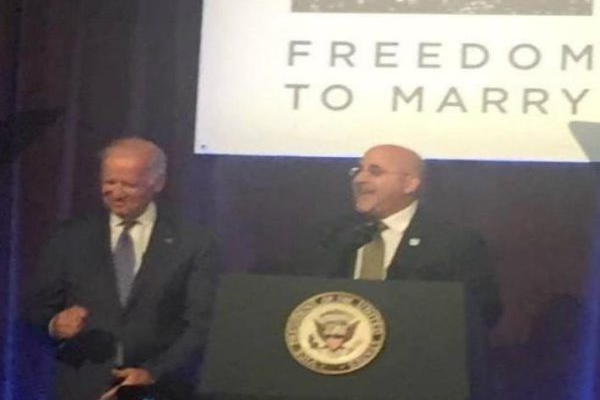
I last spent real time with Joe Biden when the then-Vice President spoke to the more than 1000 advocates and celebrants at Freedom to Marry’s Victory Celebration on July 9, 2015.
“Let me begin by saying I take full credit for Evan” were Biden’s opening words (greeted by laughter). He then shared lessons he’d learned from his father about love, his evolution in understanding gay people, and how he came to support the freedom to marry — even getting out in front a bit to help nudge the Administration along. He recalled his pivotal Senate role in defeating the anti-gay Robert Bork, nominated by Reagan to the Supreme Court. That, in turn, led to the appointment of Justice Anthony Kennedy instead, who went on to write the marriage victory we had worked for and were celebrating.
“In 1983, there was a Harvard Law essay making the constitutional case for marriage equality written by a young man,” Vice President Biden told the audience. “He said, ‘Human rights illuminate and radiate from the Constitution, shedding light on the central human values of freedom and equality.’…. That was the basis upon which I took on Judge Bork.”
“These were not words from an illustrious Supreme Court Chief Justice,” Biden concluded. “These are the words written by Evan Wolfson when he was in law school. Pretty courageous for a 26-year-old kid at Harvard Law School when the future looked so dark and lonely.”
Whether or not his former intern’s law school thesis on marriage, written just a few years after my internship, really had been top of mind in Biden’s thinking as he took on Bork and continued his Senate career, I still appreciated his generosity. It was yet another example of what I know I really learned from him.
When I endorsed him for president, I wrote that “Biden [sometimes] got things I cared about wrong — even, initially, my own work to win the freedom to marry. But, crucially, he has also always shown a willingness to listen and learn, an eagerness to explore new approaches and syntheses, a capacity to empathize and evolve.”
“I have seen firsthand,” I added, “how, unlike Trump, Joe Biden cares about governing, knows how the government works, and will work through it, not war on it…. Biden’s concern for people and deep knowledge and experience give him the ability to bring people together” and to deliver on good ideas to restore our democratic possibilities.
From a wunderkind senator, the embodiment of ambition, Joe Biden came to embody virtues of empathy, faith in government, and hope as a politician, candidate, and now, our president. On him now — and on us — literally rests the future of America as a democracy.
I can’t claim to know President Biden well enough to know every bit of his inner thinking, but from what I’ve experienced in interacting with him , it’s clear that in his own way, too, Joe Biden learned what I began learning under his tutelage: A committed life is found not in just the ambition to be great, but the ambition to “do great” — to do for others. To persevere and put in the work. To listen and to grow. To be kind. To be hopeful, and to convey hope. And, too, and always, the personal matters.
Now, heading into 2022, we must redouble our efforts to help (and push) President Biden and all true democrats. Together we must rally enough Americans to defend liberal democracy, reach for justice, combat inequality, and build America back better. We have to persuade, organize, hang in, maneuver, mobilize, and vote. What I learned as a college kid, and since, sustains my belief that we Americans can, yet again, meet the call to action and rise to the great work this moment and history require.
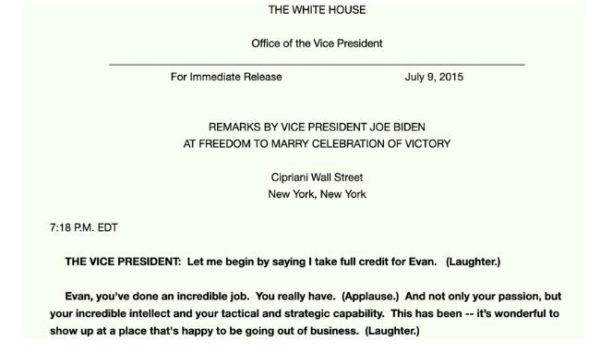
Vice President’s Remarks, Freedom to Marry Victory Celebration, July 9, 2015
*********************
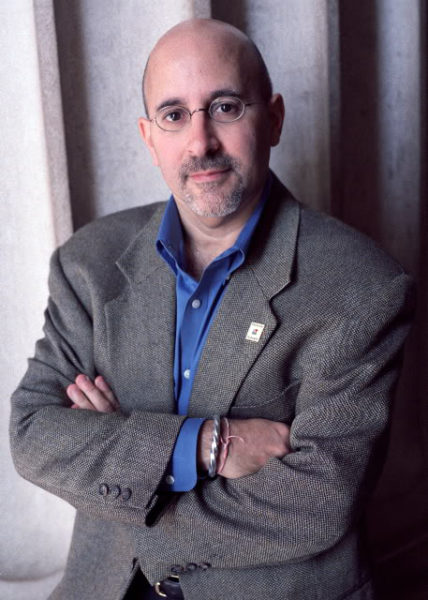
Evan Wolfson led the campaign to win the freedom to marry for same-sex couples. Since victory in 2015, he advises and assists diverse movements in the US on “how to win,” as well as activists seeking to win marriage in other countries worldwide.
*********************
The preceding piece was previously published on Medium and is republished with permission.






Commentary
Center Arts Gallery celebrates 10 years with reception, auction
Oct. 17 fundraiser to feature jazz combo, artwork created on site

Ten years ago, I had a vision: to create a dedicated space within The DC LGBTQ+ Community Center for local LGBTQ+ artists to share their creativity in a community space conceived specifically for them. That vision became the Center Arts Gallery. Over the past decade, the Center Arts Gallery has grown into a true home for our LGBTQ+ siblings, a place illuminating our joy, resistance, and resilience through the power of art.
Art is so much more than decoration. It can be a powerful protest, a keeper of memories, a testament to survival, and a vivid reminder that our lived experiences deserve to be seen, heard, and deeply valued. When we created the Center Arts Gallery, our goal was to remove barriers so that queer artists could feel welcomed, supported, and completely free to express themselves. Now, as we mark the incredible 10th anniversary of Center Arts, love truly comes full circle as many of those same amazing artists and creatives are giving back by donating their artwork for a special benefit auction.
On Saturday, Oct. 17, 2026, The DC LGBTQ+ Community Center will host our annual Fall Reception and Art Auction, celebrating 10 years of Center Arts Gallery at 1827 Wiltberger St., N.W., with an ambitious fundraising target of $25,000.
Appropriately themed “The Art of Belonging,” this milestone celebration will bring our community together with intention, uniting multiple forms of local queer creativity under one roof. The evening promises to be an unforgettable experience.
We are thrilled to have the celebration hosted by award-winning spoken word artist, poet, and educator Charity Blackwell. Attendees will enjoy smooth jazz selections performed by 2nd Independence — a jazz combo from the DC Different Drummers — alongside delicious heavy hors d’oeuvres provided by Shaw Tavern and exquisite dessert offerings by celebrity chef Patrick Vanas.
Throughout the night artwork will be created live on site, joining the online pieces generously donated by local artists.
Most importantly, every dollar raised during the reception and auction goes directly toward sustaining The DC Center’s life-affirming programs and supportive services. From food assistance providing nourishing meals, the free food pantry, and behavioral health counseling, to trauma-informed case management, resource navigation, HIV/STI testing, and essential hygiene services like showers, laundry, and a clothing boutique, our doors remain open because
of community support. These funds also support our cyber lounge, mail and locker services, harm reduction supplies, and critical wellness programs.
To ensure that everyone in our community can fully participate, ASL interpretation will be provided during the event program. We offer flexible ways to join us: General Admission is free (currently at capacity), with custom signature cocktails, wine, and beer available for purchase.
For those looking for an elevated evening, our $75 VIP Experience includes early admission at 6 p.m., early online auction access, complimentary Champagne (6-7 p.m.), an intimate opportunity to mingle with participating artists, a special swag bag, plus an open beer and wine bar throughout the entire evening.
For 10 years, Center Arts Gallery has shown us that belonging is an art form we create together. As we look back on a decade of community and look forward to the future, I invite you to join us, support local queer artists, and invest in the essential programs that keep our community thriving. Let’s come together to ensure that The DC Center can continue to educate, empower, uplift, and connect us all for generations to come.
Kimberley Bush is executive director of The DC LGBTQ+ Community Center.
Commentary
Washington Blade responds to concerns over White House pool duties
Inaccurate media reports create confusion but we stand with our colleagues
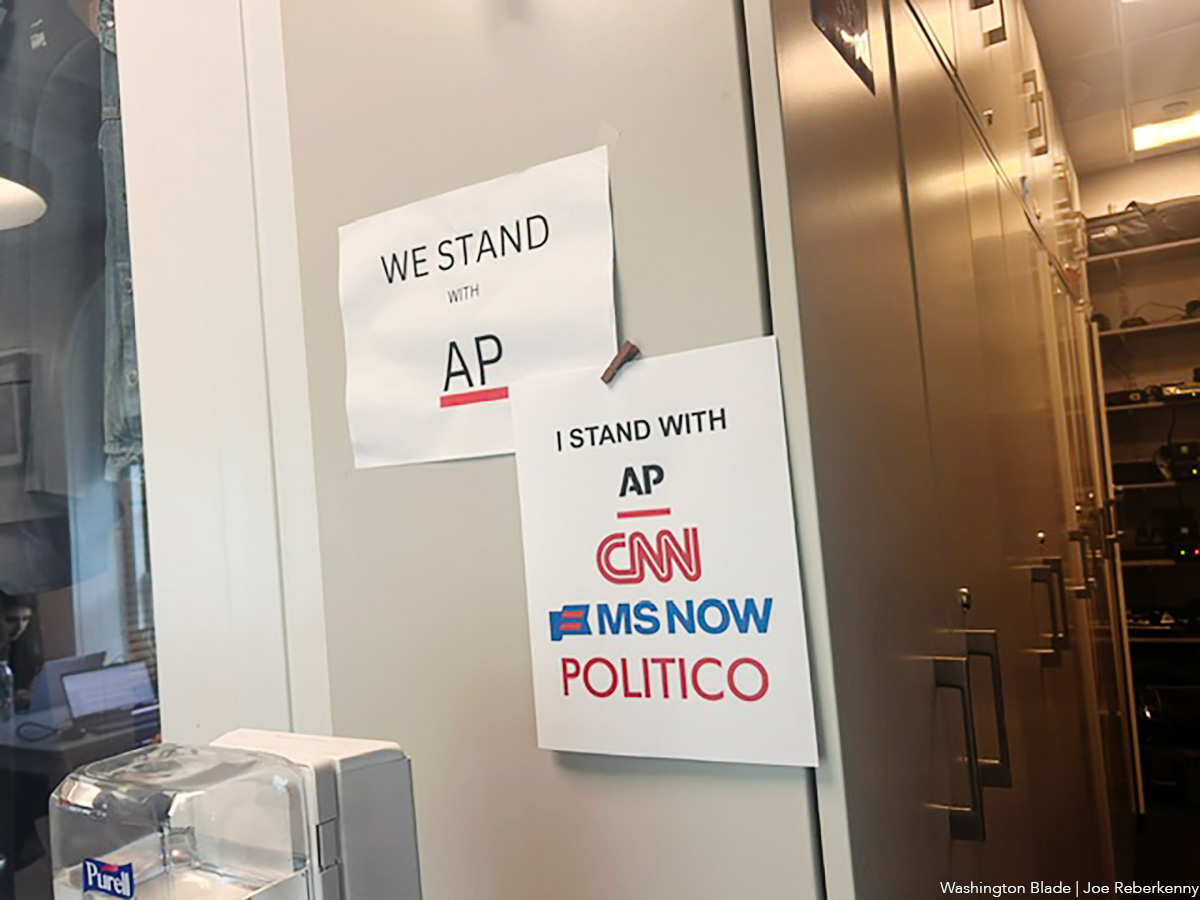
Last week, President Trump announced his unconstitutional ban of CNN, MSNow, and Politico from the White House. Coincidentally, on Monday, it was the Washington Blade’s turn to serve as the print pool reporter on duty covering the president’s actions that day. This important responsibility is shared and rotated among the print members with each serving roughly once per month. The Blade is the only LGBTQ outlet with a seat in the briefing room, a slot in the pool rotation, and membership in the White House Correspondents’ Association, something we fought for decades to secure after enduring years of discrimination, ridicule, and resistance to openly queer journalists working inside the White House. We take our responsibilities there seriously.
There are two pools that cover the president: broadcast and print. The other four members of the broadcast pool — ABC, CBS, NBC, and Fox News — agreed to boycott their pool duties. There has been no boycott among the print pool, which is a separate entity. I called the president of the White House Correspondents’ Association on Monday to confirm that no outlets in the print pool were boycotting.
A boycott by the Blade would set us back and lead to our expulsion from the pool and briefing room and our replacement by a right-wing outlet sympathetic to President Trump’s approach to attacking the media. The LGBTQ community is far better served with the Blade in the room than a far-right blogger taking our seat.
Let’s be clear: the Blade stands for diversity, equity, and inclusion and we stand for the First Amendment and freedom of the press. In solidarity with the broadcast pool, we made two important decisions on Monday — the first day anyone had to think about any of this. First, we refused to take or share any videos or still photos of the president, which would have undermined the broadcast boycott. Second, when Politico’s turn comes up for pool duty in mid-October, the Blade will not fill in and cover for them while they are banned. Politico must be readmitted and allowed to do their job.
After a rough day navigating and reporting on all of this, the Advocate published a reckless and inaccurate story suggesting that the Blade had crossed a picket line. Not true, as there is no print pool boycott. They claimed that I wouldn’t talk to their reporter. Also not true. I called their reporter within 90 minutes of receiving his message and he didn’t take the call or call me back. Their story named me and our White House reporter, immediately exposing us to public criticism and worse. The environment in D.C. is so toxic and even violent these days that subjecting our staff to unfair and false accusations like this invites harassment, doxxing, and worse. To do that without even talking to us is next level irresponsible and the antithesis of journalism.
On Tuesday, I talked to two reporters and an editor at the Advocate but they refused to retract anything in their inaccurate story. If the reporter had returned my call, I could have explained all of this but they are more concerned with clickbait and sensational headlines, a dangerous practice in these troubled times.
Back to the pool. The Blade was in the briefing room in the Reagan era, when Press Secretary Larry Speakes made jokes about AIDS and the reporters in the room laughed out loud. We endured all of that abuse and worse for decades, always standing in the back of the room and never being called on. The Blade’s journalists persevered. When President George W. Bush was re-elected in 2004, the Blade’s White House credentials were revoked amid an earlier press crackdown. Notably, no one boycotted or stood up for us. When Barack Obama won election in 2008, I received an email from his communications director informing me that effective midnight on Jan. 20, 2009, the Blade’s credentials would be restored.
So we have had quite a ride navigating administrations and their changing requirements for gaining access but always playing the long game. As Barney Frank used to say, “If you’re not at the table, then you’re probably on the menu.” The Blade is at the table and we do our best to ensure the LGBTQ community’s issues are addressed by both parties.
Thanks for reading and supporting the Blade’s work. If you have questions about our approach, you can reach me at [email protected].
Kevin Naff is editor of the Washington Blade. Reach him at [email protected].
Commentary
What LGBTQ veterans are building after ‘Don’t Ask, Don’t Tell’
DADT repeal took effect on Sept. 20, 2011. Trans servicemember ban reinstated

Fifteen years ago this month, the repeal of “Don’t Ask, Don’t Tell” took effect. At the time, the importance of the change was obvious: gay, lesbian, and bisexual Americans would no longer have to hide who they were to wear the uniform. What was harder to see was what would follow: a generation of LGBTQ veterans able to carry their service openly into American civic life.
Earlier this month, Alaska state Rep. Andrew Gray, an Army veteran, stood before the Anchorage Assembly and asked the city to recognize Sept. 20 as LGBTQ Veterans Day.
His former command sergeant major, Mike Grunst, followed him to the microphone. A 35-year veteran who had served in combat, Grunst called troops who had served while hiding who they were “the bravest I have ever served with.”
Then Denise Sudbeck stepped forward. A Vietnam-era Navy veteran, she thanked the country for the privilege of serving and asked that the next generation have the same chance.
The Assembly approved the recognition.
Nothing about the scene required a new vocabulary. A veteran made a request of his community. A commander vouched for those who served beside him. Another veteran asked that younger Americans inherit the opportunity she valued. They entered the civic record simply as veterans.
That identity can do more than win recognition.
When federal policy abruptly ended the careers of transgender servicemembers this year, veterans and servicemembers in California began asking a practical question: What happens when those Americans come home?
Republican Assemblyman Jeff Gonzalez, a Marine combat veteran, began one hearing with questions about transgender military service. He listened as veterans explained how the military handles medical care and deployment case by case.
Then the discussion turned to separation.
“I don’t wanna see any veteran homeless,” Gonzalez said. Before the hearing ended, he was asking: “How can I help? How can I understand? How can I be a good advocate?”
The legislation that followed would provide housing, employment and transition assistance to discharged servicemembers. Republican state Sen. Shannon Grove spoke for it. The Senate passed it 32 to 0.
Americans have plainly not settled their disagreements over transgender people. Nor should military service be a prerequisite for rights that belong to every citizen.
But military service creates relationships that are difficult to reduce to the abstractions of the culture war. Before a legislature, “the transgender issue” can become a veteran who deployed, an officer who led troops, or the person who once stood beside you.
The political question changes because the human relationship has already changed.
The pattern is beginning to appear across the country. Kansas is among the states recognizing LGBTQ Veterans Day for the first time this year. New York and Virginia are pursuing broader state-level programs for LGBTQ veterans.
Sept. 20 is deliberate. On that day in 2011, “Don’t Ask, Don’t Tell” ended.
We usually remember repeal for what LGBTQ Americans gained: the ability to serve openly. Fifteen years later, we can also see what the country gained.
A gay veteran can stand before his local government beside the commander who once led him. A transgender servicemember can sit before a legislator who begins with doubts and ends by asking how he can help. A veteran from an older generation can ask her neighbors to give those who follow her the same chance to serve.
This is citizenship in practice.
The enduring legacy of “Don’t Ask, Don’t Tell” repeal is not only that Americans were finally allowed to serve openly. It is also what they can now build after coming home.

Center Arts Gallery celebration, auction to take place on Oct. 17

Comings & Goings

‘Hidden in Plain Sight:’ The story of Odessa Madre

‘Governments that attack LGBTQ+ rights learn from each other’

Horror genre has evolved into space to explore queer identity

ICC unseals arrest warrants for Taliban officials accused of persecuting LGBTQ people, women

Physician: addiction doesn’t always look the way you think it does

Calendar: October 9-15

Solidarity beyond the parade: the actual cost of Pride

Essential queer horror classics for Halloween
-

 Afghanistan5 days ago
ICC unseals arrest warrants for Taliban officials accused of persecuting LGBTQ people, women
-
District of Columbia5 days ago
Physician: addiction doesn’t always look the way you think it does
-
Calendar5 days ago
Calendar: October 9-15
-
Opinions4 days ago
Solidarity beyond the parade: the actual cost of Pride