Massachusetts
Maura Healey clinches nomination in Massachusetts as lesbian candidate for governor
Candidate set to become first out lesbian elected governor
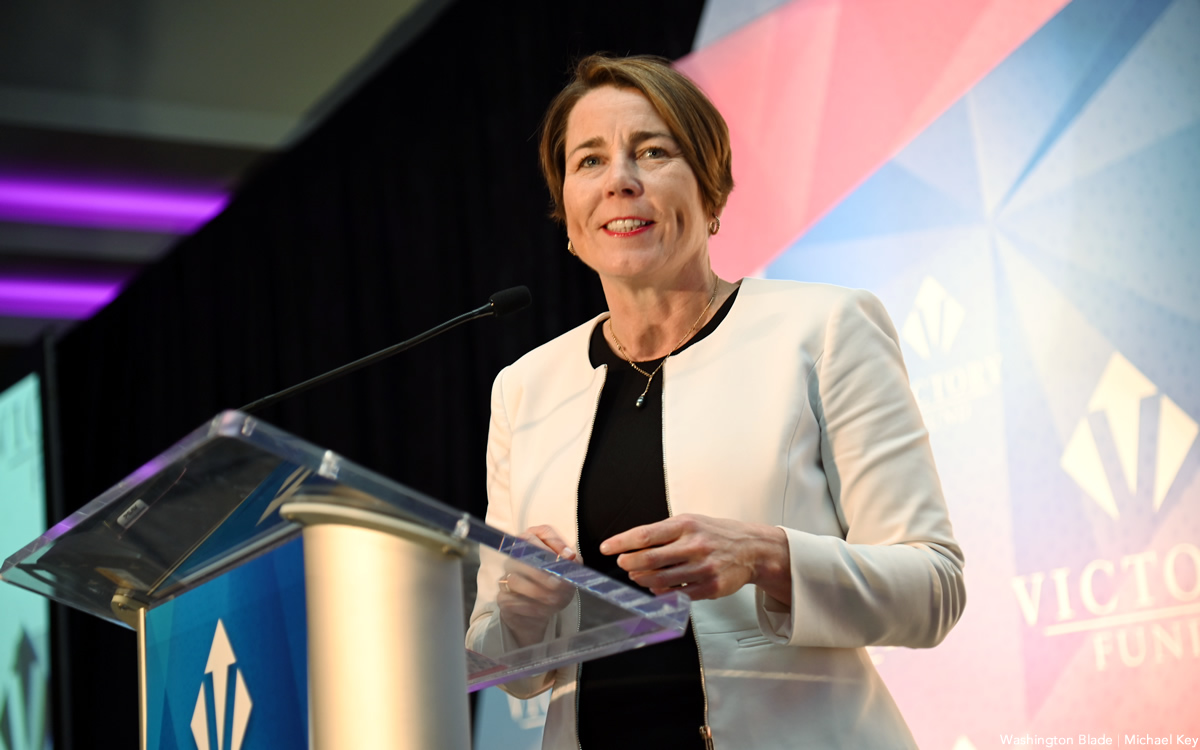
Maura Healey, the Democratic contender to become the next governor of Massachusetts, secured on Saturday her party’s nomination for the general election in November, setting herself up to become the first out lesbian to be elected governor in the United States.
Healey, who previously made history as the first out lesbian and LGBTQ person elected as state attorney general, announced on Monday she had secured 71 percent of the vote from party delegates at the Democratic State Convention in Worcester.
In her speech accepting the nomination, Healey made lowering the high cost of living, expanding job training and making Massachusetts a global leader on clean energy central components of her campaign.
“I will be a governor who sees everyone, listens to everyone, and hears everyone,” Healey said. “A governor who fights to make sure people share in our progress and no one is left behind. A governor as tough as the state she serves…Because in Massachusetts, we don’t follow. We lead. We don’t wait. We act. And we never back down when people are counting on us.”
Local media in Massachusetts have declared Healy the victor in all but name five months ahead of the general election in November. Massachusetts Gov. Charlie Baker, who’s a Republican, is popular but has declined to run for re-election. Even though the GOP is expected to achieve serious wins in November, no serious Republican is in the field who could compete against Healy.
Healy could end up sharing the distinction of being one of the first out lesbians to be elected governor in the United States. Also in contention is Tina Kotek, a former speaker of the Oregon House, who’s also a lesbian and could achieve the same distinction.
The two would follow a long list of firsts made by openly gay and lesbian officials in recent years after the advancement of LGBTQ rights and visibility, such as the confirmation of Pete Buttigieg as transportation secretary.
A full 10 years ago in 2012, Tammy Baldwin became the first out lesbian elected to the Senate, and Gov. Jared Polis became the first openly gay man elected governor in 2018. Oregon already had an LGBTQ person serving as governor; the current governor, Kate Brown, is bisexual.






Massachusetts
EXCLUSIVE: Markey says transgender rights fight is ‘next frontier’
Mass. senator, 79, running for re-election
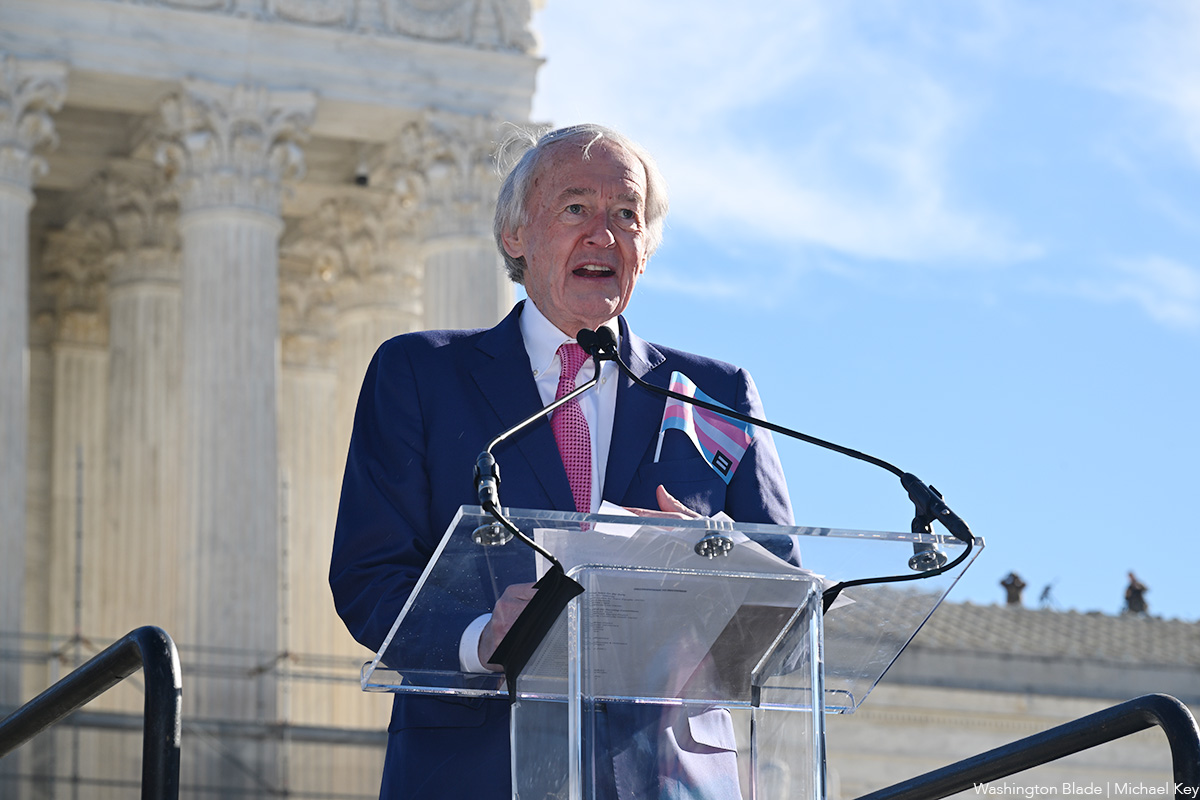
For more than half a century, U.S. Sen. Edward Markey (D-Mass.) has built a career around the idea that government can — and should — expand rights rather than restrict them. From pushing for environmental protections to consumer safeguards and civil liberties, the Massachusetts Democrat has long aligned himself with progressive causes.
In this political moment, as transgender Americans face a wave of federal and state-level attacks, Markey says this fight in particular demands urgent attention.
The Washington Blade spoke with Markey on Tuesday to discuss his reintroduction of the Trans Bill of Rights, his long record on LGBTQ rights, and his reelection campaign — a campaign he frames not simply as a bid for another term, but as part of a broader struggle over the direction of American democracy.
Markey’s political career spans more than five decades.
From 1973 to 1976, he served in the Massachusetts House of Representatives, representing the 16th Middlesex District, which includes the Boston suburbs of Malden and Melrose, as well as the 26th Middlesex District.
In 1976, he successfully ran for Congress, winning the Democratic primary and defeating Republican Richard Daly in the general election by a 77-18 percent margin. He went on to serve in the U.S. House of Representatives for nearly four decades, from 1976 until 2013.
Markey in 2013 ran in the special election to fill an open Senate seat after John Kerry became secretary of state in the Obama-Biden administration. Markey defeated Republican Gabriel E. Gomez and completed the remaining 17 months of Kerry’s term. Markey took office on July 16, 2013, and has represented Massachusetts in the U.S. Senate ever since.
Over the years, Markey has built a reputation as a progressive Democrat focused on human rights. From environmental protection and consumer advocacy to civil liberties, he has consistently pushed for an expansive view of constitutional protections. In the Senate, he co-authored the Green New Deal, has advocated for Medicare for All, and has broadly championed civil rights. His committee work has included leadership roles on Senate Foreign Relations Committee and the Senate Health, Education, Labor and Pensions (HELP) Committee.
Now, amid what he describes as escalating federal attacks on trans Americans, Markey said the reintroduction of the Trans Bill of Rights is not only urgent, but necessary for thousands of Americans simply trying to live their lives.
“The first day Donald Trump was in office, he began a relentless assault on the rights of transgender and nonbinary people,” Markey told the Blade. “It started with Executive Order 14168 ‘Defending women from gender ideology extremism and restoring biological truth to the federal government.’ That executive order mandates that federal agencies define gender as an unchangeable male/female binary determined by sex assigned at birth or conception.”
He argued that the executive action coincided with a sweeping legislative push in Republican-controlled statehouses.
“Last year, we saw over 1,000 anti trans bills across 49 states and the federal government were introduced. In January of 2026, to today, we’ve already seen 689 bills introduced,” he said. “The trans community needs to know there are allies who are willing to stand up for them and affirmatively declare that trans people deserve all of the rights to fully participate in public life like everyone else — so Trump and MAGA Republicans have tried hard over the last year to legislate all of these, all of these restrictions.”
Markey said the updated version of the Trans Bill of Rights is designed as a direct response to what he views as an increasingly aggressive posture from the Trump-Vance administration and its GOP congressional allies. He emphasized that the legislation reflects new threats that have emerged since the bill’s original introduction.
In order to respond to those developments, Markey worked with U.S. Rep. Pramila Jayapal (D-Wash.) to draft a revised version that would more comprehensively codify protections for trans Americans under federal law.
“What we’ve added to the legislation is this is all new,” he explained, describing how these proposed protections would fit into all facets of trans Americans’ lives. “This year’s version of it that Congresswoman Jayapal and I drafted, there’s an anti-trans bias in the immigration system should be eliminated.”
“Providers of gender affirming care should be protected from specious consumer and medical fraud accusations. The sexual and gender minority research office at the National Institutes of Health should be reopened and remain operational,” he continued. “Military discharges or transgender and nonbinary veterans and reclassification of discharge status should be reviewed. Housing assignments for transgender and nonbinary people in government custody should be based on their safety needs and involuntary, solitary or affirmative administrative confinement of a transgender or nonbinary individual because of their gender identity should be prohibited, so without it, all of those additional protections, and that’s Just to respond to the to the ever increasingly aggressive posture which Donald Trump and his mega Republicans are taking towards the transgender.”
The scope of the bill, he argued, reflects the breadth of challenges trans Americans face — from immigration and health care access to military service and incarceration conditions. In his view, the legislation is both a substantive policy response and a moral declaration.
On whether the bill can pass in the current Congress, Markey acknowledged the political hardships but insisted the effort itself carries as much significance as the bill’s success.
“Well, Republicans have become the party of capitulation, not courage,” Markey said. “We need Republicans of courage to stand up to Donald Trump and his hateful attacks. But amid the relentless attacks on the rights and lives of transgender people across the country by Trump and MAGA Republicans, it is critical to show the community that they have allies in Congress — the Trans Bill of Rights is an affirmative declaration that federal lawmakers believe trans rights are human eights and the trans people have the right to fully participate in public life, just like everyone else.”
Even if the legislation does not advance in this congress, Markey said, it establishes a framework for future action.
“It is very important that Congresswoman Jayapal and I introduce this legislation as a benchmark for what it is that we are going to be fighting for, not just this year, but next year,” he said when asked if the bill stood a legitimate chance of passing the federal legislative office when margins are so tight. “After we win the House and Senate to create a brand new, you know, floor for what we have to pass as legislation … We can give permanent protections.”
He framed the bill as groundwork for a future Congress in which Democrats regain control of both chambers, creating what he described as a necessary roadblock to what he views as the Trump-Vance administration’s increasingly restrictive agenda.
Markey also placed the current political climate within the longer arc of LGBTQ history and activism.
When asked how LGBTQ Americans should respond to the removal of the Pride flag from the Stonewall National Monument — the first national monument dedicated to recognizing the LGBTQ rights movement — Markey was unwavering.
“My message from Stonewall to today is that there has been an ongoing battle to change the way in which our country responds to the needs of the LGBTQ and more specifically the transgender community,” he said. “When they seek to take down symbols of progress, we have to raise our voices.”
“We can’t agonize,” Markey stressed. “We have to organize in order to ensure that that community understands, and believes that we have their back and that we’re not going away — and that ultimately we will prevail.”
Markey added, “That this hatefully picketed White House is going to continue to demonize the transgender community for political gain, and they just have to know that there’s going to be an active, energetic resistance, that that is going to be there in the Senate and across our country.”
Pam Bondi ‘is clearly part’ of Epstein cover up
Beyond LGBTQ issues, Markey also addressed controversy surrounding Attorney General Pam Bondi and the handling of the Epstein files, sharply criticizing the administration’s response to congressional inquiries.
“Well, Pam Bondi is clearly part of a cover up,” Markey said when asked about the attorney general’s testimony to Congress amid growing bipartisan outrage over the way the White House has handled the release of the Epstein files. “She is clearly part of a whitewash which is taking place in the Trump administration … According to the New York Times, Trump has been mentioned 38,000 times in the [Epstein] files which have been released thus far. There are still 3 million more pages that have yet to be released. So this is clearly a cover up. Bondi was nothing more than disgraceful in the way in which she was responding to our questions.”
“I think in many ways, she worsened the position of the Trump administration by the willful ignoring of the central questions which were being asked by the committee,” he added.
‘I am as energized as I have ever been’
As he campaigns for reelection, Markey said the stakes extend beyond any single issue or piece of legislation. He framed his candidacy as part of a broader fight for democracy and constitutional protections — and one that makes him, as a 79-year-old, feel more capable and spirited than ever.
“Well, I am as energized as I have ever been,” he said. “Donald Trump is bringing out the Malden in me. My father was a truck driver in Malden, Mass., and I have had the opportunity of becoming a United States senator, and in this fight, I am looking ahead and leading the way, affirming rights for the trans community, showing up to defend their rights when they are threatened from this administration.”
He continued, reiterating his commitment not only to the trans community but to a future in which progressive and proactive pushes for expanded rights are seen, heard, and actualized.
“Our democracy is under threat from Donald Trump and MAGA Republicans who are trying to roll back everything we fought for and threaten everything we stand for in Massachusetts, and their corruption, their greed, their hate, just make me want to fight harder.”
When asked why Massachusetts voters should reelect him, he said his age and experience as a 79-year-old are assets rather than hindrances.
“That’s exactly what I’m doing and what I’m focused upon, traveling across the state, showing up for the families of Massachusetts, and I’m focused on the fights of today and the future to ensure that people have access to affordable health care, to clean air, clean water, the ability to pay for everyday necessities like energy and groceries.”
“I just don’t talk about progress. I deliver it,” he added. “There’s more to deliver for the people of Massachusetts and across this country, and I’m not stopping now as energized as I’ve ever been, and a focus on the future, and that future includes ensuring that the transgender community receives all of the protections of the United States Constitution that every American is entitled to, and that is the next frontier, and we have to continue to fight to make that promise a reality for that beleaguered community that Trump is deliberately targeting.”
Massachusetts
Mass. Senate passes bill to repeal sodomy, anti-transgender laws
Measures now go to state House of Representatives

The Massachusetts state Senate unanimously passed a bill Thursday to repeal several archaic criminal laws that were still on the books, including the state’s sodomy law and a law critics have dubbed the “walking while trans” law. The bill now heads to the state House of Representatives, where it is expected to pass.
“I’m just really happy that it passed. And I hope that it will pass seamlessly in the house. There’s absolutely no reason for it not to pass,” says Tanya Neslusan, executive director of MassEquality, a leading statewide LGBTQ advocacy group.
Despite long being considered a leader in passing progressive legislation for LGBTQ rights, Massachusetts is one of 12 states that still have laws banning gay sex in its criminal statutes. Massachusetts General Law Chapter 272, Sections 34-35 criminalize “the abominable and detestable crime against nature” and “unnatural and lascivious acts with another person.”
Both laws have been limited by a series of Massachusetts Supreme Judicial Court rulings between 1974 and 2002 that held that they could not be used against people committing consensual acts in private, but the laws have never been repealed or amended to reflect that change.
Bill S.2551 passed by the Senate repeals the “crime against nature” statute entirely and limits the “unnatural and lascivious acts” statute to acts done “in public with the intent of public exposure.”
It also amends Section 53, which criminalizes certain types of behaviors in public, by removing a reference to “common night walkers, common street walkers, both male and female,” which some activists have said has been used to harass trans people committing no actual offence other than being out in public.
“That’s something that hits the queer community. It’s something easy to target when somebody is not creating a disturbance, but they are visibly queer or trans and you can label them a ‘common night walker,’” Neslusan says. “It’s also really stigmatizing language when you refer to somebody as a ‘common night walker.’”
During debate, senators also added a provision to the bill that repeals Section 36, which makes “blasphemy” a crime punishable by up to a year in jail or a fine of $300.
Versions of the bill have been proposed several times over the years, but none has made it this far in the legislative process. The bill was introduced during last year’s session, where it was studied and passed by the Joint Committee on the Judiciary and the Joint Committee on Rules. Earlier this week it was reported out of the Senate Ways and Means Committee.
In 2003, the U.S. Supreme Court struck down all remaining state sodomy laws as unconstitutional, but they also remain on the books in Florida, Georgia, Kansas, Kentucky, Louisiana, Michigan, Mississippi, North Carolina, Oklahoma, South Carolina and Texas. Maryland and Minnesota repealed their sodomy laws last year. A bill to partially repeal Michigan’s sodomy law has been proposed by state Democrats.
There has been a push to repeal sodomy laws and enshrine LGBTQ rights in legislation since the Supreme Court’s 2022 Dobbs decision, which overturned the right to seek an abortion. In a concurring opinion, Justice Clarence Thomas argued the court should also overturn previous decisions decriminalizing sodomy and legalizing same-sex marriage.
“With the Dobbs decision, all of those privacy decisions came into question,” Neslusan says.
Although Democrats hold a commanding 135-24 majority in the state House, MassEquality says it cannot take for granted that the bill will pass, especially since the state has failed to pass previous iterations of the bill in the past.
“I would hope that it will go through without any challenge. I would like to think that’s the world in which we live. But I’m not going to take it for granted that we’re going to have a unanimous vote to move forward for that,” Neslusan says.
******************************************************************************************

Rob Salerno is a writer and journalist based in Los Angeles and Toronto.
2022 Midterm Elections
As votes are tallied, progressive groups celebrate LGBTQ midterm candidates
While final results of the midterm elections were pending as of Tuesday night, several LGBTQ candidates had already made history with their electoral victories
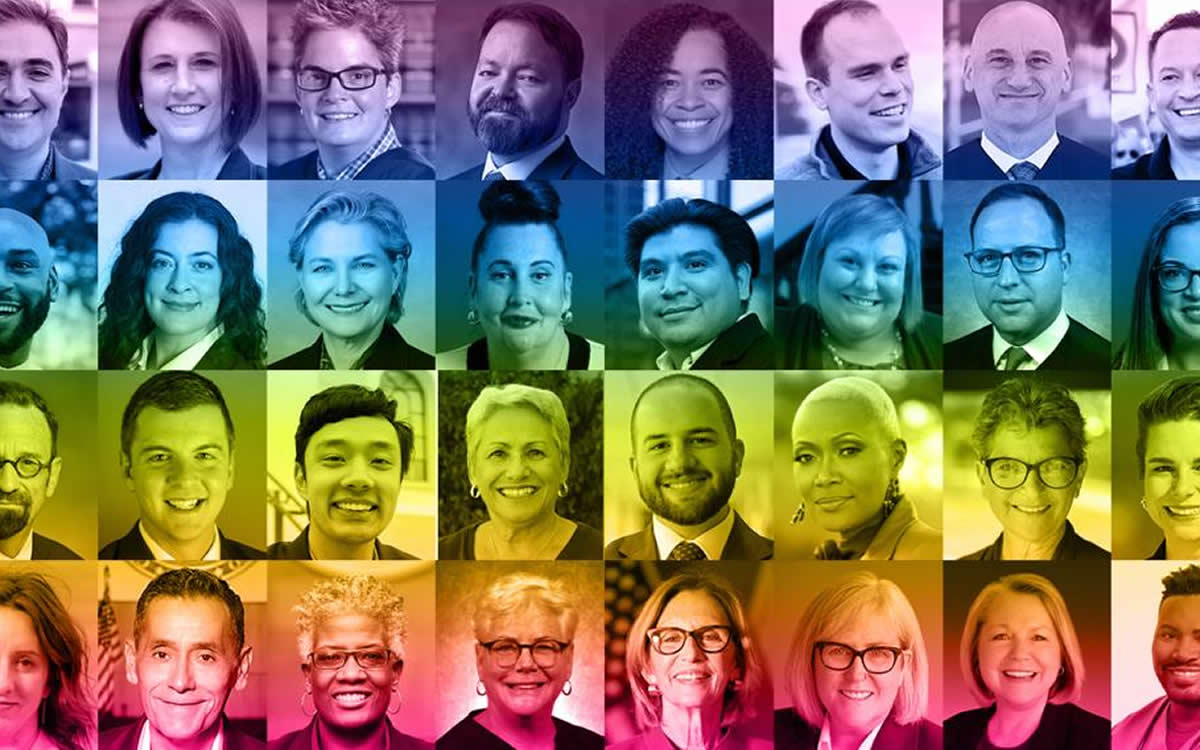
Progressive LGBTQ groups celebrated the pro-equality LGBTQ candidates running in key midterm races across the country on Tuesday, several of whom claimed victory as Election Day stretched into the night.
Becca Balint and Maura Healey were among the first candidates whose races were called, both becoming the first women and the first LGBTQ people elected to, respectively, represent Vermont in Congress and serve as governor of Massachusetts.
The LGBTQ Victory Fund, which supports pro-choice LGBTQ candidates, toasted the candidates’ success “shattering lavender and glass ceilings.”
“The future of LGBTQ equality and women’s rights were on the ballot — and Vermonters delivered tonight,” Victory Fund President Mayor Annise Parker said in a press release on Balint’s win. “For nearly a decade, Becca led efforts to pass meaningful legislation to increase fairness and equity within Vermont. Now, she is ready to do the same in Congress.”
In a press release announcing Healey’s victory, Parker said, “In the face of so much hate and intolerance sweeping our nation, her win is a sign — especially to LGBTQ kids in desperate need of hope — that LGBTQ people have a place in American society and can become respected public leaders.”
LPAC, a group that supports women and nonbinary LGBTQ candidates running for public office, also published press releases celebrating Healey and Balint on Tuesday afternoon.
Just before midnight, the Victory Fund called Robert Garcia’s victory for California’s 42nd Congressional District. Garcia will be the first openly gay immigrant elected to Congress.
“We are confident Robert’s deep policy experience and ability to build strong, diverse coalitions will make him an exceptional legislator,” Parker said. “His win tonight will inspire countless other LGBTQ and first-generation Americans to pursue careers in public service.”
Democrat and LGBTQ ally Wes Moore also made history on Tuesday, becoming Maryland’s first Black governor-elect in his race against Donald Trump-backed far-right candidate Dan Cox, while openly gay Colorado Gov. Jared Polis and U.S. Rep. Chris Pappas (D-N.H.) won their reelection bids.
Democrat and LGBTQ ally Maxwell Alejandro Frost, 25, became the first Generation Z candidate to win a Congressional seat, where he will represent Florida’s 10th Congressional District in the House.
Per pool reports, by 11:30 p.m. ET, President Joe Biden made congratulatory calls to Healey; Polis; Senate Majority Leader Chuck Schumer (D-N.Y.); U.S. Sens. Tammy Duckworth (D-Ill.) and Richard Blumenthal (D-Conn.); Democratic Rhode Island Gov. Dan McKee; Democratic Illinois Gov. J.B. Pritzker; Democratic Maine Gov. Janet Mills; U.S. Sens. Michael Bennett (D-Colo.), Maggie Hassan (D-N.H.) and Alex Padilla (D-Calif.); U.S. Reps. Lisa Blunt Rochester (D-Del.), Abigail Spanberger (D-Va.) and Jennifer Wexton (D-Va.), U.S. Sen. Chris Van Hollen (D-Md.), D.C. Mayor Muriel Bowser), U.S. Sen.-elects Peter Welch (D-Vt.) and Seth Magaziner (D-R.I.), and Pennsylvania Gov.-elect Josh Shapiro.
Meanwhile, Tina Kotek is locked in a close race for Oregon’s governorship whose outcome may not be clear until later this week. If elected, she would join Healey as the nation’s first openly lesbian governor.
And the fates of LGBTQ candidates in closer races for seats in the lower chamber are still unclear. These include U.S. Reps. Sean Patrick Maloney (D-N.Y.) and Sharice Davids (D-Kan.), who are running for reelection, along with Jamie McLeod-Skinner and Will Rollins, who are competing for House seats in Oregon and California, respectively.
Heather Mizeur, who would have been Maryland’s first openly lesbian member of Congress, conceded her defeat Tuesday evening to incumbent Republican Maryland Congressman Andy Harris.
A historic number of LGBTQ candidates ran for elected office this year, advocacy groups said. The Victory Fund endorsed 411 people in races in 49 states, D.C., Guam, and the U.S. Virgin Islands.
The Human Rights Campaign, America’s largest LGBTQ advocacy group, also touted the diverse pool of candidates in the midterms, citing the record numbers of transgender and gender nonconforming people who ran this year. The organization also noted that the electorate is composed of more LGBTQ voters than ever before.
“We will continue to stand and fight every day alongside our allies and partners across the country, in support of a pro-democracy, pro-equality, and pro-choice future,” Interim HRC President Joni Madison said in a press release from the organization.

Kristi Noem ‘devastated’ as husband’s alleged fetish spending surfaces

Colo. activists condemn SCOTUS conversion therapy ruling

Is Ghana’s selective justice a human rights contradiction?

Supreme Court ruling against conversion therapy bans could affect Md. law

Glisten report details hostile climate for LGBTQ students

‘Out for McDuffie’ event held at D.C. gay bar

The Oscar-losing performance that’s too good to miss

‘Jonah’ an undeniably compelling but unusual memory play

PHOTOS: ‘No Kings’ rally and march