United Nations
U.S. ambassador to U.N. attends Summit of the Americas in Calif.
Linda Thomas-Greenfield says LGBTQ rights remain a top priority
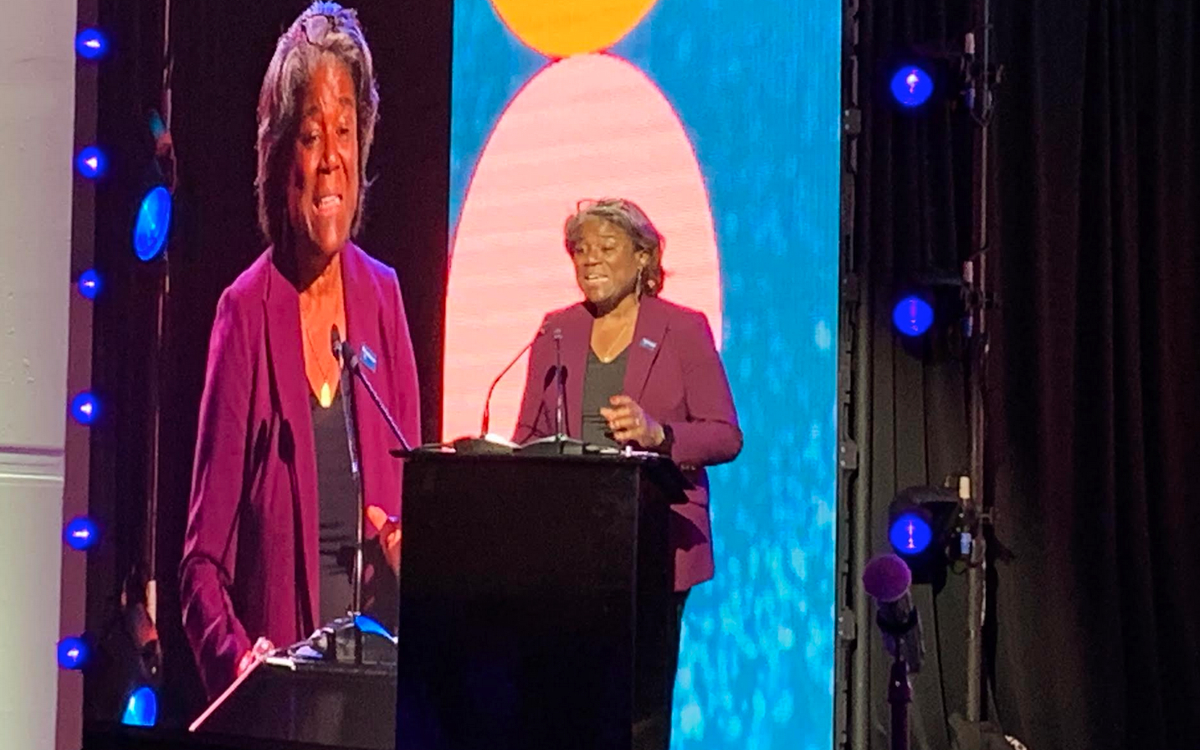
U.S. Ambassador to the U.N. Linda Thomas-Greenfield on Friday said LGBTQ rights remain a top priority for her and her colleagues at the United Nations.
“There’s a lot of work to be done, but it’s very much a priority for us as we deal with numerous crises across the board,” Thomas-Greenfield told the Los Angeles Blade during a telephone interview from the Summit of the Americas, which took place this week in Los Angeles.
The U.S. Senate in February 2021 confirmed Thomas-Greenfield as the next U.S. ambassador to the U.N.
The Louisiana native is a veteran American diplomat who was the U.S. Ambassador to Liberia from 2008-2012. Thomas-Greenfield was assistant secretary of state for African affairs from 2013-2017.
Thomas-Greenfield in response to the Blade’s question about the previous administration’s campaign that encouraged countries to decriminalize consensual same-sex sexual relations said “all of our embassies and our ambassadors had instructions to address issues of criminalization of the LGBTQI community.” Thomas-Greenfield also noted then-Liberian President Ellen Johnson Sirleaf refused to sign a bill that would have criminalized same-sex relationships after she “went to the president” with her concerns.
“They (Liberian officials) were very, very clear on what our position is,” said Thomas-Greenfield.
She pointed out the U.S. is a member of the LGBTI Core Group, a group of U.N. countries that have pledged to support LGBTQ rights.
Thomas-Greenfield said the U.N. General Assembly’s adoption of a free elections resolution last November that specifically includes sexual orientation and gender identity “was extraordinarily important for us.” Thomas-Greenfield also noted the U.S. Embassy in Guyana supported efforts to decriminalize cross-dressing in Guyana in accordance with a 2018 Caribbean Court of Justice ruling.
Guyanese lawmakers last August approved a bill that removed cross-dressing from the country’s Summary Jurisdiction (Offenses) Act.
“Our embassy there advocated for the removal of this language and we were successful in doing that,” said Thomas-Greenfield.
President Biden in February 2021 signed a memo that committed the U.S. to promoting LGBTQ rights abroad as part of his administration’s overall foreign policy. Thomas-Greenfield said the directive “was one of my guiding principles when I arrived in New York.”
“Having that memo in hand gave me the impetus to do those things that all of us care about anyways, but it made a difference having the president instruct us,” she said.
The Taliban regaining control of Afghanistan and Russia’s invasion of Ukraine are among the myriad crises to which Thomas-Greenfield has responded since her arrival at the U.N.
Advocacy groups continue to urge the U.S. and other Western governments to do more to help LGBTQ Afghans and other at-risk groups to leave the country. Reports from Ukraine indicate transgender people have not been able to leave the country because their gender presentation does not correspond with the gender marker on their ID documents.
“It’s so important that we are there to ensure that this community receives the protection that is afforded to them,” said Thomas-Greenfield.
Thomas-Greenfield said she and her U.N. colleagues in Geneva “are working to ensure that LGBTQI+ issues are taken into consideration in all of the work that the U.N. is doing around the world, including as it relates to refugees.”
She noted they “provide and encourage the U.N. to provide” the same human trafficking protections offered to young Ukrainian women “to the LGBTQI+ community when they’re crossing borders.” Thomas-Greenfield also acknowledged the difficulties that Trans Ukrainians who want to leave the country face.
“I’m aware of it and I know that the U.N. is aware of it and is making every attempt to address the issue,” she said. “The point I would make to these countries is when people leave their countries, they’re not racing to get documents to prove who they are or what they believe in. You race for your life.”
“What people told us is that they were lucky to get out with a backpack,” added Thomas-Greenfield. “So, we have to press these countries to stop these restrictions that require people to show any kind of documentation when they’re fleeing for their lives.”
The Summit of the Americas took place in Los Angeles from June 6-10.
Thomas-Greenfield noted she attended President Biden’s meetings with Canadian Prime Minister Justin Trudeau and Brazilian President Jair Bolsonaro. Thomas-Greenfield also met with Honduran government officials, among others.
Thomas-Greenfield on Thursday delivered the closing keynote speech at the Young Americas Summit. She noted that one of the people who she met at the event was an “extraordinary, extraordinary young man” from Colombia who works to implement the peace agreement between his government and the Revolutionary Armed Forces of Colombia that specifically acknowledges the conflict’s LGBTQ victims.
“I was just amazed at his courage, his commitment, his passion for making change and ensuring the LGBTQI community in Colombia was protected and the necessary assistance that they need,” said Thomas-Greenfield.
Thomas-Greenfield also acknowledged criticisms over the decision not to invite Cuba, Nicaragua and Venezuela to the summit.
“We heard the concerns about this, but I will tell you that civil society was invited across the board from these countries,” she said. “We think it was important that the voices of those individuals who have been abused by these countries … got amplified, if not highlighted. I think that was an important result of this.”




United Nations
UN human rights chief sounds alarm over ‘comprehensive onslaught’ against LGBTQ rights
Volker Türk on Monday spoke at UN LGBTI Core Group event
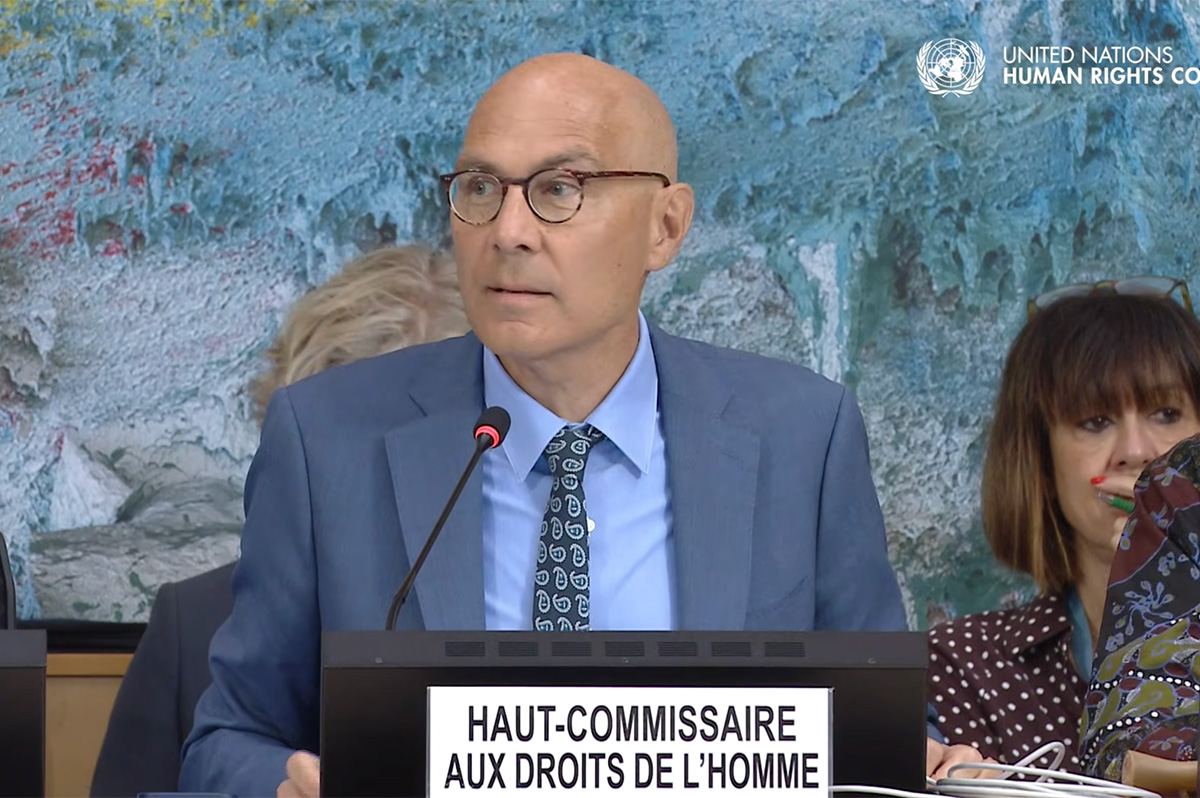
UNITED NATIONS — U.N. High Commissioner for Human Rights Volker Türk on Monday said there is a “comprehensive onslaught” against LGBTQ and intersex rights around the world.
“We know that progress for human rights has never been linear … but today’s backlash is deep and it is coordinated and the persecution of LGBTIQ+ people around the world is escalating at an alarming rate,” he said during an U.N. LGBTI Core Group event that took place on the sidelines of the U.N. General Assembly.
The Core Group is a group of U.N. member states that have pledged to support LGBTQ and intersex rights.
Mexico and Norway are the current co-chairs. The U.S. withdrew from the Core Group shortly after the Trump-Vance administration took office in 2025.
“We know that across every region, LGBTIQ+ people continue to live and to love in the face of hostility and exclusion,” said Türk. “Their rights, safety, well-being are under attack … it’s a comprehensive onslaught.”
The event took place days after Turkish authorities carried out raids in Istanbul and in other cities across the country that targeted the country’s LGBTQ community.
Türk in his remarks specifically referenced Turkey and Senegal, which further criminalized consensual same-sex sexual relations earlier this year. He also noted some countries have deemed LGBTQ and intersex rights groups as “terrorists, extremists, or national security threats.”
The Trump-Vance administration’s anti-terrorism strategy that it released in May specifically references “radically pro-transgender” groups.
Türk noted “more and more candidates and political parties … use bigotry in order to promote anti-LGBTIQ+ sentiments” during election campaigns. He pointed out trans people and women are often targeted.
“These attacks are designed to confuse and to distract,” said Türk. “They cloak bigotry in the language of decency and morality. They evoke the protection of children against manufactured threats, while real and growing dangers to children’s lives and futures, including those linked to technology, to inequality and to the climate disaster remain unaddressed.”
“More broadly those who seek to erase difference and independent thought, expression, and voices from our societies often begin this by erasing LGBTIQ+ people from books and classrooms, from film and culture and from our streets,” he added. “So, this is always the beginning. It’s a wedge issue that unfortunately is used politically to erase other portions of society eventually.”
90 percent of LGBTQ, intersex groups have lost funding since 2025
The event took place less than two weeks after Outright International released a report that found 90 percent of LGBTQ and intersex rights groups around the world have lost funding since January 2025.
The Trump-Vance administration froze nearly all U.S. foreign aid shortly after it took office.
Secretary of State Marco Rubio in March 2025 announced 83 percent of U.S. Agency for International Development contacts had been cancelled, and the State Department would administer the remaining programs. USAID officially shut down on July 1, 2025.
Rubio issued a waiver that allowed PEPFAR and other “life-saving humanitarian assistance” programs to continue to operate during the funding freeze. The Washington Blade has previously reported PEPFAR-funded programs in Kenya and other African countries have been forced to suspend services and even shut down because of gaps in U.S. funding.
Dutch Foreign Trade and Development Cooperation Minister Sjoerd Sjoerdsma in his remarks at the Core Group event noted his government — openly gay Prime Minister Rob Jetten took office in February — will pledge €50 million ($57.29 million) to support LGBTQ groups around the world. British Under Secretary of State Chris Elmore pointed out his government has pledged £21 million ($28.05) from 2026-2029 to bolster LGBTQ and intersex rights around the world.
“Equality benefits everyone,” said Elmore.
Mexican Foreign Affairs Secretary Roberto Velasco Álvarez, Norwegian International Development Minister Åsmund Aukrust, Icelandic Foreign Affairs Minister Þorgerður Katrín Gunnarsdóttir, Maltese Foreign and European Affairs Minister Chris Fearne, Brazil’s National Secretary for the Promotion and Defense of the Rights of LGBTQIA+ People Symmy Larrat, Irish State Minister for International Development and Diaspora Neale Richmond, South African Department of International Relations and Cooperation Director-General Zane Dangor, Uruguayan Multilateral Affairs Director María Noel Beretta, French Ambassador-at-Large for Human Rights Isabelle Rome, Cabo Verdean Permanent U.N. Representative Tania Romualdo, Estonian Department of International Organizations and Human Rights Director General Käthlin Saluveer, and Swedish International Development Cooperation Director-General Camilla Nevstad Bruzelius also spoke at the event that Outright International Executive Director Maria Sjödin moderated.
Other speakers included Jon Tilli of Deutsche Bank, UN Women Civil Society Division Director Lopa Banerjee and two activists: Gloria Quaye of Ghana and Nhuun Wannapong Yodmuang of Thailand.
Quaye was among the 21 people who Ghanaian authorities arrested in 2021 during a human rights workshop for LGBTQ activists. She was detained for three weeks until a court dropped the charges.
“In times of adversity, countries can often be tempted to turn inward at precisely the moment when international cooperation is needed the most,” said Sjödin. “The United Nations, of course, brings together sovereign states, but sovereignty cannot be used to decide whose rights count.”
Then-first lady Jill Biden in 2024 spoke at a Core Group event that took place on the sidelines of that year’s U.N. General Assembly. Then-Vice President Joe Biden in 2016 headlined the Core Group event that coincided with that year’s U.N. General Assembly.
The U.S. did not send any representatives to this year’s event.
Jessica Stern, the former special U.S. envoy for the promotion of LGBTQ and intersex rights under the Biden-Harris administration, and former U.S. Ambassador to Bosnia and Herzegovina Eric Nelson were among those from the U.S. who attended.
“The movement for the equal rights of LGBTIQ+ people has much to teach the world, particularly at this moment, but some seek to erase or reject those lessons,” said Türk. “The history of the movement for the equal rights is full of courage, dignity, and solidarity and it is an integral part of the human rights movement.”
“It’s not something separate; it’s an integral part of the full human rights movement,” he added. “In claiming their freedom, the LGBTIQ+ communities helped free our societies. We need to see it as a broader strive for freedom.”
Congress
Mike Waltz confirmed as next UN ambassador
Trump nominated former national security advisor in May
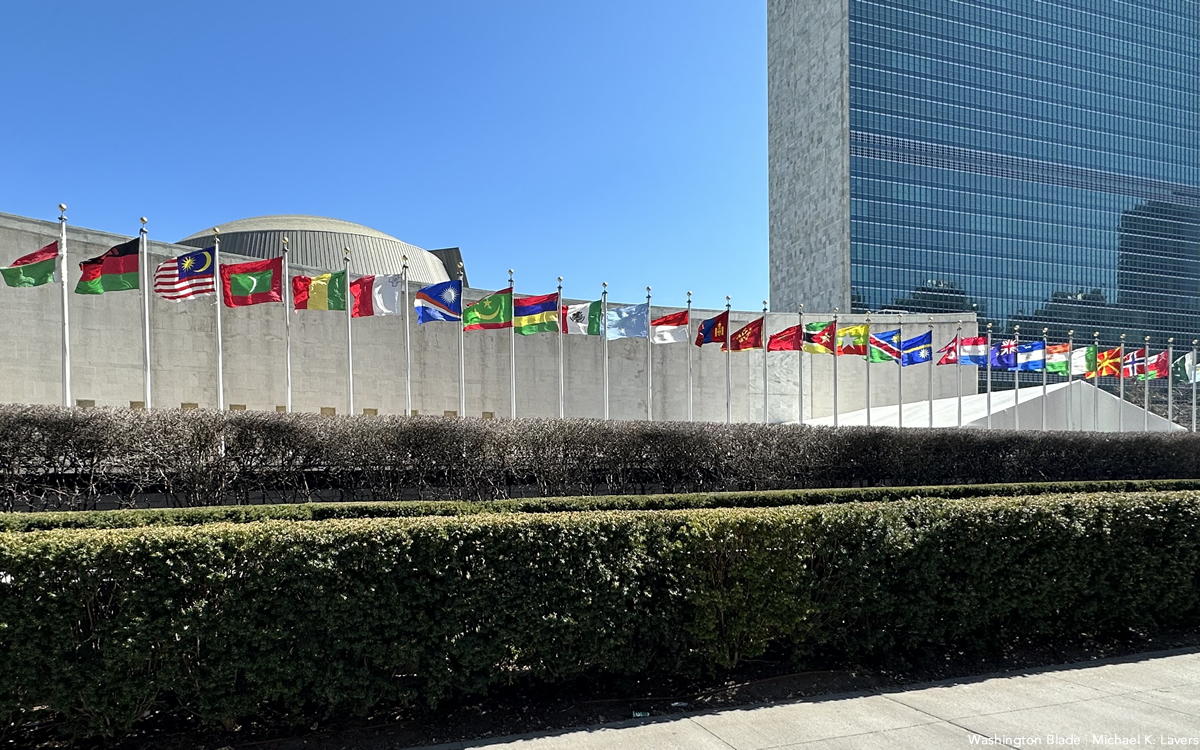
The U.S. Senate on Sept. 19 confirmed former U.S. Rep. Mike Waltz (R-Fla.) as the next U.S. ambassador to the U.N.
The Florida Republican had been the national security advisor until President Donald Trump in May tapped him after U.S. Rep. Elise Stefanik (R-N.Y.) withdrew her nomination in order to ensure Republicans maintained their narrow majority in the U.S. House of Representatives.
Senators approved Waltz’s nomination by a 47-43 vote margin.
“Thank you President Trump and the U.S. Senate for your trust and confidence to Make the UN Great Again,” said Waltz on X.
The U.N. General Assembly is taking place this week in New York. Trump is scheduled to speak on Tuesday.
United Nations
UN Human Rights Council extends LGBTQ rights expert’s mandate
29 countries voted for resolution
The U.N. Human Rights Council on Monday extended the mandate of the United Nations’ independent LGBTQ rights expert for another three years.
The resolution passed with 29 countries (Albania, Belgium, Bolivia, Brazil, Bulgaria, Chile, Colombia, Costa Rica, Cuba, Cyprus, the Czech Republic, the Dominican Republic, France, Georgia, Germany, Iceland, Japan, Kenya, the Marshall Islands, Mexico, the Netherlands, North Macedonia, South Korea, Romania, South Africa, Spain, Switzerland, Thailand, and Vietnam) voting for it and 15 countries (Algeria, Bangladesh, Burundi, China, Cote d’Ivoire, Democratic Republic of Congo, Ethiopia, Gambia, Indonesia, Kuwait, Malawi, Maldives, Morocco, Qatar, and Sudan) voted against it.
Benin, Ghana, and Kyrgyzstan abstained.
The U.S. in February withdrew from the Human Rights Council. The Trump-Pence administration in 2018 pulled the U.S. from it. The U.S. in 2021 regained a seat on the Human Rights Council.
Graeme Reid has been the UN’s independent LGBTQ rights expert since 2023. The South African activist, among other things, previously ran Human Rights Watch’s LGBT Rights Program.

Annie Andrews denounces trans athletes after Trump targets her

On Republican Long Island, gay Democrat Chris Gallant bets on public service over politics

Report: LGBTQ exclusion costs Japanese economy billions a year

Center for Black Equity honors leaders, activists at BE. Gala

In ‘The Lost Brontë,’ a complicated lie can lead to danger

U.S. int’l trade negotiator, consultant James Bedore dies at 82

Campaign urges Virginia High School League to reverse stance on trans athletes

Calif. GOP gubernatorial candidate ad ‘disgusting attempt to exploit lesbian intimacy’

Center Arts Gallery celebrates 10 years with reception, auction

Trump, Netanyahu, and Putin are all war criminals
-

 Obituary5 days ago
U.S. int’l trade negotiator, consultant James Bedore dies at 82
-
Virginia5 days ago
Campaign urges Virginia High School League to reverse stance on trans athletes
-
California5 days ago
Calif. GOP gubernatorial candidate ad ‘disgusting attempt to exploit lesbian intimacy’
-
Commentary5 days ago
Center Arts Gallery celebrates 10 years with reception, auction