European Union
More than 20K attend Slovakia vigil after LGBTQ bar shooting
Two people killed outside establishment in Bratislava on Oct. 12
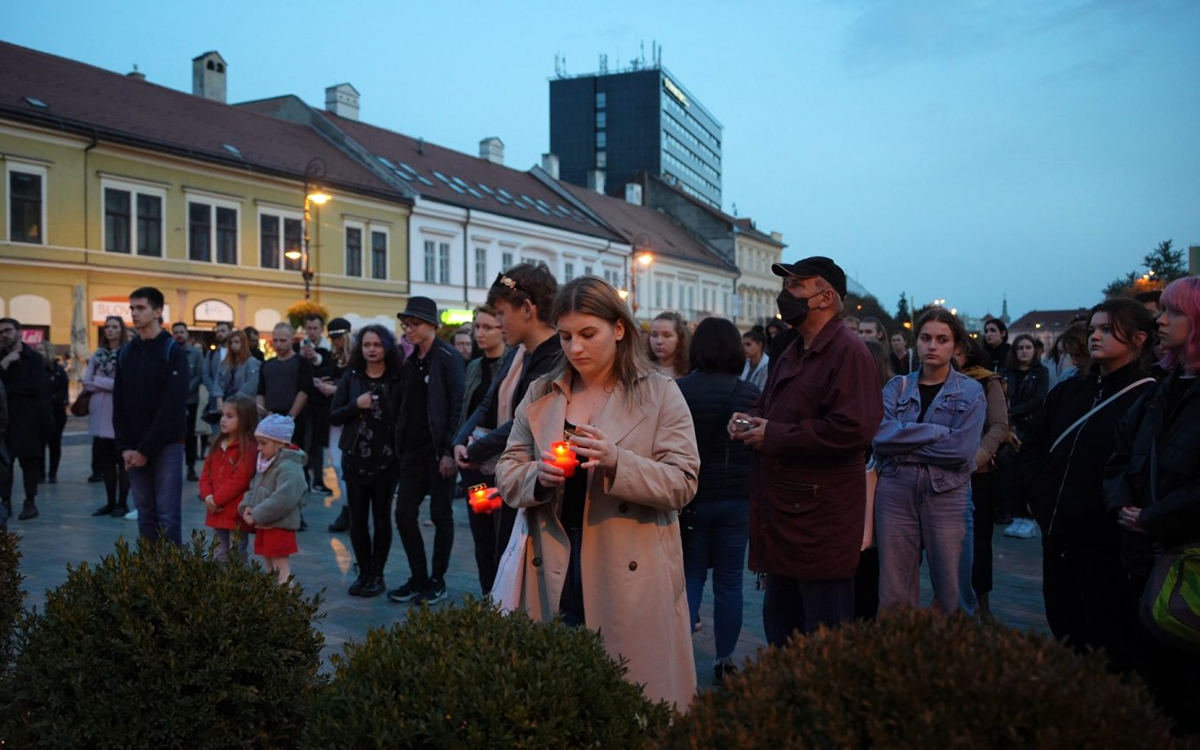
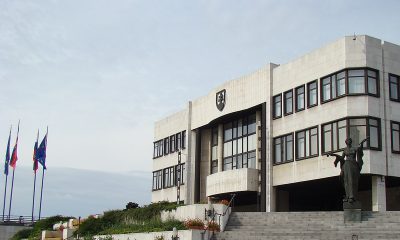
A vigil held Friday evening in the Slovakian capital city to honor the two victims killed and a third who was badly wounded in a shooting outside of the Tepláreň bar, a popular LGBTQ establishment in the old city, was also attended by the nation’s president and the European Parliament’s vice president.
Organized by the Iniciatíva Inakosť, an LGBTQ NGO, there were more than an estimated 20,000 people, according to officials. The murders shook the tight-knit Slovakian LGBTQ community and its allies.
Slovakia is a fairly conservative European Union member country where same-sex marriage is not legal.
A spokesperson for the Polícia Slovenskej republiky, the country’s national police force, said that his agency has classified the shootings as premeditated murder, motivated by hatred of a sexual minority.
19-year-old Juraj Krajcik, the radicalized son of a prominent member of the far-right extremist Vlast party, had left social media posts filled with anti-Semitic and anti-LGBTQ messages including a so-called “manifesto” which the gunman had posted prior to the rampage.
Krajcik, who had an online history of hate-filled rhetoric had posted a picture of himself outside the Tepláreň bar this past August along with other writings and posts that led Polícia Slovenskej republiky investigators to conclude that the crime was planned.
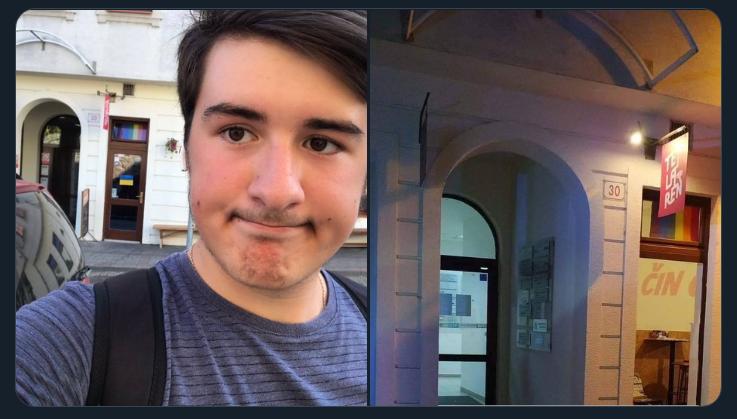
According to Polícia Slovenskej republiky, the gunman was outside of the bar for nearly an hour before opening fire at around 7 p.m. local time on Oct. 12. Investigators said multiple rounds were fired but did not disclose the number nor the weapon used. Police say he was found dead from a self-inflicted gunshot.
During the vigil for the shooting victims, Slovak President Zuzana Caputova told the crowd, “I’m sorry that our society was not able to protect your loved ones,” adding, “You belong here, you are valuable for our society.”
BBC Europe reported that European Parliament Vice President Michal Simecka was also at Friday’s event. Simecka expressed his determination to have the European legislature discuss the murders during a session next week.
“To express our sympathy, but also to call on the Slovak authorities to take clear steps to put an end to the language of hatred towards LGBTI people,” he said.
In addition to political leadership at Friday evening’s vigil, Elena Martinčoková, the president of the Association of Parents and Friends of LGBTI+ people, spoke expressing her grief and anger towards the environment in the country that fostered far-right hate.
In a Facebook post published by Košice PRIDE, she told the crowd;
“I’m going through a lot of pain. Since I heard about this tragedy, I’m in spirit with the parents of the murdered children. They were adults, but they were mainly children, grandchildren, cousins, friends, colleagues who will be greatly missed and the wound and pain the survivors will feel will never heal.
Many tragedies affect us in life, some of them cannot be prevented. Yes to some of them. And this is exactly the one that could have been prevented. Long-term and intensively spreading and inciting hatred towards LGBT+ people in our public space. It is hatred that blinds people, prevents them from thinking sober.
Certain people are responsible for this tragedy. They are the ones who are intensively and increasingly inciting and spreading hatred towards the LGBTI community. They are all over the place. In the National Council of Slovakia, in government, among many church representatives, in extremist groups, among disinformation spreaders and those who do not have credible information, or when they have it, they do not understand them or do not want to understand. I hope this tragedy will not leave the public indifferent. We must act, we must act now. We will not be quiet. We are not going to be intimidated.”
Video via România liberă, a Romanian daily newspaper founded in 1943 and currently based in Bucharest:



Bulgaria
Top EU court issues landmark transgender rights ruling
Member states must allow name, gender changes on ID documents
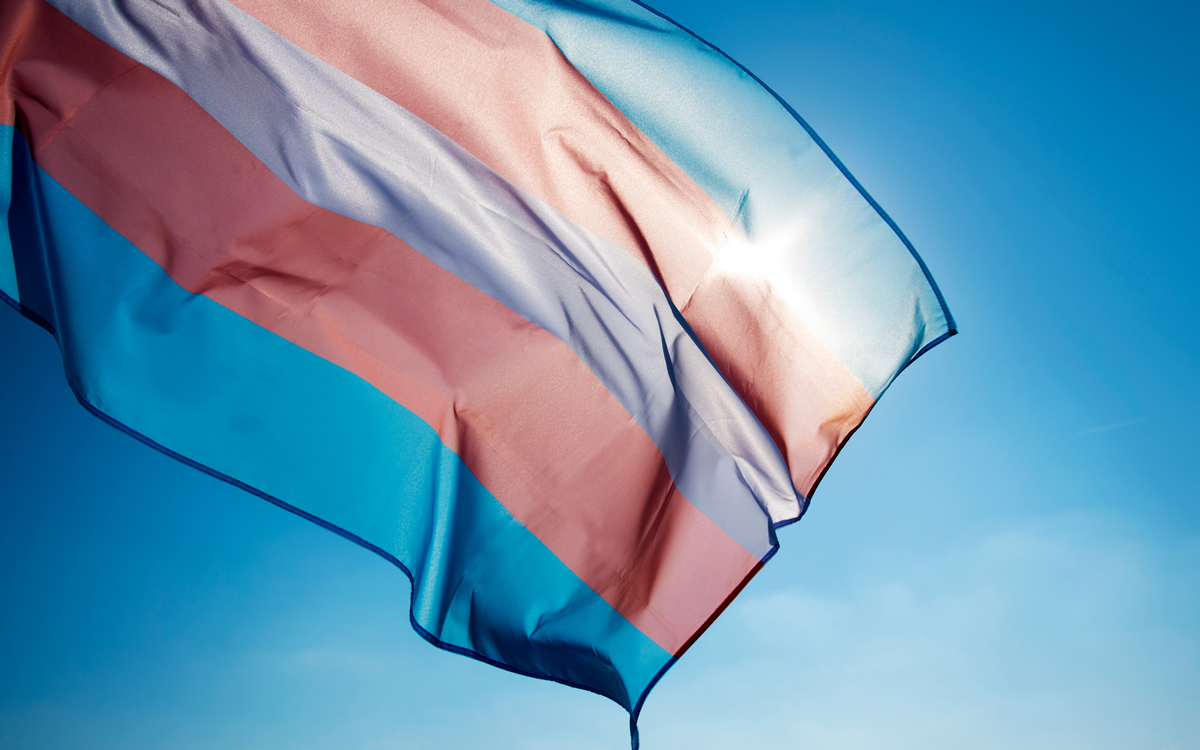
The European Union’s highest court on Thursday ruled member states must allow transgender people to legally change their name and gender on ID documents.
The EU Court of Justice in Luxembourg issued the ruling in the case of “Shipova,” a trans woman from Bulgaria who moved to Italy.
“Shipova” had tried to change her gender and name on her Bulgarian ID documents, but courts denied her requests for nearly a decade.
A ruling the Bulgarian Supreme Court of Cassation issued in 2023 essentially banned trans people from legally changing their name and gender on ID documents. Two Bulgarian LGBTQ and intersex rights groups — the Bilitis Foundation and Deystvie — and ILGA-Europe and TGEU – Trans Europe and Central Asia supported the plaintiff and her lawyers.
“Because her life in Italy also depended on her Bulgarian documents, the lack of documents reflecting her lived gender creates an obstacle to her right to move and reside within EU member states,” said the groups in a press release. “This mismatch between her gender identity and expression and her gender marker in her official documents leads to discrimination in all areas of life where official documents are required. This includes everyday activities such as going to the doctor and paying for groceries by card, finding employment, enrolling in education, or obtaining housing.”
Denitsa Lyubenova, a lawyer with Desytvie, in the press release said the case “concerns the dignity, equality, and legal certainty of trans people in Bulgaria.” TGEU Senior Policy Officer Richard Köhler also praised the ruling.
“Today, the EU Court of Justice has taken an important step towards a right to legal gender recognition in the EU,” said Köhler. “Member states must allow their nationals living in another member state to change their gender data in public registries and identity cards to ensure they can fully enjoy their freedom of movement. National laws or courts cannot stand in their way.”
“Thousands of trans people in the EU are breathing a sigh of relief today,” added Köhler.
European Union
European Parliament resolution backs ‘full recognition of trans women as women’
Non-binding document outlines UN Commission on the Status of Women priorities
The European Parliament on Feb. 11 adopted a transgender-inclusive resolution ahead of next month’s U.N. Commission on the Status of Women meeting.
The resolution, which details the European Union’s priorities ahead of the meeting, specifically calls for “the full recognition of trans women as women.”
“Their inclusion is essential for the effectiveness of any gender-equality and anti-violence policies; call for recognition of and equal access for trans women to protection and support services,” reads the resolution that Erin in the Morning details.
The resolution, which is non-binding, passed by a 340-141 vote margin. Sixty-eight MPs abstained.
The commission will meet in New York from March 10-21.
A sweeping executive order that President Donald Trump signed shortly after he took office for a second time on Jan. 20, 2025, said the federal government’s “official policy” is “there are only two genders, male and female.” The Trump-Vance administration has withdrawn the U.S. from the U.N. LGBTI Core Group, a group of U.N. member states that have pledged to support LGBTQ and intersex rights, and dozens of other U.N. entities.
European Union
Top EU court: Poland must recognize same-sex marriage from other European countries
Activists celebrate landmark decision
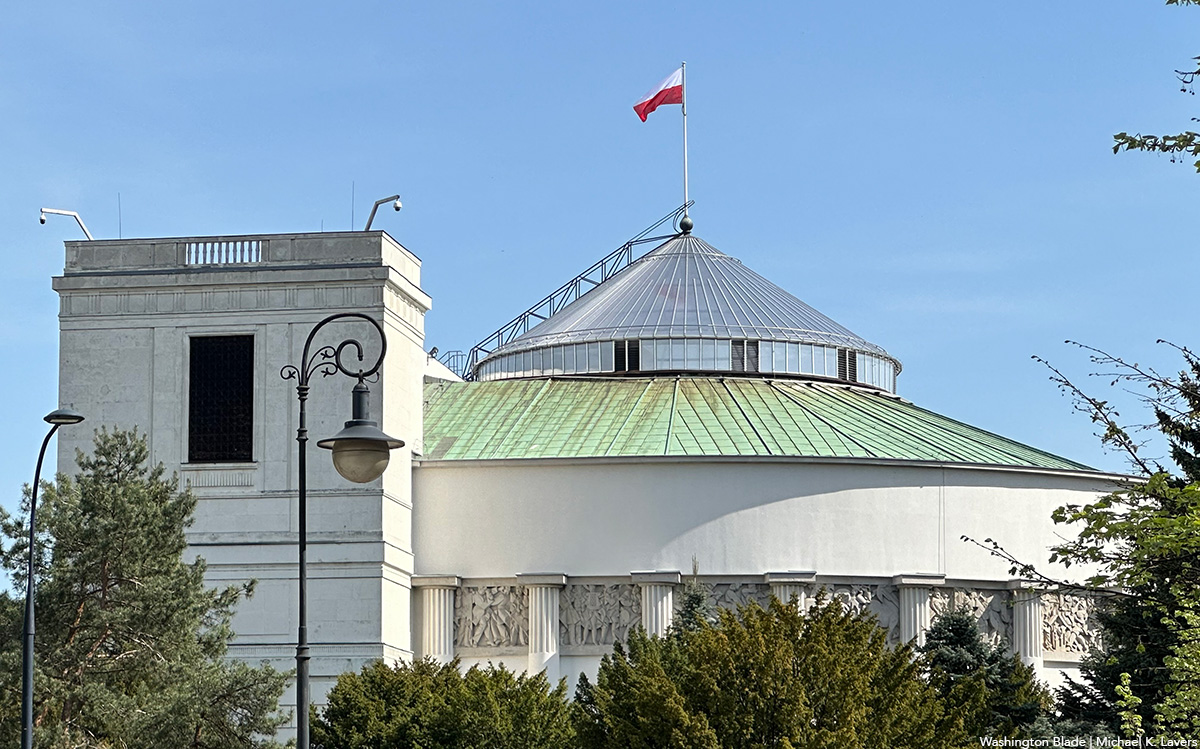
The European Union’s top court on Tuesday ruled member states must recognize same-sex marriages legally performed in other member states.
The EU Court of Justice in Luxembourg ruled in favor of a couple who challenged Poland’s refusal to recognize their German marriage.
ILGA-Europe notes Polish authorities refused “to transcribe into the civil register a certificate of same-sex marriage concluded” in Germany “between a Polish citizen and a Polish-German citizen … on the grounds that Polish law does not allow same-sex marriage.”
The couple who lives in Poland brought their case to Polish courts. The Polish Supreme Administrative Court referred it to the EU Court of Justice.
“Today’s ruling of the Court of Justice of the EU is of key importance not only for the couple involved in the case, but also for the entire LGBT+ community in Poland,” said the Campaign Against Homophobia, a Polish LGBTQ and intersex rights group, in response to the decision. “It clearly states that refusing to transcribe a marriage concluded abroad is incompatible with EU law. Therefore, regardless of the absence of registered partnerships and marriage equality, Poland must ensure the possibility of effective transcription.”
“With this judgment, the CJEU clearly states that the recognition of marriage status is key to enjoying EU citizens’ fundamental right to freedom of movement across the EU,” added ILGA-Europe Advocacy Director Katrin Hugendubel. “The EC now needs to ensure that this judgment is implemented quickly by the Polish state and across the EU.”
Sixteen EU countries — Ireland, Portugal, Spain, France, Luxembourg, Belgium, the Netherlands, Germany, Denmark, Austria, Slovenia, Malta, Greece, Sweden, Finland, and Estonia — have extended full marriage rights to same-sex couples. Poland, Romania, Bulgaria, and Slovakia are the EU countries with no legal recognition of same-sex couples.

Thousands attend ‘No Kings’ protests in D.C.

Blade contributor, husband exchange vows in D.C.

Ghanaian president welcomed to Philadelphia amid backlash over anti-LGBTQ bill

PHOTOS: ‘No Kings’ rally and march

‘Out for McDuffie’ event held at D.C. gay bar

Pa. House passes bill to codify marriage equality in state law

Introducing the Torchbearers Awards honoring queer, trans women and nonbinary people

New IOC policy bans trans women from Olympics

A surtax would end this war quickly

‘No Kings’ protests set for D.C.
-

 Pennsylvania5 days ago
Pa. House passes bill to codify marriage equality in state law
-
a&e features5 days ago
Introducing the Torchbearers Awards honoring queer, trans women and nonbinary people
-
Sports5 days ago
New IOC policy bans trans women from Olympics
-
Opinions5 days ago
A surtax would end this war quickly