European Union
Shooting at LGBTQ bar in Slovakia capital leaves two dead
Country’s president, prime minister condemned murders
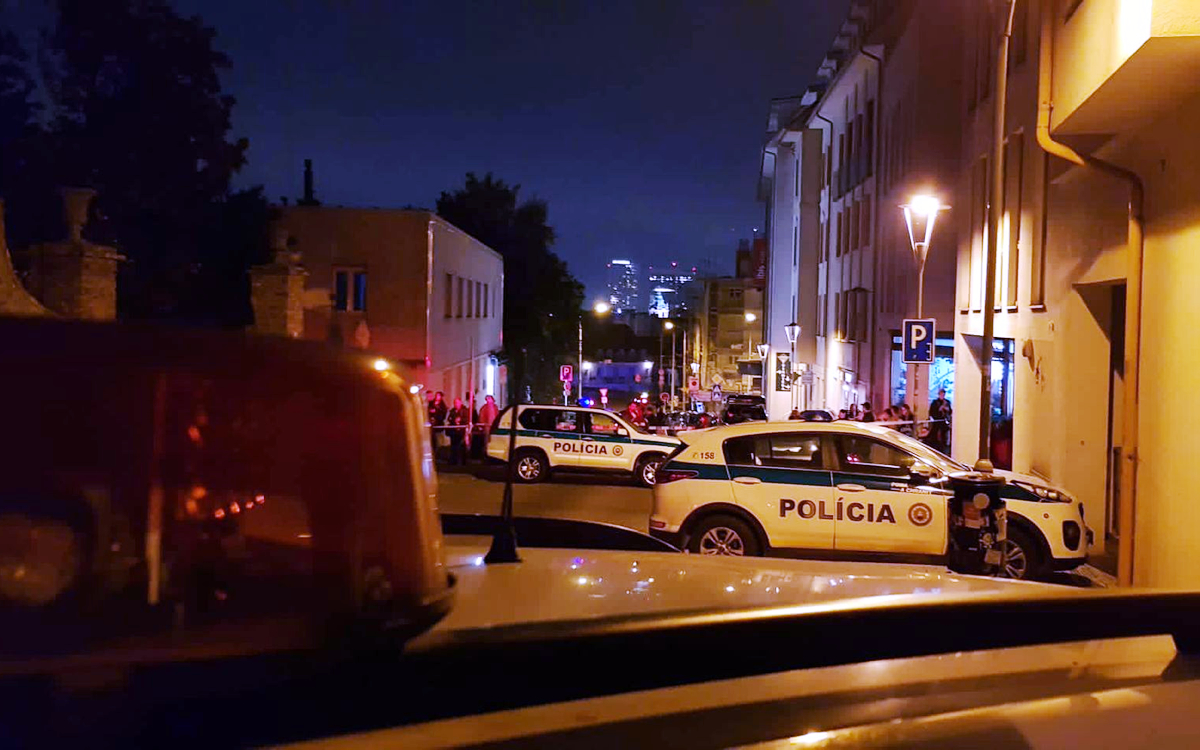
Three people are dead, including the gunman, in a shooting in front of a popular LGBTQ bar in the old town neighborhood of the Slovakian capital of Bratislava on Wednesday evening.
A spokesperson for the Polícia Slovenskej republiky, the country’s national police force, told media outlets that the shooter was found deceased Thursday morning after an hours long search.
The Polícia Slovenskej republiky said the incident at the Tepláreň bar on Zámocká Street in central Bratislava left two young men dead and one woman injured, and investigators are naming the perpetrator, Local media identified him as 19-year-old Juraj Krajcik, the son of a prominent member of the far-right Vlast party, a radicalised 19-year-old student from Bratislava.
According to Polícia Slovenskej republiky, the gunman was outside of the bar for nearly an hour before opening fire at around 7 p.m. local time. Investigators said multiple rounds were fired but did not disclose the number nor the weapon used. Police say he was found dead from a self-inflicted gunshot.
Polícia Slovenskej republiky also said that the female victim is in critical but stable condition at local hospital. She and one of two young men killed were both employed at the bar.
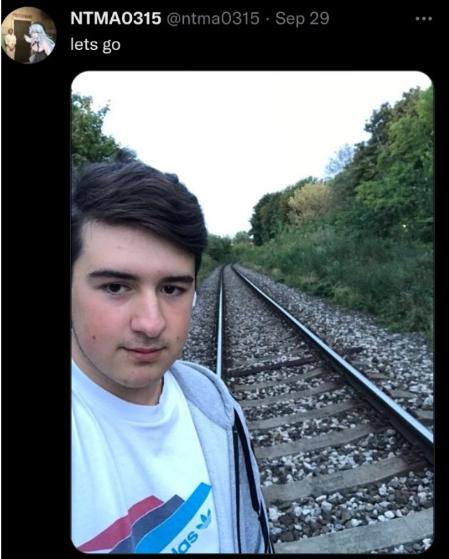
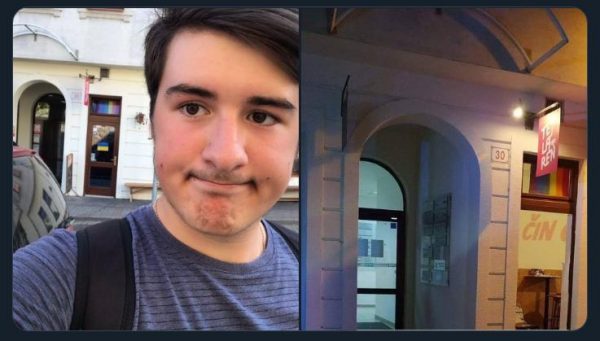
Allegations and speculation arose on social media as a Twitter account tied to the shooter was discovered and shared, filled with anti-Semitic and anti-LGBTQ posts including a so called “manifesto” which the gunman had posted prior to the rampage. That account also had a picture of the gunman outside the Tepláreň in mid-August.
On Facebook Dúhový Pride Bratislava said, “We’re shocked by the information about the shooting and casualties at Tepláreň, where we meet regularly.” The organization changed its Facebook page photo to black. Iniciatíva Inakosť, another Slovakian LGBTQ organization followed suit.
Slovakian Prime Minister Eduard Heger condemned the double murder on Thursday in a press conference telling media outlets that “extremism is unacceptable.”
President Zuzana Čaputová called on politicians to stop spreading hate. “My thoughts are with the family and friends of the victims of yesterday’s horrific attack in Bratislava and everyone in the LGBTIQ+ community affected by it,” Čaputová said in her Twitter post.
“Words can become weapons. Hate kills. As politicians, we must weigh every word we say before it’s too late,” she added.
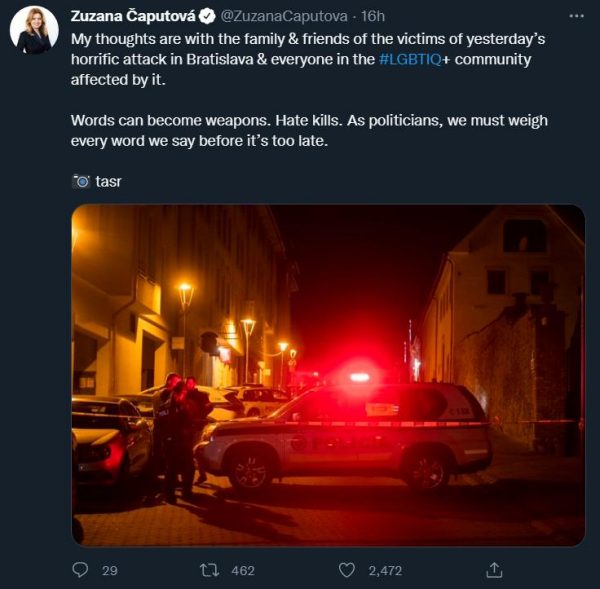
Čaputová came to the scene of the shooting on Thursday afternoon, laying flowers in front of Tepláreň and embraced the owner of the bar.
Polícia Slovenskej republiky in a statement issued late Thursday said:
“First of all, we would like to thank conscientious citizens who provided us with valuable information on the shooting case in Bratislava at 158. We need to remind everyone again and again: Don’t hesitate to call 158. Just putting something on social media may not help. Thank you!
Police act from the first moment. The physical presence of our uniformed colleagues was undoubtedly noticed in the streets throughout the night.
Not only uniformed policemen worked and are working and not all of them are active in the field. Due to the ongoing investigation, but also the tactics, we can’t comment more closely, so we can’t even defend ourselves when any ‘guaranteed’ news regarding our activities appear at these moments. Hence our silence at this stage, please understand.
Procedures to be followed by a police investigator are firmly established in the Criminal Order. Of course, his top priorities include finding the perpetrator’s motive. In order to publish his motive as a police department, it is necessary to take necessary actions.
We will inform you about everything, we are thinking about active communication, but we all have to be patient and give the investigator time and space.
And whether it is a hateful motive or not, we want to assure the public that the police department maintains zero tolerance for any form of violence, bullying or hatred. We have our values, which we will always stand by, which we have announced long ago.
Thank you for your help and understanding of the legal procedures we follow.”
In a tweet Friday morning, LGBTQ+ rights group ILGA-Europe condemned the attack:
This kind of violence and destruction of life is what the instrumentalising of LGBTI people as scapegoats for society by those who wish to remain in power leads to. The legitimisation of hatred by any leader for any group of people cannot, and will not, be tolerated.
— ILGA-Europe (@ILGAEurope) October 14, 2022




European Union
Poland’s top court rejects recognition of same-sex marriages from other EU countries
Ruling sets up potential clash with bloc

Poland’s top court this week rejected the recognition of same-sex marriages legally performed in other EU countries.
The EU Court of Justice in Luxembourg last November ruled in favor of a same-sex couple who challenged Poland’s refusal to recognize their German marriage. Poland’s Supreme Administrative Court in March reaffirmed the decision.
The couple, who lives in Poland, brought their case to Polish courts in 2019. The Supreme Administrative Court referred it to the EU Court of Justice.
The Polish government in May announced it will recognize same-sex marriages legally performed in other EU countries. Polish President Karol Nawrocki on July 17 vetoed bills that would have extended rights to same-sex couples.
The Constitutional Tribunal ruling, which it issued on July 28, was unanimous and final. It also sets up a potential clash between it and the EU Court of Justice.
European Union
European Commission says all EU countries should ban conversion therapy
Recommendation ‘an important step forward for LGBTI rights across Europe’

The European Commission on Wednesday said all European Union countries should ban so-called conversion therapy.
The recommendation comes weeks after the European Parliament voted in favor of prohibiting the widely discredited practice across the EU. More than 1.2 million people signed a campaign in support of the ban that ACT (Against Conversion Therapy) LGBT launched in 2024 through the EU’s European Citizens Initiative framework.
“We warmly welcome today’s commitment from the European Commission to a recommendation on ending conversion practices, an important step forward for LGBTI rights across Europe,” said ILGA Europe in a statement.
Seven EU countries — Belgium, Cyprus, France, Malta, Norway, Portugal, and Spain — have banned conversion therapy outright.
Greece in 2022 banned the practice for minors. German lawmakers in 2020 passed a law that prohibits conversion therapy for minors and for adults who have not consented to undergoing the widely discredited practice.
ILGA Europe said the European Commission’s recommendation “highlights how much work remains to be done.”
“Ending conversion practices cannot stop at symbolic commitments or fragmented national approaches,” stressed the advocacy group. “We need coordinated EU action, proper training for professionals, and survivor-centered support systems that recognize the serious harm these practices cause.”
“More than one million people supported the European Citizens’ Initiative calling for change,” added ILGA Europe. “The message is clear: conversion practices are not therapy or belief, they are a form of violence that Europe can and should end.”
European Union
European Parliament backs EU-wide conversion therapy ban
More than 1.2 million people backed campaign
The European Parliament on Wednesday voted in favor of banning so-called conversion therapy across the European Union.
ACT (Against Conversion Therapy) LGBT in 2024 launched a campaign in support of the ban through the EU’s European Citizens Initiative framework. More than 1.2 million people ultimately signed it.
The proposed ban had the support of 405 MEPs. The European Commission is expected to formally respond to it by May 18.
Seven EU countries — Belgium, Cyprus, France, Malta, Norway, Portugal, and Spain — have banned conversion therapy outright.
Greece in 2022 banned the practice for minors. German lawmakers in 2020 passed a law that prohibits conversion therapy for minors and for adults who have not consented to undergoing the widely discredited practice.

Center Arts Gallery celebration, auction to take place on Oct. 17

Comings & Goings

‘Hidden in Plain Sight:’ The story of Odessa Madre

‘Governments that attack LGBTQ+ rights learn from each other’

Horror genre has evolved into space to explore queer identity

ICC unseals arrest warrants for Taliban officials accused of persecuting LGBTQ people, women

Physician: addiction doesn’t always look the way you think it does

Calendar: October 9-15

Solidarity beyond the parade: the actual cost of Pride

Essential queer horror classics for Halloween
-

 Afghanistan5 days ago
ICC unseals arrest warrants for Taliban officials accused of persecuting LGBTQ people, women
-
District of Columbia4 days ago
Physician: addiction doesn’t always look the way you think it does
-
Calendar4 days ago
Calendar: October 9-15
-
Opinions4 days ago
Solidarity beyond the parade: the actual cost of Pride