Politics
LGBTQ candidates on the ballot in all 50 states for first time
Victory Fund on Wednesday released Out on the Trail report

The LGBTQ Victory Fund, the only national organization dedicated to electing LGBTQ leaders to public office, released its 2022 Out on the Trail report Wednesday.
This is the only annual report on the number and diversity of LGBTQ candidates who ran for office in 2022. At least 1,065 openly LGBTQ people ran or are running for offices with elections in 2022, the most in history.
Of the 1,065 candidates, 678 will appear on the ballot in November, an 18.1 percent increase from 2020 when 574 candidates were on the November ballot.
LGBTQ Victory Fund President Annise Parker released the following statement:
“Voters are sick and tired of the relentless attacks lobbed against the LGBTQ community this year. Bigots want us to stay home and stay quiet, but their attacks are backfiring and instead have motivated a new wave of LGBTQ leaders to run for office. When they tried to ban books and censor LGBTQ kids and teachers, a record number of LGBTQ people ran for school board. When they introduced a historic number of anti-LGBTQ laws in state legislatures, LGBTQ people ran for state legislatures like never before. When they tried to stall federal pro-equality legislation, we ran for Congress like never before. This November, we have an opportunity to elect more LGBTQ people to office than ever before. But it’s going to take each and every one of us. Sitting on the sidelines isn’t an option when our rights are on the chopping block. This is a time for action. This is a time for unity.”
Among the key findings:
- For the first time in history, LGBTQ candidates ran in all 50 states and the District of Columbia.
- A history-making 63.7 percent of known LGBTQ candidates won their primaries and will appear on the ballot in November, compared to 57.1 percent of candidates in 2020.
- 416 LGBTQ people ran for state legislatures this year, the most in U.S. history.
- The proportion of LGBTQ candidates of color grew significantly in 2022, accounting for 38.2 percent of all LGBTQ candidates.
- Candidates who are not cisgender (including transgender, nonbinary and gender non-conforming candidates) ran in record-breaking numbers, representing 13.9 percent of all LGBTQ candidates compared to 7.9 percent in 2020.
The full report, including all key findings and detailed demographic data and trends, is available at victoryfund.org/out-on-the-trail-2022.





Congress
HRC president campaigns for Chris Pappas in NH
Gay congressman running to succeed retiring U.S. Sen. Jeanne Shaheen

Human Rights Campaign President Kelley Robinson on Sunday campaigned for U.S. Rep. Chris Pappas (D-N.H.) in New Hampshire.
Robinson traveled to Manchester, the state’s largest city, nine days before the Sept. 8 primary that will determine who will vie for retiring U.S. Sen. Jeanne Shaheen (D-N.H.)’s seat.
We’re hitting the pavement across New Hampshire to fight for a freer, fairer future for everyone.
Glad to have Human Rights Campaign President @KelleyJRobinson join us for a canvass launch in Manchester today. pic.twitter.com/XWCEaQxy4o
— Chris Pappas (@ChrisPappasNH) August 30, 2026
Former U.S. Sen. John E. Sununu, who represented New Hampshire in the U.S. Senate from 2003-2009, will face off against former U.S. Sen. Scott Brown, who represented Massachusetts in the U.S. Senate from 2010-2013, in the Republican primary.
Karishma Manzur is among the Democrats challenging Pappas.
A poll the University of New Hampshire Survey Center released on Aug. 26 shows Sununu is ahead of Brown. The same survey shows Pappas ahead of Manzur and his other Democratic challengers.
The UNH Survey Center poll shows Sununu ahead of Pappas by a 45-43 percent margin if they were to face off in the general election. The margin of error is +/-2.1 percent.
Pappas would become the first openly gay man elected to the U.S. Senate if he were to win in November.
Congress
Chris Van Hollen says the Democratic Party needs change. Is he the one to lead it?
Senator is backing anti-establishment Democrats across the country
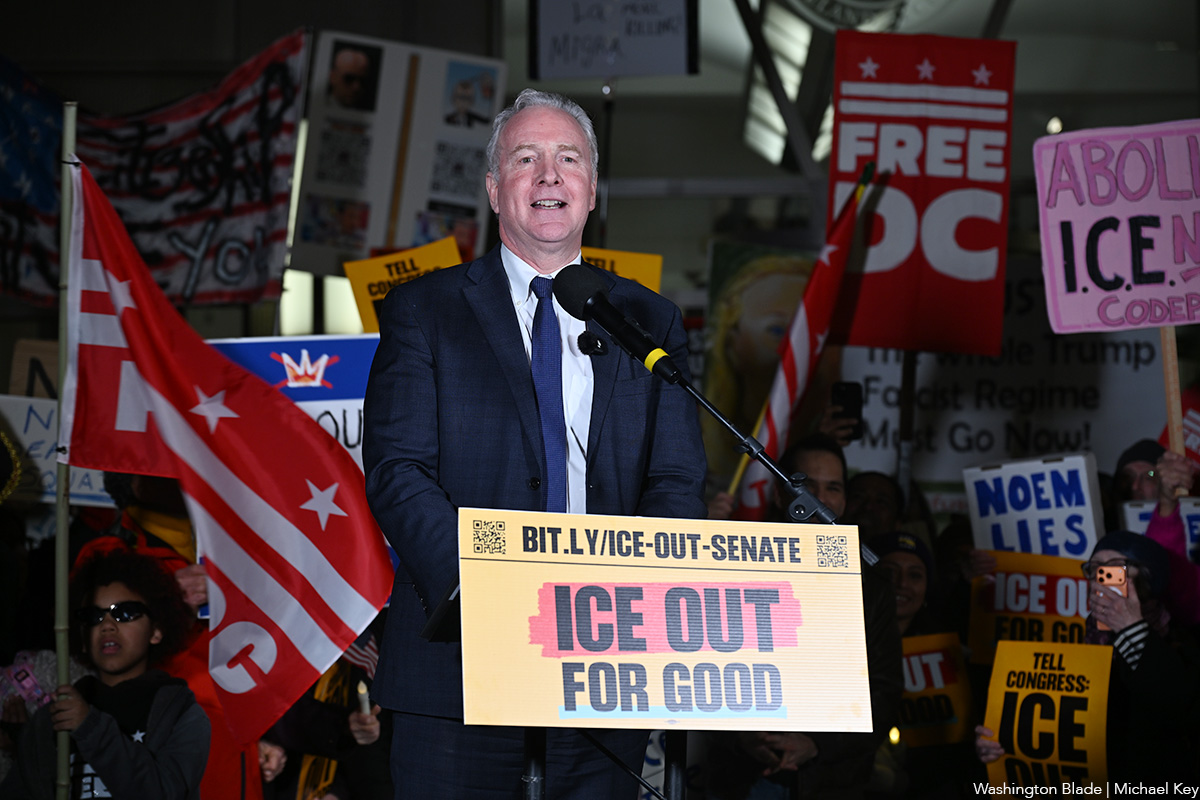
By LEE O. SANDERLIN | The Democratic Party is having something of an identity crisis — losing to President Donald Trump twice in three elections will do that.
Should the party embrace anti-establishment figures who espouse progressive policy ideas like Medicare for all and rhetoric about unrigging the economy for the 1 percent? Or should Democrats try to appeal to moderates who want to return to semi-normalcy in a time of political upheaval?
Although he’s been in Congress since 2002, with key leadership roles throughout his tenure, Maryland Sen. Chris Van Hollen, 67, counts himself firmly in the anti-establishment camp.
The rest of this article can be found on the Baltimore Banner’s website.
Politics
Log Cabin Republicans remove transgender rights from mission
Decision made after ‘significant discussion’ with members, board

Log Cabin Republicans, an organization that formerly represented LGBTQ conservatives, has removed advocating for transgender and queer rights from its “renewed” national advocacy focus.
In an opinion piece written by Log Cabin Republicans President Ross Hemminger for the conservative media outlet Town Hall, he announced that trans rights would no longer be part of what the organization advocates for through conservative leadership and candidates.
In his piece, Hemminger wrote that after “significant discussion” with members and Log Cabin Republicans’ board of directors, the organization’s leadership voted to “refine Log Cabin Republicans’ national advocacy focus to concentrate specifically on issues of sexual orientation and conservative values,” a focus that does not include trans people.
“We have fought for the right to legally marry who we love, serve our country and our communities openly and proudly, and to enjoy the same inalienable rights afforded to all law-abiding Americans — and we succeeded,” Hemminger wrote. “However, the new era of gender identity politics is not the movement we supported and fought for. Gay men and women are losing public support across the country, and support for gay marriage and other once-widely accepted rights is eroding. Why? Because many voters today weren’t alive or cognizant of the politics of gay marriage winding its way through the courts and gaining ground in public opinion. Their view of the gay community is based on today’s radical transgender activists with their unnecessary and discomfiting focus on America’s youth.”
Hemminger then went on to argue that trans advocacy has shifted to focusing primarily on minors — a characterization that does not reflect the breadth of issues trans advocates address.
“They push schools to teach radical gender ideology; they want biological men in women’s sports regardless of the consequences; perhaps most offensively, they support gender reassignment treatments for minors, often without the knowledge or consent of the parents, knowing full well these treatments are mostly irreversible,” he wrote.
Hemminger and many right-wing political leaders have continued to assert this false reality as fact.
A Harvard-affiliated study found approximately 2.1 gender-affirming surgeries occur per 100,000 trans and gender-diverse minors diagnosed with gender dysphoria, underscoring how uncommon these procedures are among minors. In addition to the option of surgery for those who think it’s right for them, there is an array of other medically sound options to treat gender dysphoria, which according to KFF, an independent source for health policy research and polling, includes “medical, surgical, mental health, and non-medical services for transgender and nonbinary people.”
Additionally trans advocacy is not as narrow as Hemminger makes it seem in his opinion piece.
There are a slew of issues the trans community faces — and fights for — on a daily basis that have nothing to do with healthcare. Those include obtaining government documents that accurately reflect one’s gender identity, multiple elements of family law that include the right to marry and adopt children as straight couples can, protections from violence, hate crime protections, the right to serve in the military, access to bathrooms corresponding with their gender, and the right to education.
Despite the overwhelming number of issues trans people — regardless of political affiliation — have to struggle with as a result of systemic gaps in protections that are supposed to be afforded to everyone under the law, they remain vulnerable to unequal treatment.
Despite this shift, Log Cabin Republicans has committed to standing with the Republican Party rather than LGBTQ people as a whole. The organization was initially founded as a loosely connected network of local California social clubs made up of LGBTQ conservatives in the late 1970s before eventually emerging as a national political organization in the early 1990s under its founding executive director, Rich Tafel.
As the organization continued to gain momentum, it endorsed a handful of Republicans who voted against the Respect for Marriage Act, the 2022 law that federally recognized marriage equality for same-sex couples.
The Washington Blade reached out to Log Cabin Republicans for comment but did not hear back by the time of publication.

PHOTOS: Miss Gay Old Bay

SUNFESTIVAL takes center stage as Rehoboth Beach closes out summer

Anne Arundel schools now need parent permission to call trans students by preferred names

Shooting outside gay bar in Ariz. leaves three dead

‘People don’t see me. They see a trend’

San Francisco, long a queer safe haven, remains competitive for homebuyers

Trans, nonbinary Americans find refuge in the Netherlands

Calendar: August 28-September 3

‘Teenage Sex and Death’ has never been more entertaining

Actor Tim Curry dies at 80
-

 California4 days ago
San Francisco, long a queer safe haven, remains competitive for homebuyers
-
Netherlands5 days ago
Trans, nonbinary Americans find refuge in the Netherlands
-
Calendar4 days ago
Calendar: August 28-September 3
-
Movies4 days ago
‘Teenage Sex and Death’ has never been more entertaining