District of Columbia
Zachary Parker sworn in as new D.C. Council member
Restores out representation, vows to advocate for ‘overlooked’ communities
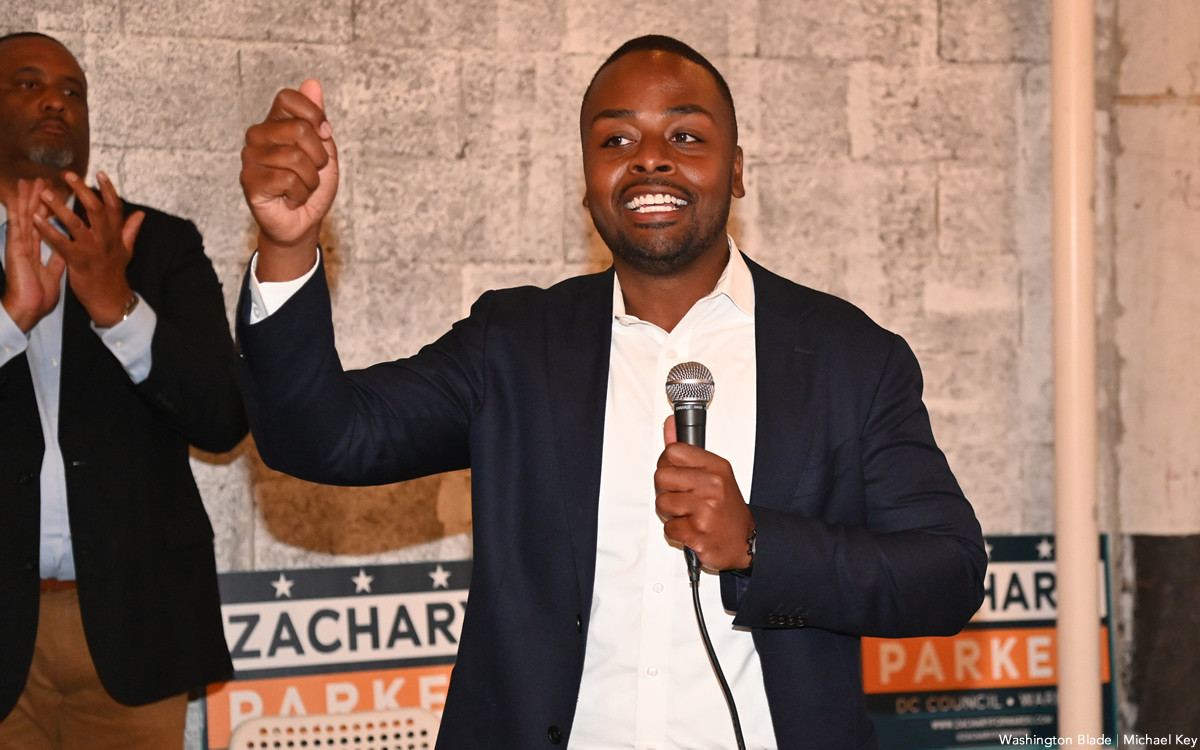
Former D.C. school board member Zachary Parker was sworn in on Monday as the first openly gay member of the D.C. Council since 2015 at an inaugural ceremony in which other elected officials, including D.C. Mayor Muriel Bowser and six other Council members, were also sworn in.
Parker, a Democrat, won election in November to the Ward 5 Council seat by a wide margin after winning a hotly contested Democratic primary for the Ward 5 seat in June.
“I stand here today knowing what I can give toward my neighbors and District residents is directly related to what I am willing to risk,” Parker said in his inaugural speech at D.C.’s Walter Washington Convention Center where the inaugural ceremony was held.
“By one of the widest margins seen in this election cycle, Ward 5 neighbors elected an educator born on the south side of Chicago with a simple based vision that all District residents deserve good and accountable government,” he said in referring to his role as a teacher before running for public office.
“That means we must serve as responsible stewards of the District’s resources examining how we spend taxpayer money while also making sure we extend support to those in greatest need,” Parker said in is speech. “It also means making government more accessible and accountable to you, the people,” he said.
“What’s more, for the first time since 2015, there will be an out gay on the Council,” Parker continued. “And for the first time ever, that Council member will be black,” he said.
“With this honor comes the responsibility to address the ridiculously high rates of queer youth homelessness, fight to protect federal protections that are under assault by officials just down the street, and ensure that we’re investing in the people and organizations that are fighting every day for our LGBTQIA plus neighbors,” Parker told the gathering to loud applause.
Also taking the oath of office at the ceremony were D.C.’s newly elected Attorney General Brian Schwalb and newly elected Ward 3 Council member Matthew Frumin, both Democrats.
The others, in addition to Mayor Bowser, who was sworn in to her third term in office, included incumbent Council Chair Phil Mendelson (D-At-Large) and incumbent Council members Anita Bonds (D-At-Large), Kenyan McDuffie (I-At-Large), Brianne Nadeau (D-Ward 1), and Charles Allen (D-Ward 6).
Transcript of inaugural address:
Zachary Parker
Ward 5 D.C. Council member
Inaugural Address
Walter Washington D.C. Convention Center
Jan. 2, 2023
[His address immediately followed his swearing in by a D.C. Court of Appeals judge]
Thank you all for your patients. And good morning, D.C. I want to first start by extending congratulations to our mayor, Muriel Bowser, on an historic swing again that has yet to come. And Chairman Mendelson and Council members Bonds, McDuffie, Nadeau, and Allen on your re-election.
I also want to give a special congratulation to the other freshman, Council member Matt
Frumin. It will be great to have another education advocate. I for one, first and foremost, will always be an educator.
It’s always an honor to share the stage with our warrior on the Hill, Congresswoman Norton. Congratulations to you as well as to our newly minted Attorney General Brian Schwalb. Thanks to the judges who have joined us to officiate today’s swearing-in ceremony, particularly Chief Judge Anna Blackburne-Rigsby. And thanks to my family and friends who traveled near and far to be here today.
And every member of Team Zachary. You know who you are. Your unwavering commitment and support mean the world to me.
When I was here four years ago giving remarks after being sworn-in to the State Board of Education I referenced the classic line from Charles Dickins’ A Tale of Two Cities. “It is the best of times. It is the worst of times.”
And I have referenced that line to describe the disparities that exist within D.C. and within our schools. Where for many, it is the best of times. They are flushed with resources. But for many more, it is the worst of times. And people are holding on for dear life.
And I stand here knowing that despite the disparities that persist, Washington, D.C. is the greatest city in the world and one day will become the 51st state in the United States. So, speaking with that tradition I started in my tenure four years ago, today I want to call on another literary work. This time by the brilliant James Baldwin – The Fire Next Time.
One can give nothing with whatever without giving oneself. That is to say risking oneself, Baldwin writes. He said, If one cannot risk oneself then one is simply incapable of giving.
I stand here today knowing that what I can give toward my neighbors and District residents is directly related to what I am willing to risk. Neighbors have cast their votes, their sacred votes for me to risk standing alone for those things that are right and what’s good for the greater good. Our neighbors have cast their votes for me to take a risk and taking on the darts and arrows that are a common place in this business to fight for their interests.
And you know, and I agree, that we cannot mistake absolutism for principles or continue to put profit over people or bastardize words like equity while upholding systems that disadvantage black folks and brown folks and poor folks.
Baldwin also teaches us that change is renewal and that nothing is constant. I’m humbled that my election represents needed change in Ward 5 and on the D.C. Council as the District emerges from a global pandemic. By one of the widest margins seen in this election cycle, Ward 5 neighbors elected an educator born on the south side of Chicago with a simple based vision that all District residents deserve good and accountable government.
That means we must serve as responsible stewards of the District’s resources examining how we spend taxpayer money while also making sure we extend support to those in greatest need. It also means making government more accessible and accountable to you, the people.
What’s more, for the first time since 2015, there will be an out gay on the Council. And for the first time ever, that Council member will be black. With this honor comes the responsibility to address the ridiculously high rates of queer youth homelessness, fight to protect federal protections that are under assault by officials just down the street, and ensure that we’re investing in the people and organizations that are fighting every day for our LGBTQIA plus neighbors.
So today – and I’m wrapping – if you are feeling the same calling for renewal in the District that I do, where all our neighbors have a shared quality of life and can live in safe and healthy communities and where natives and residents who have long lived in the District can benefit from this city’s prosperity. If you feel the same responsibility that I do to give voice to communities that are often overlooked and to prioritize getting things done versus political points, then I invite you to join me on this journey.
For when times change, so must we. And the time has found us to chart a new path for the District’s renewal. Thank you again Ward 5. It is the honor of my life to represent this community that I love. Thank you.
[loud applause]


District of Columbia
Gay priest credited with boosting church support for LGBTQ Catholics
Fr. Tom Oddo’s biographer speaks at Dignity Washington event
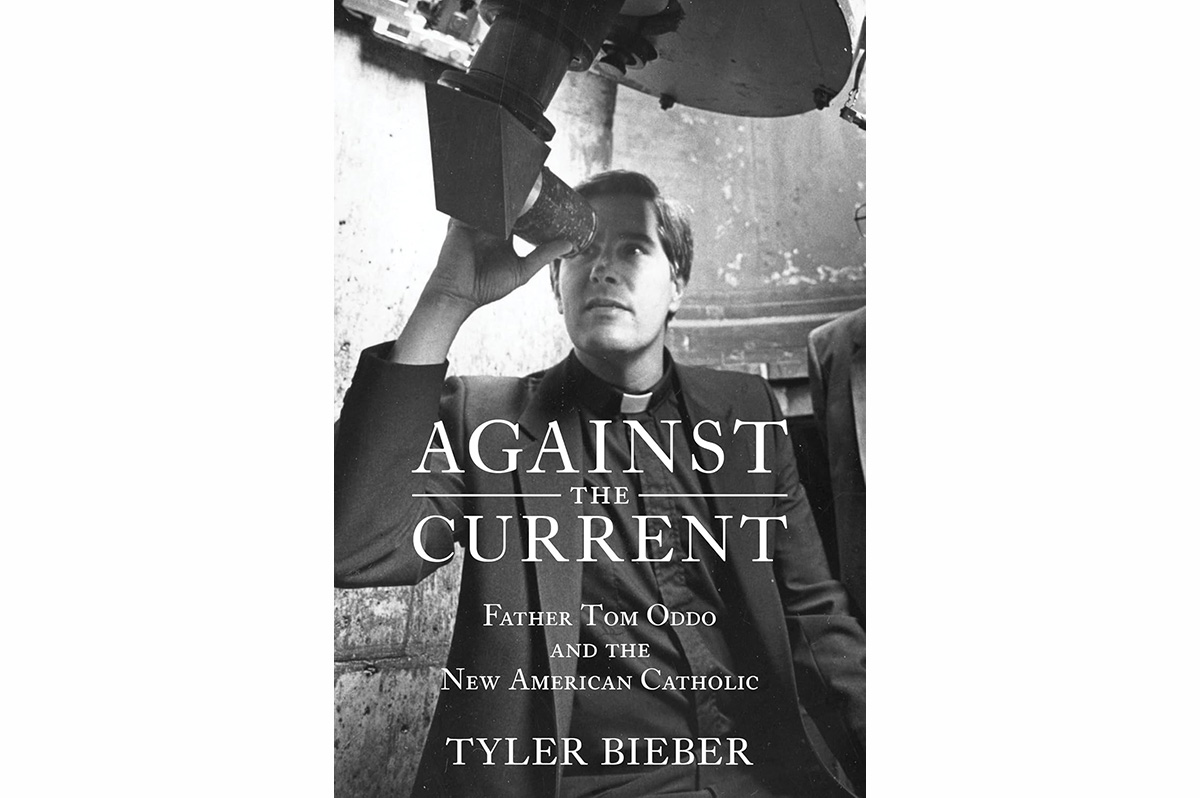
The author of a biography of a U.S. Catholic priest said to have advocated for support by the Catholic Church of gay Catholics in the early 1970s has called Father Thomas ‘Tom’ Oddo a little known but important figure in the LGBTQ rights movement.
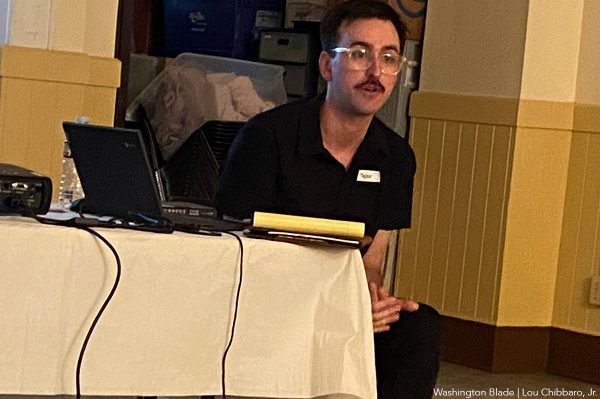
Tyler Bieber, author of the recently published book “Against The Current: Father Tom Oddo And the New American Catholic,” told of Oddo’s life and work on behalf of LGBTQ rights at a March 22 talk before the local LGBTQ Catholic group Dignity Washington.
Among Oddo’s important accomplishments, Bieber said, was his role as a co-founder of the national LGBTQ Catholic group Dignity U.S.A. in 1973 at the age of 29.
But as reported in the prologue of his book, Bieber presented details of the sad news that Oddo died in a fatal car crash in 1989 at the age of 45 in Portland, Ore., where he was serving as the highly acclaimed president of the University of Portland, a Catholic institution.
“He was a major figure in the gay rights movement in the 1970s, an unsung hero of that movement,” Bieber told Dignity Washington members, who assembled for his talk in a meeting room at St. Margaret Episcopal Church near Dupont Circle, where they attend their weekly Catholic mass on Sundays.
“And Dignity U.S.A. saw intense growth in membership and visibility” during its early years under Oddo’s leadership, Bieber said. “The story of Father Tom and his contemporaries is a story largely untold in the history of the gay rights movement, but one worth knowing and considering,” he said.
As stated in his book, Bieber told the Dignity Washington gathering Oddo was born and raised in a Catholic family on Long Island, N.Y., and attended a Catholic high school in Flushing Queens. It was at that time when he developed an interest in becoming a priest, according to Bieber.
After studying at the University of Notre Dame and completing his religious studies he was ordained as a priest in 1970 and began his work as a priest in the Boston area, Bieber said. It was around that time, Bieber told the Dignity Washington audience, that gay Catholics approached Oddo to seek advice on how they should interact with the Catholic Church. It was also around that time that Oddo became involved in a group supportive of then gay Catholics that later became a Dignity chapter in Boston.
In a development considered unusual for a Catholic priest, Bieber said Oddo in 1973 testified in support of gay rights bill before a committee of the Massachusetts Legislature and collaborated with then Massachusetts gay and lesbian rights advocate Elaine Noble.
In 1982, at the age of 39, Oddo was selected as president of the University of Portland following several years as a college teacher in the Boston area, Bieber’s book states. It says he was seen as a “vibrant and capable administrator who delivered real results to his campus,” adding, “His magnetism was obvious. One student described him as ‘John Kennedyesque’ to the university’s student newspaper.”
Bieber said that although Oddo was less active with Dignity U.S.A. during his tenure as UP president, he continued his support for gay Catholics and what is now referred to as LGBTQ rights.
“For those that knew him prior to his term at UP, though, he represented something greater than an accomplished university administrator and educator,” Bieber’s book states. “He was a new kind of priest, a gay man living and ministering in a world set loose from tradition by the Second Vatican Council,” the book says.
It was referring to the Vatican gathering of worldwide Catholic leaders from 1962 to 1965 concluding under Pope Paul VI that church observers say modernized church practices to allow far greater participation by the laity and opened the way for sympathetic consideration of gay Catholics.
District of Columbia
HRC to host National Rainbow Seder
Bet Mishpachah among annual event’s organizers

The 18th National Rainbow Seder will take place at the Human Rights Campaign on Sunday.
The sold out event is the country’s largest Passover Seder for the Jewish LGBTQ community.
Organizations behind the event include Bet Mishpachah, a local D.C. LGBTQ synagogue that Rabbi Jake Singer-Beilin leads, and GLOE, an Edlavitch DC Jewish Community Center program that sponsors events for the queer Jewish community. The theme for this year’s Seder is “Liberation For All Who Journey: Remembering, Resisting, Rebuilding.” Rabbis Atara Cohen, Koach Frazier, and Avigayil Halpern will lead it.
The Seder will honor the late GLOE co-chair Michael Singer. Singer also served on the Edlavitch DC Jewish Community Center’s board.
“This Seder is both a celebration of how far we have come and a call to continue building a more just and inclusive world.” Bet Mishpachah Executive Director Joshua Maxey told the Washington Blade.
District of Columbia
Trans Day of Visibility events planned
Rally on the National Mall scheduled for Saturday

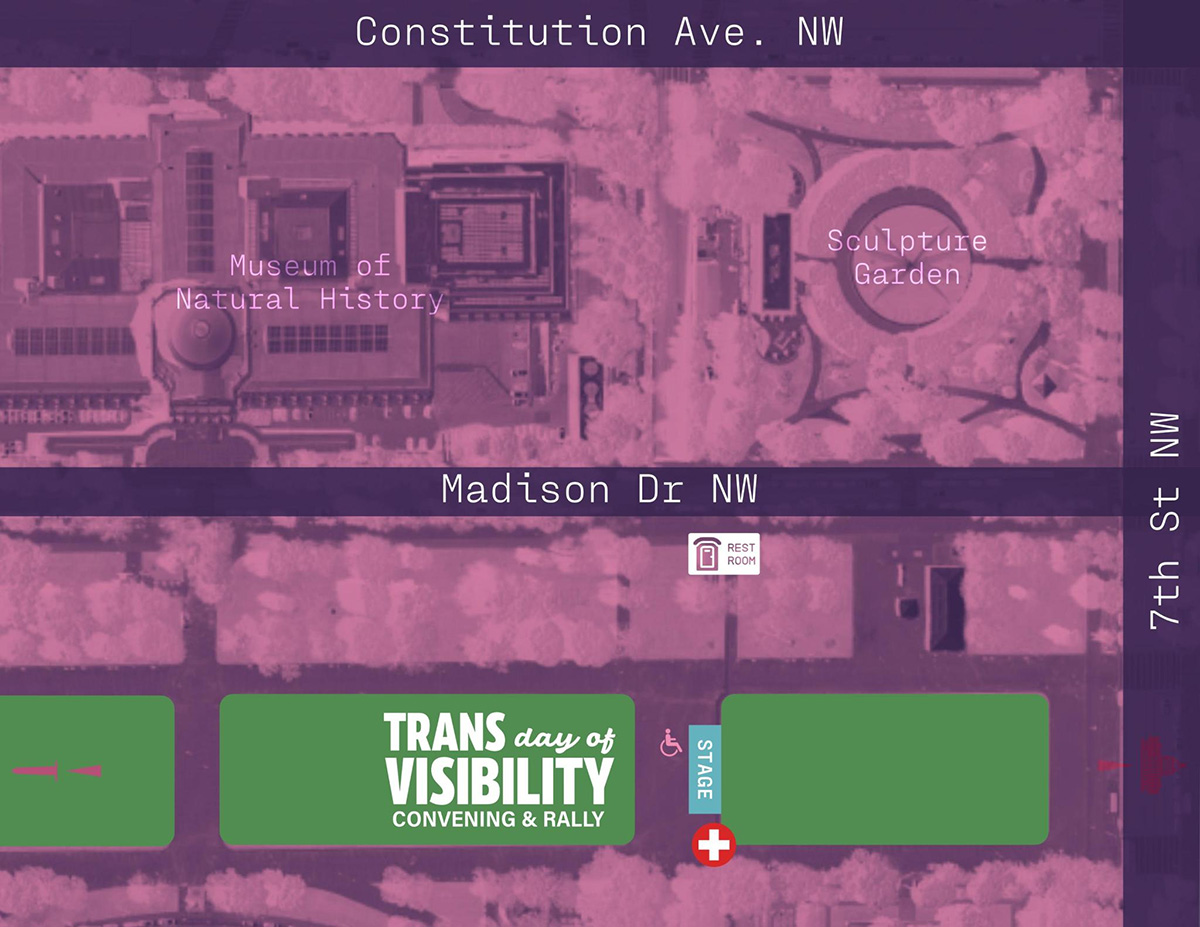
The Christopher Street Project has a number of events planned for the 2026 Trans Day of Visibility, including a rally on the Mall and an “Empowerment Ball” at the Eaton Hotel. Plenaries, panel discussions and meetings with members of Congress are scheduled in the three days of programming.
Announced speakers include N.H. state Rep. Alice Wade; Commissioner of the Metropolitan Water Reclamation District of Greater Chicago Precious Brady-Davis; activist and performer Miss Peppermint (“RuPaul’s Drag Race”); Lexington, Ky. Councilwoman Emma Curtis; Rabbi Abby Stein; D.C. activist and host Rayceen Pendarvis; Air Force Master Sgt. Logan Ireland; among other leaders, advocates and performers.
Conference programming on Thursday and Friday includes an educational forum and a Capitol Hill policy education day. Registration for the two-day conference has closed.
The “Trans Day of Visibility PAC Reception” is scheduled for Thursday, March 26 from 7:30-9 p.m. at As You Are (500 8th St., S.E.). Special guests include Rep. Dina Titus (D-Nevada) and Rep. Delia Ramirez (D-Ill.). Tickets are available at christopherstreetproject.org starting at $25.
The National Council of Jewish Women and the Christopher Street Project host a “Trans Day of Visibility Shabbat” on Friday, March 27 from 7-8 p.m. at Sixth & I (600 I St., N.W.). The service is to be led by Rabbi Jenna Shaw and Rabbi Abby Stein.
The “Now You See Me: Trans Empowerment Social & Ball” is scheduled for Friday, March 27 from 6-11 p.m. at the Eaton Hotel (1201 K. St., N.W.). The trans-themed drag ball is hosted by the Marsha P. Johnson Institute with support from the D.C. Mayor’s Office of LGBTQ+ Affairs, the Capital Ballroom Council, the Christopher Street Project, the Center for Black Equity, Generation for Common Good, and Parenting is Political. RSVP online at christopherstreetproject.org.
The National Transgender Day of Visibility Rally is scheduled for Saturday, March 28 on the National Mall at 11 a.m. The rally will include speakers and performances. Following the rally, attendees are encouraged to participate in the “No Kings” rally being held at Anacostia Park.

Border to border: modern slavery and human trafficking in refugee movements across East Africa

New IOC policy bans trans women from Olympics

Introducing the Torchbearers Awards honoring queer, trans women and nonbinary people

Pa. House passes bill to codify marriage equality in state law

A surtax would end this war quickly

PHOTOS: Capital Stonewall Democrats 50th anniversary

‘Inherit the Wind’ isn’t about science vs. religion, but the right to think

Small is beautiful: subcompact SUVs

Polish court rules country must recognize same-sex marriages from EU states

Capital Stonewall Democrats 50th anniversary gala draws sold out crowd
-

 Photos3 days ago
PHOTOS: Capital Stonewall Democrats 50th anniversary
-
Theater4 days ago
‘Inherit the Wind’ isn’t about science vs. religion, but the right to think
-
Autos4 days ago
Small is beautiful: subcompact SUVs
-
Poland3 days ago
Polish court rules country must recognize same-sex marriages from EU states