
Congress
McCarthy confirms Santos faces House ethics probe
‘If Ethics finds something, we’ll take action’

House Speaker Kevin McCarthy (R-Calif.) confirmed to CNN on Tuesday that U.S. Rep. George Santos (R-N.Y.) faces an investigation by the House Ethics Committee.
“Ethics is moving through, and if Ethics finds something, we’ll take action,” McCarthy said.
For his part, Santos continued to lean into the defiant attitude with which he has recently treated the many scandals that have enveloped him since his arrival to Washington.
Santos told CNN he is “not concerned” about the ethics probe and is eager to welcome the constituents from his district, New York’s 3rd Congressional, who are headed to Capitol Hill today to demand his resignation.
“Right now we’re not allowing him to be on committees from the standpoint of the questions that have arisen,” McCarthy told the network, following reports last week that Santos stepped down from the House Small Business and Science, Space and Technology Committees.
Asked whether his resignations came at the speaker’s behest, Santos told reporters at the time: “Nobody tells me to do anything.”
Also last week came reports that the FBI was exploring allegations that Santos ran a GoFundMe scam, allegedly stealing crowdsourced money that was intended for oncology treatments for a homeless veteran’s treasured service dog.
Politico reported that on Tuesday, dozens of constituents from Santos’ district called on the beleaguered New York Republican to resign — or demanded House GOP leadership call a vote to expel him.
Gathering on Capitol Hill outside of congressional offices on the day that President Joe Biden is to deliver his State of the Union address, constituents waved a number of signs including those that read “I believe in Santa more than Santos,” “Scamtos,” and “Sashay away George.” They chanted: “Force him out!” The New York Republican has given no indication he’d resign.
One of his GOP constituents said he found Santos’ lie that his mother perished during 9/11 particularly offensive. “You have to be really psychologically impaired to throw that around like it’s nickels,” Ben Marzouk, a local Republican, said.
Just now: Constituents deliver petition to George Santos’s office demanding he leave congress. pic.twitter.com/LlOHzfOxZb
— Ford Fischer (@FordFischer) February 7, 2023
Right now: constituents of Rep George Santos gather at the Capitol to demand his removal from congress.
— Ford Fischer (@FordFischer) February 7, 2023
Will be live-streaming their press conference which will begin in a few minutes. pic.twitter.com/QIgrrguiHN




Congress
LGBTQ advocates look to new Congress for path forward on federal protections
Ricardo Martinez (GLAD Law) spoke about the future of LGBTQ protective policy under the 120th Congress

Following Democratic victories in the midterm elections, LGBTQ advocates are looking to the incoming Congress for renewed opportunities to pass pro-LGBTQ legislation.
For decades, advocates and lawmakers have pushed for a federal law prohibiting discrimination based on sexual orientation and gender identity. With Democrats set to take control of both chambers in January, advocates say the new majority could provide an opening to advance legislation that has repeatedly stalled in Congress, even as the Trump administration continues its efforts to roll back existing protections.
The Equality Act remains at the top of the legislative wish list. The legislation would amend the Civil Rights Act of 1964 and related federal laws to explicitly prohibit discrimination based on sexual orientation and gender identity in employment, housing, public accommodations, education, federally funded programs, credit, and jury service.
The latest version was introduced in the House by Equality Caucus Chair Rep. Mark Takano (D-Calif.) and in the Senate by Sen. Jeff Merkley (D-Ore.), with Sen. Ed Markey (D-Mass.) among its co-sponsors.
Other proposals include the Transgender Bill of Rights, reintroduced in February by Markey and Rep. Pramila Jayapal (D-Wash.), with Reps. Sara Jacobs (D-Calif.) and Takano among its co-sponsors. The resolution calls on the federal government to take steps to protect transgender and nonbinary people and ensure access to medical care, shelter, safety, and economic security.
Rep. Bonnie Watson Coleman (D-N.J.), a co-chair of the Congressional Equality Caucus, has also backed legislation aimed at addressing discrimination against LGBTQ people. She has co-sponsored the Therapeutic Fraud Prevention Act of 2025, which would prohibit commercial sexual orientation conversion therapy, as well as the Tyler Clementi Higher Education Anti-Harassment Act, which would require colleges and universities to establish policies addressing homophobia and transphobia on campus.
But while advocates see a Democratic-controlled Congress as an opportunity to advance those proposals, they are also approaching the next two years with an understanding of the political and legislative challenges ahead.
The Washington Blade spoke with Ricardo Martinez, executive director of GLAD Law, about the future of federal LGBTQ policy under the new Congress and what the midterm results revealed about the priorities of American voters.
“The first thing that I think of when I think of the election is that this election showed that people are tired of division, and they want leaders who are focused on everyday concerns like healthcare, safety, economic security,” Martinez told the Blade by phone Tuesday. “I think a lot of people in the United States, including LGBTQ people, are hurting.”
Martinez said the incoming 120th Congress has tools to protect LGBTQ people, even if passing sweeping new federal protections proves difficult in the near term.
“Passing new federal protections for LGBTQ people specifically may be hard in the near term, and we are realistic about that,” Martinez said. “But still, Congress can lay the groundwork now, either through hearings or bill development.”
He pointed to healthcare and economic policy as areas where lawmakers could make progress that benefits LGBTQ people alongside the broader public.
“But there’s a lot Congress can do on healthcare minimum wage that would apply and benefit LGBTQ people,” he said. “Lasting progress has always depended on the support of both parties, so that’s a coalition that I think is worth building, and hopefully, in the not so near future, the Equality Act can be a thing that moves.”
Beyond passing legislation, Democrats are preparing to use their new majority to scrutinize the Trump administration. Rep. Robert Garcia (D-Calif.), the gay lawmaker who won reelection, is slated to chair the House Oversight Committee when Democrats take control of the chamber.
Garcia has pledged to investigate the administration and hold officials accountable for actions he believes violated the law. That promise has already drawn a response from the White House, where Trump administration officials have warned against efforts to intimidate or threaten executive branch employees.
In response to those warnings, the Democratic staff of the House Oversight Committee defended Congress’ authority to investigate the administration, arguing that its oversight powers come from the Constitution and do not depend on White House approval.
Martinez said that kind of oversight is particularly important when government actions affect personal privacy, healthcare, and community programs.
“Oversight of the executive branch is one of Congress’s basic responsibilities, no matter who is in office,” Martinez said. “So, recent federal actions on personal privacy and data cuts to healthcare, research, and community programs deserve careful review.”
He said the consequences extend beyond LGBTQ people, warning that government actions targeting one group’s privacy or access to services can threaten protections for everyone.
“Their effects reach Americans broadly, not only LGBTQ people,” Martinez said. “And when the government can single out one group’s privacy or services, everyone’s rights are less secure, and transparency protects all of us.”
Democrats could also use their control of congressional spending negotiations to push for funding for programs serving LGBTQ communities. Martinez specifically pointed to the Ryan White HIV/AIDS Program and said lawmakers should oppose discriminatory policy riders in federal spending bills.
According to the Human Rights Campaign, House Republicans introduced more than 50 anti-LGBTQ+ policy riders across federal funding bills over the past year. The proposed provisions sought to restrict gender-affirming care, permit discrimination against same-sex couples and undermine diversity, equity and inclusion (DEI) initiatives, which have been a longstanding target of the president’s agenda.
Separately, significant cuts have affected federal funding for HIV/AIDS programs. Under the Trump-Vance administration, funding shortfalls pushed by the administration have emerged in programs serving LGBTQ people and other vulnerable communities. The HIV and Hepatitis Policy Institute says $1 billion in cuts to domestic HIV prevention, surveillance, and support programs have left some of the communities most affected by HIV struggling to cover medical costs.
“Last year was full of disruptions in HIV prevention grants and services, which created great instability. Not only do we need to maintain current funding levels, but increases are urgently needed, particularly for the AIDS Drug Assistance Program (ADAP) due to rising enrollment and insurance premium costs,” said Carl Schmid, executive director of the HIV+Hepatitis Policy Institute, earlier this year.
Still, congressional oversight and funding decisions will not necessarily stop the administration from pursuing policies LGBTQ advocates oppose. Martinez said GLAD Law plans to continue challenging those actions in court.
“Our plan has always been and will remain consistent, which is we are in the process of a surge in litigation, which means that we’re going to try to stop as much of the bad as possible,” Martinez said.
The organization’s work will also extend to state governments, where many laws directly affecting LGBTQ people’s daily lives are passed. Martinez said GLAD Law will continue challenging harmful state policies while pursuing legislation to strengthen legal protections for LGBTQ families, including in adoption, assisted reproduction and parental recognition.
The election also offered hope on transgender rights, despite continued political attacks targeting transgender people. Martinez said advocates must continue challenging misinformation and helping Americans better understand the lives of LGBTQ people.
That message was echoed by U.S. Rep. Sarah McBride (D-Del.), the nation’s first transgender member of Congress, who pushed back against the idea that Democrats should abandon transgender people politically to win elections after winning her re-election last week.
Speaking during a HRC call Tuesday night, McBride argued that Democrats’ electoral gains were not built by sacrificing vulnerable communities.
“The majority was not built by throwing vulnerable people under the bus. This majority was built by people of principle, by candidates who have defended their voters and their constituents, all of them, regardless of their sexual orientation and gender identity,” McBride said.
She also pointed to her own re-election as evidence that voters were not rejecting transgender representation at the ballot box.
“I’m proud that at a time when Republicans seemingly made every single issue in some form or fashion about trans issues, that voters in my state returned the nation’s first out transgender member of Congress to office, with the largest number of votes of any candidate on the statewide ballot this year,” she said.
For Martinez, the work ahead will involve not only legislation and litigation, but also changing how Americans understand LGBTQ people, particularly transgender people.
“Accurate information also matters,” he said. “And we’re going to continue countering misinformation and disinformation, and helping more people understand LGBTQ people’s lives, especially transgender people.”
He said advocates must continue sharing their experiences and emphasizing their place in communities across the country.
“We are your neighbors. We are small business owners. We are, you know, your colleagues and coworkers, and that’s important for people to know,” Martinez said. “Familiarity is incredibly important, and at the heart of this is something very simple: that transgender people want to live their lives in peace, like everyone else, and that’s a value I think Americans share across party lines.”
2026 Midterm Elections
Democrats take control of Congress in historic rebuke of Donald Trump
‘Voters delivered a resounding message: equality wins’
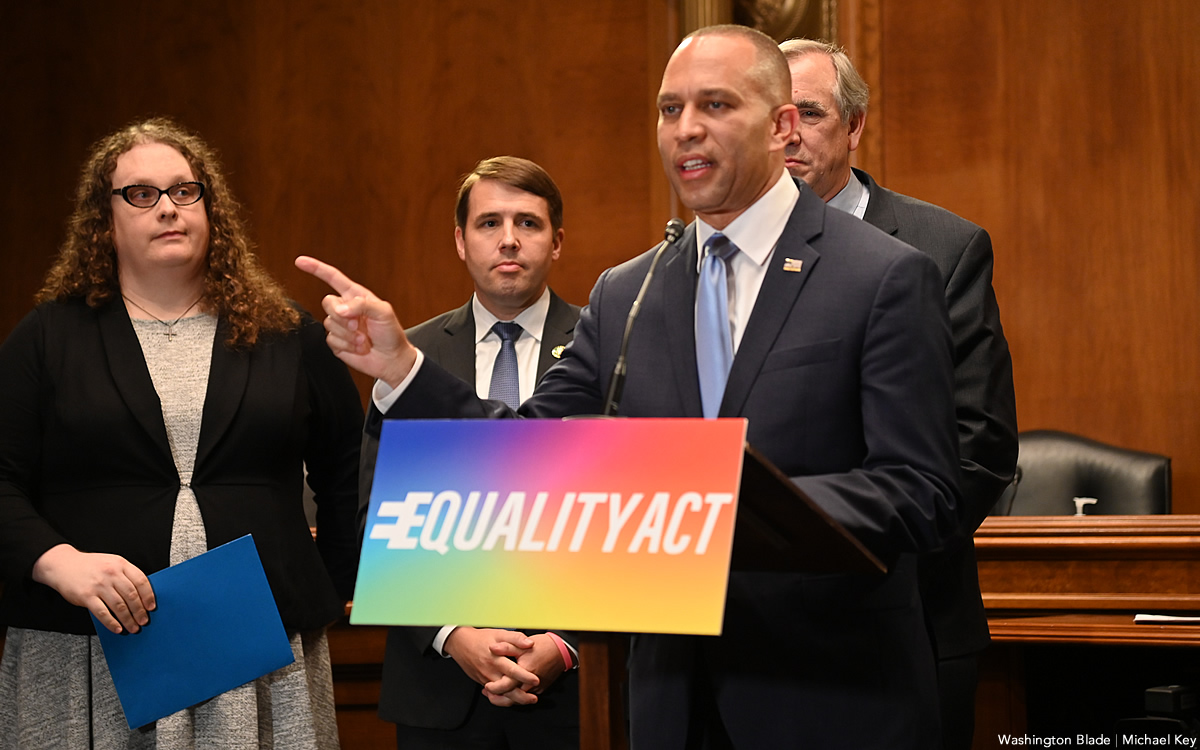
Midterm elections are traditionally viewed as a check on the party in control of the White House. With Republicans holding control of all three branches of government, President Donald Trump was able to advance his agenda with few congressional obstacles.
From getting the United States involved in a war in Iran to imposing tariffs that have increased the cost of everyday goods, Trump has faced mounting criticism over his priorities, including his insistence on pursuing vanity projects in the nation’s capital rather than addressing issues affecting most American voters.
Following the midterm elections, both chambers of Congress will now be controlled by the Democratic Party.
Affordability was a key issue in this year’s midterms. As Americans watched Trump receive a brand-new Air Force One from a foreign government and continue a war that has directly affected everyday costs, particularly gasoline and groceries, voters delivered a devastating and historic rebuke to the president and his party.
Republicans spent $305 million on advertisements, compared with $256 million spent by Democrats, in competitive Senate, House and gubernatorial races between Oct. 23 and 29, according to The Washington Post, which analyzed data from AdImpact, a political advertising tracking firm.
Republican attempts to use LGBTQ issues as culture-war talking points appeared to be less effective in 2026 than they were in 2024.
This year’s advertisements targeting transgender people primarily focused on two policies: transgender athletes’ participation in women’s and girls’ sports and gender-affirming medical care, particularly surgery, for minors.
Despite Republican efforts to make LGBTQ identity a political liability, the midterm elections resulted in a historic number of LGBTQ candidates being elected to federal office.
Chris Pappas, the senator-elect from New Hampshire, will become the first openly gay man elected to the U.S. Senate, joining Sen. Tammy Baldwin (D-Wis.), an out lesbian who has held her seat since 2012. Meanwhile, a record number of LGBTQ representatives have been elected and reelected to the U.S. House. They include Sarah McBride, the first openly transgender member of Congress, who retained Delaware’s seat; JD Ford, who flipped Indiana’s seat; and Cait Conley, who defeated incumbent Mike Lawler.
Following the election results, LGBTQ advocacy groups celebrated Democratic victories and the election of several LGBTQ candidates.
The Human Rights Campaign (HRC), the largest LGBTQ advocacy organization in the United States, issued a statement following Democrats’ securing control of both chambers of Congress.
“Tonight, voters delivered a resounding message: equality wins. After two years of MAGA Republicans waging a culture war, wasting taxpayer dollars attacking LGBTQ+ people, and spending $340 million on anti-trans ads while families suffered, voters have had enough,” said HRC President Kelley Robinson.
“In a historic rebuke, voters didn’t just reject LGBTQ+ hate, they have elected a historic number of LGBTQ+ elected officials. Chris Pappas is the first-ever out gay man elected to the U.S. Senate, and JoAnna Mendoza, Cait Conley, and Jeremy Moss will join Sarah McBride, who won by a huge margin, in the U.S. House — and that’s just the start. Virginia reaffirmed that love is love. Missouri rejected an anti-trans, anti-abortion ballot measure. And we are seeing victories up and down the ballot across the country,” she added. “The message from LGBTQ+ voters could not be any more clear: Our rights are not up for debate, our community will not be a political punching bag, and we are not going anywhere.”
Emily Wagner, a communications official with the Transgender Freedom Alliance, also weighed in on the results, arguing that the relentless anti-transgender advertising Republicans ran across the country failed to deliver the electoral results they sought.
“Massive anti-trans spending failed to prevent important Democratic victories. Republicans spent nearly $400 million on anti-trans ads altogether—and still lost key races to candidates who pushed back,” Wagner said in an email. “These victories reinforce TFA’s research: candidates can answer attacks effectively by speaking confidently about shared values, addressing voters’ concerns, and challenging their opponents’ priorities without abandoning transgender people.”
There were early predictions that a Democratic “blue sprinkle,” or even a modest wave, could serve as a check on Trump’s power by installing Democratic lawmakers in a Congress over which he had previously exercised significant influence. Instead, the results amounted to a blue tsunami.
Democrats won several states Trump carried by double digits in 2024, as voters voiced their disapproval of the president.
Democrats flipped seven previously Republican-held seats, including in Iowa, Kansas, Maine, North Carolina, South Carolina, Ohio and Texas. Some of those states had gone decades without electing a Democratic leader.
The seismic shift in federal power has also prompted changes in Republican leadership. Speaker Mike Johnson (R-La.) told his staff during a phone call Wednesday morning that he will not remain Republican leader in the new Congress, according to four sources on the call cited by NBC News. Republicans are scheduled to hold an internal election to select their candidate for the position next week, on Nov. 10.
With control of the House and expanded oversight powers, more LGBTQ Democrats could also be positioned to take on leadership roles in the new Congress.
Incumbent Congressman Robert Garcia (D-Calif.) is poised to become chair of the House Oversight Committee, giving him greater authority to investigate the Trump-Vance administration, subpoena officials and oversee federal agencies.
Garcia responded to the confirmation of Democratic control with a two-word statement: “Lawyer up.”
2026 Midterm Elections
Democrats projected to win Senate majority, opening door to LGBTQ legislation
U.S. Sen-elect Chris Pappas (D-N.H.) is gay
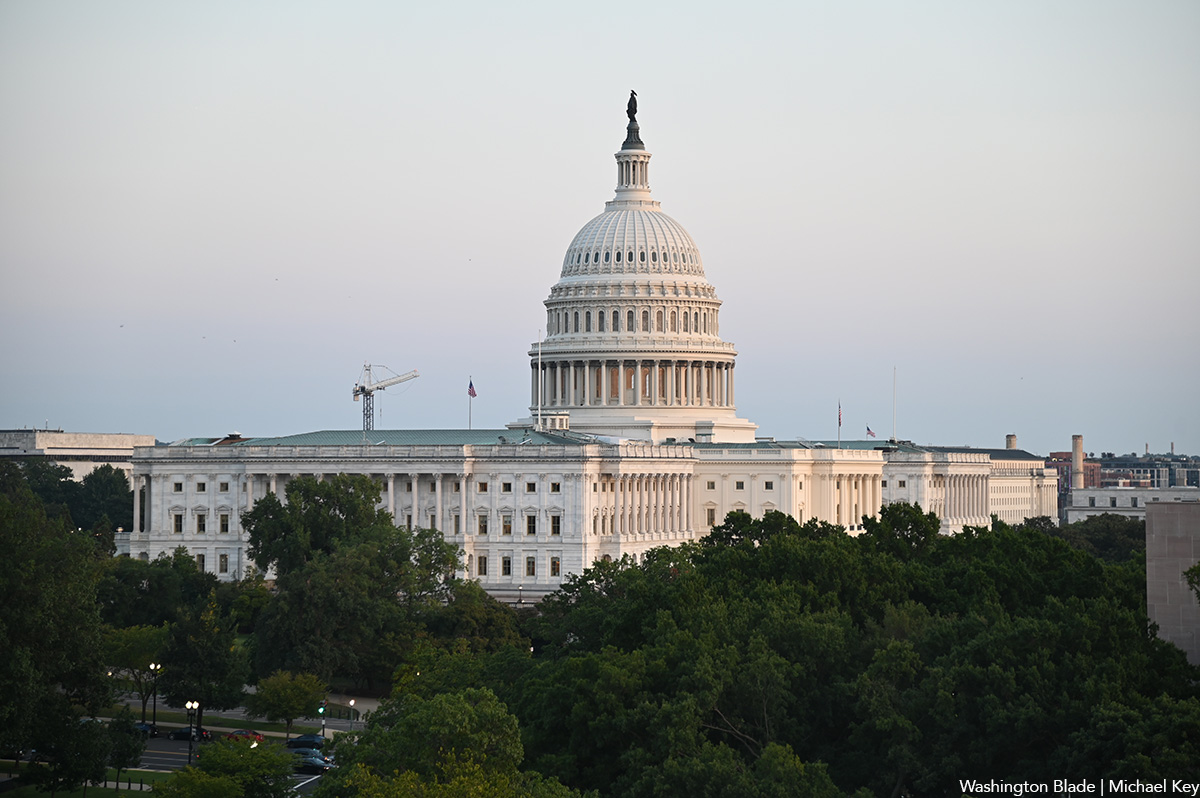
The U.S. Senate has flipped to Democratic control.
Democrats will control of the Senate after flipping the minimum four Republican-held seats, giving the party control of both chambers of Congress and a majority in the legislative branch, according to NBC.
The Senate, the upper legislative body, holds 100 seats, two for every state, and oversees several important functions of the federal government, including confirming judicial and Cabinet appointments.
There will now be two openly LGBTQ members of the Senate: freshly elected Chris Pappas of New Hampshire, who is gay, and Tammy Baldwin of Wisconsin, who is a lesbian.
With greater control over federal legislation, Democrats could have an opportunity to advance measures such as the Equality Act, which would expand federal protections against discrimination based on sexual orientation and gender identity.
During the campaign, President Donald Trump repeatedly referred to South Carolina Democratic Senator-elect Annie Andrews using the anti-transgender slur “Tranny Annie,” while emphasizing culture war issues, including trans participation in sports and gender-affirming care.
Democrats, meanwhile, have centered their campaigns on the growing affordability crisis as somatic issues, including the Ukrainian-Russian war, Palestinian-Israeli war, and the war in Iran.

Witness describes scene inside Logan Circle gym during fatal shooting

Andrew Scott talks ‘Elsinore,’ Hamlet, and AIDS

D.C. lesbian activist champions cause of common law marriage

BREAKING NEWS: One dead, four injured in shooting at VIDA Fitness in Logan Circle

US funding cuts leave LGBTQ Indonesians with HIV more vulnerable

Epic ‘La bola negra’ delivers powerful romance for the ages

Kim Kardashian gets the bio treatment in new book

Honoring LGBTQ+ veterans and advancing housing equality

Botswana’s marriage equality case and the politics of family values

New Orchestra of Washington to perform ‘Requiem for a People’
-

 Movies4 days ago
Epic ‘La bola negra’ delivers powerful romance for the ages
-
Books4 days ago
Kim Kardashian gets the bio treatment in new book
-
Real Estate4 days ago
Honoring LGBTQ+ veterans and advancing housing equality
-
Botswana3 days ago
Botswana’s marriage equality case and the politics of family values