District of Columbia
Judge dismisses gay D.C. cop’s bias lawsuit
Former officer claimed anti-gay harassment and retaliation
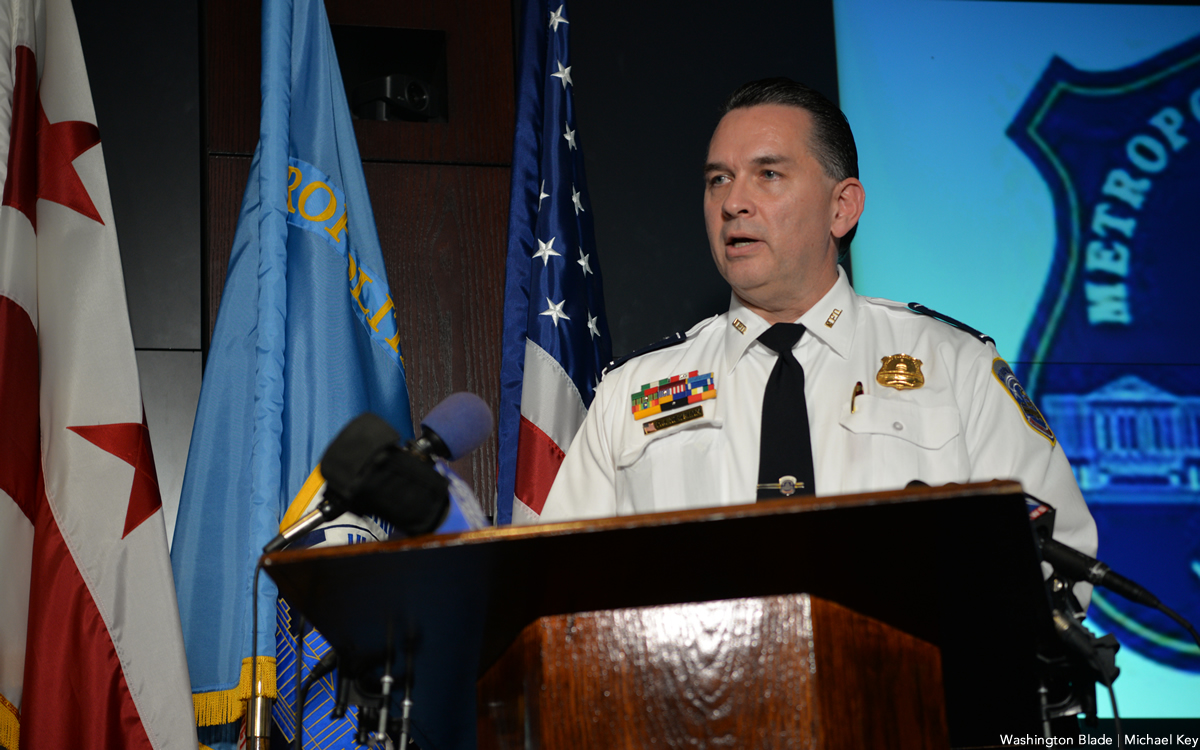
In a little-noticed development, a federal judge on Feb. 21 of this year dismissed a lawsuit filed in 2015 by gay former D.C. police officer Christopher Lilly accusing fellow officers and supervisors of subjecting him to discrimination, harassment, and retaliation based on his sexual orientation.
In a 65-page ruling, U.S. District Court Judge Emmet G. Sullivan explained why he approved a motion filed by the District of Columbia requesting a summary judgement decision dismissing the case based on the assertion that the lawsuit lacked sufficient evidence to substantiate that discrimination of any kind took place.
The motion was filed by attorneys with the Office of the D.C. Attorney General, who represented the District and the Metropolitan Police Department of Washington, D.C., who were named as defendants in the lawsuit filed by Lilly.
Neither Lilly nor his attorney, Sameera Ali of the D.C. law firm Ali, White & Coleman, responded to a request by the Washington Blade seeking comment on the judge’s ruling.
Lilly charged in his lawsuit filed in May 2015 that between 2011 and 2013 he was subjected, among other things, to repeated anti-gay name-calling and other forms of harassment, including the placement of more than a dozen AIDS awareness stickers on his locker at the Fourth Police District, where he was stationed.
At the time he saw the AIDS stickers on his locker he also saw that someone wrote the word “fag” on the locker and poured a white liquid on the floor next to the locker simulating semen, according to the lawsuit.
The lawsuit says the discriminatory actions began shortly after December 2010 when “without plaintiff Lilly’s knowledge or consent, his sexual orientation, homosexual, was publicized maliciously and intentionally” at the Fourth District.
“Following plaintiff Lilly’s ‘outing,’ any other officer to come into contact with plaintiff Lilly subjected him to scrutiny, retaliation and ridicule by means of vulgar language, slandering his name and abilities to function as a police officer and questioning his abilities to serve due to his sexual orientation,” the lawsuit alleged.
The lawsuit, among other things, charged D.C., through the actions of police officials, with violating the D.C. Human Rights Act, which bans discrimination based on sexual orientation, and violating Title VII of the U.S. Civil Rights Act of 1964, by discriminating against Lilly because of his gender and sexual orientation, creating a hostile work environment, and retaliating against him when he raised objections to the alleged discrimination.
In his ruling dismissing the case, Judge Sullivan points to arguments in the District’s answer to the lawsuit filed in 2020 and in the District’s motion calling for summary judgement, that Lilly failed to provide sufficient evidence to support his allegations.
The judge also cited what he described as multiple undisputed facts presented by the AG Office attorneys showing that Lilly had faced disciplinary actions for breaching police rules, including not showing up for work or showing up late for his shift of duty.
Other allegations by the MPD against Lilly, which Judge Sullivan says were unrelated to his sexual orientation, involved the temporary revocation of his police powers in 2012 due to alleged emotional stress he faced from a work-related exposure to bedbugs, according to the judge’s account of court filings.
“A few days later, Mr. Lilly was referred by MPD officials for a Psychological Fitness for Duty Evaluation,” the judge states in his ruling.
“Gloria Morote, a licensed clinical psychologist, evaluated Mr. Lilly on October 10, 2012, and October 24, 2012, alongside MPD referral documents informing her that ‘following a period of good service, Officer Lilly’s performance and appearance began to deteriorate in August/September 2012,’ including ‘two major investigations for neglect of duty,’ ‘deterioration’ in his mental condition, and ‘marked nervousness and erratic behavior while on-duty after exposure to bedbugs,’” the judge wrote in his ruling.
Over the next several months, the judge’s ruling states, Lilly continued to get into trouble for being late for work and other breaches of police rules leading up to May 22, 2013, when “Mr. Lilly was placed on administrative leave after ‘rambling’ with ‘glassy’ eyes to a commanding officer about being sent by his family to a ‘funny farm,’” Judge Sullivan continues in is ruling.
“Then, on May 31, 2013, Mr. Lilly self-admitted into Dominion Hospital, a mental health facility in Virginia, to receive psychiatric treatment,” Sullivan states.
He reports in his ruling that based on Lilly’s record of infractions of police rules and his mental health status, the Police and Firefighters’ Retirement and Relief Board (PFRRB) “ordered Mr. Lilly’s retirement, determining that he was incapacitated from further duty by reason of a disability incurred in the performance of duty, and his retirement took effect on August 16, 2013.”
Court records show that under this forced retirement order Lilly would receive 40 percent of his salary as part of his retirement benefit.
“Drawing every justifiable inference in Mr. Lilly’s favor, as the Court must do, it finds no basis under Title VII or the D.C. Human Rights Act upon which a reasonable fact finder could conclude that the District had discriminatory intent based on his gender and/or sexual orientation or was retaliating against him for taking part in a protected activity,” Sullivan concludes in his ruling. “Accordingly, the District’s Motion for Summary Judgement, EFC No. 45, is granted.”
The judge described his action as a “final appealable order,” which indicates that Lilly could appeal the ruling to the D.C. Court of Appeals.
Lilly and his lawyer, Sameera Ali, couldn’t immediately be reached to determine whether Lilly plans to appeal the decision.
Shortly after Lilly’s lawsuit was filed, officials with the MPD and the Office of the Attorney General declined to comment, saying they could not discuss issues surrounding a pending lawsuit. But then Assistant D.C. Police Chief Peter Newsham, who later became Chief of Police, told the Blade the department does not tolerate discrimination.
“I can’t talk about a specific lawsuit,” he said. “But I can tell you about how we don’t tolerate bias by any members of this police department,” said Newsham. “It’s something we take very seriously. And if we become aware of it, corrective action will be taken all the way up to removal if it was severe enough,” he said.



District of Columbia
Blade contributor, husband exchange vows in D.C.
Yariel Valdés and Kevin Vega held ceremony at Jefferson Memorial on March 23

Washington Blade contributor Yariel Valdés and his husband, Kevin Vega, exchanged vows at the Jefferson Memorial on March 23.
The couple married in Fort Lauderdale, Fla., on Nov. 24, 2025. The Jefferson Memorial ceremony — which Blade International News Editor Michael K. Lavers and Samy Nemir Olivares officiated — coincided with the third anniversary of Yariel and Kevin’s first date.
Yariel in 2019 asked for asylum in the U.S. because of the persecution he suffered as a journalist in his native Cuba. He spent nearly a year in U.S. Immigration and Customs Enforcement custody before his release on March 4, 2020.
Yariel wrote a series of articles about his time in ICE custody that the Blade published. The series was nominated for a GLAAD Media Award in 2022.
Yariel and Kevin live in South Florida.
District of Columbia
‘Out for McDuffie’ event held at D.C. gay bar
Mayoral candidate cites record of longtime support for LGBTQ rights
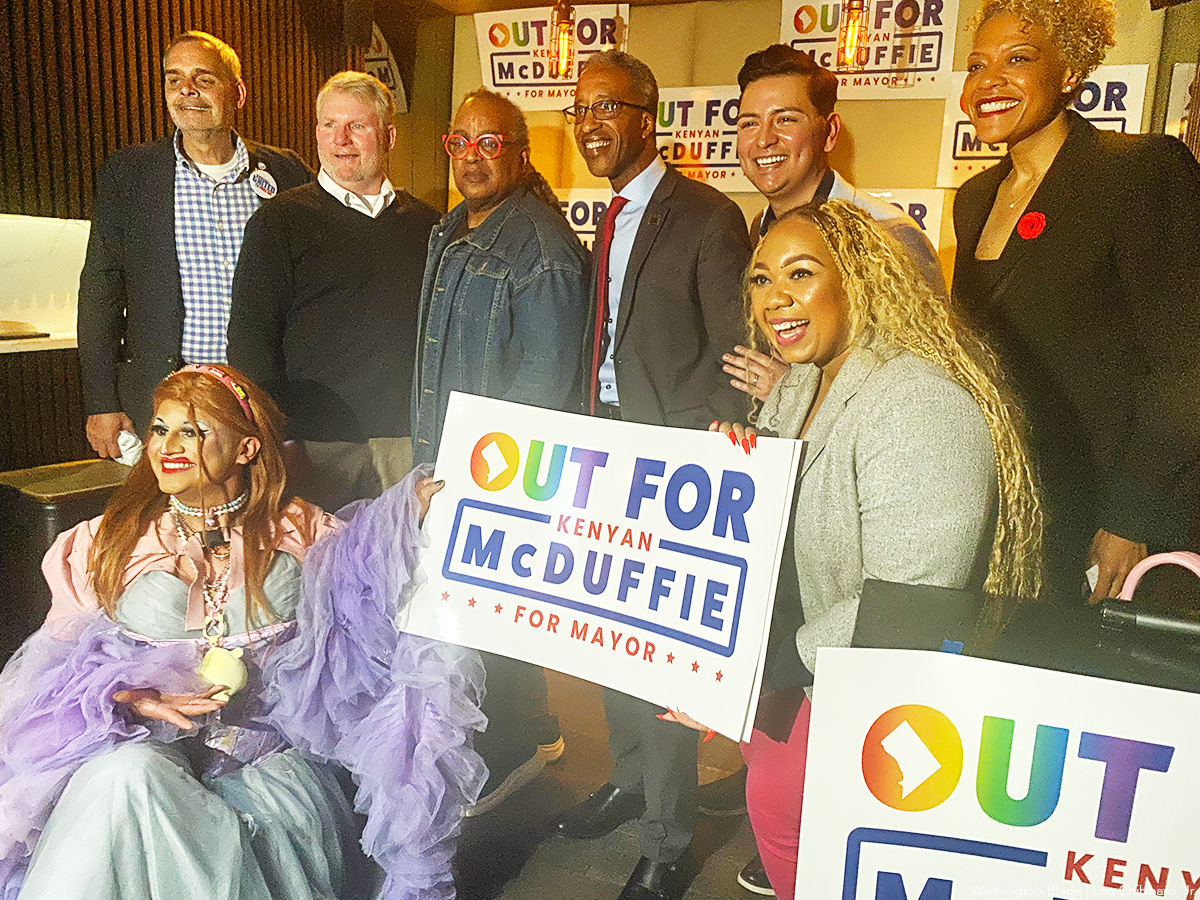
More than 100 people filled the upstairs room of the D.C. gay bar Number 9 on Thursday night, March 26, to listen to D.C. mayoral candidate Kenyan McDuffie at an event promoted as an “Out for McDuffie” meet and greet session.
Several local LGBTQ activists who attended the event said they support McDuffie, a former D.C. Council member, in his run for mayor while others said they had not yet decided whom to vote for in the June 16 D.C. Democratic primary election.
As of March 27, eight other Democrats were competing against McDuffy in the June 16 primary, including D.C. Council member Janeese Lewis George (D-Ward 4), considered McDuffie’s lead opponent. Lewis George also has a record of strong support on LGBTQ issues.
Most political observers consider McDuffie and Lewis George the two lead candidates in the race, with the others having far less name recognition.
The two lead organizers of the Out for McDuffie event were LGBTQ rights advocates Courtney Snowden, a former D.C. deputy mayor in the administration of Mayor Muriel Bowser, and Cesar Toledo, a local LGBTQ youth housing services advocate.
“I’m a candidate for mayor of Washington, D.C. and I’m running for mayor because I love this city,” McDuffie told the gathering after being introduced by Snowden. “And now more than ever we need leadership to take us to the future,” he said, adding that he and his administration would “stand up and fight” against President Donald Trump’s efforts to intervene in local D.C. affairs.
“Our strength is in the 700,000 beautifully diverse residents of Washington, D.C.” he told the gathering. “And as Courtney said, I didn’t just show up and run for mayor and then start saying that I’m going to be an ally for the queer community, for the LGBTQ+ community,” he said, “I’ve lived my entire professional life fighting for justice and fighting for fairness.”
Following his speech, McDuffie told the Washington Blade, “We’re going to fight to protect our LGBTQ+ community every single day. That’s what I’ve spent my career doing, making sure we have a beautifully diverse and inclusive city.”
He remained at Number 9, located at 1435 P St., N.W., for nearly an hour after he spoke, chatting with attendees.
District of Columbia
‘No Kings’ protests set for D.C.
Anti-Trump demonstrations to take place across country on Saturday

As President Donald Trump and his administration escalate rhetoric targeting transgender youth and student athletes, push efforts to restrict voting access for millions of Americans, and pursue foreign policy decisions that critics say bypass congressional authority, organizers across the country are once again mobilizing in protest.
For many LGBTQ advocates, the moment feels especially urgent.
In recent months, activists have pointed to a surge in anti-trans legislation, attacks on gender-affirming care, and efforts to roll back nondiscrimination protections as direct threats to the safety and visibility of queer and trans communities. Organizers say the demonstrations are not just about policy, but about defending the right of LGBTQ people — particularly trans youth and people of color — to live openly and safely.
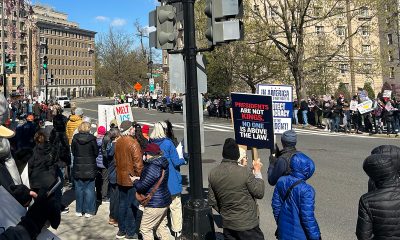
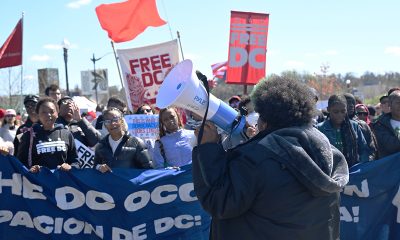
Thousands of “No Kings” protests are planned nationwide, with multiple demonstrations set to take place in D.C.
One of the primary events, “No Kings Washington,” will be held in Anacostia, an overwhelmingly Black area of D.C. that is often at the center of conversations around racial justice, policing, and access to resources in the nation’s capital.
The protest in Anacostia is focused on what organizers describe as the “power behind the throne,” specifically Stephen Miller, the White House Deputy Chief of Staff for Policy and Homeland Security Advisor. Miller has been closely associated with the administration’s “zero tolerance” immigration policy, including the family separation practice that resulted in thousands of children being separated from their parents at the Southern border.
Activists have also linked immigration enforcement policies to broader concerns about LGBTQ migrants, including queer asylum seekers who often face heightened risks of violence and discrimination both in their home countries and within detention systems.
Anacostia protest details:
Participants are asked to gather starting at 1:30 p.m. on the southeast side of the Frederick Douglass Bridge. The closest Metro station is Anacostia on the Green Line, about an 8-minute walk from the starting point. Organizers strongly encourage attendees to use public transportation, as street parking is limited.
The march will proceed past Fort McNair and conclude near the Waterfront Metro station.
D.C. icon and LGBTQ activist Rayceen Pendarvis is set to speak at the protest around 2 p.m.
Kalorama protest details:
A separate protest will take place earlier in the day in Kalorama, a neighborhood long associated with political power and home to presidents, cabinet officials, and foreign ambassadors. Demonstrators are expected to gather at 10 a.m., with a march running until approximately noon near the intersection of Connecticut Avenue and Kalorama Road.
Arlington/National Mall protest details:
Another group is expected to assemble at Memorial Circle near Arlington National Cemetery at 10 a.m. before crossing the Memorial Bridge into D.C., passing the Lincoln Memorial and continuing on to the Washington Monument. Organizers say the march is intended to defend “American democracy, the rule of law, and a healthy planet.”
Unlike last June — when organizers discouraged large-scale demonstrations in D.C. due Trump’s military/birthday parade — activists are now explicitly calling on people to show up in the nation’s capital and surrounding areas.
The protests also coincide with Transgender Day of Visibility weekend, which includes additional gatherings and celebrations on the National Mall. At the same time, peak bloom for the National Cherry Blossom Festival is expected to draw large crowds to the city. With multiple major events happening simultaneously, officials and organizers anticipate significant congestion, increased traffic, and crowded public transit throughout the weekend.
Organizers are urging participants to plan ahead and come prepared.
“Bring your signs, noisemakers, music, and creative ideas, and gather in joyful, nonviolent protest,” they said. “Children are very welcome.”
For more information, visit nokings.org.

The cost of speaking one’s mind

Senegalese president signs bill that further criminalizes homosexuality

Md. lawmakers reaffirm legislative priorities

Supreme Court rules against Colo. law banning conversion therapy for minors

Thousands attend ‘No Kings’ protests in D.C.

Celebrate cherry blossoms the drag way

Lorato ke Lorato: marriage equality, democracy, and the unfinished work of justice in Botswana

Japanese Supreme Court to consider marriage equality

The outrage economy is not the LGBTQ community

Anti-trans visa ruling echoes Nazi regime destroying trans documents
-

 Out & About4 days ago
Celebrate cherry blossoms the drag way
-
Botswana4 days ago
Lorato ke Lorato: marriage equality, democracy, and the unfinished work of justice in Botswana
-
Japan4 days ago
Japanese Supreme Court to consider marriage equality
-
Opinions4 days ago
The outrage economy is not the LGBTQ community