Celebrity News
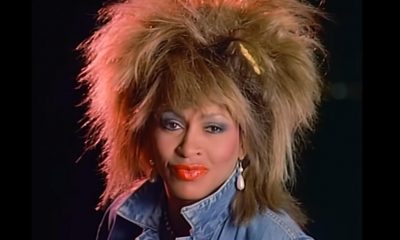
There will only ever be one Tina Turner
Legendary singer performed at first-ever Gay Games in 1982
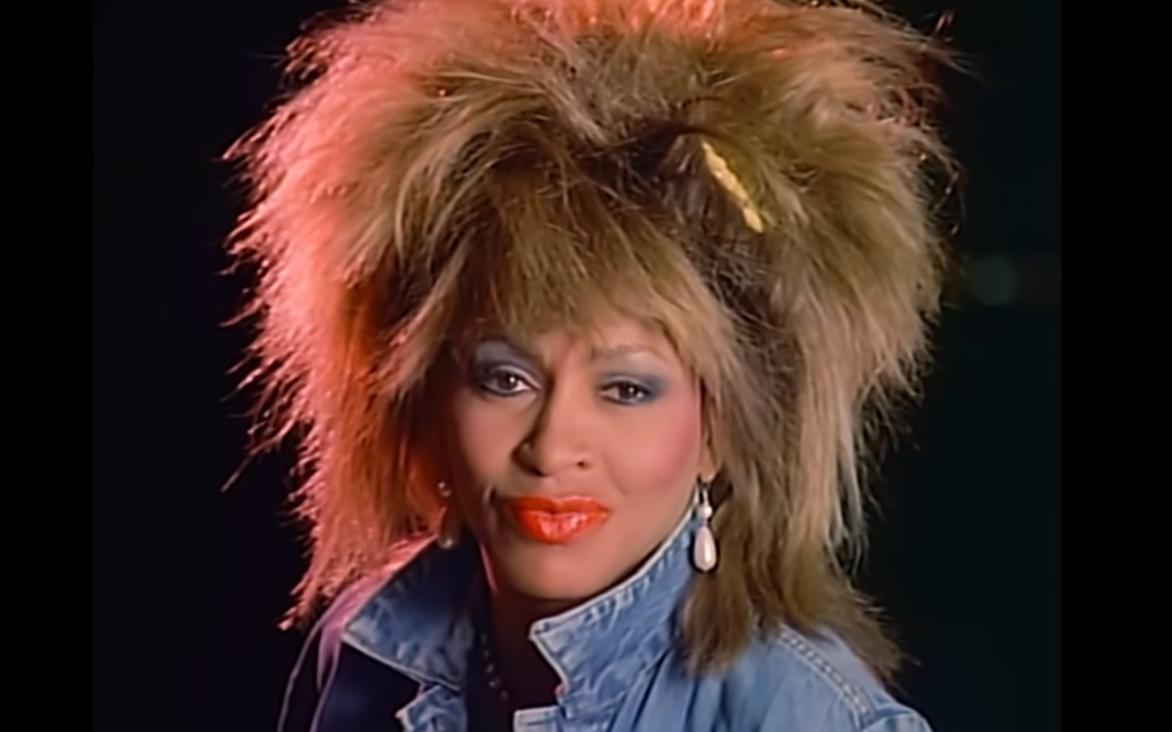
Legendary singer Tina Turner, dubbed the ‘Queen of Rock’ n Roll,’ has died at the age of 83 at her home in Switzerland after a long illness, her publicist Bernard Doherty told the PA news agency. A statement read: “With her, the world loses a music legend and a role model.”
Today, upon her passing, everyone around the world is declaring Tina Turner “an icon.”
It doesn’t fit. There are icons, an atmospheric leap, all of Heaven, and then, and only then, sitting above it all … is Tina Turner.
Simply, The Best.
For the non-conforming male personas amongst us, and for the female personas among us, she was our phoenix rising from the ashes of toxic masculinity, over coming it, and becoming the epitome of the queen, the warrior, the triumphant. She was the diva of rock, not just as in “Rock and Roll”, which was true, but as in “rocking your world.” When she borrowed Sir Elton’s “I’m Still Standing”, we knew she meant it.
In case you missed her story told many times, written about and immortalized on film, she was born Anna Mae Bullock. An up-and-coming musician named Ike Turner domineered her into his act and gave her the name “Tina Turner.” In classic “star is born” form, Tina Turner overcame her mentor in talent and popularity, and he married her.
Her voice was not one of sweetness and ice cream sodas. She was the real deal. Right from the start, she sang from the edge. She was not likely to be mistaken for Doris Day or Petula Clark, no, Tina Turner had grit, strength and even a tone of rage.
While other “iconic” singers debuted in film as sweet innocents, Tina’s launch was as the Acid Queen in Tommy. She played an erratic prostitute who advocated prophetic LSD in an effort to cure the title character.
With her humanness, her fight, and her willingness to be authentic, she spoke to, and for, many in the LGBTQ spectrum.
As we enter an era where identities are valued and under siege, Tina Turner was a pioneer. While she was a cisgender woman of color, and none of those descriptions were ever challenged, she famously stood to fight for something that was … her name. When, during their contentious divorce, and Ike sought to deprive her of the identity she had built for herself, she fought back and she fought back hard.
She gave up everything to keep what she treasured. She famously said, “Except my name. I’ll give up all that other stuff, but only if I get to keep my name. I’ve worked too hard for it, your Honor.”
For our transgender and drag brothers and sisters, hear her. She blazed a trail for the chosen identity, and who could deny that “Tina Turner” was not the real her?
The outpouring of love and respect from the world’s LGBTQ population is deserved. She has been a longtime supporter and adored queen diva of the gay and LGBTQ community forever. She pioneered when others wouldn’t, by performing at the opening ceremonies of the first ever Gay Games in San Francisco in 1982. It was a watershed moment in sports for LGBTQ athletes and allies. She has been imitated by drag queens for decades on platforms all across the world in the best “imitation is the highest form of flattery” way, beyond the point of homage and in some cases, to the point of worship.
She loved us back. Tina frequently expressed her gratitude and love for her gay fans in interviews and concerts. She did not capitalize on her own sexuality but acknowledged her bisexuality and her relationships with women. While being open about her sexuality, she did not consider it a defining factor of her identity or her music.
Only Tina Turner defined Tina Turner.
She meant something to all of us. Grief and wonder is pouring out from everyone from Diana Ross to NASA.
NASA, not an organization to normally recognize celebrities, but an absolute authority on things Heavenly, tweeted, “Simply the best. Music legend Tina Turner sparkled across the stage and into millions of hearts as the Queen of Rock ‘n’ Roll. Her legacy will forever live among the stars.”
Mick Jagger said, “She was inspiring, warm, funny and generous. She helped me so much when I was young and I will never forget her.”
“Rest in peace to one of my favorite artists of all time, the legendary queen of rock n’ roll Tina Turner,” stated Magic Johnson.
Speaking for many under and over the rainbow, George Takei stated, “She was our River Deep and our Mountain High, the Private Dancer in our hearts. She showed us that love really does has everything to do with it, and that we really did need another hero. And she was it.”
It was not just that Tina Turner was a hero. It was that she was a survivor, trailblazer and hero to so many. From women of color who needed to see their strength demonstrated, to people in abusive relationships who needed to see their possibilities illuminated, to beaten gay boys who needed to see the power in standing and fighting, she gave hope to them all.
She showed us all how to embody our authentic selves and capture our creativity, our innovation and our truth. She said, “Sometimes you have to let everything go — purge yourself. If you are unhappy with anything — whatever is bringing you down — get rid of it. Because you will find that when you are free, your true creativity, your true self comes out.”
There is a line from “We Don’t Need Another Hero”: “So what do we do with our lives? We leave only a mark. Will our story shine like a light? Or end in the dark? Give it all or nothing.”
She gave us her all, and the mark she left?
Her story does not just shine like a light, it seared every person, every walk of life, she touched. She lived as any true hero would and has gone out in a fierce blaze of glory.
********************************************************************
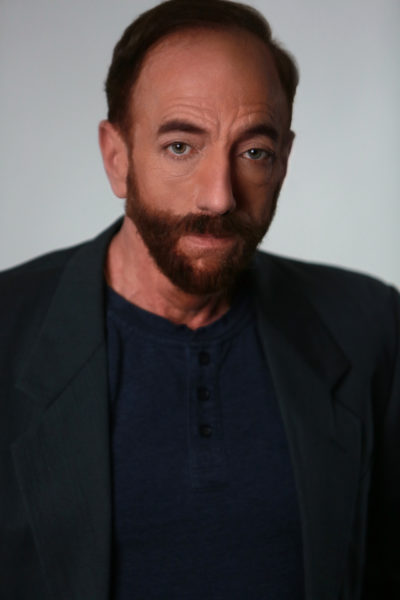
Rob Watson is the host of the popular Hollywood-based radio/podcast show RATED LGBT RADIO.
He is an established LGBTQ columnist and blogger having written for many top online publications including The Los Angeles Blade, The Washington Blade, Parents Magazine, the Huffington Post, LGBTQ Nation, Gay Star News, the New Civil Rights Movement, and more.
He served as Executive Editor for The Good Man Project, has appeared on MSNBC and been quoted in Business Week and Forbes Magazine.
He is CEO of Watson Writes, a marketing communications agency, and can be reached at [email protected] .




Celebrity News
Fashion icon Bob Mackie dead at 87
Designing legend to all the divas, gone but not forgotten
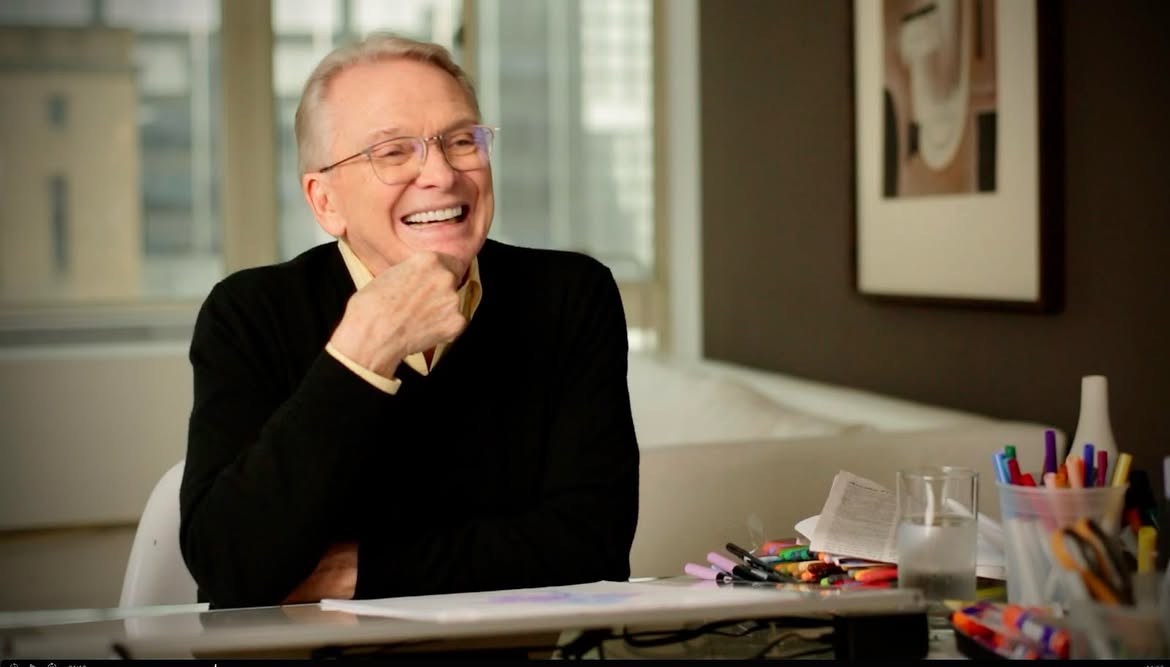
To those still reeling from the loss of Dolly Parton and Tim Curry, we have another queer icon to add to the In Memoriam of 2026: Bob Mackie. A designer known for being extra, before that was even a thing, has left us with a legacy of looks and an indelible mark on fashion.
The news broke on his Instagram account Monday, Sept. 14, with the message:
“It is with a heavy heart that we share the news that Mr. Bob Mackie passed away today. He lived his 87 years to the fullest, fulfilling his dream of being a fashion and costume designer, which is all he ever wanted to do. His genius and extraordinary designs will live on forever, continuing to bring beauty into this world.” According to People magazine, he passed away in Palm Springs, Calif., due to pneumonia.
At 87, Mackie was the definitive designer for divas. Mackie has literally dressed them all, including Diana Ross, Whitney Houston, Barbra Streisand, Dolly Parton, Tina Turner, Bette Midler, Bernadette Peters, and even RuPaul. He’s dressed film and television icons like Raquel Welch, Lynda Carter, Goldie Hawn, and Jennifer Lopez. It’s not just female divas; he’s also done many of Elton John’s famous costumes as well as David Bowie’s.
His first major mark was drawing the first design of Marilyn Monroe’s famous “Happy Birthday, Mr. President” dress. Next, he was an assistant to costume designer Ray Aghayan on “The Judy Garland Show.” The two would carry on a professional and romantic partnership for 50 years until Aghayan’s passing in 2011.
Mackie then went on to do all of the costumes for “The Carol Burnett Show,” creating an estimated 17,000 costumes for her show’s 11-year run. This gave him much critical acclaim and notoriety, making him a permanent fixture in the variety show market.
He became a frequent collaborator of Cher, having made her famous midriff-revealing Oscar gown, her “If I Could Turn Back Time” costume, and being her designer for her various television shows, including “The Sonny and Cher Show.” He even designed costumes for her Farewell Tour. The two are synonymous with him having lent his artistic sensibilities to give her a distinct look. Cher even said in 2024, “He helped me create a different me.”
Mackie has left his mark on fashion with a distinct style of glamorous, over-the-top looks. He received the monikers the “Sultan of Sequins,” the “Rajah of Rhinestones,” and the “Guru of Glitter” for challenging the line between costume and fashion with lots of fringe, flash, and over-the-top eye-catching elements. He’s managed to retain a presence not just in entertainment but in the fashion industry for decades. Most recently, one of his outfits was a major plot point for the final season of “Hacks.”
Mackie has received his share of awards and acknowledgments. In addition to dressing many people for the Oscars, he received three nominations, including dressing Diana Ross for “Lady Sings the Blues.” He won a Tony Award for “The Cher Show.” He won nine Emmy Awards and received 30 nominations for his prolific television work.
Luckily, Mackie’s life was celebrated before his passing, receiving various Lifetime achievement awards including the Geoffrey Beene CFDA Lifetime Achievement Award, being honored by the Television Hall of Fame, and receiving “RuPaul’s Drag Race”‘s Giving Us Life-time Achievement Award. He was the first guest judge on the popular series.
It’s clear that not only was Mackie talented, he was magical. He gave a bit of stardust to countless celebrities, luminaries, and public figures with looks that not only defied expectations but managed to be truly spectacular. He’s part of the glitz we think of when we think of Hollywood, and while often elaborate costumes, the shrewd fashion sense and elegance cannot be denied. Mackie will be missed, but his work lives on in the countless pieces still in circulation and forever captured on film and in media.
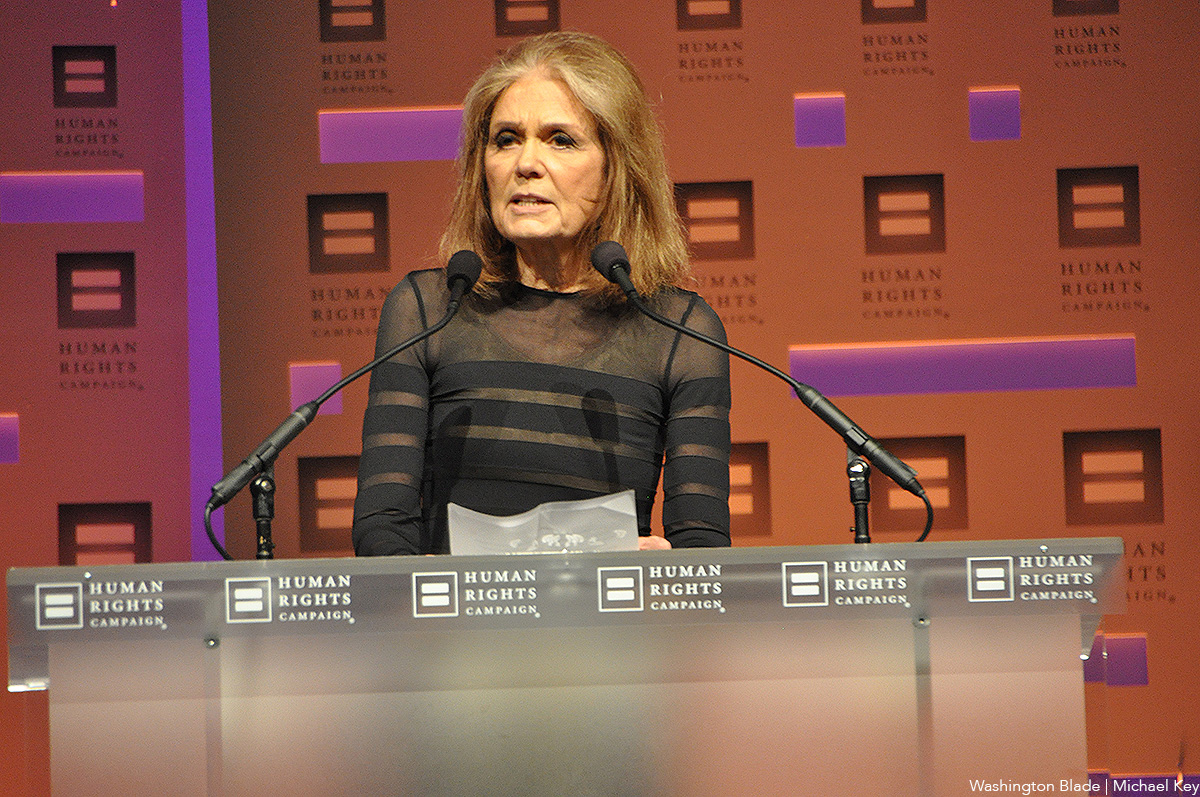
Gloria Steinem, writer, activist, and a leading voice of the feminist movement in the 1970s, died on Wednesday in Manhattan. Her death was announced on Instagram by her official foundation, Gloria’s Foundation, which shared that Steinem “passed away peacefully at her home, surrounded by some of the many who loved her.” She was 92.
A leading figure and spokesperson for the second-wave feminist movement, running from the 1960s through the ’80s — the earlier women’s rights suffrage movement being considered the first — Gloria Steinem campaigned for workplace equality, equality in the home and reproductive freedom, seeing those struggles as inseparable from the wider causes of social and racial equality.
She also championed LGBTQ rights, supporting lesbian visibility within the larger women’s liberation movement, and standing in opposition to the idea that lesbians posed a “lavender menace” to the cause of feminism.
In her vision of the future, marriage equality was a given: “Lesbians or homosexuals will no longer be denied legally binding marriages, complete with mutual-support agreements and inheritance rights.”
GLAAD President Sarah Kate Ellis said in a statement following Steinem’s death: “Gloria Steinem was a trailblazing titan of civil rights whose vision for liberation bridged the movements for gender equality, bodily autonomy, and LGBTQ rights. She recognized that feminist progress is incomplete without full inclusion and stood as an ally to transgender people’s fight for equality. Gloria rejected rigid binaries, choosing instead to build bridges of empathy and coalition across all marginalized identities. Gloria’s life was a masterclass in coalition-building, courage, and unconditional empathy.”
Among her many trailblazing milestones, Steinem was widely known for co-founding the National Women’s Political Caucus in 1971 alongside foundational feminist figures Bella Abzug, Shirley Chisholm, Betty Friedan, Fannie Lou Hamer, LaDonna Harris, Mildred Jeffrey, and Jill Ruckelshaus.
The mandate: get women into political office and positions of power — “women who are committed to the causes of other women — not women who are going to just imitate the male politics as it has been practiced all these years complete with elitism, racism and prejudice against women,” she said, “but women who really care about their sisters and will work for social reform.”
“This is no simple reform. It really is a revolution.”
Liz Abzug, daughter of Bella Abzug, remembers Steinem as “a lifelong activist and a humanist with lots of love to give,” as well as “a very, very close and dear friend of my mother’s,” as the two “worked side by side to change the American landscape for women.”
“It’s hard for me and all of her other supporters and admirers to imagine a world without Gloria leading the charge and fighting for women’s rights and full gender equality,” Abzug shared.
Indeed, there was much about that American landscape in need of change. Steinem came up during a time when discrimination against women was the legal and societal norm.
A married woman, for instance, often required her husband’s signature to obtain a credit card, a form of gender discrimination remedied in 1974 with the Equal Credit Opportunity Act. Women were often unable to get jobs. Life turned Steinem down, saying “We don’t want a pretty girl, we want a writer. Get out of here.” If women did land a job, in 1973, they would have likely made 56.6 cents to every dollar that men earned.
The law’s failure to support women’s autonomy was especially visible on the matter of reproductive rights.
For many women in America, legal abortion remained unavailable until 1973, when Roe v. Wade established a constitutional right to abortion nationwide. Steinem spent years speaking out for women’s safety, and promoted the idea that “decision-making power over our own physical selves” was intertwined with equal regard for women as citizens.
“The vast majority of women support safe and legal abortion. My response is if those legislators were half women, this wouldn’t happen,” she said in a 2022 interview with Katie Couric. “If we actually had a democracy, if those legislators looked like the country from a gender, racial, and class perspective, this probably would not be happening…”
Gloria Marie Steinem was born on March 25, 1934, in Toledo, Ohio, the daughter of Leo and Ruth (Nuneviller) Steinem. Her father was an antiques salesman; her mother had worked for a newspaper before she got married, but suffered what was called at the time a “nervous breakdown” and spent time in an institution. Following a divorce, her mother was left largely in the care of 11-year-old Gloria Steinem in a house that has been described as infested by vermin.
“I didn’t go to school a full year until I was 11 or 12, so I lived in books. I really was an observer of life,” Steinem said in a 2011 interview.
After moving to D.C. to live with her older sister, Susanne, Steinem graduated from Western High School in 1952. She followed Susanne to Smith College where she studied government and wrote for the student newspaper, graduating in 1956.
Upon moving to New York in 1960, she worked for Help! magazine and wrote freelance for publications that included Life, Esquire, and Glamour. According to Smith College Libraries, she co-founded New York magazine in 1968 and served as political columnist until 1972. In the 1960s and ’70s, Steinem was active in causes that included United Farmworkers, Vietnam War Tax Protest, and Committee for the Legal Defense of Angela Davis. She also participated in the political campaigns of Adlai Stevenson, Robert Kennedy, Shirley Chisholm, and others.
Steinem is said to have found her way to the Women’s Movement in 1969, following an abortion “speak-out” meeting of the Redstockings. She was inspired to begin speaking to audiences across the country, alongside activist Dorothy Pitman Hughes, and later Florynce Kennedy and Margaret Sloan.
Among Steinem’s most enduring legacies, and still in publication today, is Ms. magazine, which she co-founded. Widely considered the first national American feminist magazine (and owned, operated, and written by women!), it first appeared as a preview insert in New York Magazine in December 1971 with a tagline, “The New Magazine for Women.” Ms. earned status as a full-on publication in July 1972 with a cover image depicting a modern pregnant Hindu goddess Kali holding a clock, skillet, typewriter, rake, mirror, telephone, steering wheel, and an iron.
Ms. is credited with raising cultural awareness on policy issues, like the Equal Rights Amendment, taking on taboo topics and putting women’s issues front and center.
Steinem’s long list of published work includes the 1983 bestselling book Outrageous Acts and Everyday Rebellions, a collection of her Ms. articles and other pieces. The book includes the feminist’s essay on her undercover exposé of the Playboy Club, for which she donned bunny ears, collar, and bow to covertly report on working conditions for women.
In 1986, she published “Marilyn: Norma Jeane,” which explored the life of Marilyn Monroe and the idea of women as vulnerable and at the disposal of society — men in particular.
Steinem also wrote “Revolution from Within” (1992); “Moving Beyond Words” (1994); and “Doing Sixty & Seventy” (2006). She was awarded the Presidential Medal of Freedom in 2013 by President Barack Obama.
Steinem’s relationships over the years included Ted Sorensen, counselor to President John F. Kennedy; Stanley Pottinger, a Justice Department official; and publisher and real-estate businessman Mort Zuckerman. In 2000, she married South African businessman David Bale, who died in 2003.
Steinem was predeceased by her mother and her sister, Susanne Steinem Patch, who died in 2007. On multiple occasions, she spoke of a community that extended beyond birth family — people whom she chose, and who chose her.
“[Feminism is] about friends and sisters and community,” Steinem said in an interview with bell hooks. “The good part and the great part is that it’s about chosen family. We have each other’s backs and that is so precious.
In announcing Steinem’s passing, her foundation offered this reflection: “Gloria’s greatest gift was her ability to listen to others, to make others feel seen and heard. Her words, actions, and example gave people permission to be their truest selves. Gloria lived true to her independent spirit, always with curiosity and a great sense of humor.
“She spent her recent years doing the two things she loved most: being in community with others and writing … Gloria loved the tradition of lighting signal fires on hills to light the way to the other side of the mountain.”
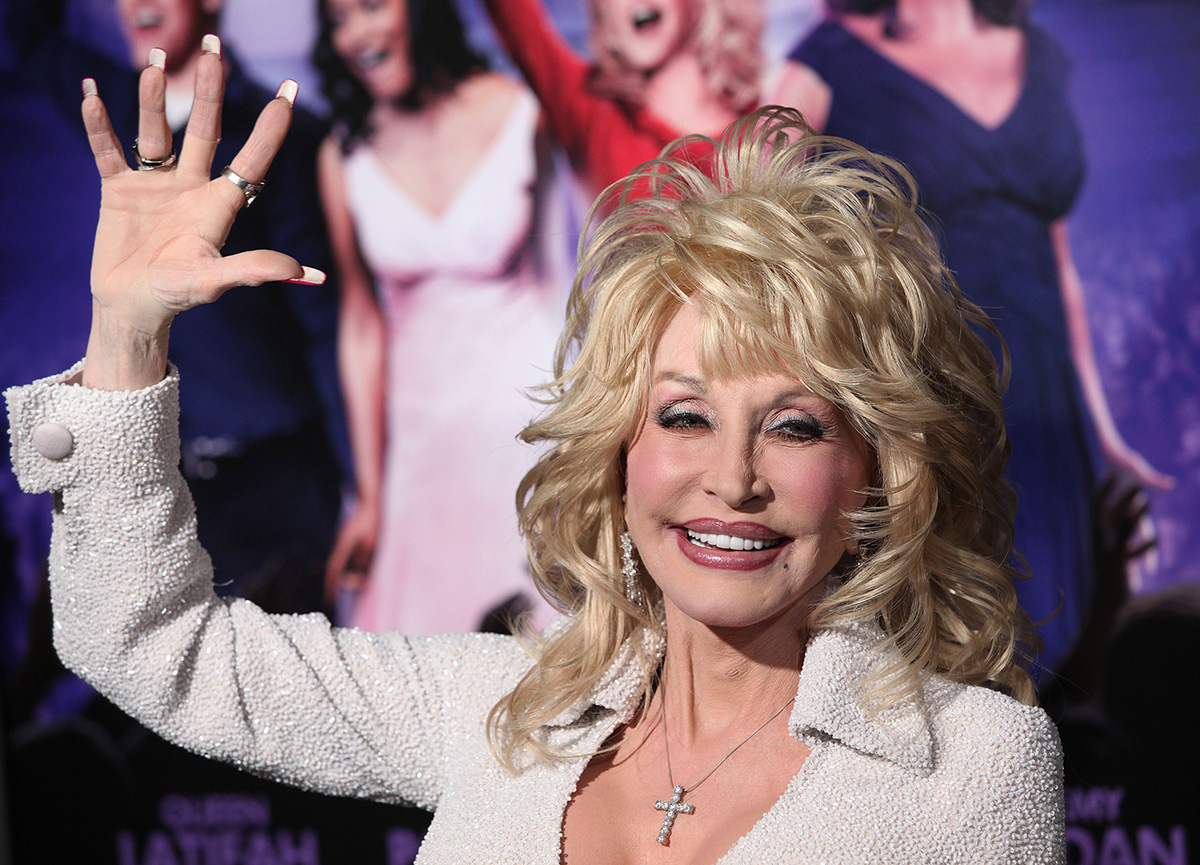
Dolly Parton died on Tuesday at a Nashville hospital. She was 80.
Her publicist, Marcel Pariseau, said Parton passed away at the Vanderbilt-Ingram Cancer Center “after bravely facing a brief battle with cancer.” Parton’s nephew, Bryan Seaver, announced his aunt’s death in a video posted to her Instagram page.
Born in Sevier County, Tenn., on Jan. 19, 1946, Parton was one of 12 children who grew up in poverty.
She moved to Nashville in 1964 and later became known as the “Queen of Country Music” with hits that include “Jolene” and “I Will Always Love You.” Parton also starred in “9 to 5” and “Steel Magnolias.”
Parton in 1995 created the Imagination Library, which sends free books to children. Parton, among other things, donated $1 million to Vanderbilt University Medical Center that helped fund research that paved the way for Moderna’s COVID-19 vaccine, and gave another $1 million for Hurricane Helene relief efforts in Tennessee and North Carolina.
Parton was also a long-time LGBTQ ally.
She spoke in support of marriage equality and wrote “Travelin’ Thru,” a song that was part of the soundtrack for “Transamerica,” a 2005 film that documented a transgender woman’s trip across the country with her son. Parton in 2011 also appeared at the GLAAD Media Awards.
“Parton’s warm spirit, kindheartedness, and joie de vivre deeply resonated with the LGBTQ community, cementing her as a global queer icon whose art always held space for outsiders, no matter the risk,” said GLAAD on Tuesday. “Parton’s entire career was built on love and respect for all, and her unwavering allyship is a legacy that will last forever.”
Human Rights Campaign President Kelley Robinson in a statement said HRC is “heartbroken by Dolly’s passing.”
“She showed the world what it looks like to lead with love and stood with our community long before others in entertainment, using her voice and platform to create a world where LGBTQ+ people feel seen and celebrated,” she said. “Her music and her spirit touched millions; and her generosity, especially toward children, will be felt for generations. We will miss her dearly, and we will carry forward the light she shared with all of us.”
Lambda Legal CEO Kevin Jennings also mourned Parton.
“Long before it was easy or popular, Dolly Parton told our community that we belonged, and she meant it. She championed children’s literacy through her Imagination Library, lent her voice and resources to the fight against HIV and AIDS, and stood up, time and again, for the community she embraced as her own, all with the humor, warmth, and grace that made the whole world fall for her,” said Jennings.
The Congressional Equality Caucus and U.S. Rep. Sarah McBride (D-Del.), who is the first openly trans person elected to Congress, are among those who also celebrated Parton’s life.

White House press pool pushes back after Trump bars three outlets

PHOTOS: Shenandoah Valley Pride

Long-time DignityUSA executive director announces retirement

PHOTOS: Walk and 5K to End HIV

PHOTOS: Wanda Alston Foundation Fall Reception

Gun reform is an LGBTQ rights issue

All the queer things to watch this fall

Parties, dinners, concerts and more on tap for fall nightlife

Jeremy Moss looks to bring LGBTQ advocacy from Lansing to Capitol Hill