Arts & Entertainment
Fall means Artscape, John Waters, The Wiz, and more in Baltimore
Major concerts, opening of M&T Bank Exchange among highlights
Can Baltimore walk and chew gum at the same time?
The question came up this summer when leaders of several local arts organizations voiced concerns that the fall arts calendar is so full of events that they feared the city wouldn’t be able to handle them all.
The biggest change is that Baltimore’s popular three-day Artscape festival, one of the largest free arts gatherings in the country, is shifting from its usual mid-July date to mid-September for the first time. In the past, it has drawn upwards of 350,000 people over three days.
The dates selected for Artscape this year, Sept. 22-24, coincide with the Baltimore Symphony Orchestra’s Sept. 23 fall gala at the Meyerhoff Symphony Hall, where new music director Jonathon Heyward will begin his tenure, and four comedy shows by Nate Bargatze at Lyric Baltimore – all within the relatively compact Mount Royal Cultural District.
How will the city control all the traffic, the doubters asked. Where will everyone park? And what about the Ravens-Colts football game at Camden Yards the same weekend?
Baltimore Mayor Brandon Scott promised that the city can put on more than one big event at a time.
“We are a major city,” he said last month. “Major cities are going to have multiple events at the same time…Walk and chew gum, as my grandmother would say.”
The concerns about Artscape weekend are a sign of how much Baltimore has rebounded from the lockdowns of the COVID-19 pandemic, which caused festivals and other public gatherings to be cancelled for public health reasons. This month’s event will be the first time Artscape has been held since 2019.
But it’s not just one weekend that has so much going on. Artscape is one of many big festivals, shows, and exhibits that are coming to Baltimore this fall, including the launch of a new national touring production of “The Wiz,” Billy Joel and Stevie Nicks appearing at the M&T Bank Stadium; and another packed lineup at the recently refurbished CFG Bank Arena, including Queen + Adam Lambert; the Jonas Brothers; Kiss and Pentatonix. Just about every weekend this fall has multiple big events scheduled, even without factoring in how the Orioles do in the playoffs.
Here are some of the highlights:
Artscape 2023: Artscape celebrates the visual arts, dance, fashion, music, the culinary arts and other creative endeavors. This year’s musical headliners will be: DJ Pee.Wee (the persona of Anderson .Paak) on Friday night; composer, producer, arranger and guitarist Nile Rodgers & Chic on Saturday afternoon; Angelo Moore of Fishbone performing with his band Dr. Madd Vibe on Saturday night; and the Baltimore Symphony Orchestra on Sunday afternoon.
The festival’s footprint has expanded from the Mount Royal cultural district to include part of the Station North Arts and Entertainment District farther north. A complete list of events is available at Artscape.org.
Fell’s Point Fun Festival: Two weeks after Artscape, from Oct. 6-8, the Fell’s Point Fun Festival will draw crowds to Baltimore’s waterfront (fellspointfest.com) This annual showcase for Baltimore’s art, crafts, food and music typically draws 50,000 visitors, while helping raise funds to support the programs and activities of the Preservation Society of Federal Hill and Fell’s Point, a non-profit that works to protect two of the city’s most historic neighborhoods.
Baltimore native and country music star Brittney Spencer will be the headliner Friday night. The eclectic lineup for the three-day event includes: Better Off Dead, a band that celebrates The Grateful Dead; ilyAIMY (i love you And I Miss You); Shelby Blondell; the Baltimore Symphony Orchestra’s OrchKids; Orquestra Nfuzion from Washington, D. C.; The Cover Up; Old Eastern; DJ Allure; Annapolis’s 8 Ohms Band, Rufus Roundtree & Da B’more Brass Factory; The Trinidad & Tobago Steel Drum Band; Baltimore All-Stars; DJ G-Money, and, in honor of Indigenous People’s Day on October 9, Mark Tayac and the Piscataway Nation Singers and Dancers, a group that educates audiences about Native American history and culture as part of their performances.
Billy Joel and Stevie Nicks concert: On Saturday, Oct. 7, Billy Joel and Stevie Nicks will perform at M&T Bank Stadium, 1101 Russell St., starting at 7 p.m. It will be one of the only times that the Camden Yards sport complex is used for a major concert this year, after Bruce Springsteen and The E Street Band cancelled a Sept. 9 performance at Oriole Park.
More performing arts events:
CFG Bank Arena, 201 West Baltimore St. (cfgbankarena.com): Concerts include: 50 Cent: The Final Lap Tour, September 19; Jonas Brothers: Five Albums. One Night. September 22; SZA – SOS Tour with special guest D4VD, September 28; Queen + Adam Lambert – The Rhapsody Tour, October 4 and 5; Carin Leon – Colmillo De Leche Tour, October 7; Disney on Ice presents Magic in the Stars, October 12-15; John Mayer – Solo, October 20; Lauren Daigle – The Kaleidoscope Tour, Oct 21; Katt Williams, October 27; Baltimore R&B Music Experience: Xscape, Bell Biv DeVoe, 112, October London, Silk, Next, October 28, and Romeo Santos – Formula Vol. 3 Tour, November 2.
Also, The 1975 Still…at their very best, November 8; Bronco – En Vivo y A Todo Color!, November 17; Ringling Bros. and Barnum & Bailey presents The Greatest Show On Earth, November 24 to 26; Kiss – The End of the Road Tour, November 29; Old Dominion – No Bad Vibes Tour, December 2; Pentatonix The Most Wonderful Tour of the Year, December 3; Travis Scott Utopia Tour Presents Circus Maximus, December 6; Billy Strings, December 8 and 9, and Andrea Bocelli, December 10.
Baltimore Symphony Orchestra: The Baltimore Symphony marks the arrival of Jonathon Heyward as its new music director with a gala celebration at Strathmore in North Bethesda on September 22; a gala celebration at the Joseph Meyerhoff Symphony Hall in Baltimore on September 23 and a free public concert at the Meyerhoff during Artscape on September 24. More information about the symphony’s fall schedule at the Meyerhoff, including speakers such as Sonia Sotomayor (September 27); David Sedaris (October 5); Fran Lebowitz (October 6) and Jane Fonda (October 12) is on its website at bsomusic.org.
Hippodrome Theatre, 12 S. Eutaw St., Baltimore.Broadway.com: The fall season starts with an all-new revival of The Wiz, a musical that debuted in Baltimore in 1974, with shows from September 23 to 30. Other shows include: Heilung, October 19; The Rocky Horror Picture Show 48th Anniversary Spectacular Tour with Patricia Quinn, the original Magenta, on October 21; Chris Tucker: The Legend Tour 2023, October 22; Funny Girl, October 24 to 29; the State Ballet Theatre of Ukraine Presents Snow White, November 4; ‘Twas the night before…by Cirque du Soleil, November 24 to December 3; Moulin Rouge! The Musical, December 5 to 17, and Nutcracker! Magical Christmas Ballet, December 18 and 19. A new performing and events venue next to the Hippodrome, called the M&T Bank Exchange, will have its grand opening on October 11.
Lyric Baltimore, 140 West Mount Royal Avenue, lyricbaltimore.com: Justin Willman: Magic for Humans in Person Tour, September 16; Wild Kratt Live 2.0 Activate Creature Power! Starring the Kratt Brothers, September 22; Nate Bargatze — The Be Funny Tour, September 23 and 24; Raphael Saadiq Revisits Tony! Toni! Tone! Just Me and You Tour, September 26; Trey Kennedy Grow Up Comedy Tour, September 28; Buddy Guy — Damn Right Farewell, September 29; Ms. Pat: Ya Girl Done Made It Tour, September 30; Casting Crowns: 20th Anniversary Tour, October 1; Anthony Jeselnik: Bones and All, October 5; Charm City Blues Festival, October 6; Blippi: The Wonderful World tour, Oct 7, and Stavros Halkias: The Fat Rascal Tour, October 12-14;
Also, Nick Offerman: Live! October 26; Steve Martin & Martin Short, October 28; Encanto: the Sing-Along Film Concert, October 29; Maverick City Music, November 2; The Fab Four: The Ultimate Tribute, November 3; Nikki Glaser: The Good Girl Tour, November 4; One Night of Queen, November 9; Shane Gillis Live, November 10; The Princess Bride, November 17; Chris D’Elia: Don’t Push Me, November 18; Brian Culbertson: The Trilogy Tour: November 19; Joe Bonamassa, November 25; A Drag Queen Christmas, November 26; Peppa Pig’s Sing-Along Party1, November 30; David Spade: Catch Me Inside, December 1; The Nutcracker, December 14; A Charlie Brown Christmas: Live On Stage, December 15, and Mark Normand: Ya Don’t Say Tour!, December 16.
Creative Alliance, 3134 Eastern Ave., (creativealliance.org): In the main gallery through September 30 is “God Couldn’t be Everywhere…That’s Why He Made Momma,” an exhibit by Salome Sykes and Lendl Tellington. In the Amalie Rothschild Gallery through October 21 “Taking Space,” an exhibit featuring work by Baltimore based Latino artists, including Tito Rosa; Christina Delgado; Jessy DeSantis; Jaz Erenberg and Edgar Reyes. Other events: Tianquiztli, a Latin American Artisan Market and Festival on September 16; the Alejandro Brittes Quartet, September 23; Walters Art Museum he Charm City Burlesque & Variety Festival September 29 to October 1; and Kavita Shah & The Cape Verdean Blues Project, October 4.
Baltimore Center Stage, 700 North Calvert St. (centerstage.org): In partnership with the Baltimore American Indian Center, the theater recently opened an Indigenous Art Gallery that is free and open during box office hours. Shows include: Lady Day at Emerson’s Bar and Grill, September 14 to October 8; Imprint: Jazz’s Timeless Legacy, September 30; Locally Grown Festival, October 21 to 22; The Rocky Horror Picture Show Interactive Movie Night, featuring Chocolate-Covered Rocky Horror in Partnership with Creative Alliance; October 27-28; Baltimore Butterfly Sessions, part of a civic dialogue series, November 10, and Cinderella (Enchanted Edition, co-produced with Artscentric), November 25 to December 23.
Robert C. Marshall Recreation Center, 1201 Pennsylvania Ave.: Amal Walks Across America, September 16, 4:30 p.m. Little Amal, an internationally celebrated 12-foot-tall puppet of a 10-year-old Syrian refugee girl, will arrive in Baltimore as part of a 6,000-mile journey across the United States.
Everyman Theatre, 315 West Fayette Street (everymantheatre.org): The current production, running through September 29, is A Doll’s House. It will be followed by The Chinese Lady, a Baltimore premiere, October 22 to November 19; and Dial M for Murder, December 3 to 31.
Arena Players, 801 McCulloh Street (arenaplayersinc.com): Celebration A Musical Revue, with shows September 15, 16, 17, 22, 23, 24 and 29 and October 1.
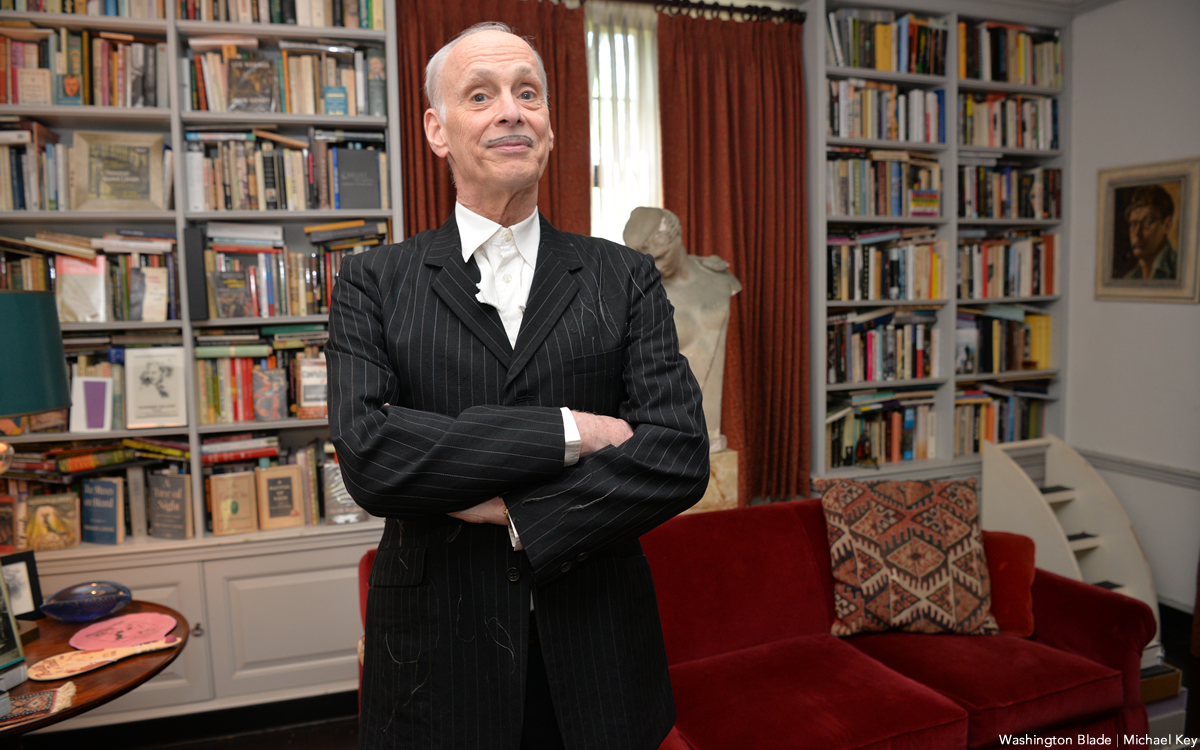
Baltimore Soundstage, 124 Market Place: Writer and filmmaker John Waters returns with: “A John Waters Christmas: Let’s Blow It Up,” on December 21. The complete fall lineup is at Baltimoresoundstage.com.
Visual arts events:
Baltimore Museum of Art, 10 Art Museum Drive, (artbma.org): “Making Her Mark: A History of Women Artists in Europe, 1400-1800,” opens October 1 and runs through January 7, 2024. This blockbuster exhibit will feature more than 200 paintings, sculptures, textiles, works on paper, pieces of furniture and decorative arts that show how women contributed to the visual arts of Europe from the 15th to 18th centuries. Other exhibits opening this fall include: “Tiona Nekkia McClodden: Play Me Home,” September 13, 2023, to May 12, 2024; “Art/Work: Women Printmakers of the WPA,” November 5, 2023, to June 30, 2024; “Eyewinkers, Tumbleturds and Candlebugs: The Art of Elizabeth Talford Scott,” November 12, 2023, to April 28, 2024, and “Raul Nieves: And imagine you are here,” November 19, 2023, to May 1, 2025. Current exhibits closing this fall include: “Recasting Colonialism: Michelle Erickson Ceramics,” and “The Matter of Bark Cloth,” which will end October 1, “Matsumi Kanemitsu: Figure and Fantasy,” which ends October 8, and “Wild Forms: Fauve Woodcuts,” which ends October 15.
American Visionary Art Museum, 800 Key Highway, (avam.org): The next “mega exhibit” at the American Visionary Art Museum is “If You Build It, They Will Come,” a look at visionary artists and their handcrafted environments, from October 7, 2023, to September 1, 2024. Featured artists include: Zebedee Armstrong; Gayleen Aiken; Ruby C. Williams; Leslie Payne; DeVon Smnitha nd Loring Cornish.
Walters Art Museum, 600 North Charles Street, (thewaltersorg.) Opening on December 3 and continuing until March 3, 2024, is “Ethiopia at the Crossroads,” celebrating the artistic traditions of Ethiopia from their origins to the present day. “New on the Bookshelf: Expanded Narratives,” a look at recent additions to the museum’s Rare Books and Manuscripts collection, runs through December 7, 2023.
The Peale, 225 Holliday Street, (thepealeorg.) Exhibits include “The Guardians of Baltimore,” a documentary and storytelling project that celebrates the unrecognized community work of Black female leaders from city neighborhoods, through October 1; “Dark Beauty,” featuring artist Daisy Brown’s portraits, stills and filmed interviews of Baltimore women with dark skin completions, through October 1, and “Soul of a Butterfly,” a look at Chicory, a poetry magazine published by the Enoch Pratt Free Library from 1966 to 1983, through October 8.
Maryland Center for History and Culture: 610 Park Avenue, (mdhistory.org.): “The Jim Henson Exhibition: Imagination Unlimited,” a multi-media tribute to the creator of the Muppets, continues through December 30.
Doors Open Baltimore, citywide, (doorsopenbaltimore.org): A popular annual program that allows participants to tour places that aren’t usually open to the public returns on October 7 and 8, with approximately 50 sites open this year.

Theater
Minimal version of ‘Streetcar Named Desire’ heading to Dupont Underground
Director Nick Westrate on this traveling take on Williams’s masterwork
‘A Streetcar Named Desire’
Produced by The Streetcar Project
April 20-May 4
Dupont Underground
19 Dupont Circle, N.W.
Tickets start at $85.
Dupontunderground.org
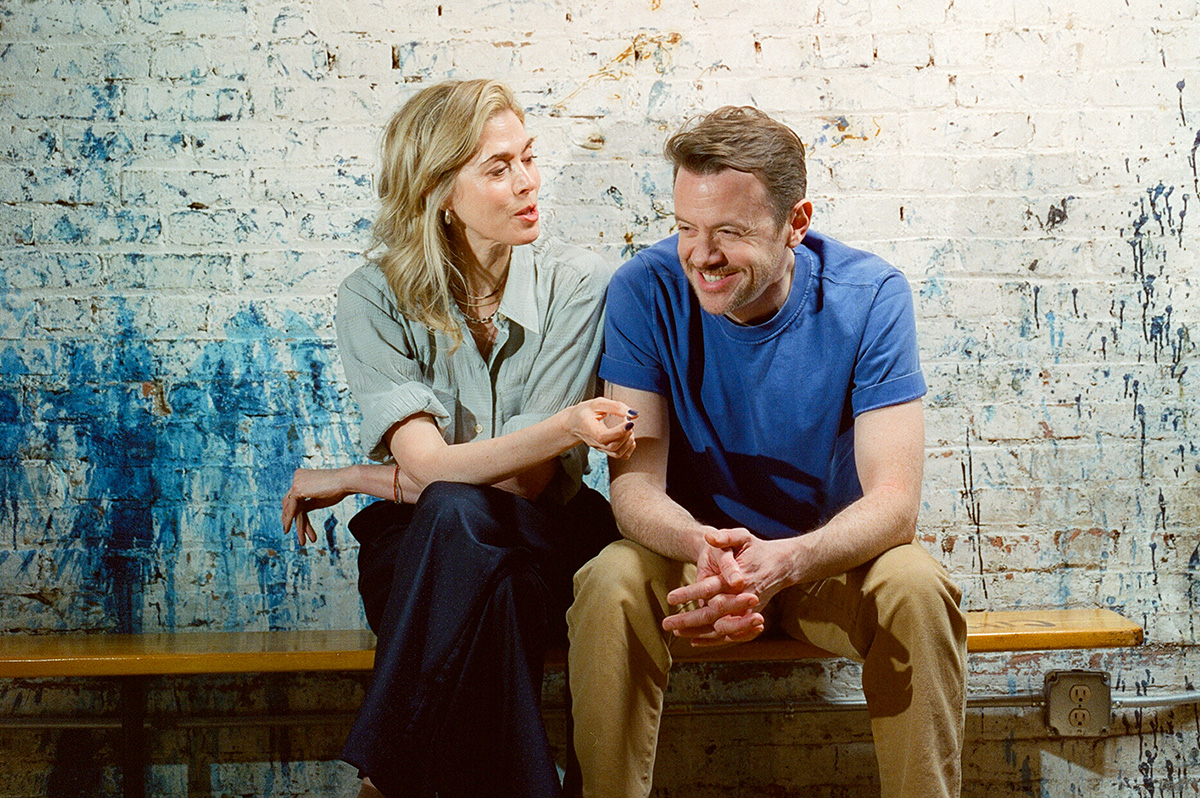
An aggressively minimal version of Tennessee Williams’s “A Streetcar Named Desire” is poised to run at Dupont Underground (April 20-May 4), the nonprofit cultural space located in a repurposed, abandoned 1949 streetcar station beneath Dupont Circle.
The Streetcar Project’s production performs in site-specific spaces. It’s almost entirely without design elements. There is no steamy, cramped Vieux Carré apartment. You won’t see Blanche’s battered trunk exploding with cheap finery, faded love letters, and demands for back property taxes, or the familiar costumes.
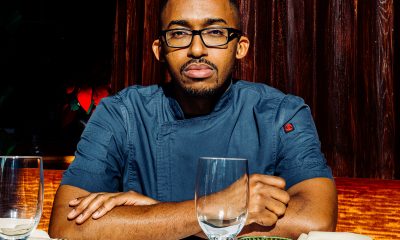
Co-created by Lucy Owen (who stars as Blanche DuBois) and out director Nick Westrate in 2023, this traveling spare take on Williams’s masterwork about a fragile woman on the margins in conflict with her brutish brother-in-law seems a reaction to necessity. It’s also an exploration of whether, like Shakespeare’s “Henry V,” it can subsist on language alone.
With little distractions (even Blanche’s cultivated southern belle accent has been daringly stripped away), the spotlight shines almost solely on text. “This play holds that,” says Westrate, 42. “I remind the actors that the while there is plenty of movement, language is really the only game in town.”
New York-based Westrate, who’s best known as an esteemed actor with New York and regional credits including Prior Walter in János Szász’s production of “Angels in America” at Arena Stage, describes “Streetcar” as “the most perfect play on earth” but not one he thinks of acting in (“I’m not right for Stanley Kowalski or Mitch”) though he agreed to direct.
“These days if you’re not a not a movie star or an established director, you’re not likely to do “Streetcar.” So, for us, we have to be able to do it with almost nothing, on the New York subway if necessary. And that’s kind of how we built it.”
Westrate first experienced Dupont Underground while attending a staged reading. He was so obsessed with the space as a prospective place to take the production, he found it hard to concentrate. He says, “With its long, curved track and tunnel, Dupont Underground is a terrifying, beautiful room that carries so much metaphorical weight, so much possibility for our production.”
WASHINGTON BLADE: Is finding the right space for this “Streetcar” part of the thrill?
NICK WESTRATE: Whenever I enter a weird room or pass by an abandoned CVS, I try to figure out how we might do the show there, especially places that are dilapidated, architecturally odd, or possibly haunted. And each space we use, lends something to the production. The Rachel Comey store in Soho was a very Blanche coded space. And an artist’s workshop on Venice Beach in California with its huge saws and metal hooks lent raw imagery. The scenes between Blanche and Stanley near the end were absolutely terrifying.
BLADE: More recently that same bare bones production has played in more traditional spaces like the Wheeler Opera House in Aspen and San Francisco’s A.C.T. Is it hard to now go to Dupont Underground?
WESTRATE: Each time we do this we have to crack open the play again because the staging is entirely new, but we’re used to performing in unusual spaces and Dupont Underground rather takes us back to form. As a former streetcar station, it’s the most appropriate space we’ve had yet.
The cast will literally act on streetcar tracks and go without dressing rooms but they’re game, and because they have history and authorship over the work, the sacrifice is more meaningful than if they were just some hired guns.
BLADE: Audiences have an expectation, especially with a work they’re likely to know. How do they react seeing such an unadorned take on Williams’s American classic?
WESTRATE: For the first 10 or 15 minutes, they’re unsure. Then, you can pretty much see the audience members’ brains click in and their imaginations turn on. It’s like they’re scratching an itch that they didn’t even know they had.
BLADE: Did you and Lucy foresee gaining this kind of momentum behind your vision?
WESTRATE: Absolutely not. Lucy had a philosophy that we’ll just walk through open doors. Early on, we were given spaces and artists filled the seats, and increasingly we’ve begun to rent some spaces and attract more regular theatergoers.
We basically sell tickets in order to pay a living wage to artists involved. There isn’t some big institution or commercial producer who’s getting a lot of money from this. Audiences of all types seem to respond to this mode of making theater.
BLADE: In presenting “Streetcar” intermittently, usually with the same cast over three years in wildly varying venues, have you learned more about a piece that you already loved?
WESTRATE: Mostly I’ve come to realize that Blanche is the smartest character I’ve ever read in a play. She’s like Hamlet – tormented by dreams and terrified of death. She’s skilled at wordplay and always ahead of everyone else in the room. Also like Hamlet, people think she’s insane and she uses that to her advantage.
Blanche is certainly the Everest of roles for actresses and watching Lucy sort of break it apart in a different way than you’ve ever seen, and knowing that I’ve helped to facilitate this performance has been one of the great joys of my career.
Friday, April 10
Center Aging Monthly Luncheon With Yoga will be at 12 p.m. at the DC Center for the LGBT Community. Email Mac at [email protected] if you require ASL interpreter assistance, have any dietary restrictions, or questions about this event.
Women in their Twenties and Thirties will meet at 8 p.m. on Zoom. This is a social discussion group for queer women in the Washington, D.C. area. For more details, visit Facebook.
Saturday, April 11
Go Gay DC will host “LGBTQ+ Community Brunch” at 11 a.m. at Freddie’s Beach Bar & Restaurant. This fun weekly event brings the DMV area LGBTQ+ community, including allies, together for delicious food and conversation. Attendance is free and more details are available on Eventbrite.
The DC Center for the LGBT Community will host a screening of “Love Letters” at 1:30 p.m. This movie is a tender, intimate look at love, parenthood, and the quiet fight to claim your place in your own family. For more details, visit the DC Center’s website.
Sunday, April 12
Spark Social will host “Tea Time! A Local DC Drag Comedy Show” at 3 p.m. This event features the hilarious TreHER and Tiara Missou Sidora. This dynamic duo will have guests cackling as they discuss the “Latest Tea” in DC. Have drama in your own life? TrevHER and Tiara are ready to provide advice and rate how hot your tea is. Hottest tea wins a piece of Spark merch. Tickets cost $13.26 and can be purchased on Eventbrite.
Just Kidding Comedy Collective will host “Best of DC at the Woke Mob Comedy Festival” at 5 p.m. at Pikio Taco. The Woke Mob Comedy Festival celebrates everything that makes this region the best and showcases the DMV’s funniest comedians, especially highlighting BIPOC, women, LGBTQ+ and gender-queer performers, plus a few “prodigal” comics who got their start here before heading national. Tickets cost $15.18 and can be purchased on Eventbrite.
Monday, April 13
Center Aging: Monday Coffee Klatch” will be at 10 a.m. on Zoom. This is a social hour for older LGBTQ adults. Guests are encouraged to bring a beverage of choice. For more information, contact Adam ([email protected]).
Genderqueer DC will be at 7 p.m. on Zoom. This is a support group for people who identify outside of the gender binary, whether you’re bigender, agender, genderfluid, or just know that you’re not 100% cis. For more details, visit www.genderqueerdc.org or Facebook.
Tuesday, April 14
Trans Discussion Group will be at 7 p.m. on Zoom. This event is intended to provide an emotionally and physically safe space for trans people and those who may be questioning their gender identity/expression to join together in community and learn from one another. For more details, email [email protected].
Coming Out Discussion Group will be at 7 p.m. on Zoom. This is a safe space to share experiences about coming out and discuss topics as it relates to doing so — by sharing struggles and victories the group allows those newly coming out and who have been out for a while to learn from others. For more details, visit the group’s Facebook.
Wednesday, April 15
Job Club will be at 6 p.m. on Zoom upon request. This is a weekly job support program to help job entrants and seekers, including the long-term unemployed, improve self-confidence, motivation, resilience and productivity for effective job searches and networking — allowing participants to move away from being merely “applicants” toward being “candidates.” For more information, email [email protected] or visit thedccenter.org/careers.
The DC Center for the LGBT Community will host “Movement for Healing” at 3 p.m. This trauma- and yoga therapy–informed class is designed to help guests gently reconnect with their body and their breath. Through mindful movement, somatic awareness, and grounding practices, guests will explore how to release tension, increase mobility, and cultivate a deeper sense of safety and ease within. For more details, visit the DC Center’s website.
Thursday, April 16
The DC Center’s Fresh Produce Program will be held all day at the DC Center for the LGBT Community. People will be informed on Wednesday at 5:00 pm if they are picked to receive a produce box. No proof of residency or income is required. For more information, email [email protected] or call 202-682-2245.
Virtual Yoga Class will be at 7 p.m. on Zoom. This free weekly class is a combination of yoga, breathwork and meditation that allows LGBTQ+ community members to continue their healing journey with somatic and mindfulness practices. For more details, visit the DC Center’s website.
Movies
A Sondheim masterpiece ‘Merrily’ rolls onto Netflix
Embracing raw truth lurking just under the clever lyrics
It’s been long lamented by fans of the late Stephen Sondheim – and they are legion – that Hollywood has hardly ever been successful in transposing his musicals onto the big screen.
Sure, his first Broadway show – “West Side Story,” on which he collaborated with the then-superstar composer Leonard Bernstein – was made into an Oscar-winning triumph in 1961, but after that, despite repeated attempts, even the most starry-eyed Sondheim aficionados would admit that the mainstream movie industry has mostly offered only watered-down versions of his works that were too popular to ignore: “A Little Night Music” was muddled into an ill-fitted star vehicle for Liz Taylor, “Sweeney Todd” became a middling entry in the Tim Burton/Johnny Depp canon, “Into the Woods” mutated into a too-literal all-star fantasy with most of its wolf-ish teeth removed, and we’re still waiting for a film version of “Company” – not that we would have high hopes for it anyway, given the track record.
Of course, most of those aficionados would also be able to tell you exactly why this has always been the case: erudite, sophisticated, and driven by an experimental boldness that would come to redefine American musical theater, Sondheim’s musicals were never about escapism; rather, they deconstructed the romanticized tropes and presentational glamour, turning them upside down to explore a more intellectual realm which favored psychological nuance and moral ambiguity over feel-good fantasy. Instead of pretty lovers and obvious villains, they showcased flawed, complicated, and uncomfortably relatable people who were just as messed-up as the people in the audience. Any attempt to bring them to the screen inevitably depended on changes to make them more appealing to the mainstream, because they were, at heart, the antithesis of what the Hollywood entertainment machine considers to be marketable.
To be fair, this often proved true on the stage as well as the screen. Few of Sondheim’s shows, even the most acclaimed ones, were bona fide “hits,” and at least half of them might be considered “failures” from a strictly commercial point of view – which makes it all the more ironic that perhaps the most purely “Sondheim” of the stage-to-screen Sondheim efforts stems from one of his most notorious “flops.”
“Merrily We Roll Along” was originally conceived and created more than 40 years ago, a reunion of Sondheim with “Company” book-writer George Furth and director Harold Prince, based on a 1934 play by George Kaufman and Moss Hart. Telling the 20-year story of three college friends who grow apart and become estranged as their lives and their goals diverge, it wasn’t ever going to be a feel-good musical; what made it even more of a “downer” was that it told that story in reverse, beginning with the unhappy ending and then going backward in time, step by step, to the youthful idealism and deep bonds of camaraderie that they shared in their first meeting. On one hand, getting the “bad news” first keeps the ending from becoming a crushing disappointment; but on the other hand, the irony that results from knowing how things play out becomes more and more painful with each and every scene.
The original production, mounted in 1981, compounded its challenging format with the additional conceit of casting mostly teen and young adult actors in roles that required them to age – backwards – across two decades; though the cast included future success stories (Jason Alexander and Giancarlo Esposito, among them), few young actors could be expected to convey the layered maturity required of such a task, and few audiences were capable of suspending their disbelief while watching a teenager play a disillusioned 40-year old. This, coupled with a minimalist presentation that left audiences feeling like they were watching their nephew’s high school play, turned “Merrily We Roll Along” into Sondheim’s most notorious Broadway flop – despite raves reviews for the show’s intricately woven score and the stinging candor of its lyrics.
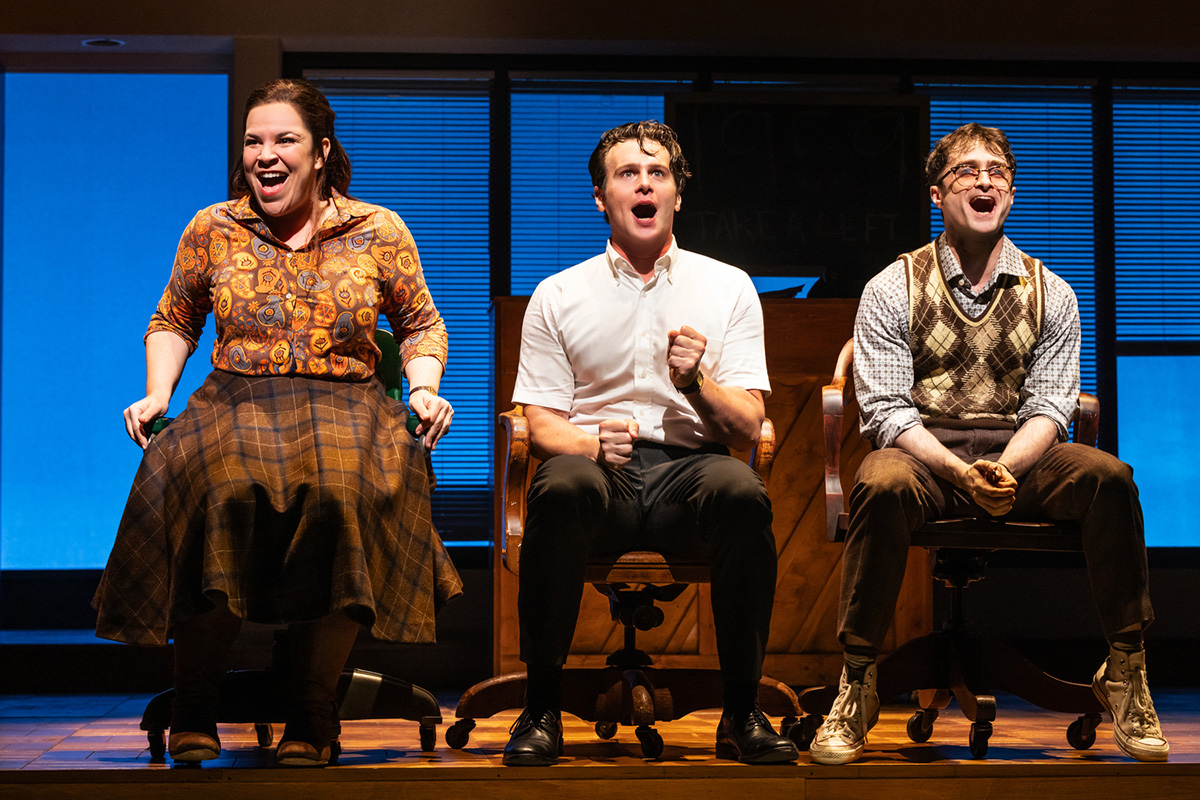
Fast forward to 2022, when renowned UK theater director Maria Friedman staged a new revival of the show in New York. In the interim, “Merrily” had undergone multiple rewrites and conceptual changes in an effort to “fix” its problems, abandoning the concept of using young performers and opting for a more “fleshed-out” approach to production design, and the show’s reputation, fueled by a love for its quintessentially “Sondheim-esque” score, had grown to the level of “underappreciated masterpiece.” Inspired by an earlier production she had helmed at home a decade earlier, Friedman mounted an Off-Broadway version of the show starring Jonathan Groff, Daniel Radcliffe, and Lindsay Mendez – and suddenly, as one critic observed, Sondheim’s biggest failure became “the flop that finally flew.” The production transferred to Broadway, winning Tony Awards for Groff and Radcliffe’s performances, as well as the prize for Best Revival of a Musical, in 2024.
Sondheim, who died at 91 in 2021, participated in the remount, though he did not live to see its premiere, nor the success that officially validated his most “problematic” work.
Fortunately, we DO get the chance to see it, thanks to a filmed record of the stage performance, directed by Friedman herself, which was released in limited theaters for a brief run last year, but which is now streaming on Netflix – allowing Sondheim fans to finally experience the show in the way it was designed to be seen: as a live performance.
Embracing the conventions of live theatre into its own cinematic ethos, this record of the show gives viewers the kind of up-close access to its performances that is impossible to experience even from the front-row of the theatre – and they are impeccable. Groff’s raw and deeply deluded Frank Shepard, the ambitious composer who sells out his values and alienates his friends on the road to success and wealth; Radcliffe’s mawkishly loyal Charlie Kringas, who remains committed to the dream he shared with his best friend until he just can’t anymore; and Mendez’ heartbreaking perfection as Mary Flynn, the wisecracking good-time girl who rounds out their trio while concealing a secret passion of her own – each of them bring the kind of raw and vulnerable honesty to their roles that can, at last, reveal both the deep insights of Sondheim’s intricate lyrics and the discomforting emotional conflicts of Furth’s mercilessly brutal script.
Yes, it’s true that any filmed record of a live performance loses something in the translation. There’s a visceral connection to the players and a feeling of real-time experience that doesn’t quite come through; but thanks to unified vision that Friedman shepherded and instilled into her cast – including each and every one of the brilliant ensemble, who undertake the show’s supporting characters and embody “the blob” of show-biz hangers-on who are central to its cynical theme – what does come through is more than enough.
Honestly, we can’t think of another Sondheim screen adaptation that comes close to this one for embracing the raw truth that was always lurking just under the clever lyrics and creative rhyme schemes. For that reason alone, it’s essential viewing for any Sondheim fan – because it’s probably the closest we’ll ever get to having a “real” Sondheim film that lives up to the genius behind it.

Minimal version of ‘Streetcar Named Desire’ heading to Dupont Underground

Comings & Goings

An effort to increase the number of psychiatrists of color

Calendar: April 10-16

BLUF leather social set for April 10 in Rehoboth
Tenn. lawmakers pass transgender “watch list” bill

Vance speaks at Orbán rally in Hungary

White House ends protections for trans students in multiple school districts

LGBTQ groups condemn Trump’s threat to destroy Iranian civilization

Report: Grenell wants Russian ambassadorship
-

 Tennessee4 days ago
Tenn. lawmakers pass transgender “watch list” bill
-

 Hungary5 days ago
Vance speaks at Orbán rally in Hungary
-
The White House5 days ago
White House ends protections for trans students in multiple school districts
-
Iran4 days ago
LGBTQ groups condemn Trump’s threat to destroy Iranian civilization