Congress
Mike Johnson elected next House speaker
La. Republican opposes LGBTQ rights, abortion

After three weeks of House Republican infighting to select a new speaker to replace ousted U.S. Rep. Kevin McCarthy (R-Calif.), the GOP majority voted U.S. Rep. Mike Johnson (R-La.) to take up the gavel Wednesday.
Johnson, who received 220 votes, three more than required to be elected speaker, has a long record of opposition to LGBTQ equal rights and holds pro-life anti-choice views
He is a longtime supporter of former President Donald Trump, who during the Capitol insurrection on Jan. 6, 2021, expressed solidarity with the rioters who invaded the building that morning and promised to take their efforts to Congress later in the day.
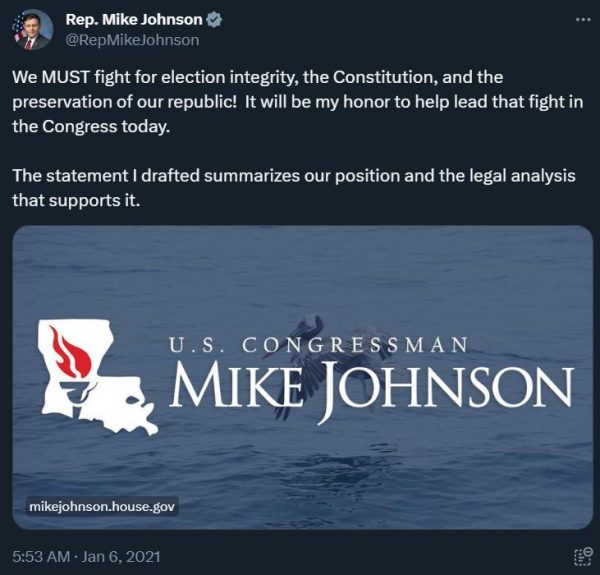
“We must fight for election integrity, the constitution and the preservation of our republic! It will be my honor to help lead that fight in the Congress today,” Johnson tweeted.
Johnson led the amicus brief signed by more than 100 House Republicans in support of a lawsuit filed by Texas Attorney General Ken Paxton, seeking to invalidate the 2020 election results in four swing states won by President Joe Biden: Georgia, Michigan, Pennsylvania and Wisconsin.
He is vice chairman of the Republican conference, an assistant whip for House Republicans, a member of the Judiciary Committee, the Armed Services Committee and a member and former chairman of the Republican Study Committee.
Axios reported the team of former U.S. Rep. Liz Cheney (R-Wyo.), a driving force of the House Jan. 6 committee and an outspoken Trump critic, released old videos highlighting Johnson’s involvement, as well as a quote in the New York Times that called him “the most important architect of the Electoral College objections,” NBC reports.
Anti-LGBTQ record
Johnson previously served as a senior attorney and spokesperson for the Alliance Defending Freedom and continues to act as an ADF allied attorney in Congress. The ADF is a self-labeled “legal alliance of Christian attorneys” with a history of funding and representing cases targeting LGBTQ people, youth and protections.
It is listed as an anti-LGBTQ hate group by the Southern Poverty Law Center, which also notes ADF’s efforts against abortion access.
While an attorney at ADF, Johnson received the “Family, Faith and Freedom Award” from the Family Research Council, a Southern Poverty Law Center-designated anti-LGBTQ hate group.
While serving at ADF, Johnson filed preemptive lawsuits in nine states in 2014 on behalf of Christian vendors who objected to marriage equality. Johnson also led the ADF’s campaign against GLSEN’s anti-bullying Day Of Silence.
Prior to his election to the House, Johnson served in the Louisiana State Legislature from February 2015 to January 2017, where in 2015 he introduced the Marriage and Conscience Act a virulently anti-LGBTQ bill that would have explicitly allowed discrimination against same-sex couples.
In 2018, he joined in with anti-LGBTQ former TV actor and evangelical Kirk Cameron in Cameron’s attempt to persuade Louisiana lawmakers to allow Christian prayer in the state’s public schools.
In December 2022 Johnson introduced a federal “Don’t Say Gay” bill.
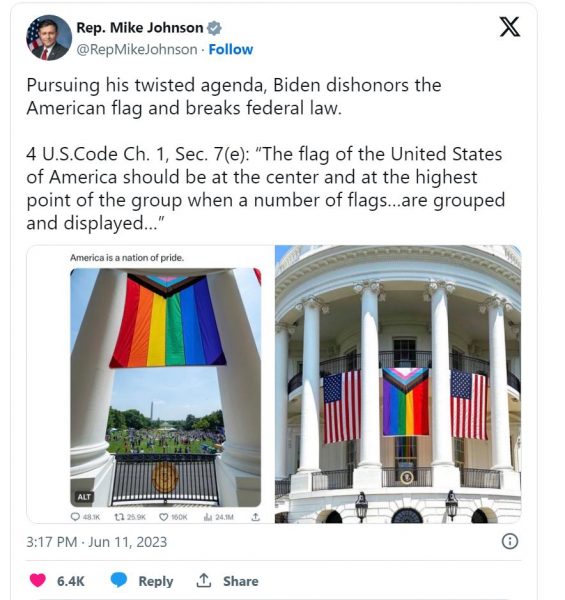
In June 2023, the now speaker-elect posted a since-deleted tweet claiming that it was illegal to fly a rainbow flag at the White House.






Congress
HRC president campaigns for Chris Pappas in NH
Gay congressman running to succeed retiring U.S. Sen. Jeanne Shaheen

Human Rights Campaign President Kelley Robinson on Sunday campaigned for U.S. Rep. Chris Pappas (D-N.H.) in New Hampshire.
Robinson traveled to Manchester, the state’s largest city, nine days before the Sept. 8 primary that will determine who will vie for retiring U.S. Sen. Jeanne Shaheen (D-N.H.)’s seat.
We’re hitting the pavement across New Hampshire to fight for a freer, fairer future for everyone.
Glad to have Human Rights Campaign President @KelleyJRobinson join us for a canvass launch in Manchester today. pic.twitter.com/XWCEaQxy4o
— Chris Pappas (@ChrisPappasNH) August 30, 2026
Former U.S. Sen. John E. Sununu, who represented New Hampshire in the U.S. Senate from 2003-2009, will face off against former U.S. Sen. Scott Brown, who represented Massachusetts in the U.S. Senate from 2010-2013, in the Republican primary.
Karishma Manzur is among the Democrats challenging Pappas.
A poll the University of New Hampshire Survey Center released on Aug. 26 shows Sununu is ahead of Brown. The same survey shows Pappas ahead of Manzur and his other Democratic challengers.
The UNH Survey Center poll shows Sununu ahead of Pappas by a 45-43 percent margin if they were to face off in the general election. The margin of error is +/-2.1 percent.
Pappas would become the first openly gay man elected to the U.S. Senate if he were to win in November.
Congress
Chris Van Hollen says the Democratic Party needs change. Is he the one to lead it?
Senator is backing anti-establishment Democrats across the country
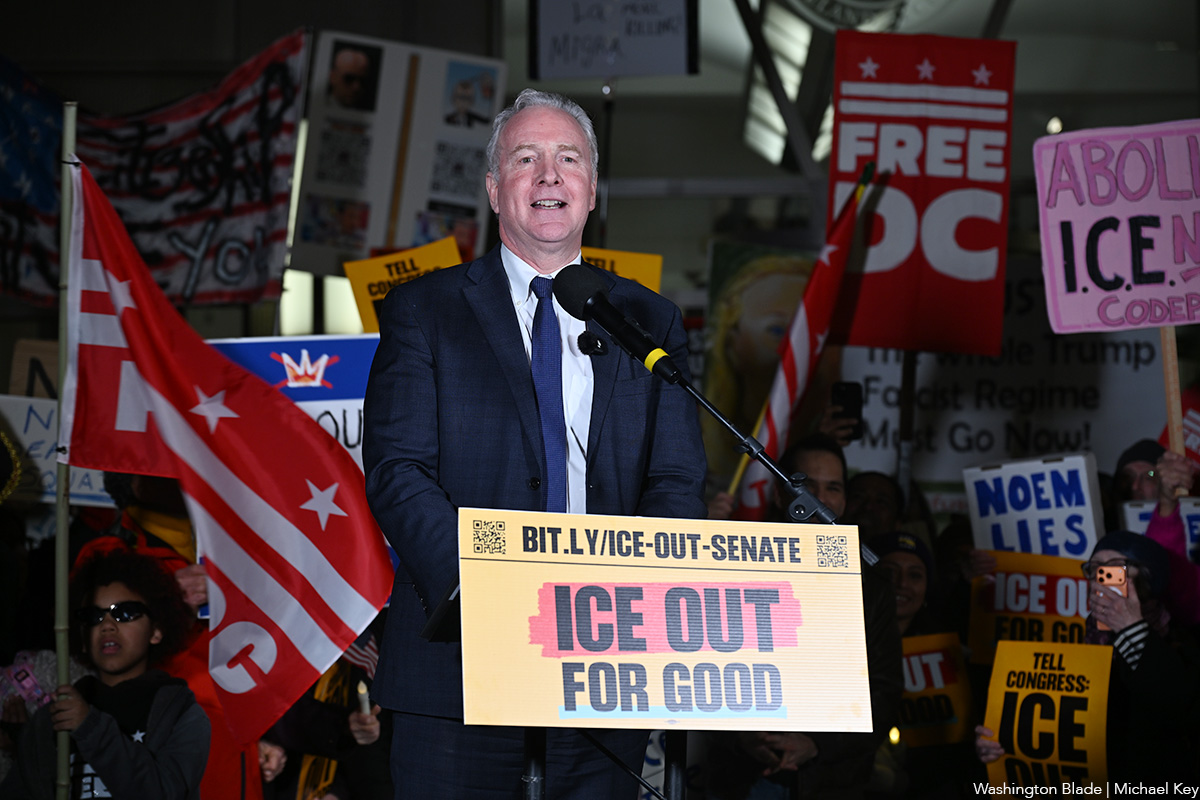
By LEE O. SANDERLIN | The Democratic Party is having something of an identity crisis — losing to President Donald Trump twice in three elections will do that.
Should the party embrace anti-establishment figures who espouse progressive policy ideas like Medicare for all and rhetoric about unrigging the economy for the 1 percent? Or should Democrats try to appeal to moderates who want to return to semi-normalcy in a time of political upheaval?
Although he’s been in Congress since 2002, with key leadership roles throughout his tenure, Maryland Sen. Chris Van Hollen, 67, counts himself firmly in the anti-establishment camp.
The rest of this article can be found on the Baltimore Banner’s website.
Congress
House blocks effort to codify transgender servicemember ban into law
Lawmakers approved two anti-trans NDAA amendments

The U.S. House of Representatives on Tuesday rejected an amendment to the National Defense Authorization Act that would have codified a ban transgender servicemembers in the military.
The bipartisan vote was 212-217.
The NDAA is for the 2027 fiscal year and sets policies for the Defense Department programs and activities and the national security programs of the Department of Energy.
U.S. Rep. Lauren Boebert (R-Colo.) proposed the amendment on July 21. It stated that all personnel are required to serve in accordance with their biological sex, citing military readiness and discipline.
Human Rights Campaign Senior Director of Government Affairs Jennifer Pike Bailey stated that she is grateful for the bipartisan vote that rejected President Donald Trump and Defense Secretary Pete Hegseth’s “dangerous and discriminatory policy that has kicked brave transgender servicemembers out of the military and weakened our national security.”
“Everyone who meets the same rigorous standards should be able to serve their country. We should honor that patriotism, particularly in this moment where we are witnessing brave servicemembers making the ultimate sacrifice for our country, instead of ending their careers and politicizing their existence. We’re grateful that a permanent extension of this ban failed, and we will keep fighting to reverse this senseless policy,” Bailey said.
Mark Takano, chair of the Congressional Equality Caucus, stated that he and his members put in countless hours of work to kill the amendment.
“When Americans know they or their families are going to be targeted by or not supported by the military, that leads them to avoid signing up to serve or staying in the service — making it harder to keep the ranks of the armed services full and our nation safe. My colleagues in the Equality Caucus and I will continue working to prevent these attacks on our servicemembers and their families from becoming law,” Takano said.
According to the Congressional Equality Caucus, two other bills could potentially be passed that would also target the transgender community, both of which were proposed by U.S. Rep. Nancy Mace (R-S.C.).
The first was a bill that would have prohibited gender-related medical care under TRICARE and to prevent TRICARE from covering certain gender-related medical procedures and treatments, which was approved in a vote of 219-208.
The second was a bill that would have prohibited male participation in female sports at DoDEA schools. DoDEA schools are Department of Defense Dependents Schools, which is a network of primary and secondary schools.
The amendment was approved in a vote of 221-203.

Blade Foundation to host fundraiser in Rehoboth on Sept. 12

New book examines fashionista Audrey Smaltz’s fabulous life

Actress takes on bisexual ‘Ma’ Rainey in new Round House production

‘Here the Whole Time’ delivers queer coming-of-age comedy

Pentagon expands testosterone screening as trans troops face hormone therapy restrictions

The mastery of love

Enlarging the Supreme Court keeps making more sense

Gloria Steinem dies at 92

Trans people need a politics of ordinary life