Congress
Equality Caucus report documents GOP’s anti-LGBTQ attacks in 2023
President Joe Biden has vowed to block homophobic, transphobic bills

The Congressional Equality Caucus on Monday released a 36-page report titled “Obsessed: House Republicans’ Relentless Attacks Against the LGBTQI+ Community in 2023,” which meticulously documents a year of anti-LGBTQ legislative activity in the lower chamber.
Trends detailed in the report map onto those seen in legislatures across the country. According to the American Civil Liberties Union, a total of 510 anti-LGBTQ bills were introduced last year, 84 of which were ultimately signed into law.
The caucus noted measures targeting the community that were proposed last year are likely to see movement in 2024. And just two days shy of six weeks into the new year, the ACLU is tracking 411 new anti-LGBTQ bills.
“When Republicans took control of the House of Representatives last year, we saw an
avalanche of attacks against the LGBTQI+ community,” U.S. Rep. Mark Pocan (D-Wis.), who chairs the caucus, said. “In one year, they forced more than 50 anti-LGBTQI+ votes on the House floor.”
“The cruelty is the point,” he said. “You expect bullies in school, but yet there are bullies walking around the halls of Congress. These elected officials target LGBTQI+ youth, especially
trans youth, because it helps increase their clout with a small slice of their base.”
The congressman highlighted efforts by his Republican colleagues to prohibit transgender women and girls from participating on women’s and girls’ sports teams and to ban medically necessary healthcare interventions for trans Americans.
Pocan added, “Not only have they passed numerous amendments to restrict access to medically necessary care, but 46 Republicans have signed on to a Marjorie Taylor Greene bill to throw doctors and parents in jail for providing evidence based care to transgender youth.”
Along with the more than 50 votes on anti-LGBTQ measures that House Republicans took to the floor of the chamber, the caucus’s report notes that GOP members filed more than 95 anti-LGBTQ amendments, introduced more than 55 anti-LGBTQ bills.
During more than 40 committee hearings, these lawmakers and the witnesses they brought made disparaging comments about LGBTQ people, according to the caucus.
Last year, House Republicans used their majority to pass legislation like House Resolution 5 and House Resolution 734 — which, respectively, “require schools that take steps to respect a student’s gender identity to forcibly out those transgender youth to their parents” and “ban all trans girls and trans women — as young as kindergarten — from participating on school sports teams.”
The bills were destined to fail in the Democratic-controlled U.S. Senate, and President Joe Biden vowed never to sign them. Still, advocacy groups warn the introduction of policies targeting LGBTQ people, along with the rhetoric in legislatures where they are debated, heightens the risk of depression, anxiety, self harm behaviors and suicide, particularly among queer youth.
With respect to gender affirming care — which is supported by every mainstream scientific and medical society in the U.S. — House Republicans were focused on restricting access for both youth and adults, the caucus’ report notes.
Additionally, nearly every appropriations bill introduced by Republican members in 2023 contained language permitting discrimination against LGBTQ people, the caucus said. “These provisions create a license for people and organizations, especially those receiving taxpayer funds, to discriminate against LGBTQI+ people by preventing the federal government from adequately responding.”
Among the other details contained in the caucus’s report are:
- How GOP members hijacked funding bills that have traditionally passed with wide bipartisan margins to demand anti-LGBTQ provisions, despite the near certainty that they would be rejected by the Senate and by President Biden
- How House Republicans stripped funding from three community-based projects because they supported LGBTQ centers
- How GOP members are trying to exclude children’s hospitals that provided gender affirming care for patients younger than 18 from eligibility for funding under the Children’s Hospitals Graduate Medical Education program, which trains medical residents and fellows
- The extreme anti-LGBTQ career of the Republican House Speaker U.S. Rep. Mike Johnson (La.)
- A breakdown of bills targeting the LGBTQ community, those with anti-LGBTQ provisions, and votes on various amendments on matters including anti-discrimination protections, use of the “Holman rule to reduce the salary of federal employees due to their LGBTQI+ status or because of their support of LGBTQI+ rights,” and HIV/AIDS funding
- Examples of hearings in which Republicans and their witnesses made anti-LGBTQI+ remarks or asked questions motivated by opposition to LGBTQI+ policies and equality





Congress
Top Democrats re-introduce trans bill of rights
Lawmakers spoke outside US Capitol on Wednesday
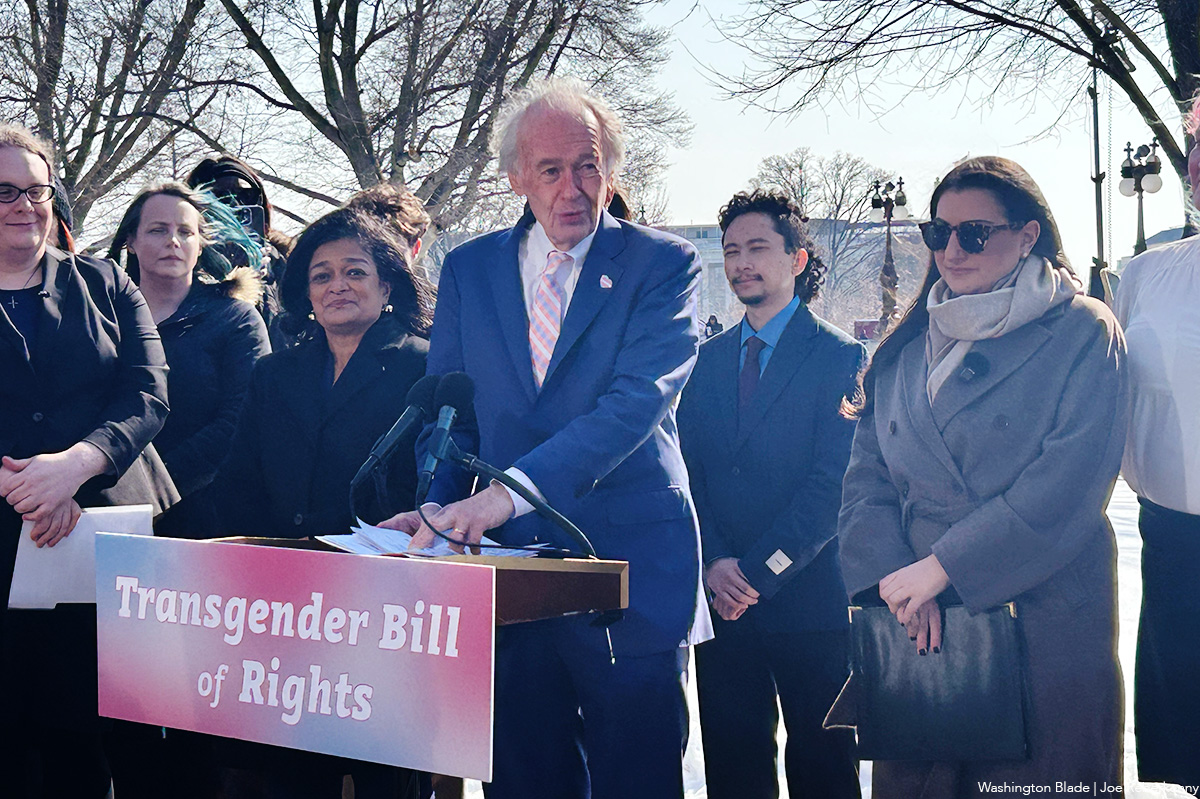
U.S. Sen. Ed Markey (D-Mass.) and U.S. Reps. Pramila Jayapal (D-Wash.), and Sara Jacobs (D-Calif.) announced the reintroduction of a “Trans Bill of Rights” on Wednesday.
Despite chilling winds and snow on the ground, transgender activists, LGBTQ rights advocates, and trans-supporting lawmakers gathered outside the U.S. Capitol to announce the reintroduction of the “Transgender Bill of Rights” resolution to protect trans Americans, as the Trump-Vance administration continues to target LGBTQ Americans.
About 30 people gathered outside to hear from legislators and individuals impacted by recent White House policies.
“Today we say loud and clear that trans rights are human rights, and they must be protected every single day of every single year,” Markey told the crowd. “We stand together in solidarity with the trans community and with those who have too often been left behind by a system that refuses to recognize their humanity. We are here to ensure that every trans and gender-diverse person in America can live freely and safely and authentically. That’s what the Trans Bill of Rights is all about.”
Markey is leading the resolution on the Senate side, while Jayapal is pushing it forward in the House.
“With the Trans Bill of Rights, we are laying out a comprehensive vision to provide protections for transgender and nonbinary people — a vision that ensures every single person has a chance to thrive,” Jayapal said. “A vision that says: you are us, you belong, and you are worthy of the same rights as everyone else. This bill supports amending the Civil Rights Act to ensure that trans people have the same rights and protections as all other Americans. It creates a level playing field where trans people no longer have to fight tooth and nail to get the same treatment as their cisgender friends.”
The resolution for House and the Senate reads:
“Recognizing that it is the duty of the federal government to develop and implement a Transgender Bill of Rights to protect and codify the rights of transgender and nonbinary people under the law and ensure their access to medical care, shelter, safety, and economic security.”
Trans Legislation Tracker, an independent research organization that collects data on anti-trans legislation from the hyper-local level to the floor of the U.S. Senate, found that in 2025, 1,022 measures were proposed across the country to restrict the rights of trans Americans — from health care removals to bathroom bans.
Markey directly called out those lawmakers for what he described as discriminatory actions taken against trans Americans who, as he pointed out, are fighting for rights that everyone else is inherently given.
“Trump and MAGA Republicans have used the power of government to spread fear and hate across our country. They have tried to ban lifesaving and medically necessary health care, strip anti-discrimination protections, and turn trans lives into political talking points for their benefit. Well, we have a message for them: we are louder, we are stronger, and we are not going anywhere. We’re in this fight for the long term,” the Massachusetts senator said.
Jacobs, a co-chair of the Transgender Equality Task Force within the Congressional Equality Caucus, also spoke at the event.
“Trans Americans are being targeted just for being who they are — by laws and court decisions that try to erase them from classrooms, from courts and fields, from health care and public life. These attacks aren’t about safety or fairness,” Jacobs said. “They’re about hatred and instilling fear. And we know how quickly fear can warp into suspicion and violence with deadly consequences.”
In addition to lawmakers, trans Americans and supporters spoke.
Olivia Hunt from Advocates for Trans Equality, LaLa Zannell from the American Civil Liberties Union, as well as three additional people who have been actively harmed by the ongoing wave of anti-trans legislation, shared their stories.
Hunt emphasized the staggeringly high number of anti-trans bills being introduced in statehouses across the country — despite trans adults making up less than 1 percent of the population, according to the Williams Institute’s 2025 data.
“Since 2020, thousands of anti-LGBTQIA+ bills have been introduced in statehouses across the country,” Hunt said. “It’s a veritable tidal wave of political bullying disguised as legislation, and most of these bills specifically target transgender and nonbinary people — especially trans youth and their families. This is a moment that demands action.”
Hunt, who is trans, helps trans people in D.C. obtain legal documents that match their gender identity — something the Trump-Vance administration has stopped.
“Trans youth deserve to be protected by their government. They shouldn’t have to be protected from their government,” she said. “It’s long past time that our federal laws reflect and protect the reality and dignity of all people. Trans people have always existed — we are your neighbors, your family members, your community — and we belong.”
Zannell, who spoke proudly about her trans identity, explained why the bill is necessary and how it would protect trans people in all facets of their lives.
“I stand here as an unapologetic Black trans woman who has led this movement for over a decade to get us to moments like this. The reintroduction of the Trans Bill of Rights will aim to protect access to gender-affirming care, prevent discrimination in housing and public spaces, and preserve legal recognition,” Zannell said. “My hope is that this affirms our government’s duty to protect all trans and nonbinary people.”
The Transgender Bill of Rights is cosponsored in the Senate by U.S. Sens. Jeff Merkley (D-Ore.), Elizabeth Warren (D-Mass.), Mazie Hirono (D-Hawaii), Ron Wyden (D-Ore.), Martin Heinrich (D-N.M.), Alex Padilla (D-Calif.), Bernie Sanders (I-Vt.), and Peter Welch (D-Vt.).
In the U.S. House of Representatives, the resolution is led by Jayapal, co-led by Jacobs and U.S. Rep. Mark Takano (D-Calif.), with nearly 100 other representatives signing on as co-sponsors.
“To all trans people across the United States: you are seen, you are valued, and you are loved,” said Markey. “And I want you to know there are people who will fight for you every single day on the floor of the House and Senate to win those rights for you.”
Congress
New Equality Caucus vice chair endorses Equality Act, federal trans bill of rights
Salinas talks about her personal road to LGBTQ advocacy
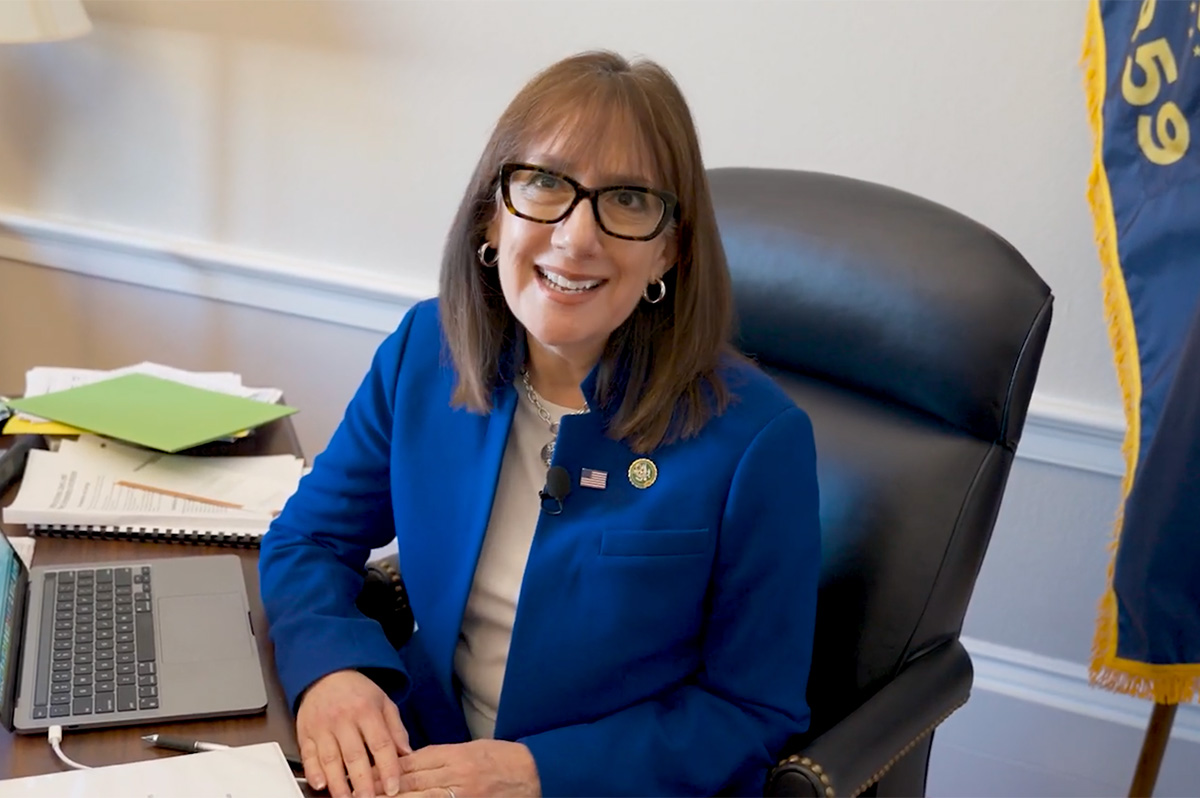
Rep. Andrea Salinas, the new vice chair of the Equality Caucus, sat down with the Blade to discuss the battles ahead as she demands protections for LGBTQ Americans.
Salinas is no stranger to government service. The daughter of a Mexican immigrant, she graduated from the University of California, Berkeley, and soon became a valued member of multiple Democratic offices — including working as a congressional aide to U.S. Sen. Harry Reid (D-Nev.) and U.S. Reps. Pete Stark (D-Calif.) and Darlene Hooley (D-Ore.). From there, she served six years in the Oregon House of Representatives before being elected to Congress, representing areas south of Salem and parts of southern Portland. With her new role in the Equality Caucus, Salinas vows to push protections for LGBTQ Americans in every room she enters.
The Washington Blade spoke with Salinas last week following her leadership announcement to discuss what the role means to her, why she — as a straight woman— feels it is her duty to fight for LGBTQ protections, and how she views the current state of the country.
When asked why she decided to take on a leadership role within the Equality Caucus, Salinas explained that she was already doing the work — but that the timing of the caucus’s outreach, coupled with what she described as a growing threat posed by the Trump-Vance administration, made the moment feel especially urgent.
“I was actually asked to take on this role because of the work I’ve already been doing. I didn’t seek out a title— the Congressional Equality Caucus came to me, and I was honored by that,” the Oregon representative told the Blade. “I’ve been a lifetime advocate, first as a mother and then as a legislator. With Trump back in office and the shackles off, kids are vulnerable right now, and they’re being attacked. We need champions, and with or without a title, I was going to do this work anyway.”
That work includes passing LGBTQ-related education policy during her time in the Oregon House of Representatives, requiring the Oregon Department of Education to train teachers on how to better support LGBTQ students. She also backed legislation aimed at preventing LGBTQ-related bullying and harassment, while using her platform to ensure educators had the skills needed to address trauma in the classroom. Salinas also pushed for Oregon’s 2013 conversion therapy ban and played a role in defending it.
Salinas said her personal motivation for expanding and protecting LGBTQ rights is rooted in the experiences of her daughter, Amelia.
“My daughter is queer, and she has known who she is since she was a child,” Salinas said. “She presents very masculine, and I’ve had to advocate for her her entire life — from whispers on soccer sidelines to fears about using the bathroom when she was just three or four years old. That kind of bullying and harassment stays with you as a parent. It became part of who I am, part of my ‘mama bear’ advocacy. When I entered public office, continuing that fight was the most natural thing in the world.”
That “mama bear” advocacy, she said, now extends far beyond her own family.
“Across this country, kids are vulnerable right now, and Trump is attacking them,” she said. “My daughter was devastated after the 2024 election— she said, ‘They’re coming after us,’ and she was right. That fear is real, especially for transgender youth. Civil rights should be expanding, not being stripped away from certain communities. That’s why this fight feels so urgent.”
Since returning to the White House in 2024, the Trump administration has moved to roll back anti-discrimination protections, particularly those affecting transgender people. These efforts include barring transgender people from serving openly in the military, blocking access to gender-affirming medical care in federal health programs, challenging state laws that protect transgender students on religious grounds, and arguing that the Constitution entitles employers to discriminate against LGBTQ people based on religious beliefs — even in states with nondiscrimination laws.
For Salinas, the Equality Caucus’s most urgent task under the Trump-Vance administration is advancing what she called a long-sought but non-negotiable priority: the Equality Act.
The Equality Act would add explicit protections based on sexual orientation and gender identity to federal law. Despite more than five decades of debate on Capitol Hill, no version of the bill has yet become law.
“We have to keep pushing the Equality Act— there’s no way around that. No one should be discriminated against in housing, employment, credit, or healthcare because of who they are,” Salinas said. “Republicans are making LGBTQ identity a political wedge because they think it’s expedient, and that’s unacceptable. Sexual orientation and gender identity should not matter in determining someone’s access to opportunity. Yet here we are, still having to fight for that basic principle.”
Salinas added that advancing legislation like the Equality Act requires compassion— even when that compassion is not returned— and a commitment to education.
“We have to meet people where they are— Democrats, Republicans, independents, all of them. Until you know a family, or understand someone’s lived experience, it can feel abstract and overwhelming,” she said. “Education, compassion, and empathy are essential to moving the dial. When people understand this is about human rights, not politics, conversations start to change. That’s how we build broader support.”
She also emphasized the need for a federal transgender bill of rights, which would provide explicit protections for transgender Americans amid what she described as an increasingly hostile federal environment.
“A transgender bill of rights would clarify that discrimination against transgender and nonbinary people is illegal — in employment, housing, credit, and healthcare,” Salinas said. “What’s happening right now, with efforts to criminalize doctors for providing evidence-based care, is unheard of and dangerous. We also need to ban conversion therapy nationwide, because states are increasingly trying to undo those protections through the courts. These safeguards are about ensuring people can live safely and with dignity. That should not be controversial.”
Mental health is another central focus of Salinas’s work. She said ensuring children have access to support— particularly LGBTQ youth— is critical to their long-term wellbeing.
After the Trump administration eliminated the LGBTQ-specific option from the 988 Suicide and Crisis Lifeline, Salinas said her reaction was one of outrage.
“When Trump shut down the 988 press-three option for LGBTQ youth, I was apoplectic,” she said. “It is one of the simplest, most upstream ways to save lives, and it felt arbitrary, cruel, and inhumane. We know the suicide risk among transgender youth is far higher than among non-LGBTQ kids. Connecting them with someone who understands their experience can be life-saving. This should be bipartisan, and I’m going to keep pushing to restore it.”
“You cannot be what you cannot see….” she added while reflecting on the handful of LGBTQ leaders who have— and continue to— navigate the halls of Congress to protect their community. “When Sarah McBride was elected, my daughter met with her and walked out glowing… joyful, hopeful, and excited about the future. That kind of representation changes lives. Electing LGBTQ leaders changes the trajectory for people across the country. Grassroots organizing and electoral power go hand in hand, and we need both.”
With Salinas’s experience in both the Oregon House of Representatives and the U.S. House of Representatives, she said that while one arena may reach more people, change often begins locally, especially when combating anti-LGBTQ attacks.
“I’ve seen how misinformation fuels fear at the local level— whether it’s school board fights or bathroom debates rooted in baseless claims. There is no data to support these scare tactics,” she said, echoing her past work with the Oregon Department of Education. “What actually helps is facts, education, and training teachers to better support LGBTQ students. I passed legislation in Oregon to give educators real tools to prevent bullying and harassment. That kind of work matters just as much as what we do in Congress.”
Despite just being named vice chair of the Equality Caucus, the Blade asked Salinas what legacy she hopes to leave, particularly when it comes to LGBTQ advocacy.
“I want people to be able to live authentically, without fear from their government or their neighbors. That means passing real legislation— the Equality Act and a transgender bill of rights— so protections are not dependent on who’s in power. Civil and human rights are meant to expand, not contract.
“I’ve been doing this work since I became a mother, and I’ll keep doing it for as long as it takes. My daughter deserves it, and so does every LGBTQ person in this country.”
Congress
McBride, other US lawmakers travel to Denmark
Trump’s demand for Greenland’s annexation overshadowed trip

Delaware Congresswoman Sarah McBride is among the 11 members of Congress who traveled to Denmark over the past weekend amid President Donald Trump’s continued calls for the U.S. to take control of Greenland.
McBride, the first openly transgender person elected to Congress, traveled to Copenhagen, the Danish capital, with U.S. Sens. Chris Coons (D-Del.), Thom Tillis (R-N.C.), Jeanne Shaheen (D-N.H.), Dick Durbin (D-Ill.), and Lisa Murkowski (R-Alaska) and U.S. Reps. Steny Hoyer (D-Md.), Gregory Meeks (D-N.Y.), Madeleine Dean (D-Pa.), Don Bacon (R-Neb.), and Sarah Jacobs (D-Calif.). The lawmakers met with Danish Prime Minister Mette Frederiksen and Greenlandic MP Pipaluk Lynge, among others.
“I’m grateful to Sen. Coons for his leadership in bringing together a bipartisan, bicameral delegation to reaffirm our support in Congress for our NATO ally, Denmark,” said McBride in a press release that detailed the trip. “Delaware understands that our security and prosperity depend on strong partnerships rooted in mutual respect, sovereignty, and self-determination. At a time of growing global instability, this trip could not be more poignant.”
Greenland is a self-governing territory of Denmark with a population of less than 60,000 people. Trump maintains the U.S. needs to control the mineral-rich island in the Arctic Ocean between Europe and North America because of national security.
The Associated Press notes thousands of people on Saturday in Nuuk, the Greenlandic capital, protested against Trump. British Prime Minister Keir Starmer is among those who have criticized Trump over his suggestion the U.S. would impose tariffs against countries that do not support U.S. annexation of Greenland.
A poll that Sermitsiaq, a Greenlandic newspaper, and Berlingske, a Danish newspaper, commissioned last January indicates 85 percent do not want Greenland to become part of the U.S. The pro-independence Demokraatit party won parliamentary elections that took place on March 12, 2025.
“At this critical juncture for our countries, our message was clear as members of Congress: we value the U.S.-Denmark partnership, the NATO alliance, and the right of Greenlanders to self-determination,” said McBride on Sunday in a Facebook post that contained pictures of her and her fellow lawmakers meeting with their Danish and Greenlandic counterparts.

Trump budget targets ‘gender extremism’

Susan Lucci on love, loss, and ‘All My Children’

How to navigate shifting tenant expectations

Viktor Orbán ousted in Hungarian elections

Minimal version of ‘Streetcar Named Desire’ heading to Dupont Underground
Tenn. lawmakers pass transgender “watch list” bill

LGBTQ groups condemn Trump’s threat to destroy Iranian civilization

Report: Grenell wants Russian ambassadorship

D.C. Council member honored by LGBTQ homeless youth group

Glisten’s 30th annual Day of Silence to take place April 10
-

 Tennessee5 days ago
Tenn. lawmakers pass transgender “watch list” bill
-

 Iran5 days ago
LGBTQ groups condemn Trump’s threat to destroy Iranian civilization
-
The White House5 days ago
Report: Grenell wants Russian ambassadorship
-
District of Columbia5 days ago
D.C. Council member honored by LGBTQ homeless youth group