Theater
Deaf, gay actor on gripping, funny ‘Private Jones’
Musical makes premiere at Signature with Obie winner Dickie Drew Hearts

‘Private Jones’
Through March 10
Signature Theatre
4200 Campbell Ave.
Arlington, Virginia 22206
$40-$99
Sigtheatre.org
Set against the harsh vicissitudes of the Great War, “Private Jones” a new musical written and directed by Marshall Pailet, is currently making its world premiere at Signature Theatre in Arlington.
Touted as gripping, unexpectedly funny, and purportedly true, it’s the story of Gomer Jones, a young Deaf Welshman who after wriggling his way into military service becomes a celebrated sniper only to learn there might be more to life.
The production features a cast of hearing, Deaf, and hard-of-hearing actors including Dickie Drew Hearts, the Deaf, gay, and affable actor who recently won an Obie Award for “Dark Disabled Stories” at the Public in New York, and is probably best known for his performance of Mateo in Netflix’s “Tales of the City” (2019 miniseries).
Gathered around the end of a long conference table in the Sondheim Multipurpose Room at Signature Theatre, Hearts and I along with two top notch interpreters (one to sign my questions and another to voice the actor’s replies) dive into conversation.
Hearts plays Henry, a Deaf munitions factory worker whose sister Gwenolyn (Leanne Antonio) becomes the love interest of Gomer (played by hard-of-hearing actor Johnny Link). It’s Henry who teaches Gomer sign language and essentially introduces him to Deaf culture, which isn’t unusual, says Hearts. It’s often through other Deaf people that the Deaf themselves get introduced to the Deaf community and signing world.
When the actors met in 2018, says Hearts, “Johnny [Link] was just learning sign language. I assured him that those who are hard-of-hearing are automatically very welcome members of the deaf community. Point blank. There are no qualifications.”
And now, six years later, Hearts is thrilled to be working with Link. “It’s amazing to see Johnny again, and to be having full conversations with him in sign language both on and off stage.”
Not only is “Private Jones” a physically demanding show, but because it’s performed in spoken English as well as some American Sign Language (ASL) and British Sign Language (BSL) it presents some extra difficulties.
To play Henry, Hearts – a native ASL user since childhood – has had to learn BSL, tantamount to doing the show in an entirely new and different language. Hearts says, “I hope people recognize that. And signing along musically in BSL adds a layer of challenge beyond signing BSL dialogue.”
Of course, he remains undaunted. It’s about the job and getting the character right. And for the thirtysomething actor that means going deep.
“I would like to think Henry is a closeted gay man. Henry has ‘a roommate,’ is how I thought of his backstory.”
Hearts adds, “I know that queer people have always been here and I like to infuse that into the characters I play whether or not it’s stated. I look for those moments of where it might be hinting at sexuality, and ask what was it like at the time, was it safe to be out?”
Born Deaf in Queens, New York, into a hearing family who’d recently immigrated from formerly British Guyana in South America, Hearts grew up in Newport News, Va.
A childhood spent watching captioned TV shows taught him both English and how to impersonate characters, an obsession that he took out into the neighborhood. “Eventually, somebody said there’s a thing for what I do. It’s called theater,” he signs with a grin.
While attending Gallaudet University here in D.C., Hearts focused on film until his senior year when he randomly auditioned for the musical comedy “Urinetown” and landed the lead role of dashing Bobby Strong. A love for acting resurfaced and took hold.
After graduating, Hearts came out and promptly moved to L.A. where he spent the next six years skirmishing over a dearth of Deaf parts. When a gig led him to New York in 2018, his luck changed.
“Being a Deaf, gay, BIPOC actor was amazing for finding stage and film work in New York. But just when a lot of doors were opening for me, the pandemic hit and everything stopped.”
Slowly things picked up. And in 2021 he became part of a new project. He was soon reporting to a nondescript high rise in midtown Manhattan workshopping what would become “Private Jones.”
Now at Signature, Hearts is busy bringing Henry to life. “It’s been an amazing journey and I’m really fortunate to have witnessed its evolution from the beginning. It’s become grander, more elevated, and the characters more complex. It’s a wonderful thing”





Theater
‘Inherit the Wind’ isn’t about science vs. religion, but the right to think
Holly Twyford on new role and importance of listening to different opinions

‘Inherit the Wind’
Through April 5
Arena Stage
1101 Sixth St., S.W.
Tickets start at $73
Arenastage.org
When “Inherit the Wind” premiered on Broadway in 1955 with a cast of 50, its fictional setting of Hillsboro, an obscure country town described as the buckle on the Bible Belt, was filled with townspeople. And now at Arena Stage, director Ryan Guzzo Purcell has somehow crowded Arena’s large Fichandler space with just 10 actors, five principals and a delightful ensemble of five playing multiple roles.
Inspired by the real-life Scopes Monkey Trial of 1925, Jerome Lawrence and Robert E. Lee’s fictionalized work pits intellectual freedom against McCarthyism via the imagined trial of Bertram Cates (Noah Plomgren), a Tennessee educator charged with teaching evolution. Drawn into the fracas are big shot lawyers, defense attorney Henry Drummond (Billy Eugene Jones), and conservative prosecutor, Matthew Harrison Brady (Dakin Matthew). On hand to cover the closely watched story is wisecracking city slicker and Baltimore reporter E.K. Horneck (played by nonbinary actor Alyssa Keegan).
Out actor Holly Twyford, a four-time Helen Hayes Award winner who has appeared in more than 80 Washington area plays, is part of the ensemble. In jeans and boots, she memorably plays Meeker, the bailiff at the Hillsboro courthouse and the jailer responsible for holding Cates in the days leading to his trial.
Twyford also plays Sillers, a slack jawed earnest employee at the local feed store who’s called to serve on the jury. And more importantly she plays Brady’s quietly strong wife Sarah whom he affectionately calls “Mother.”
When Twyford makes her memorable first entrance as Meeker, she’s wiping shaving cream from her face with a hand towel. With shades of Mayberry R.F.D., the jail is run casually. Meeker says Cates isn’t the criminal type, and he’s not.
“There’s a joke among actors,” says Twyford. “When an actor gets his shoes, they know who their character is. And it’s sort of true. When you put on boots, heels, or flip flops, there’s a different feeling, and you walk differently.”
Similarly, shares Twyford, it goes for clothes too: “When Mother slips a pink coat dress over her cowboy boots, dons a little hat and ties her scarf, or Meeker puts on his work shirt, I know where I am. And all of that is thanks to a remarkable wardrobe crew.
“Additionally, some of the ensemble characters are played broadly which is helpful to the actors and super identifying for the audience too.”
During intermission, an audience member loudly described the production as “a proper play” filled with beautifully written passages. And it’s true. Twyford agrees, adding “That’s all true, and it’s also been was fun for us to be a part of the Arena legacy as well. Arena took ‘Inherit the Wind’ to the Soviet Union in the early ‘70s when the respective governments did a cultural exchange. At the time, the iron curtain was very much in place, and they traveled with a play about a man with his own thoughts.”
When the ensemble was cast, actors didn’t know which tracts exactly they were going to play. “What came together was a cast, diverse in different ways. Some directors, including myself when I direct, are interested in assembling a cast that’s a good group. No time for egos. It’s more about who will make the best group to help me tell this story.”
At one point during rehearsal, ensemble members began to help one another with minor onstage costume changes, like jackets and hats: “We just started doing it and Ryan [Guzzo Purcell] picked up on it, saying things really began to come alive when we helped each other, so we went with that.”
“For me, it was reminiscent of ‘The Laramie Project’ [Ford’s Theatre in 2013] when we played five different parts and we’d help each other with a vest or jacket in a similar way. It worked so well then too,” says Twyford.
“Inherit the Wind” isn’t about science versus religion. It’s about the right to think, playwright Jerome Lawrrence has been quoted as saying. And it’s a quote that makes the play that much more relevant today.
Twford remembers a chat in a hair salon: “I was getting my hair cut and the woman next to me shared that she was tired of message plays. Understandably there are theater makers who believe that message plays are the point, while others think it’s all about entertainment. I feel like ‘Inherit the Wind’ sits in a nice place in the middle.”
She adds “the work is a creative way of showing different opinions and that, I think, is what we should be paying attention to right now. Clearly, it’s not right or wrong to express what you think.”

Ideally, spring is our season of renewal – personal, emotional, and social. Lucky for those in the DMV, there’s a lot of exhilarating new theater to help make it happen.
At Arena Stage, there’s still time to catch the world premiere production of “Chez Joey” (extended through March 22). Set around the 1940s Chicago jazz scene, this smart reboot of the Broadway classic “Pal Joey” effervesces with music by Rodgers and Hart and a terrific cast brimming with big talent (including Myles Frost, Awa Sal Secka, and out comedic actor Kevin Cahoon).
Also at Arena, is “Inherit the Wind” (through April 5), the extraordinarily timely work based on the real-life Scopes “Monkey” Trial. It’s a courtroom drama that pits two towering legal minds against each other in a small-town battle over science, religion, and the right to think. The large, talented cast includes Billy Eugene Jones, Dakin Matthews, and out actors Holly Twyford and Alyssa Keegan. Arenastage.org
La Pluma Theatre, a queer Latin company housed in Dupont Underground, presents “The Ladybird of Saint John” (April 6-12), a powerful story about two sisters navigating immigration, separation, and the fragile bonds of family. @laplumatheatre – Instagram
Great gay playwright Tennessee Williams’ “A Streetcar Named Desire” (April 20–May 4) is also coming to the Dupont Underground space. Directed by out actor/director Nick Westrate, the touring production of Williams’s classic work set in New Orlean’s steamy Vieux Carré is performed with neither set nor props. It focuses on the words. Lucy Owen and Brad Koed star as fragile Blanche Dubois and her brutal brother-in-law Stanley. Dupontunderground.org
Folger Theatre is serving up one of the Bard’s best comedies, “As You Like It” (through April 12). Staged by out director Timothy Douglas, Folger’s production “offers a love note to D.C., imbuing the forest of Arden with the familiar vibes, culture, and characters that mark the District as a singular, resilient, and redemptive place of belonging.” Folger.edu
As part of the country’s semi-quincentennial celebrations, Ford’s Theatre presents “1776” (through May 16), a Tony Award-winning musical about the Second Continental Congress’s struggle to adopt the Declaration of Independence in Philadelphia. Directed by Luis Salgado, the show features a large cast including queer talent like Tom Story, Jake Loewenthal, Jimmy Mavrikes, and Wood Van Meter. Fords.org
In Falls Church, Creative Cauldron presents “Twelve Dancing Princesses” (through March 29), a Learning Theater Production targeting both kids and adults. Adapted from a Brothers Grimm tale, the eerie story features Spanish language elements and original music by husbands Matt Conner and Stephen Gregory Smith. Creativecauldron.org
The National Theatre presents “Disney’s Beauty and the Beast” (March 18–April 5). This musical “tale as old as time” is a love story involving Belle, a cursed beast, and the arrogant and famously spurned Gaston played out actor Stephen Mark Lukas, a beauty in his own right. Broadwayatthenational.com
At Mosaic Theater Company, Michael Bahsil-Cook plays the titular activist/congressman in Psalmayene 24’s “Young John Lewis: Prodigy of Protest.” (March 26–May 3). Staged by Mosaic’s out artistic director Reginald L. Douglas, focuses on Lewis’s formative years of ages 18-28, revealing the budding humanity and heart of this mighty historic figure. Talented out actor Vaughn Ryan Midder plays legendary civil rights activist Medgar Evers and other parts. Mosaictheater.org
At Olney Theatre Center, it’s the anticipated area premiere of “Appropriate” (March 18–April 19). Penned by Tony Award-winning out playwright Branden Jacobs-Jenkins, the darkly comic work follows a dysfunctional white family that gathers on a plantation home to liquidate their late father’s estate where they uncover a dark history of racism.
Excellent area actors Kimberly Gilbert and Cody Nickell play siblings battling over possessions as well as their father’s shady legacy. Performed in Olney’s black box Mulitz-Gudelsky Theatre Lab, the company promises a unique staging of this important American play. Jason Loewith directs.
Also at Olney Theatre, celebrity chef and longtime queer ally Carla Hall debuts her one-woman show, “Carla Hall — Please Underestimate Me” (June 3–July 12). Olneytheatre.org
British imports are striding the boards at Shakespeare Theatre Company this spring. The first is “Hamnet” (March 17–April 12), the U.S. premiere of the Royal Shakespeare Company’s 2023 stage adaptation of Maggie O’Farrell’s best-selling novel about the life of Shakespeare’s wife, Agnes, and the death of their son.
And then it’s “Eddie Izzard in the Tragedy of Hamlet” (March 27–April 11), a one-woman show in which the British comedian takes on 23 characters in a unique re-telling of the renowned work. Shakespearetheatre.org
Woolly Mammoth Theatre presents “Travesty” (March 24–April 12). Created and performed by gender fluid drag performer Sasha Velour, the one-person show is part performance art, part history, and part call to action.
Also at Woolly, out actor Justin Weaks stars in his solo piece “A Fine Madness” (June 2–21), in which the Helen Hayes Award-winning actor shares his personal experience as a Black gay man receiving a positive HIV diagnosis. Woollymammoth.net
Spring at Studio Theatre is Rachel Bonds’ “Jonah” (through April 19), an exploration of a woman’s life through relationships with three men. Directed by Taylor Reynolds, the four-person cast includes Rohan Maletira in the title role and Ismena Mendes as Ana. Mendes is an accomplished stage and screen actor whose described as bisexual/queer in her IMBD bio. Studiotheatre.org
In Arlington, Signature Theatre’s out artistic director Matthew Gardiner stages “Pippin” (May 12–July 26), Stephen Schwartz’s musical about a young prince searching for a terrific life guided by a theatrical troupe. The original 1972 production featured stars like Ben Vereen and Irene Ryan (best known as TV’s Granny Clampett). Signature’s production’s big names have yet to be shared. Sigtheatre.org
Exciting stuff ahead.
Theater
Out actor Kevin Cahoon on starring role in ‘Chez Joey’
Arena production adapted from Broadway classic ‘Pal Joey’
‘Chez Joey’
Through March 15
Arena Stage
1101 Sixth St., S.W.
Tickets start at $93
Arenastage.org
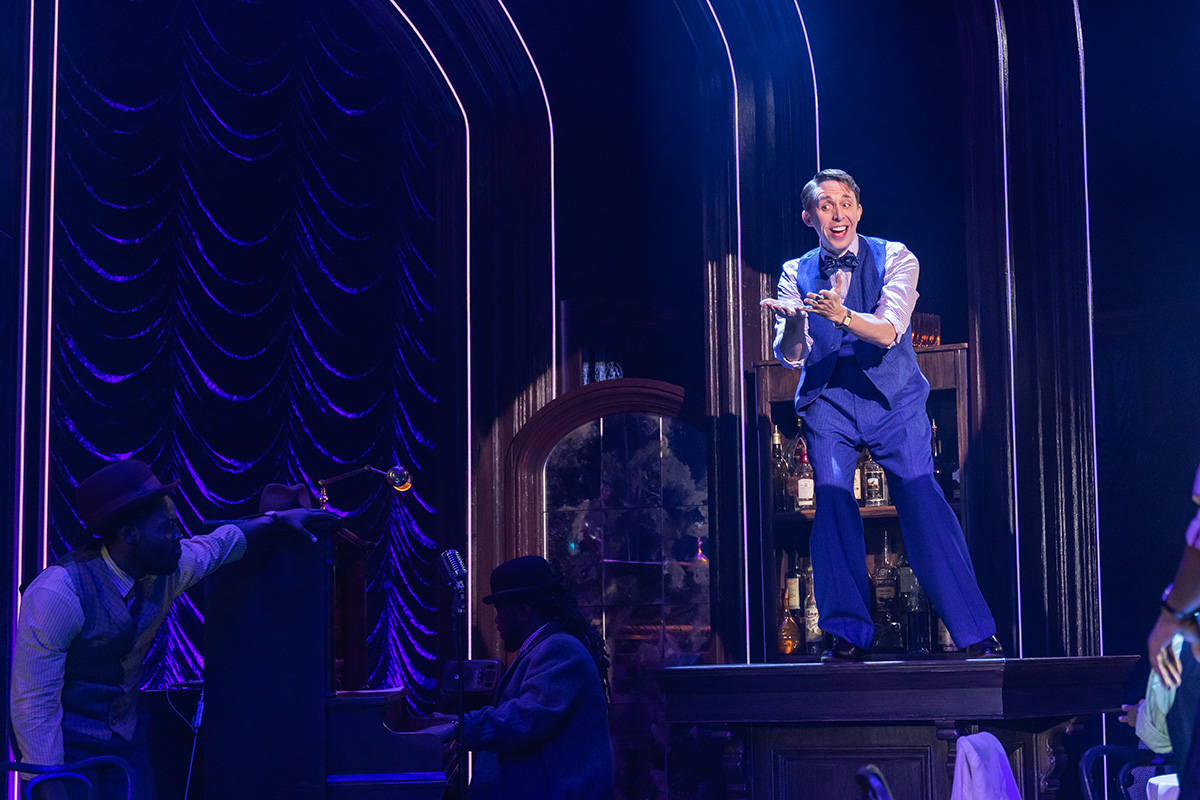
As Melvin Snyder in the new musical “Chez Joey,” out actor Kevin Cahoon plays a showbiz society columnist who goes by the name Mrs. Knickerbocker. He functions as a sort of liaison between café society and Chicago’s Black jazz scene circa 1940s. It’s a fun part replete with varied insights, music, and dance.
“Chez Joey” is adapted from the Broadway classic “Pal Joey” by Richard Rodgers and Lorenz Hart. It’s inspired by John O’Hara’s stories based on the exploits of a small-time nightclub singer published in The New Yorker.
A warm and humorous man, Cahoon loves his work. At just six, he began his career as a rodeo clown in Houston. He won the Star Search teen division at 13 singing songs like “Some People” from “Gypsy.” He studied theater at New York University and soon after graduating set to work playing sidekicks and comedic roles.
Over the years, Cahoon has played numerous queer parts in stage productions including “Hedwig and the Angry Inch,” “La Cage aux Folles,” “Rocky Horror” as well as Peanut in “Shucked,” and George the keyboardist in “The Wedding Singer,” “a sort of unicorn of its time,” says Cahoon.
Co-directed by Tony Goldwyn and the great Savion Glover, “Chez Joey” is a terrific and fun show filled with loads of talent. Its relevant new book is by Richard Lagravenese.
On a recent Monday off from work, Cahoon shared some thoughts on past and current happenings.
WASHINGTON BLADE: Is there a through line from Kevin, the six-year-old rodeo clown, to who we see now at Arena Stage?
KEVIN CAHOON: Anytime I want to land a joke in a theater piece it goes back to that rodeo clown. It doesn’t matter if it’s Arena’s intimate Kreeger Theatre or the big rodeo at the huge Houston Astrodome.
I was in the middle stadium and there was an announcer — a scene partner really. And we were doing a back and forth in hopes of getting laughs. At that young age I was trying to understand what it takes to get laughs. It’s all about timing. Every line.
BLADE: Originally, your part in “Chez Joey” Melvin was Melba who sings “Zip,” a clever woman reporter’s song. It was sort of a star feature, where they could just pop in a star in the run of “Pal Joey.”
CAHOON: That’s right. And in former versions it was played by Martha Plimpton and before her Elaine Stritch. For “Chez Joey,” we switched gender and storyline.
We attempted to do “Zip” up until two days before we had an audience at Arena. Unexpectedly they cut “Zip” and replaced it with a fun number called “I Like to Recognize the Tune,” a song more connected to the story.
BLADE: Wow. You must be a quick study.
CAHOON: Well, we’re working with a great band.
BLADE: You’ve played a lot of queer parts. Any thoughts on queer representation?
CAHOON: Oh yes, definitely. And I’ve been very lucky that I’ve had the chance to portray these characters and introduce them to the rest of the world. I feel honored.
After originating Edna, the hyena on Broadway in “The Lion King,” I left that to do “Hedwig and the Angry Inch” as standby for John Cameron Mitchell, doing one show a week for him.
Everyone thought I was crazy to leave the biggest musical of our time with a personal contract and getting paid more money that I’d ever made to get $400 a week at the downtown Jane Street Theatre in a dicey neighborhood.
At the time, I really felt like I was with cool kids. I guess I was. And I never regretted it.
BLADE: When you play new parts, do you create new backstories for the role?
CAHOON: Every single time! For Melvin, I suggested a line about chorus boys on Lakeshore Drive.
BLADE: What’s up next for Kevin Cahoon?
CAHOON: I’m about to do the New York Theatre Workshop Gala; I’ve been doing it for nine years in a row. It’s a huge job. I’ll also be producing the “Cats: The Jellicle Ball” opening on Broadway this spring; it’s a queer-centric uptown vogue ball with gay actor André de Shields reprising his role as “Old Deuteronomy.”
BLADE: There’s a huge amount of talent onstage in “Chez Joey.”
CAHOON: There is. I’m sharing a dressing room with Myles Frost who plays Joey. He won accolades for playing Michael Jackson on Broadway. We’ve become great friends. He’s a miracle to watch on stage. And Awa [Sal Secka], a D.C. local, is great. Every night the audience falls head over heels for her. When this show goes to New York, Awa will, no doubt, be a giant star.
BLADE: Do you think “Chez Joey” might be Broadway bound?
CAHOON: I have a good feeling it is. I’ve done shows out of town that have high hopes and pedigree, but don’t necessarily make it. “Chez Joey” is a small production, it’s funny, and audiences seem to love it.

‘No Kings’ protests set for D.C.

Border to border: modern slavery and human trafficking in refugee movements across East Africa

New IOC policy bans trans women from Olympics

Introducing the Torchbearers Awards honoring queer, trans women and nonbinary people

Pa. House passes bill to codify marriage equality in state law

PHOTOS: Capital Stonewall Democrats 50th anniversary

‘Inherit the Wind’ isn’t about science vs. religion, but the right to think

Small is beautiful: subcompact SUVs

Polish court rules country must recognize same-sex marriages from EU states

Capital Stonewall Democrats 50th anniversary gala draws sold out crowd
-

 Photos3 days ago
PHOTOS: Capital Stonewall Democrats 50th anniversary
-
Theater4 days ago
‘Inherit the Wind’ isn’t about science vs. religion, but the right to think
-
Autos4 days ago
Small is beautiful: subcompact SUVs
-
Poland3 days ago
Polish court rules country must recognize same-sex marriages from EU states