Politics
Massive defeat for anti-trans & anti-LGBTQ+ riders in spending bill
More than 40 were defeated

By Erin Reed | On Thursday, Congress unveiled the much-anticipated spending bill to avert a government shutdown. The bill, which includes funding for major government departments such as Health and Human Services and Education, featured fierce negotiations over conservative “policy riders.”
These policy riders included bans on coverage for gender-affirming care, DEI bans, sports bans, and more. Despite some indications that Democrats might compromise due to the sheer number of conservative policy riders, it appears those fears did not come to fruition. Democrats held firm in negotiations, and the most impactful anti-trans and anti-LGBTQ+ riders were nowhere to be found.
One policy rider proposed for the Food and Drug Administration would have defunded any hospital that “distributes, sells, or otherwise uses drugs that disrupt the onset of puberty or sexual development for those under 18,” a measure targeting not only transgender youth but also those experiencing precocious puberty.
Another rider sought to bar any government funding toward “surgical procedures or hormone therapy for the purposes of gender-affirming care” in the Department of Health and Human Services. This move would have significantly impacted private and subsidized insurance in the Healthcare Marketplace. It also aimed to bar the enforcement of President Biden’s executive order titled “Preventing and Combating Discrimination on the Basis of Gender Identity,” which broadened anti-discrimination protections for transgender individuals.
Additional riders included bans on funding for any organization that “promotes transgenderism,” Title IX protections for transgender youth, bans on legal challenges against states over anti-LGBTQ+ laws, book bans, DEI bans, and more.
In total, over 40 riders were proposed and negotiated in the spending bills. None of these were found in the final bill
Ultimately, the final spending bill released contained only a single anti-LGBTQ+ rider: a ban on pride flags being raised or displayed above foreign embassies. The policy, while certainly qualifying as anti-LGBTQ+ and a regression to Trump-era policies, notably does not bar personal displays of Pride flags by embassy workers.
In the past, some embassies have gotten around such bans by not “flying a flag over the embassy” but rather, painting portions of the embassy in rainbow colors or draping flags on the side of buildings.
News of the defeat of the most impactful anti-trans and anti-LGBTQ+ riders comes after a significant push from Equality Caucus Democrats and the Biden Administration against the riders. “As you negotiate government funding for Fiscal Year 2024 (FY24), we write to strongly urge you to reject any attempts to include anti-LGBTQ+ provisions in any final FY24 funding agreement,” said a letter signed by 163 representatives on behalf of the Congressional Equality Caucus to the Biden Administration.
However, Republicans also pushed hard for their inclusion. In a shutdown threat issued February 21st from the House Freedom Caucus, Republicans indicated that bans on gender affirming care and transgender participation in sports were necessary to prevent a potential shutdown.
Previously, Representative Dan Crenshaw stated that such bans are the “hill we will die on.” In a report published by Axios, one Republican lawmaker stated, “People are predicting a shutdown even if it’s just for a few days.” Others concurred, citing gender affirming care riders as one of the potential reasons for such a shutdown.
Many anti-LGBTQ+ leaders in the Republican Party reacted negatively to the bill. Rep. Matt Gaetz expressed anger at funding for the New Jersey Garden State Equality in Education Fund, calling it “force feeding the LGBT agenda in schools” and stating that it enables “gender mutilation surgeries in minors,” “biological men” in women’s bathrooms, and transgender participation in sports.
Rep. Marjorie Taylor Greene decried the lack of a DEI ban. Rep. Andrew Clyde stated that Republicans “surrendered” to Democrats on hormone therapy. The House Freedom Caucus published a lengthy list of healthcare and equality centers that the budget would fund, urging the GOP to vote “no” and to shut down the government.
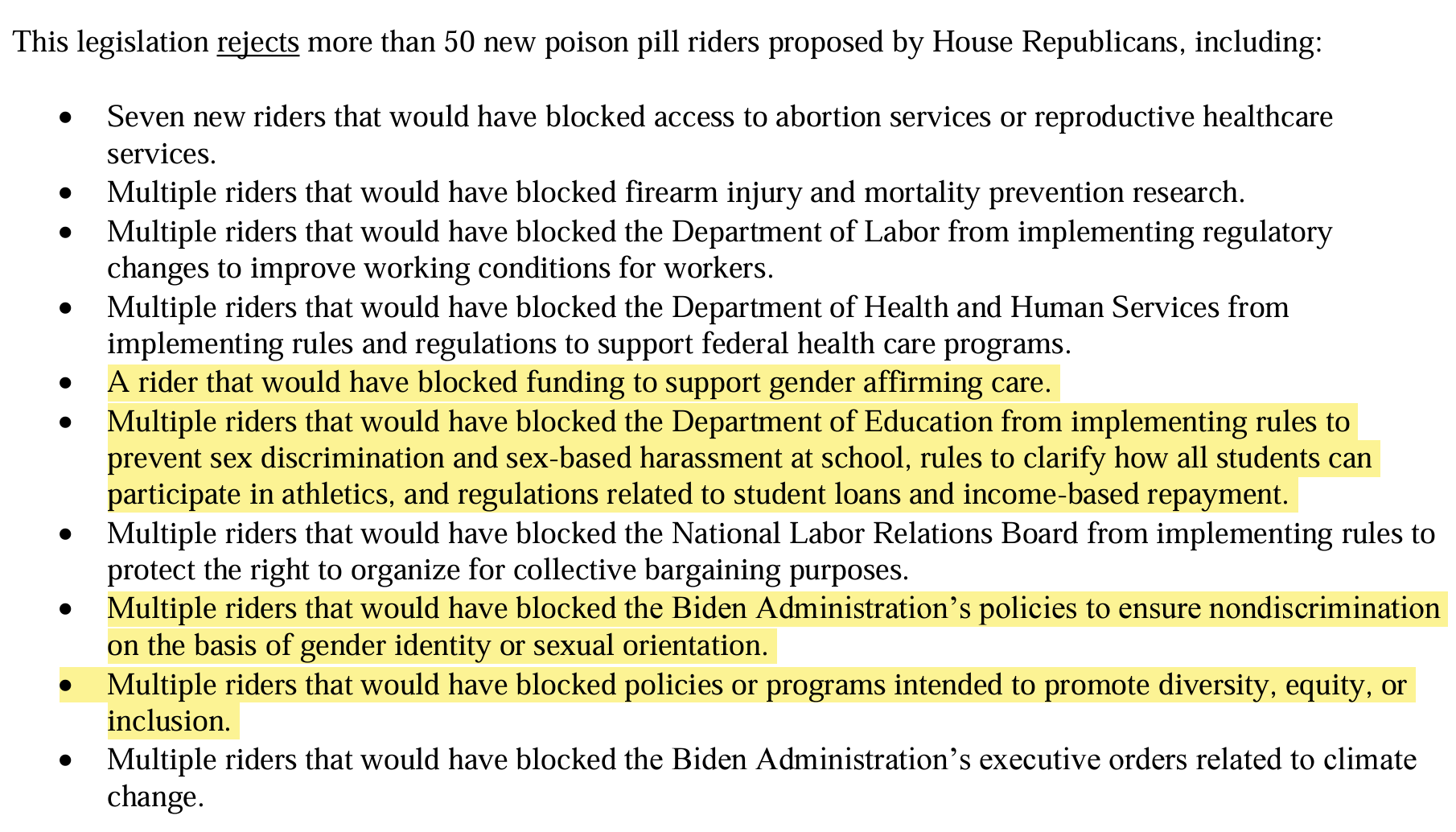
In a press release published by House Appropriations Democrats, they stated that the bill rejected over a hundred poison-pill riders, many of which targeted LGBTQ+ people. For example, the Labor-HHS-Education portion of the bill blocked provisions around gender affirming care, sports bans, and nondiscrimination.
See the House Appropriations Democrats statement:
The bill must pass by Friday evening to avert a government shutdown, though the impacts of such a shutdown would likely not be felt until Monday. If passed, the bill would keep the government funded through September, at which point all of the riders could resurface during the peak of the 2024 presidential election.
However, for the next several months, LGBTQ+ riders will not pose a significant threat in a year where transgender and queer individuals have faced attacks at historic levels.
****************************************************************************

Erin Reed is a transgender woman (she/her pronouns) and researcher who tracks anti-LGBTQ+ legislation around the world and helps people become better advocates for their queer family, friends, colleagues, and community. Reed also is a social media consultant and public speaker.
******************************************************************************************
The preceding article was first published at Erin In The Morning and is republished with permission.





2026 Midterm Elections
Markey’s primary win deemed success for LGBTQ activists
Mass. lawmaker champions transgender rights
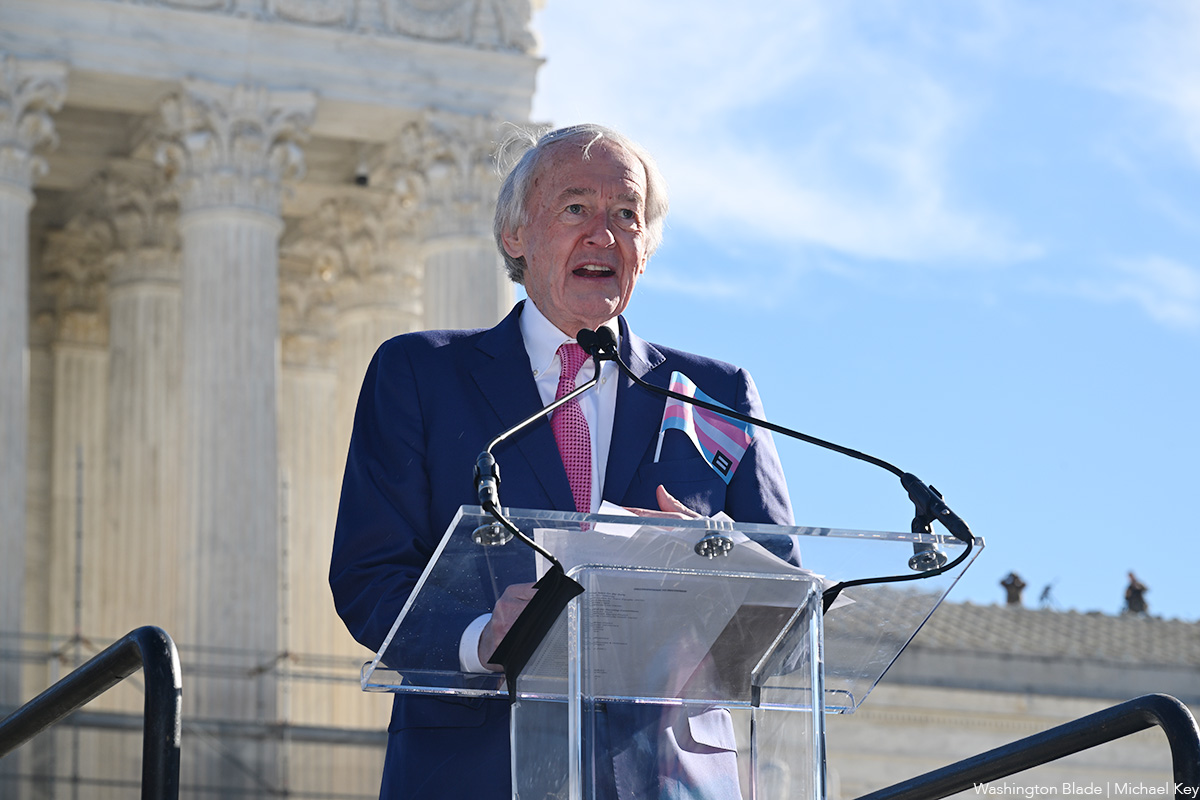
U.S. Sen. Ed Markey (D-Mass.) clinched the Democratic seat for his reelection campaign in Massachusetts’s primary election on Tuesday.
Markey won the deep-blue state with 64.8 percent of the vote, according to NBC News, triumphing over Marine Corps combat veteran and Congressman Seth Moulton, who received 35.2 percent of the vote.
Massachusetts’s primary election, which determined which Democratic candidate will head to the polls to face off against the Republican challenger in November, is being considered a victory for LGBTQ-inclusive policy, as well as for a divisive pro-transgender rights candidate — both things Markey has become an outspoken champion of.
Markey has experience at multiple levels of government, from the state level, where he served three terms in the state House of Representatives, to his federal tenure, including 20 terms in the U.S. House of Representatives and is now serving his second term as a senator. He has become a fixture of a changing Democratic Party in one of the most consistently blue places in the U.S.
This primary — and much of the national discussion surrounding the Senate seat — focused a lot of campaigning power on fighting the growing sentiment, led mostly by Republicans, that the frustration many Americans feel lends itself to an anti-establishment and anti-incumbent attitude.
Markey ran his campaign using his past as a reflection of his commitment to constantly putting his best foot forward for Bay Staters — particularly with apprehension for issues younger and more progressive democrats have been righting for — including Green New Deal and “Medicare for All” while Moulton — who was also elected to federal office prior to this run — campaigned on being younger than Markey, arguing that he was not the same type of established politician.
Moulton also faced backlash for negative comments about trans athletes, sparking criticism for those who did want younger candidate but want for trans rights to be protected.
Markey’s track record of supporting the LGBTQ community is one of the most clear in federal politics, one that has garnered a “100 percent lifetime voting record” on the Human Rights Campaign’s PAC politician review scorecard.
That list of Markey’s actions includes being a cosponsor of the Equality Act, driving landmark legislation to ensure federal protections for LGBTQ Americans, and being one of the most vocal proponents for trans rights in the federal government — specifically in multiple appropriations bills and in the National Defense Authorization Act. He was also the lead sponsor of the Transgender Health Care Access Act and the Transgender Bill of Rights resolution.
Markey first introduced the Transgender Bill of Rights in the Senate in 2023, where it ultimately failed to be brought to law. He reintroduced the legislation this year once again. This was a direct response to the attitude pushed by many conservatives after 2021, when the push to minimize trans rights started to become a key part of their cause and has been constantly propped up by the Trump-Vance administration.
“Massachusetts needs a senator who stands up and fights back, a senator who never forgets who they are fighting for,” Markey said during his victory speech. “That has been the mission of my life, and it always will be.”
Following the calling of the primary, a slew of LGBTQ organizations rallied behind Markey, many pushing his past as an asset that puts his money where his mouth is through advocating for legislation specifically protecting the LGBTQ community.
Tyler Hack, the executive director of the Christopher Street Project, an organization dedicated to pushing for legal protections for trans americans, released a statement following Markey’s win. Hack argued that putting forward such a staunchly pro-trans candidate is a win for the community, especially after endorsing him earlier this year.
“Tonight, anti-trans politics lost. Massachusetts rejected the idea that attacking transgender people is a shortcut to political power. Voters chose a different path: one where equality is not negotiable, cruelty is not courage, and transgender people do not have to disappear for Democrats to succeed.”
The Human Rights Campaign also endorsed him as a candidate earlier this year and issued a statement via its president, Kelley Robinson.
“Ed Markey has spent decades fighting for LGBTQ+ equality, for working people, and for a more livable world,” Robinson said. “He knows why equality matters. He’s stood with us no matter what. We were proud to endorse him this year, and when a pro-equality majority takes back the Senate this fall, we will continue to count on him as a champion for our community.”
Markey is running for reelection against Republican John Deaton in November, where he is expected to win.
Congress
HRC president campaigns for Chris Pappas in NH
Gay congressman running to succeed retiring U.S. Sen. Jeanne Shaheen

Human Rights Campaign President Kelley Robinson on Sunday campaigned for U.S. Rep. Chris Pappas (D-N.H.) in New Hampshire.
Robinson traveled to Manchester, the state’s largest city, nine days before the Sept. 8 primary that will determine who will vie for retiring U.S. Sen. Jeanne Shaheen (D-N.H.)’s seat.
We’re hitting the pavement across New Hampshire to fight for a freer, fairer future for everyone.
Glad to have Human Rights Campaign President @KelleyJRobinson join us for a canvass launch in Manchester today. pic.twitter.com/XWCEaQxy4o
— Chris Pappas (@ChrisPappasNH) August 30, 2026
Former U.S. Sen. John E. Sununu, who represented New Hampshire in the U.S. Senate from 2003-2009, will face off against former U.S. Sen. Scott Brown, who represented Massachusetts in the U.S. Senate from 2010-2013, in the Republican primary.
Karishma Manzur is among the Democrats challenging Pappas.
A poll the University of New Hampshire Survey Center released on Aug. 26 shows Sununu is ahead of Brown. The same survey shows Pappas ahead of Manzur and his other Democratic challengers.
The UNH Survey Center poll shows Sununu ahead of Pappas by a 45-43 percent margin if they were to face off in the general election. The margin of error is +/-2.1 percent.
Pappas would become the first openly gay man elected to the U.S. Senate if he were to win in November.
Congress
Chris Van Hollen says the Democratic Party needs change. Is he the one to lead it?
Senator is backing anti-establishment Democrats across the country

By LEE O. SANDERLIN | The Democratic Party is having something of an identity crisis — losing to President Donald Trump twice in three elections will do that.
Should the party embrace anti-establishment figures who espouse progressive policy ideas like Medicare for all and rhetoric about unrigging the economy for the 1 percent? Or should Democrats try to appeal to moderates who want to return to semi-normalcy in a time of political upheaval?
Although he’s been in Congress since 2002, with key leadership roles throughout his tenure, Maryland Sen. Chris Van Hollen, 67, counts himself firmly in the anti-establishment camp.
The rest of this article can be found on the Baltimore Banner’s website.

Pentagon expands testosterone screening as trans troops face hormone therapy restrictions

Calendar: September 4-10

Swiss government backs nationwide conversion therapy ban

Gloria Steinem dies at 92

The mastery of love

Poland begins to legally recognize same-sex marriages from other countries

HRC president campaigns for Chris Pappas in NH

We’re getting married but our parents object

Prominent French activist attacked outside Paris bar