United Nations
UN Human Rights Council adopts landmark intersex rights resolution
Final vote was 24-0 with 23 abstentions

The U.N. Human Rights Council on Thursday adopted a landmark resolution in support of the rights of intersex people.
The first-of-its-kind resolution specifically targets discrimination, violence and harmful practices against those with innate variations in sex characteristics. The resolution received overwhelming support from member states, with none voting against it.
The final vote was 24-0 with 23 abstentions.
The resolution that Finland, South Africa, Chile and Australia proposed urges countries to strive towards ensuring the highest possible standard of physical and mental health for intersex people. It also calls upon the Office of the High Commissioner to compile a report, slated for discussion at the council in September 2025.
This report will assess discriminatory laws and policies; acts of violence and harmful practices around the world, while also identifying best practices and legal protections for intersex people.
“This resolution represents yet another landmark in the international community’s attention to the rights of intersex individuals,” stated 35 advocacy groups in a joint press release they issued after the resolution’s adoption. “Years of concerted efforts by both civil society and states have generated significant momentum, but this resolution could catalyze even more decisive action. By prompting the first official United Nations report on the human rights status of individuals with innate variations in sex characteristics, this vote will elevate awareness to a level that states can no longer ignore, compelling them to take concrete measures.”
The resolution expresses “grave concern” over the violence and harmful practices faced by intersex individuals, including medically unnecessary interventions regarding sex characteristics. It furthermore acknowledges this call to action aligns with statements from various human rights bodies and the commitments outlined in the Sustainable Development Goals, particularly the one that addresses health and well-being.
“We extend our gratitude to the cross-regional coalition of states that spearheaded this resolution, as well as those who supported it,” said the advocacy groups in their press release. “Intersex individuals are present in every corner of the globe, yet they endure pervasive human rights violations, including forced medical interventions, infanticide, denial of legal recognition and discrimination in accessing essential services such as healthcare, education and sports. The United Nations’ intervention to address this situation holds immense significance in improving the lives of intersex individuals worldwide.”





United Nations
UN human rights chief sounds alarm over ‘comprehensive onslaught’ against LGBTQ rights
Volker Türk on Monday spoke at UN LGBTI Core Group event
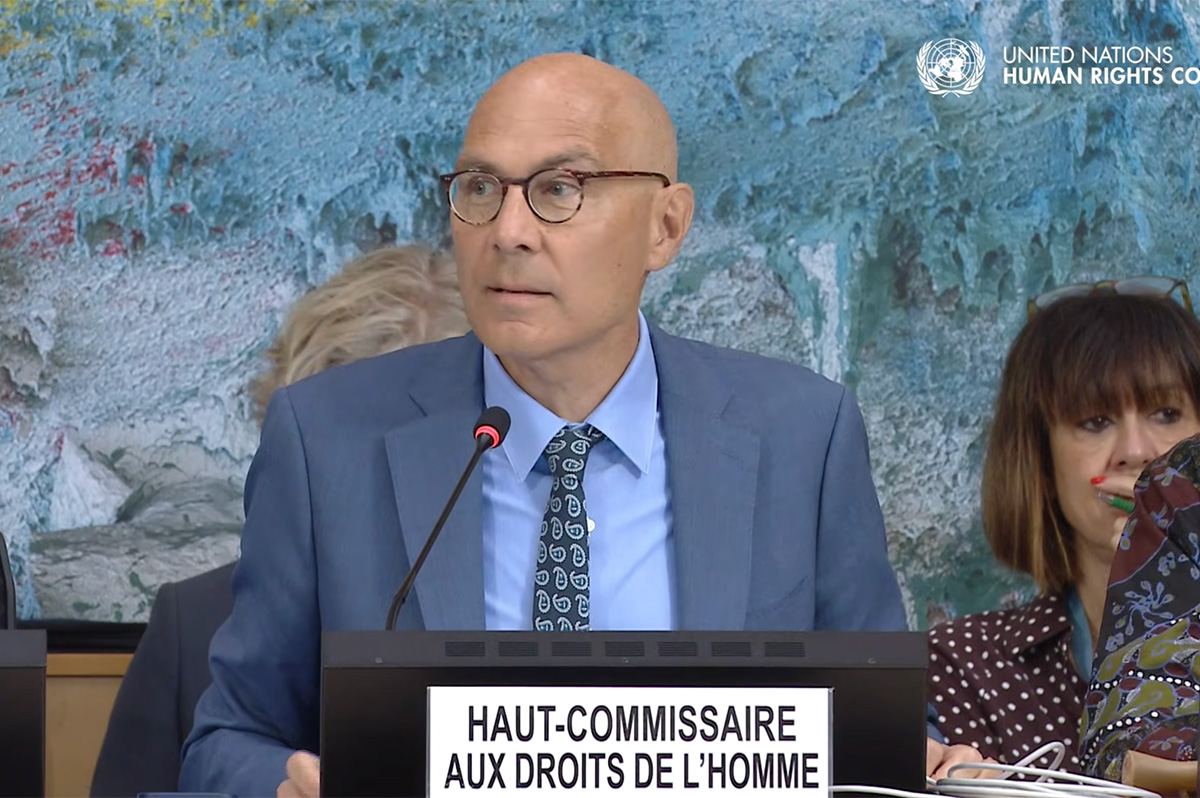
UNITED NATIONS — U.N. High Commissioner for Human Rights Volker Türk on Monday said there is a “comprehensive onslaught” against LGBTQ and intersex rights around the world.
“We know that progress for human rights has never been linear … but today’s backlash is deep and it is coordinated and the persecution of LGBTIQ+ people around the world is escalating at an alarming rate,” he said during an U.N. LGBTI Core Group event that took place on the sidelines of the U.N. General Assembly.
The Core Group is a group of U.N. member states that have pledged to support LGBTQ and intersex rights.
Mexico and Norway are the current co-chairs. The U.S. withdrew from the Core Group shortly after the Trump-Vance administration took office in 2025.
“We know that across every region, LGBTIQ+ people continue to live and to love in the face of hostility and exclusion,” said Türk. “Their rights, safety, well-being are under attack … it’s a comprehensive onslaught.”
The event took place days after Turkish authorities carried out raids in Istanbul and in other cities across the country that targeted the country’s LGBTQ community.
Türk in his remarks specifically referenced Turkey and Senegal, which further criminalized consensual same-sex sexual relations earlier this year. He also noted some countries have deemed LGBTQ and intersex rights groups as “terrorists, extremists, or national security threats.”
The Trump-Vance administration’s anti-terrorism strategy that it released in May specifically references “radically pro-transgender” groups.
Türk noted “more and more candidates and political parties … use bigotry in order to promote anti-LGBTIQ+ sentiments” during election campaigns. He pointed out trans people and women are often targeted.
“These attacks are designed to confuse and to distract,” said Türk. “They cloak bigotry in the language of decency and morality. They evoke the protection of children against manufactured threats, while real and growing dangers to children’s lives and futures, including those linked to technology, to inequality and to the climate disaster remain unaddressed.”
“More broadly those who seek to erase difference and independent thought, expression, and voices from our societies often begin this by erasing LGBTIQ+ people from books and classrooms, from film and culture and from our streets,” he added. “So, this is always the beginning. It’s a wedge issue that unfortunately is used politically to erase other portions of society eventually.”
90 percent of LGBTQ, intersex groups have lost funding since 2025
The event took place less than two weeks after Outright International released a report that found 90 percent of LGBTQ and intersex rights groups around the world have lost funding since January 2025.
The Trump-Vance administration froze nearly all U.S. foreign aid shortly after it took office.
Secretary of State Marco Rubio in March 2025 announced 83 percent of U.S. Agency for International Development contacts had been cancelled, and the State Department would administer the remaining programs. USAID officially shut down on July 1, 2025.
Rubio issued a waiver that allowed PEPFAR and other “life-saving humanitarian assistance” programs to continue to operate during the funding freeze. The Washington Blade has previously reported PEPFAR-funded programs in Kenya and other African countries have been forced to suspend services and even shut down because of gaps in U.S. funding.
Dutch Foreign Trade and Development Cooperation Minister Sjoerd Sjoerdsma in his remarks at the Core Group event noted his government — openly gay Prime Minister Rob Jetten took office in February — will pledge €50 million ($57.29 million) to support LGBTQ groups around the world. British Under Secretary of State Chris Elmore pointed out his government has pledged £21 million ($28.05) from 2026-2029 to bolster LGBTQ and intersex rights around the world.
“Equality benefits everyone,” said Elmore.
Mexican Foreign Affairs Secretary Roberto Velasco Álvarez, Norwegian International Development Minister Åsmund Aukrust, Icelandic Foreign Affairs Minister Þorgerður Katrín Gunnarsdóttir, Maltese Foreign and European Affairs Minister Chris Fearne, Brazil’s National Secretary for the Promotion and Defense of the Rights of LGBTQIA+ People Symmy Larrat, Irish State Minister for International Development and Diaspora Neale Richmond, South African Department of International Relations and Cooperation Director-General Zane Dangor, Uruguayan Multilateral Affairs Director María Noel Beretta, French Ambassador-at-Large for Human Rights Isabelle Rome, Cabo Verdean Permanent U.N. Representative Tania Romualdo, Estonian Department of International Organizations and Human Rights Director General Käthlin Saluveer, and Swedish International Development Cooperation Director-General Camilla Nevstad Bruzelius also spoke at the event that Outright International Executive Director Maria Sjödin moderated.
Other speakers included Jon Tilli of Deutsche Bank, UN Women Civil Society Division Director Lopa Banerjee and two activists: Gloria Quaye of Ghana and Nhuun Wannapong Yodmuang of Thailand.
Quaye was among the 21 people who Ghanaian authorities arrested in 2021 during a human rights workshop for LGBTQ activists. She was detained for three weeks until a court dropped the charges.
“In times of adversity, countries can often be tempted to turn inward at precisely the moment when international cooperation is needed the most,” said Sjödin. “The United Nations, of course, brings together sovereign states, but sovereignty cannot be used to decide whose rights count.”
Then-first lady Jill Biden in 2024 spoke at a Core Group event that took place on the sidelines of that year’s U.N. General Assembly. Then-Vice President Joe Biden in 2016 headlined the Core Group event that coincided with that year’s U.N. General Assembly.
The U.S. did not send any representatives to this year’s event.
Jessica Stern, the former special U.S. envoy for the promotion of LGBTQ and intersex rights under the Biden-Harris administration, and former U.S. Ambassador to Bosnia and Herzegovina Eric Nelson were among those from the U.S. who attended.
“The movement for the equal rights of LGBTIQ+ people has much to teach the world, particularly at this moment, but some seek to erase or reject those lessons,” said Türk. “The history of the movement for the equal rights is full of courage, dignity, and solidarity and it is an integral part of the human rights movement.”
“It’s not something separate; it’s an integral part of the full human rights movement,” he added. “In claiming their freedom, the LGBTIQ+ communities helped free our societies. We need to see it as a broader strive for freedom.”
Congress
Mike Waltz confirmed as next UN ambassador
Trump nominated former national security advisor in May
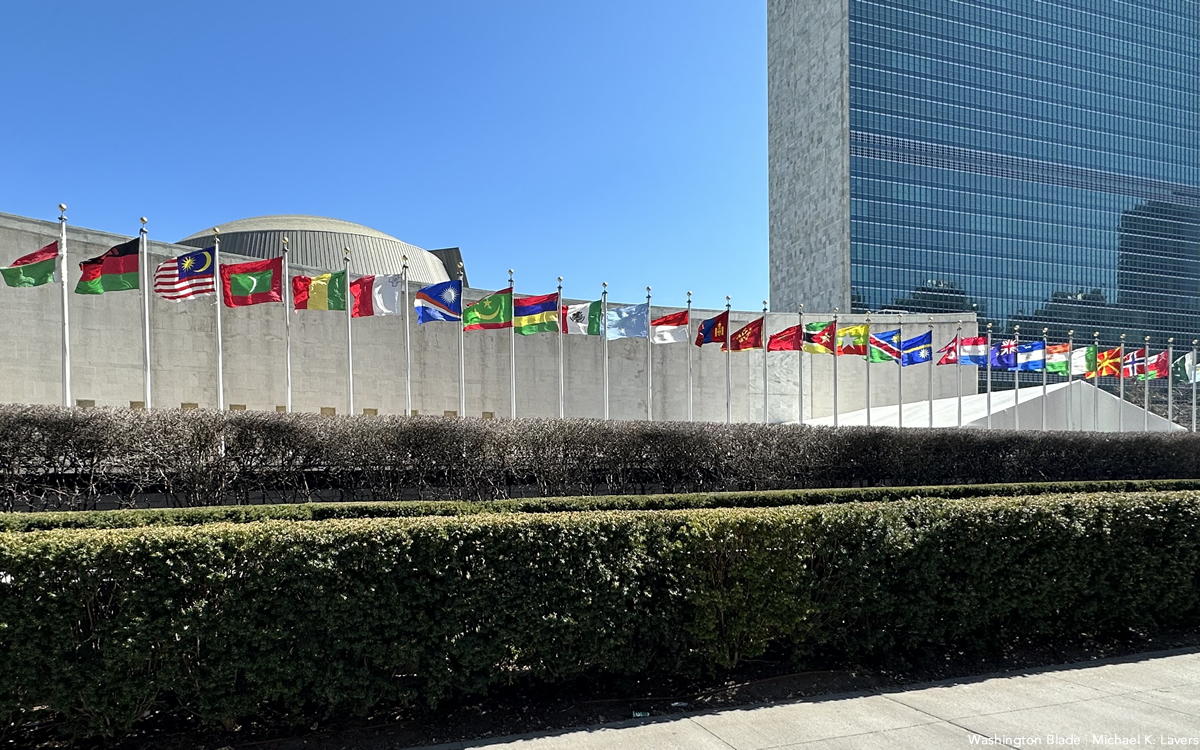
The U.S. Senate on Sept. 19 confirmed former U.S. Rep. Mike Waltz (R-Fla.) as the next U.S. ambassador to the U.N.
The Florida Republican had been the national security advisor until President Donald Trump in May tapped him after U.S. Rep. Elise Stefanik (R-N.Y.) withdrew her nomination in order to ensure Republicans maintained their narrow majority in the U.S. House of Representatives.
Senators approved Waltz’s nomination by a 47-43 vote margin.
“Thank you President Trump and the U.S. Senate for your trust and confidence to Make the UN Great Again,” said Waltz on X.
The U.N. General Assembly is taking place this week in New York. Trump is scheduled to speak on Tuesday.
United Nations
UN Human Rights Council extends LGBTQ rights expert’s mandate
29 countries voted for resolution
The U.N. Human Rights Council on Monday extended the mandate of the United Nations’ independent LGBTQ rights expert for another three years.
The resolution passed with 29 countries (Albania, Belgium, Bolivia, Brazil, Bulgaria, Chile, Colombia, Costa Rica, Cuba, Cyprus, the Czech Republic, the Dominican Republic, France, Georgia, Germany, Iceland, Japan, Kenya, the Marshall Islands, Mexico, the Netherlands, North Macedonia, South Korea, Romania, South Africa, Spain, Switzerland, Thailand, and Vietnam) voting for it and 15 countries (Algeria, Bangladesh, Burundi, China, Cote d’Ivoire, Democratic Republic of Congo, Ethiopia, Gambia, Indonesia, Kuwait, Malawi, Maldives, Morocco, Qatar, and Sudan) voted against it.
Benin, Ghana, and Kyrgyzstan abstained.
The U.S. in February withdrew from the Human Rights Council. The Trump-Pence administration in 2018 pulled the U.S. from it. The U.S. in 2021 regained a seat on the Human Rights Council.
Graeme Reid has been the UN’s independent LGBTQ rights expert since 2023. The South African activist, among other things, previously ran Human Rights Watch’s LGBT Rights Program.

Annapolis Pride arrives this weekend

Calendar: October 2-8

Renee Good’s family files two federal lawsuits

House Democrats urge White House to confront Turkish government over anti-LGBTQ crackdown

988 restores crisis services for LGBTQ youth

HRC National Dinner 2026: A night of music, activism, LGBTQ history

Education Department rolls back protections for LGBTQ students under Title IX

Trump asks Supreme Court to allow restrictions on gender-affirming care in prisons

Lesbian Bar Project co-founder: purity politics could destroy our remaining spaces

529 openly LGBTQ candidates running in Brazilian election
-

 LGBTQ Non-Profit Organizations4 days ago
HRC National Dinner 2026: A night of music, activism, LGBTQ history
-
Federal Government5 days ago
Education Department rolls back protections for LGBTQ students under Title IX
-
U.S. Supreme Court5 days ago
Trump asks Supreme Court to allow restrictions on gender-affirming care in prisons
-
Bars & Parties4 days ago
Lesbian Bar Project co-founder: purity politics could destroy our remaining spaces