District of Columbia
Lesbian-owned gift shop among recipients of D.C. business grants
Femme Fatale owners say funds will support manufacturing

Femme Fatale, an upscale gift shop and event space on Connecticut Avenue in Northwest D.C. that’s owned and operated by a lesbian couple, is among 41 small businesses to receive a total of $7 million in city grants aimed at supporting businesses that sell or produce their products in the city.
Cee Smith, who co-owns Femme Fatale with her partner Adriana Mendoza, said the funds from the $261,300 grant they received will be used, among other things, to enable them to manufacture many of the items they sell.
D.C. Mayor Muriel Bowser announced the 2024 business grant recipients at a Dec. 12 ceremony held at the D.C. Arts Center, a nonprofit organization in the city’s Adams Morgan neighborhood that received one of these grants last year and that is operated by gay executive director Sean Elias.
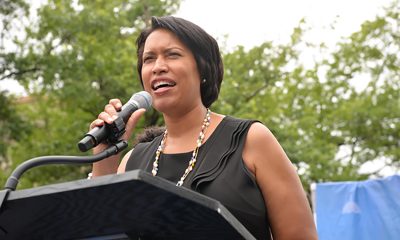
“With every grant awarded, we’re fueling innovation, creating opportunities, and building stronger communities across all eight wards,” Bowser told attendees at the Dec. 12 ceremony. “These investments don’t just help businesses thrive, they uplift our neighborhoods, create jobs, and ensure that D.C. continues to be a city where creativity and entrepreneurship flourish,” the mayor said.
Smith told the Washington Blade she and Mendoza opened Femme Fatale in the city’s Cleveland Park neighborhood in 2016. The retail store and shop is located at 3409 Connecticut Ave., N.W. on a one-block section of the street where about a dozen other shops, restaurants, and small businesses are also located. Among the items Femme Fatale sells are artwork, jewelry, clothing, holiday cards, and upscale household items such as wine glasses, coffee cups, candle holders, and flowerpots.
“We wanted to be able to manufacture some of those things ourselves,” Smith said. “And to not only be able to sell them in our store, as we know they will sell, but also to be able to access for Femme Fatale retail sales outside of just our store,” she said. “So, being able to wholesale and have them in other gift shops and locations around the city.”
Smith said Femme Fatale also hosts community events, including LGBTQ community related events at the store. She said the store has a back patio where events can be held.
A statement released by the mayor’s office announcing the business grant recipients describes Femme Fatale as a “Black, queer, and women-owned retail and event space in Cleveland Park featuring the products of D.C. women makers.”
On its website, Femme Fatale states, “We are a hub for womxn and non-binary creatives, entrepreneurs and organizers. We catalyze: a womxn led economic ecosystem that advances intersectionality on a platform of equality. We are on a mission to amplify the influence of womxn by providing inspiration and practical support.”
Elias, the D.C. Arts Center executive director, said his organization last year received a $60,000 D.C. “Great Streets” business grant that helped the center renovate its space. It is located at 2438 18th St., N.W. in the heart of the Adams Moran business and nightlife section. It is one block away from the gay bars Pitcher’s and A League of Her Own.
“We were so excited to host the mayor, deputy mayor, and Council member,” Elias told the Blade. He was referring to the D.C. Arts Center hosting the mayor’s announcement ceremony for the business grant recipients.
Among those participating in the event were Deputy Mayor for Planning and Economic Development Nina Albert and D.C. Council member Kenyan McDuffie (I-At Large).
“We’re one of the only institutions focused on fostering artists in every discipline,” he said. “Most institutions focus on just one, the performing arts, the musical arts, or visual arts. And so, we’re one of the only ones that’s crazy enough to try and do all of it,” he said.
Among other things, he noted the D.C. Arts Center, in addition to gallery exhibit space, has a theater where plays and concerts take place.


District of Columbia
How new barriers to health care coverage are hitting D.C.
Federally qualified health centers bracing for influx of newly uninsured patients
Washington, D.C. has the second-lowest rate of people who lack health insurance in the country, but many residents are facing new barriers to health care due to provisions of the sweeping federal law passed in July, which threatens access for thousands.
Changes to insurance eligibility and the rising cost of premiums, which kicked in for some in October and others more recently, are expected to leave many more patients uninsured or unable to afford medical care. Federally qualified health centers, including D.C.’s Whitman-Walker Health, where 10 to 12 percent of patients are uninsured, are bracing for an influx of newly uninsured patients while facing their own financial challenges.
Even in D.C., where uninsured rates have been among the lowest in the country, changes brought on by the passage of the Republican mega bill (known as the “Big Beautiful Bill”) will have major effects.
The changes from the bill affect Medicaid, which is free to low-income patients, and subsidies for insurance that people buy on the health insurance exchanges that were started under the Affordable Care Act, which were allowed to expire on Dec. 31.
Erin Loubier, vice president for access and strategic initiatives at Whitman-Walker Health, says some Whitman-Walker Health patients have received notices about premium increases, including several who say the increases are up to 1,000 percent more than they were paying.
“That is like paying rent,” she says. “We live in an expensive city, so any increases are going to be really, really hard on people.”
Whitman-Walker Health and other healthcare providers are expecting the changes to have multiple effects — some patients may not be able to afford coverage or may avoid going to the doctor and allow health conditions to worsen because they can’t afford care, and many more will be seeking care who don’t have insurance.
“I’m worried that we’re going to not just have people who can’t get care, but that they delay care until they’re really sick, and then the care is not as effective because they might have waited too long, and then we may have a less healthy population,” Loubier says.
Loubier says delaying care, and serving more people without insurance has major implications for Whitman-Walker Health and other health centers serving the community.
“There’s going to be a lot of pressure on us to try to find and raise more money, and that’s going to be harder, because I think all organizations who provide health care are going to be facing this,” she says.
The U.S. health care system is the most expensive in the world, and has much higher out-of-pocket costs for individuals. But in other countries like the United Kingdom, Australia, Canada, and many others, health care is much less expensive — or even free.
Even though the U.S. has a high-priced healthcare system, critics say there are still ways to bring down costs by forcing insurance and pharmaceutical companies to absorb more of the costs, rather than transferring the costs to patients.
“In the U.S., they end up trying to cut costs at the person’s level, not at the level of the different corporations or structures that are making a lot of money in healthcare,” said Loubier. “Our system is so complicated and there is probably waste in it, but I don’t think that that cost and waste is at the ‘people’ level. I think it’s higher up at the system level, but that is much, much harder to get people to try to make cuts at that end.”
Ultimately at Whitman-Walker Health, healthcare providers and insurance navigators are planning to help with everyday necessities when it comes to healthcare coverage and striving to provide healthcare in partnership with patients, said Loubier.
“The key here is we’re going to have a lot of people who may lose insurance, and they’re going to rely on places like Whitman-Walker Health and other community health centers, so we have to figure out how we keep providing that care,” she said.
(This article was written by a student in the journalism program at Bard High School Early College DC. This work is part of a partnership between the Washington Blade Foundation and Youthcast Media Group, funded through the FY26 Community Development Grant from the Office of D.C. Mayor Muriel Bowser.)
District of Columbia
Mayor Bowser signs bill requiring insurers to cover PrEP
‘This is a win in the fight against HIV/AIDS’

D.C. Mayor Muriel Bowser on March 20 signed a bill approved by the D.C. Council that requires health insurance companies to cover the costs of HIV prevention or PrEP drugs for D.C. residents at risk for HIV infection.
Like all legislation approved by the Council and signed by the mayor, the bill, called the PrEP D.C. Amendment Act, was sent to Capitol Hill for a required 30-day congressional review period before it takes effect as D.C. law.
Gay D.C. Council member Zachary Parker (D-Ward 5) last year introduced the bill.
Insurance coverage for PrEP drugs has been provided through coverage standards included in the Affordable Care Act, known as Obamacare. But AIDS advocacy organizations have called on states and D.C. to pass their own legislation requiring insurance coverage of PrEP as a safeguard in case federal policies are weakened or removed by the Trump administration, which has already reduced federal funding for HIV/AIDS-related programs.
Like legislation passed by other states, the PrEP D.C. Amendment Act requires insurers to cover all PrEP drugs approved by the U.S. Food and Drug Administration.
Studies have shown that PrEP drugs, which can be taken as pills or by injection just twice a year, are highly effective in preventing HIV infection.
“I think this is a win for our community,” Parker said after the D.C. Council voted unanimously to approve the bill on its first vote on the measure in February. “And this is a win in the fight against HIV/AIDS.”
District of Columbia
Blade editor to be inducted into D.C. Society of Professional Journalists Hall of Fame
Kevin Naff marks 24 years with publication this year
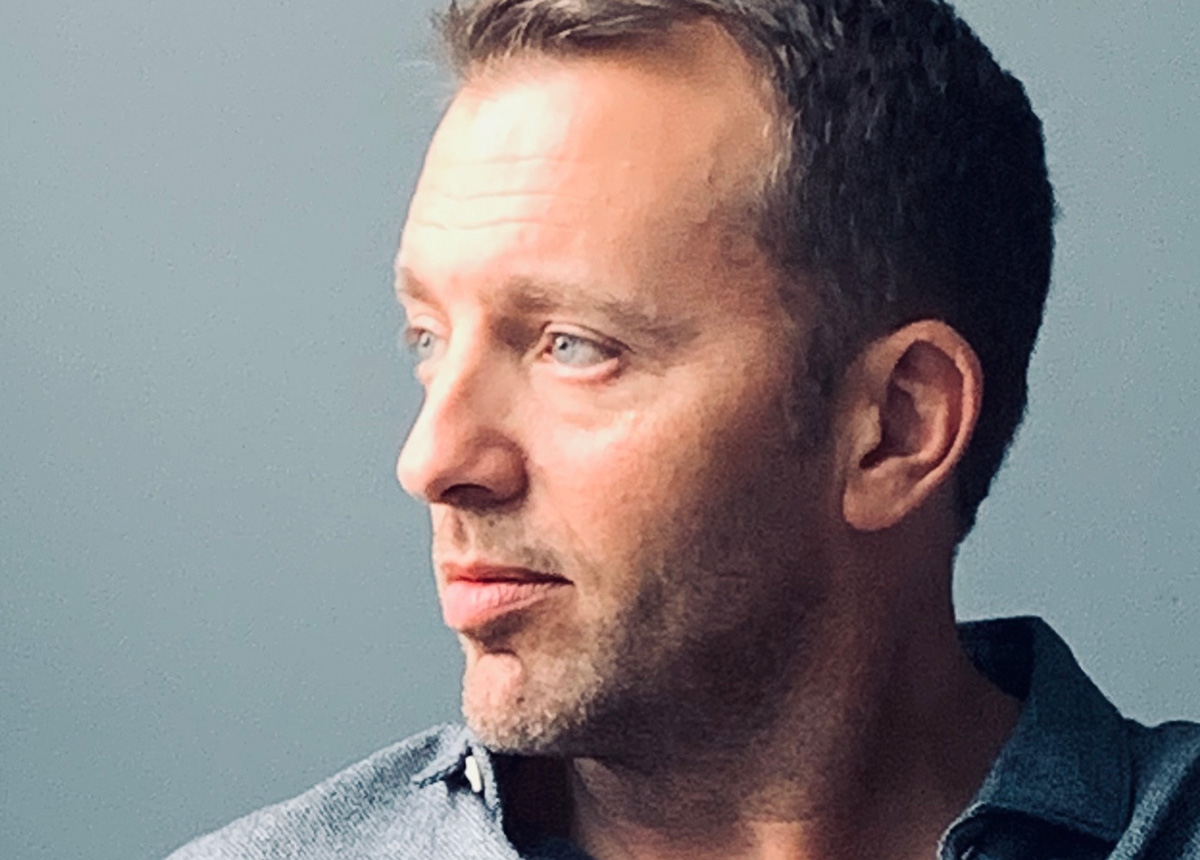
Longtime Washington Blade Editor Kevin Naff will be inducted into D.C.’s Society of Professional Journalists Hall of Fame in June, the group announced this week.
Hall of Fame honorees are chosen by the Society of Professional Journalists’ Washington, D.C., Pro Chapter. Naff and two other inductees — Seth Borenstein, a Washington-based national science writer for the AP and Cheryl W. Thompson, an award-winning correspondent for National Public Radio — will be celebrated at the chapter’s Dateline Awards dinner on Tuesday, June 9, at the National Press Club. The dinner’s emcee will be Kojo Nnamdi, host of WAMU radio’s weekly “Politics Hour.”
“I am tremendously honored by this recognition,” Naff said. “I have spent a lifetime in the D.C. area learning from so many talented journalists and am humbled to be considered in their company. Thank you to SPJ and to all the LGBTQ pioneers who came before me who made this possible.”
Naff joined the Blade in 2002 after years in print and digital journalism. He worked as a financial reporter for Reuters in New York before moving to Baltimore in 1996 to launch the Baltimore Sun’s website. He spent four years at the Sun before leaving for an internet startup and later joining the mobile data group at Verizon Wireless working on the first generation of mobile apps.
He then moved to the Blade and has served as the publication’s longest-tenured editor. In 2023, Naff published his first book, “How We Won the War for LGBTQ Equality — And How Our Enemies Could Take It All Away.”
Previous Hall of Fame inductees include luminaries in journalism like Wolf Blitzer, Benjamin Bradlee, Bob Woodward, Andrea Mitchell, and Edgar Allen Poe. The Blade’s senior news reporter Lou Chibbaro Jr. was inducted in 2015.

Women’s FEST returns to Rehoboth Beach next week

Belarusian lawmakers approve bill to crackdown on LGBTQ rights

Calendar: April 3-9

How new barriers to health care coverage are hitting D.C.

Kenyan advocacy groups launch LGBTQ voter mobilization campaign

‘Out for McDuffie’ event held at D.C. gay bar

‘Jonah’ an undeniably compelling but unusual memory play

The Oscar-losing performance that’s too good to miss

Thousands attend ‘No Kings’ protests in D.C.